
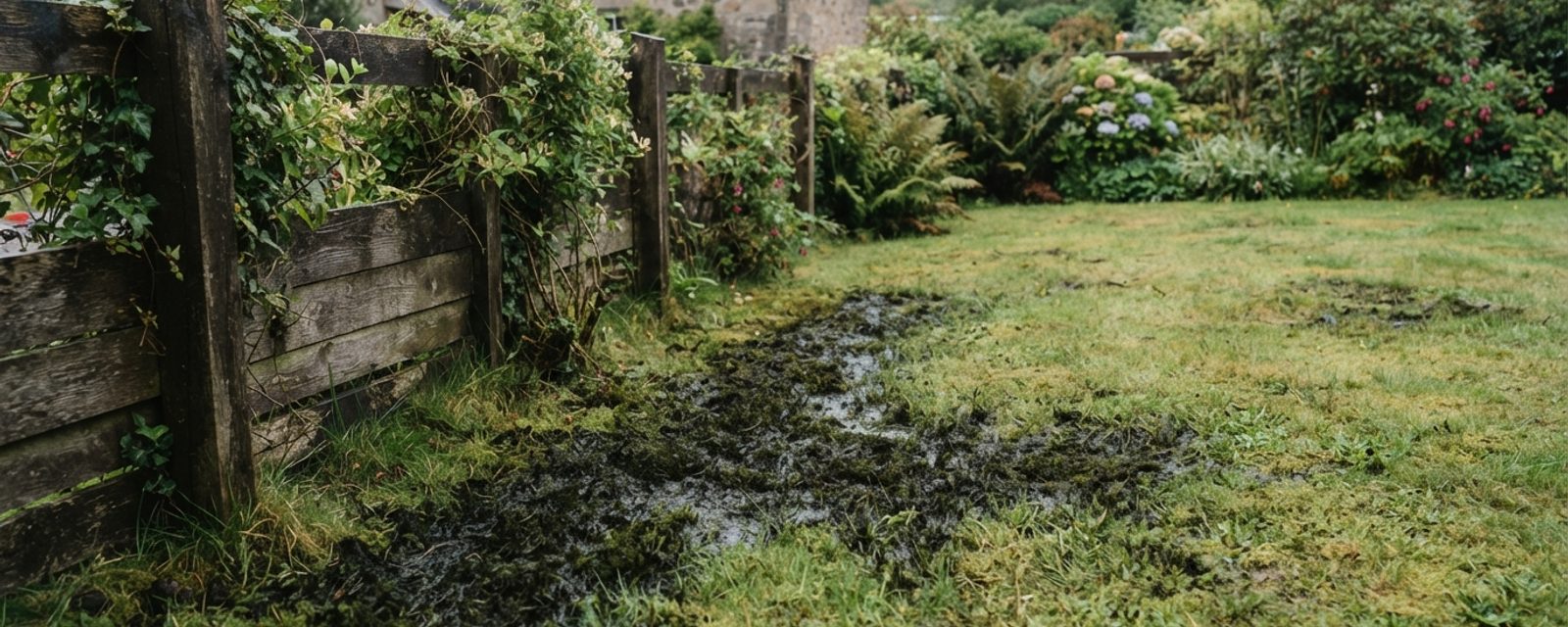
You go out after a wet fortnight and the lawn has changed colour. Not brown, not the usual autumn thinning, a flat, spongy green-black carpet has spread through the grass almost overnight, springy underfoot, swallowing whole patches near the fence line and under the trees. It looks sudden. It isn't. The moss didn't just arrive; it moved into ground the grass had already stopped defending.
That distinction matters more than it sounds like it should, because it changes what "treating" moss actually means: killing the moss you can see and fixing why it got in are two different jobs, and only doing the first one is how it comes back.
Moss doesn't cause the problem, it fills the gap
Moss is not a disease that attacks healthy turf. It's an opportunist. Grass is a vigorous, competitive plant, and where it's growing strongly it crowds moss out before it can establish. Moss only gets a foothold where grass has already been weakened, by shade, by compaction, by low fertility, by acidic soil, or by being cut too short, and it spreads fastest where those conditions are wet as well. Causes include sparse or weak grass from drought stress, shade, or mowing too low; compacted soil or poor preparation when the lawn was laid; acidic soil, since many mosses prefer soil with a low pH level; and a damp climate and/or waterlogged conditions.
Moss itself is soft, green, low-growing, giving affected turf an uneven colour and surface, and making it feel spongy underfoot when loose, useful to check against before assuming that's what you're looking at, since a lawn fungus or a bare, thinning patch can look similar at a glance.
That last cause, a damp climate, is the reason moss reads as background noise in a Scottish garden rather than an occasional nuisance.
Why this is the default lawn problem here
Scotland doesn't have uniformly wet weather, it has a strong west-to-east rainfall gradient, and most of the country's grass sits somewhere on it. 30-year climate averages (1991-2020) for two stations either side of the central belt show the scale of the difference:
| Station | Region | Annual average rainfall (1991-2020) |
|---|---|---|
| Glasgow, Bishopton | West-central Scotland | 1,370.23 mm |
| Edinburgh, Gogarbank | East-central Scotland | 784.29 mm |
That's stations barely 70km apart. The trend isn't flat, either: rainfall has generally increased with the greatest increases in the north and west compared to the 1961-1990 baseline, with Scotland's wetter areas, Argyll and Bute among them, seeing annual average rainfall increase by more than 10%. A western Scottish lawn is, on average, dealing with wetter soil more often than a lawn on the drier, more sheltered east coast, and that trend is moving in one direction, which means the drainage and compaction fixes below carry more weight for a western garden than a generic UK guide assumes.
Soil chemistry compounds it. Scotland's soils skew acidic more than most gardeners realise. A survey of 273 Scottish farmland soil samples found that nearly half came back below pH 5.8, with only 18% above pH 6.2, against a recommended target range of 6.0 to 6.2 for mineral soils. Grass tolerates a mildly acid soil poorly; moss doesn't mind it at all.
That survey measured farmland rather than garden lawns, and the rainfall figures above are regional rather than a reading from any one garden, so put together they're an indicator rather than proof of what's happening under your own turf: soil that's wetter for longer, sitting on a base that already leans acidic. That's the kind of starting condition where the balance tips toward moss more easily and more often than in a drier, less acidic part of the UK. It isn't that Scottish gardeners are doing anything wrong. It's that the starting conditions are stacked differently, worth confirming on your own lawn with a pH test rather than assuming the regional pattern applies to it directly.
Work through the causes before you treat anything
Because moss is a symptom, the diagnostic step matters more than the treatment step. Skipping it is a common way to end up with a lawn that's mossy again by spring. Walk the lawn and check each of these in turn.
Shade check
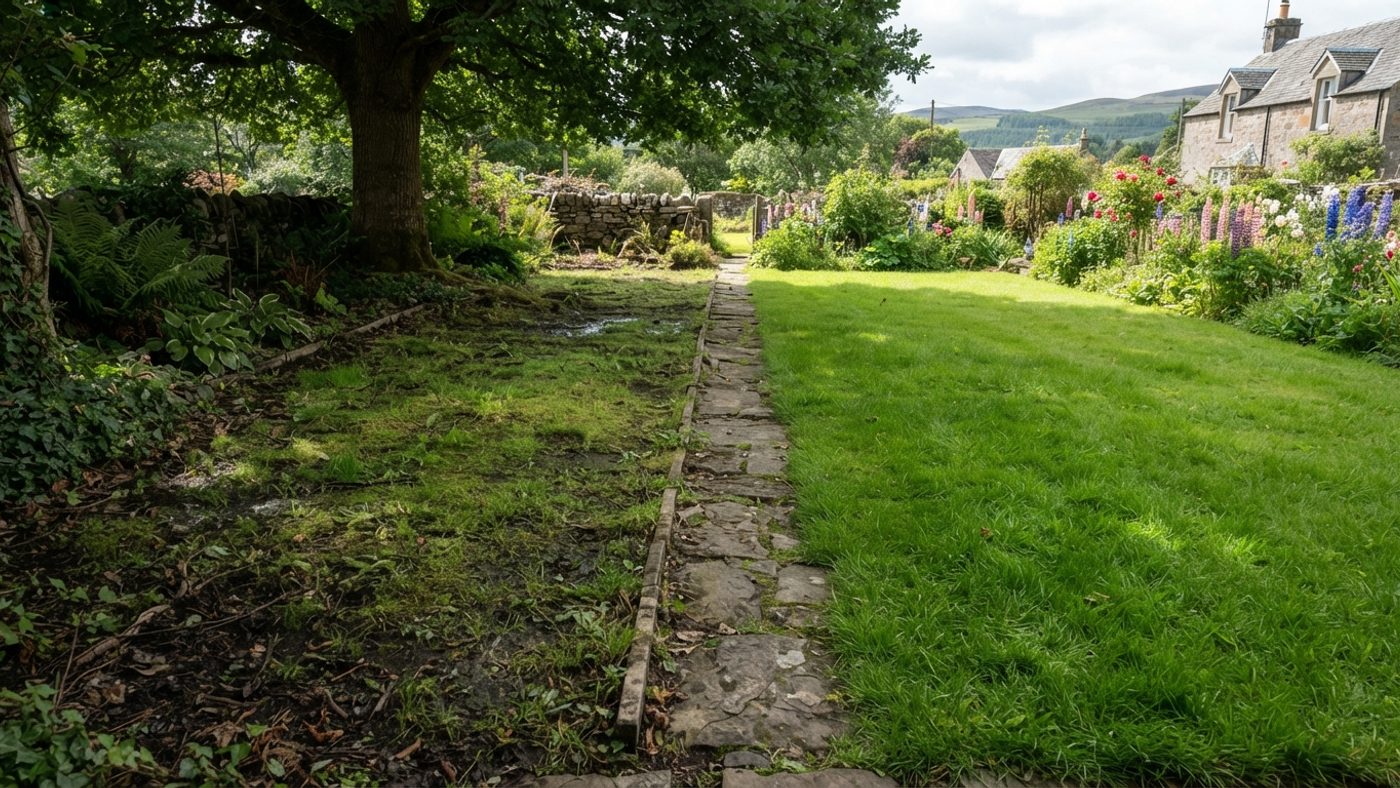
Stand on the mossy patches at different times of day. Is this ground genuinely shaded, by a fence, a hedge, a mature tree, for a large part of the day? Grass is a full-sun plant at heart; in heavy shade it simply can't out-compete moss, however well it's fed or mown. Shade from a mature tree, hedge, or fence is one of the easiest causes to rule in or out, and worth checking first before anything more involved.
Drainage and compaction check
Push a garden fork into the mossy area and into a healthy area nearby, and compare how easily it goes in. If the mossy ground is noticeably harder, or water sits on the surface after rain rather than soaking away, compaction or poor drainage is very likely a driver, and in the wetter west of the country, where soil has more rain to shed in the first place, a compacted lawn has far less margin to cope with it than the same lawn would in a drier region. Heavily used lawns, routes to the washing line, the kids' football pitch corner, compact fastest.
Mowing height check
Check what height the mower is actually set to, not what you think it's set to. Cutting too close is a repeated stress on the grass plant that moss exploits. A general-purpose lawn should be kept at around 3cm rather than scalping the grass.
Soil fertility and pH check
A cheap pH testing kit from a garden centre, used on a soil sample from the mossy patch itself, tells you directly whether you're dealing with acidic ground rather than guessing from the regional farmland figures above. Test with a pH kit, and where the soil comes back "very acid," aerate the area and brush dolomite limestone into the holes to raise the pH over time. Low fertility on its own, thin, undernourished turf, also weakens grass's ability to compete, independent of pH.
Most mossy lawns turn out to have more than one of these factors at once, commonly shade plus compaction, or acidity plus close mowing. Note down everything that applies before moving to treatment.
The treatment options, and how they relate to each other
Once you know the cause, or causes, the actual treatment choices sort into two categories: killing the moss that's there now, and fixing the conditions that let it establish. Both matter, and neither substitutes for the other.
Scarifying: necessary either way
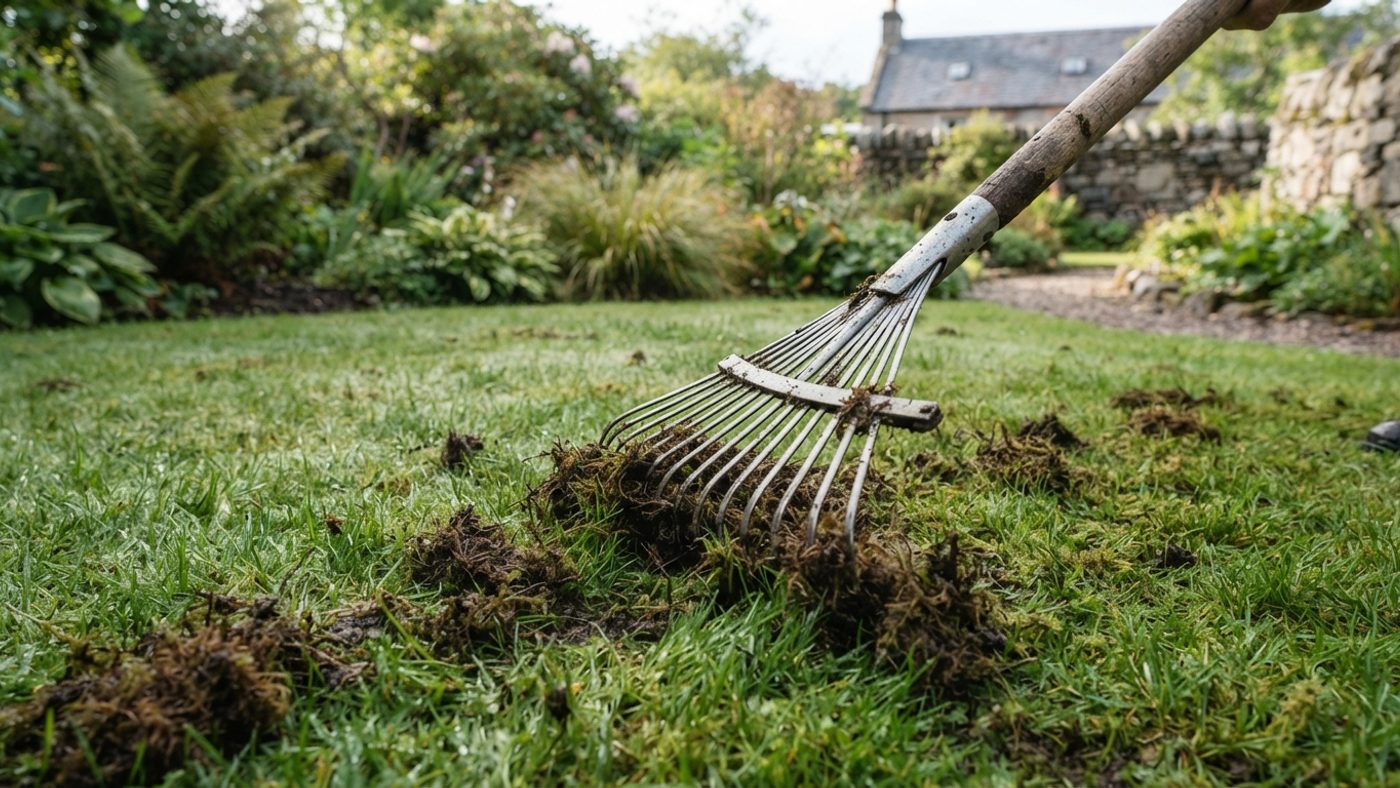
Whether or not you use a chemical mosskiller, dead moss has to be physically removed, it doesn't rot away fast enough to make room for grass, and left in place it mats down and smothers the lawn further. Scarify ideally in October or early November when the grass is growing strongly: a spring-tined rake for a small area or a patch of moss, a hired mechanical scarifier for a full lawn. If you use iron sulphate first, you're raking out blackened, dead moss rather than green; if you scarify without chemical treatment, you're pulling out moss that's still partly alive, which is harder work but avoids the chemical step entirely. That October/November window assumes grass is still growing strongly enough to recover afterwards, worth checking against your own lawn rather than the calendar alone, growth can already be slowing by then in cooler, upland gardens; if the grass looks weak or dormant going into November, scarifying a few weeks earlier gives it more time to fill back in before winter.
Iron sulphate and lawn sand: the chemical route
Iron sulphate (ferrous sulphate) is the active ingredient in most proprietary lawn mosskillers, and it kills moss effectively. "Lawn sand" is simply one traditional way of applying it: iron sulphate mixed with sand as a carrier so it spreads evenly by hand, rather than a separate chemical, and it works the same way as a modern granular or liquid mosskiller. Iron sulphate is widely sold as a lawn fertiliser, but unless it is a constituent of a proprietary, HSE (Health and Safety Executive) approved lawn mosskiller it should not be used to control moss in lawns, and any product used should be applied following its own instructions on timings, methods and rates of application, to ensure moss is effectively killed without damaging grass. In practice that means using a bought, labelled product as directed rather than raw ferrous sulphate crystals or a home-mixed solution. Non-chemical methods, scarifying plus a bacteria-based moss digester, are now considered effective enough that there's no need to use a synthetic mosskiller, worth knowing if you'd rather skip the chemical route entirely.
Aeration: fixing compaction and drainage
Spiking with a garden fork, or hollow-tining (a machine or hand tool that pulls out small plugs of soil rather than just piercing it, giving compacted ground more room to loosen), relieves compacted soil and lets water move through it instead of sitting on the surface, the direct fix for the drainage and compaction check above, and the step that matters most where rainfall is heaviest. Aerating and top dressingAdding fresh compost, feed or grit to the soil surface around an established plant, rather than digging it in. Full definition → a lawn relieves compaction and improves drainage; a simpler version is to aerate in spring and autumn and brush a material such as leaf mould into the holes annually to keep the soil open over time.
Addressing shade
Where a check showed genuine shade as the driver, the honest options are to reduce the shade, thinning or lifting the canopy of an overhanging tree or hedge, or to accept the shade and change what you're growing in it. Where shade and damp aren't always easy to alter, stop growing conventional lawn grass there at all and plant something suited to the conditions instead.
Overseeding with shade-tolerant grass
Where the tree stays and the shade can't be meaningfully reduced, overseed with a shade-tolerant grass mix rather than standard lawn seed, available as both seed and turf. This works alongside scarifying, not instead of it, clear the dead moss out first so the new seed has open ground and soil contact rather than competing through a mat of old moss.
Raising mowing height
If the check found the mower set too low, simply raising the cutting height reduces the ongoing stress on the grass and gives it more leaf area to photosynthesise and recover. It's the cheapest fix on this list and worth doing regardless of what else is going on.
Putting it together
None of these steps is a one-off, and a lawn with more than one cause needs more than one fix applied together, shade thinned, soil spiked, moss raked out, and a shade-tolerant reseed, rather than picking one and hoping. A lawn that's mossy purely because it's been scalped all summer might need nothing more than a scarify and a higher mower setting.
Where the pH test confirms acidity across the whole lawn rather than one patch, dolomite limestone worked into aeration holes treats the immediate area but won't shift the pH of the lawn as a whole on its own, a wider liming programme is a bigger, slower undertaking, worth planning around a full soil test rather than guessing quantities.
Common questions
Will iron sulphate stop moss coming back permanently?
No — it kills the moss present at the time of application but does nothing about whatever weakened the grass in the first place. Unless the underlying cause (shade, compaction, acidity, mowing height, fertility) is also addressed, moss typically returns.
Do I need to scarify if I’ve already used a moss killer?
Yes. Dead moss doesn’t clear itself, it needs to be raked out, either with a spring-tined rake on a small area or a mechanical scarifier on a larger lawn, ideally in October or early November while the grass is still growing strongly enough to recover afterwards (earlier if growth in your area has already slowed by then).
How do I know if my lawn’s moss problem is down to acidity?
Test it directly with a soil pH kit from a garden centre, taking the sample from the mossy patch itself. Scottish soils skew acidic more often than not, but that’s a general regional pattern, not proof for any individual garden.
Is there a non-chemical way to deal with moss?
Yes, scarifying combined with improving the underlying conditions (aeration, raised mowing height, shade reduction) addresses moss without iron sulphate at all. Bacteria-based moss digesters are also available as a non-chemical alternative to iron-based mosskillers.
My garden is heavily shaded by trees I can’t remove, is a moss-free lawn realistic?
Not entirely, without changing what’s growing there. Overseeding with a shade-tolerant grass mix improves the odds, but in genuinely heavy, permanent shade it may be more realistic to stop treating that patch as lawn and plant something suited to shade and damp instead.
Dealing with a different lawn problem? See mushrooms and fairy rings, red thread, worm casts, chafer grubs, drought or the dog, iron sulphate overuse, and moles.
Sources
6 sources, recorded with what each was used for
- RHS: Moss in Lawns: Keep or Remove?: Causes of moss establishment, moss identification (appearance), scarifying method and timing, iron sulphate/HSE-approved mosskiller guidance, shade-tolerant grass mix advice, and mowing height guidance
- Garden Organic: Overcoming problems with your organic lawn: Compaction/aeration method, specific mowing height figure (3cm), soil pH testing and dolomite limestone treatment, and shade/damp advice
- Met Office: Glasgow, Bishopton location-specific long-term averages: West-Scotland annual rainfall average (1,370.23mm, 1991-2020)
- Met Office: Edinburgh, Gogarbank location-specific long-term averages: East-Scotland annual rainfall average (784.29mm, 1991-2020)
- Met Office: Charting the UK's changing climate: The west/north vs south/east rainfall trend comparison between the 1961-1990 and 1991-2020 averaging periods
- SRUC: Acidic soils could be affecting production on many Scottish farms: The Scottish soil pH survey data (nearly 50% of samples below pH 5.8) and the recommended 6.0-6.2 target range