
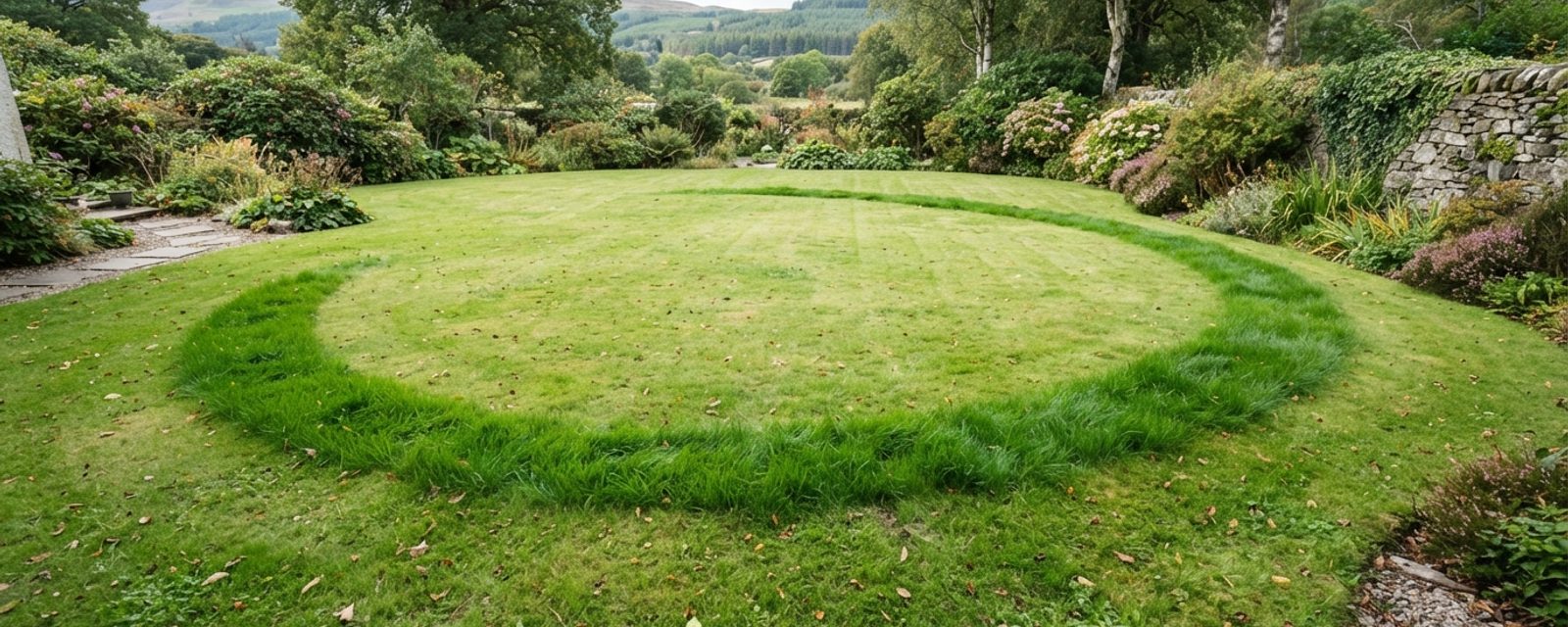
You go out one morning after a wet, mild stretch and there's a ring of pale toadstools standing in the grass that wasn't there the day before, a near-perfect circle, as if someone had drawn it with a compass. Or there's no mushroom in sight, just a band of grass gone flat and brown in a curve across the lawn, with a ring of unusually dark, lush green just inside it. Both are alarming in the way anything that appears overnight and in a perfect geometric shape tends to be. Neither means your lawn is diseased in the way a lawn disease usually works, and neither is something a weekend of treatment is likely to fix.
What's actually growing under your lawn
A mushroom or toadstool in the grass is not the organism itself, it's the fruiting body: the visible, short-lived structure a fungus produces purely to release spores. The fungus itself lives underground as a network of fine threads (hyphae, collectively called mycelium) spread through the soil or through buried decaying organic matter such as old tree roots, stumps, or buried wood, and it's present in that form more or less all year round, invisible. It only sends mushrooms up into the light when conditions are right, and in the UK that's overwhelmingly in late summer and autumn, after rain, in mild weather. That's why they seem to appear from nowhere: the fungus was already there, feeding, for weeks, months, or years beforehand.
Most of the fungi doing this in a garden fall into one of two roles. Saprophytes feed on dead plant and animal matter already in the soil, breaking it down and releasing nutrients back into it, a beneficial, ordinary decomposition process. Mycorrhizal fungi instead form a symbiotic partnership with the roots of living plants, including trees and shrubs, extending their root systems' reach for water and nutrients in exchange for sugars from the plant. Both groups are common, and the vast majority of toadstools that turn up on a lawn or flower bed belong to one or the other, causing no harm to the plants around them.
Ordinary toadstools: decomposition, not disease
If what you're looking at is a scattering of toadstools that don't form any obvious pattern, that's very likely just this decomposition process reaching the surface, not a sign your lawn is under attack. Doing nothing at all is a genuinely fine response: there's no useful reason to pick them off in an attempt to stop the fungus spreading, since the spores that matter are airborne, travel long distances, and are likely arriving from elsewhere regardless of what you do with any individual mushroom already up. Removing them is still a reasonable thing to do for tidiness, or to keep pets and children away from them (more on that below), but it isn't a treatment, and leaving them alone to rot back down isn't a mistake either. Heavy thatch, poor drainage, and compacted soil all give decomposer fungi more to feed on, so scarifying and aerating a lawn that produces toadstools every autumn reduces how much they show up, in the same way it helps with moss.
One case where "just tidy them away" is the wrong instinct: an old, unfertilised lawn, paddock, or graveyard that produces small, brightly coloured toadstools, scarlet, yellow, purple, in among the grass, especially in autumn, may be host to waxcap fungi, characteristic of ancient pastures, old lawns, and graveyards specifically. These are distinctive enough to be worth a proper look rather than a guess from a description: a genuinely waxy-feeling cap and gills are the visual giveaway, and a photo compared against a proper fungi ID guide is a better next step than deciding from memory. It matters because the UK, Scotland included, is one of Europe's strongholds for these species, several of them classed as threatened on the European Red List, and they need soil that's gone unfertilised and undisturbed for years: ploughing or fertilising ground like this causes an immediate loss of fungal diversity, and it takes over 50 years to recover. If a lawn or rough grass area has never been fed and regularly produces colourful toadstools, that longevity is exactly why it's worth identifying properly before treating the ground for anything, rather than assuming it needs fixing, and it's the same reason a fairy ring in that kind of long-undisturbed turf can go on quietly expanding for centuries.
A small number of other fungi cause real problems and are worth being able to recognise. Honey fungus (Armillaria species) is the most damaging fungal disease of UK garden trees and shrubs, attacking and killing the roots of woody and some herbaceous perennials, and it produces honey-coloured mushroom clumps around the base of dead stumps or over dead roots in late summer and autumn, sometimes well away from any obvious source of infection, since it can also spread underground along root-like cords. It's a different issue from harmless lawn toadstools and from fairy rings, but the same buried-wood mechanism, old stumps and roots left in the ground going on feeding a fungus for years, is exactly what makes a garden built over former woodland or hedgerow ground worth watching more closely.
Fairy rings are a different phenomenon
A fairy ring is a specific, more predictable pattern: a single fungal colony expanding outward from a central starting point. The typical expansion rate is roughly a foot a year, and a ring can persist for hundreds of years in undisturbed turf. Because the colony is a roughly circular advancing front growing through the soil, whatever effect it has on the grass or whatever toadstools it produces tend to appear as a ring or part-ring rather than scattered individuals.
Not every fairy ring looks the same, and the differences matter for how worried to be. Turf professionals group them into three types:
| Type | What you see | What's causing it | Effect on the grass |
|---|---|---|---|
| Type 1 | A ring of dead, browned grass, slowly widening year on year | Usually Marasmius oreades, the most damaging fairy-ring fungus; its mycelium is water-repellent and the grass over it suffers drought stress | Grass genuinely dies in the ring, though whether the fungus kills roots directly or just starves them of water is unclear |
| Type 2 | A ring of grass that's noticeably darker green or lusher than the rest of the lawn, with no dead patch | Nutrients released as the fungus decomposes organic matter in the soil, feeding the grass immediately around the ring | None — the grass isn't damaged, it's actually growing better there |
| Type 3 | A ring of toadstools only, with no visible change to the grass at all | Various other fairy-ring fungi | None on the turf itself |
Any of these can also produce toadstools when conditions suit it, typically in late summer and autumn, and for much of the year a fairy ring may show only as one of the grass patterns above with no mushrooms visible at all.
Why fairy rings are so hard to actually get rid of
There's no fungicide approved for home gardeners to use against fairy rings in the UK. Some lawn-care companies offer treatment with professional-use, HSE-approved products not sold to the public, so if you're paying for that route it's worth confirming the company is applying an approved product rather than an off-label one.
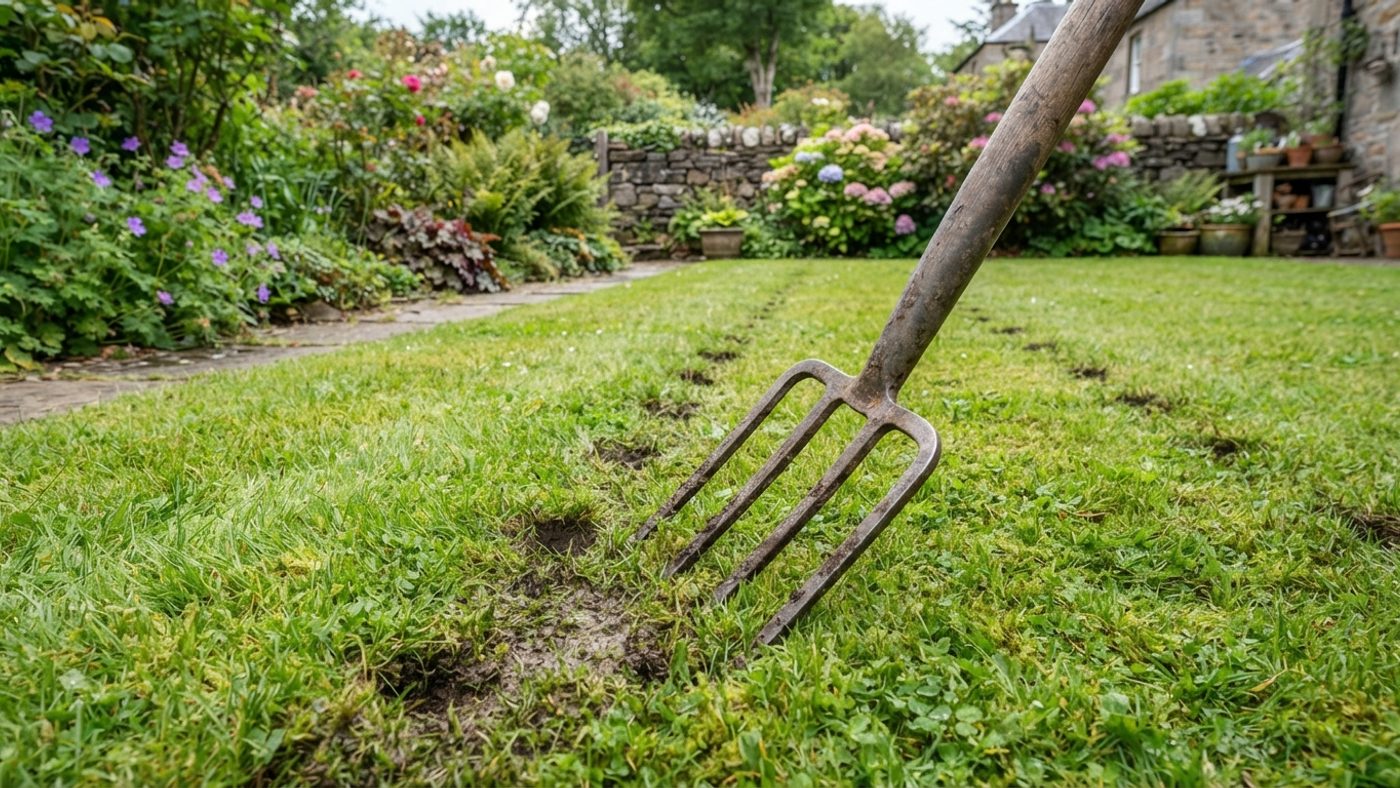
The only method that removes a ring outright is physical: excavating the active advancing edge of the colony and replacing the soil, and that has to go to at least 30cm (roughly a foot) deep and wide enough to get ahead of where the colony has already spread, followed by returfing or reseeding. For anything beyond a small ring, that's usually impractical. Where dead patches are the main problem, spiking and watering the area, along with feeding the grass, helps by breaking up the fungal colony's water-repellent effect on the soil; wetting agents can help water penetrate as well. Heavy nitrogen feeding can also green up the grass enough to hide a Type 2 ring, or mask the edges of a Type 1 dead ring, without treating the fungus underneath it, worth knowing if a ring seems to "disappear" after a feed and then reappears later. None of this kills the fungus outright, which is why rings so often persist for years regardless of what's done to the visible turf.
Is Scotland's climate making this more common here?
The mechanism is straightforward enough: these fungi fruit in response to moisture, and the toadstool stage of both ordinary lawn fungi and fairy-ring fungi is concentrated in the UK's wetter, milder months. Scotland's woodlands, grasslands and gardens support more than 12,000 recorded fungal species, among the richest fungal habitat in the British Isles, and general guidance on encouraging garden fungi points specifically to damp, shady conditions as what they need to thrive.
Nobody has directly compared how many lawns in Scotland show fairy rings or toadstools against lawns further south, so the connection is likely rather than confirmed: wetter, milder conditions favour fungal fruiting generally, and Scotland has more of both than much of the rest of the UK, which makes lawn mushrooms and fairy rings a plausible, likely candidate for "more common here" even without a direct measurement to point to.
Ex-woodland and ex-farmland gardens: a real but under-documented risk
The same buried-wood mechanism, honey fungus being the clearest and most damaging UK-wide example of a fungus that keeps feeding on stumps and roots left in the ground for years, applies to a garden built on ground that used to carry trees, hedgerows, or farmland: old root systems, stumps, and construction offcuts left buried during building work are food for exactly this kind of fungus, sometimes for years or decades afterwards. If your house is on an estate built in the last few decades on what was farmland, woodland, or a hedgerow line before, that's a genuine, sensible reason to expect more fungal activity than in an older, long-settled garden, though nobody has compared ex-woodland development sites in Scotland against ordinary gardens directly. Treat it as a sensible explanation if it matches your garden's history, not as a diagnosis on its own.
Safety: what to actually do about it
Some garden fungi are genuinely poisonous, fly agaric (Amanita muscaria), the bright red cap with white spots, being one recognisable example, and there's no reliable way to tell a dangerous species from a harmless one by eye without real expertise. The safe approach is straightforward: don't eat anything growing in the lawn, keep a close eye on young children and pets around a fresh crop of mushrooms, and either fence off the area or mow/remove the toadstools if there's a real risk of something being picked up and eaten. For a genuine identification opinion, the Royal Botanic Gardens, Kew, answers general enquiries about mushroom and toadstool toxicity. The basic rule for anyone tempted to eat something found growing wild is the same one the Scottish Wild Mushroom Code sets out: only ever eat what you can positively identify yourself, with a field guide, and leave anything you can't. If you suspect a child, adult, or pet has actually eaten a wild mushroom, treat it as a medical or veterinary emergency: seek immediate attention (an A&E department for a person, a vet for a pet) and take a sample of the fungus with you rather than trying to identify it yourself first.
Common questions
Will mushrooms or toadstools in my lawn kill the grass?
Ordinary scattered toadstools, no. They’re a sign of decomposition happening in the soil, not an attack on the grass. A Type 1 fairy ring caused by Marasmius oreades can genuinely kill the grass in the ring itself through drought stress, but Type 2 and Type 3 rings have no damaging effect on the turf at all, and Type 2 can even leave it greener.
I’ve got a ring of darker green grass but no dead patch and no mushrooms, is that still a fairy ring?
Very likely, yes, a Type 2 ring. Fairy rings often show only as a colour change for most of the year, with toadstools appearing seasonally, mainly in late summer and autumn, rather than being visible year-round.
Can I get rid of a fairy ring permanently?
Not reliably, no, and it’s worth setting that expectation before spending money on it. Even a company using a proper HSE-approved product isn’t guaranteeing the fungus is gone for good, since the only way to remove a colony outright is digging it out to depth across its full advancing edge, which most gardens can’t do for anything beyond a small ring. Most households end up managing the symptoms long-term rather than eliminating the cause.
Is it dangerous if my dog or child eats a mushroom from the lawn?
Some garden fungi are toxic, and there’s no safe way to tell which from appearance alone without real expertise. Keep pets and children away from fresh mushroom growth, remove or mow it off if that’s not practical, and if something has actually been eaten, get medical or veterinary attention straight away and take a sample of the fungus with you.
Does living somewhere in Scotland make this more likely?
Plausibly, yes, on mechanism: these fungi fruit after rain in mild weather, and Scotland has more of both than much of the UK. There isn’t a source that has measured lawn fairy-ring or toadstool rates specifically and confirmed Scotland comes out higher, so treat it as a reasonable expectation rather than a proven regional pattern.
Dealing with a different lawn problem? See moss in your lawn, red thread, worm casts, chafer grubs, drought or the dog, iron sulphate overuse, and moles.
Sources
6 sources, recorded with what each was used for
- RHS: Fairy Rings in Lawns: Fairy ring biology, colony expansion rate, the Type 1/2/3 symptom classification (dead grass ring, greener ring, toadstool-only rings), and non-chemical/chemical control guidance
- RHS: Toadstools in Gardens: What a toadstool is biologically, saprophyte vs mycorrhizal fungus roles, fly agaric as a named toxic species, general control advice, and the Royal Botanic Gardens Kew toxicity-enquiry contact and A&E advice for suspected poisoning
- RHS: Honey Fungus: Buried stump/root mechanism for mushroom emergence, including mushrooms arising from underground fungal cords away from any visible source
- NatureScot: Fungi: Scale of Scotland's fungal diversity and damp/shady conditions favouring garden fungi
- NatureScot: Grassland Fungi Mapping Tool: Waxcap and grassland fungi as characteristic of ancient pastures, old lawns, and graveyards; the UK's standing as a European stronghold for these species; nutrient-poor, undisturbed soil as the habitat requirement; and the 50-year recovery time after ploughing or fertilising that ground
- NatureScot: Scottish Wild Mushroom Code: Only-eat-what-you-can-positively-identify guidance for anyone tempted to eat wild fungi