
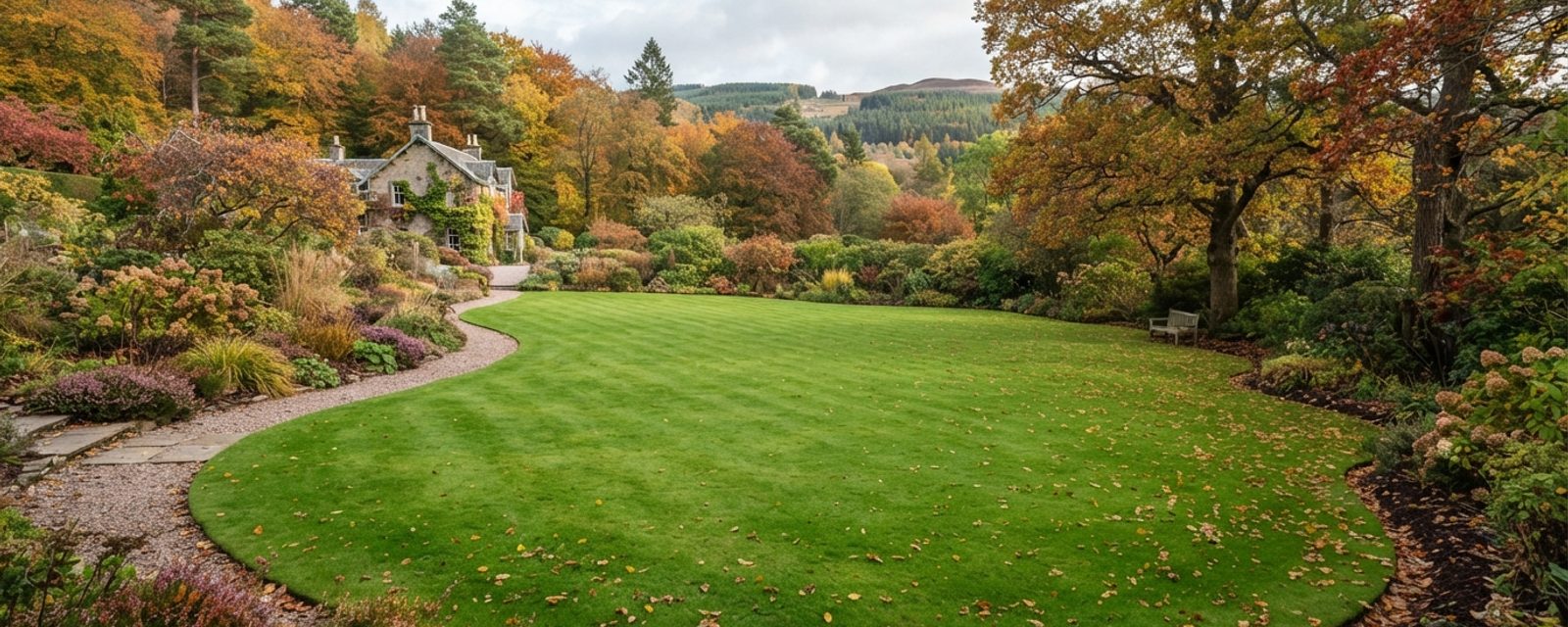
You go out in September and the lawn has gone strange overnight, not brown like a drought patch, but pink, almost rust-coloured, in ragged patches scattered across the grass, some no bigger than a dinner plate, others sprawling. Look closely and there's a faint red, almost gelatinous fuzz clinging to individual blades, like the grass has been dusted in something. It looks like the lawn is dying. In nearly every case, it isn't.
That's red thread, the most common lawn fungal disease in the UK. What it looks like, why it shows up when it does, and, more usefully, why it isn't the emergency it looks like, is worth working through properly before reaching for anything in a spray bottle.
What red thread actually looks like
Affected grass develops patches with a reddish tinge at first, fading to light brown or almost bleached, typically 7.5cm to 25cm across, though they can merge into much larger areas. The tell-tale sign, and the one that gives the disease its name, is the fungus itself: under damp conditions it produces small, pink, cottony tufts, and pinkish-red, gelatinous, thread-like strands only 1-2mm long that bind the grass blades together. Rub a patch between your fingers on a wet morning and that thread-like texture is usually there.
It's most often seen on fine-leaved lawns, fescues in particular, rather than coarser, more vigorously growing turf.
Why it happens: this is a feeding problem, not an attack
It's most serious on turf that's poorly aerated and deficient in nitrogen. A thin, undernourished, low-fertility, compacted lawn is far more vulnerable than one that's being fed and aerated properly: a lawn on a decent feeding routine rarely gets a serious outbreak at all, while a lawn that's been left to fend for itself most years, on ground that's never been spiked with a fork or scarified (raked to pull out moss and dead thatch and let air reach the soil), is exactly the kind red thread finds first. Mowing too close has the same weakening effect as poor feeding, so a lawn cut short and often is more exposed than one left slightly longer through autumn.
The conditions that trigger an outbreak
Even an undernourished lawn needs the right weather to develop visible red thread. Prolonged leaf wetness is required for infection, which is why it's most likely to appear in wet summers and during heavy autumn dews, late summer into autumn is the classic season for it, when nights are getting longer and cooler but the grass is still damp for hours at a stretch, morning after morning.
Why Scottish autumns give red thread more chances to take hold
How many autumn days actually bring rain matters more to leaf wetness than the total millimetres falling over the season. Two stations either side of the country show how much that can differ within Scotland itself:
| Station | Region | September rain days | October rain days | November rain days | Autumn total |
|---|---|---|---|---|---|
| Fort Augustus | Highlands (west) | 14.28 | 18.42 | 17.36 | 50.06 days |
| Aboyne No 2 | Aberdeenshire (east) | 9.1 | 12.53 | 13.4 | 35.03 days |
30-year averages (1991-2020), days with rainfall of 1mm or more.
Over the same three autumn months, Fort Augustus records rain on roughly 15 more days than Aboyne. A lawn on the wetter west or in the Highlands gets more of the damp mornings that let red thread infect than a lawn further east, on top of whatever its own feeding regime is doing.
None of that makes red thread inevitable anywhere in Scotland, and a well-fed lawn on the west coast will still generally outperform a starved one further east. But where the two risk factors overlap, thin, hungry turf sitting through an unusually wet, dewy autumn, a garden in a wetter part of the country has more of those damp mornings stacked against it than a drier one, which is worth knowing before assuming a bad outbreak means something's gone badly wrong.
Will it kill the lawn? No, and treating it like it will is the main mistake
The fungus doesn't touch the grass's root system, which is why recovery can happen within days or a few weeks even without any treatment at all. Only genuinely persistent patches, ones that keep coming back outbreak after outbreak, need the feeding and aeration routine below applied deliberately, a one-off autumn flare-up will very likely grow itself out once conditions dry up and the lawn gets fed.
The actual fix: feed the lawn, don't reach for a fungicide
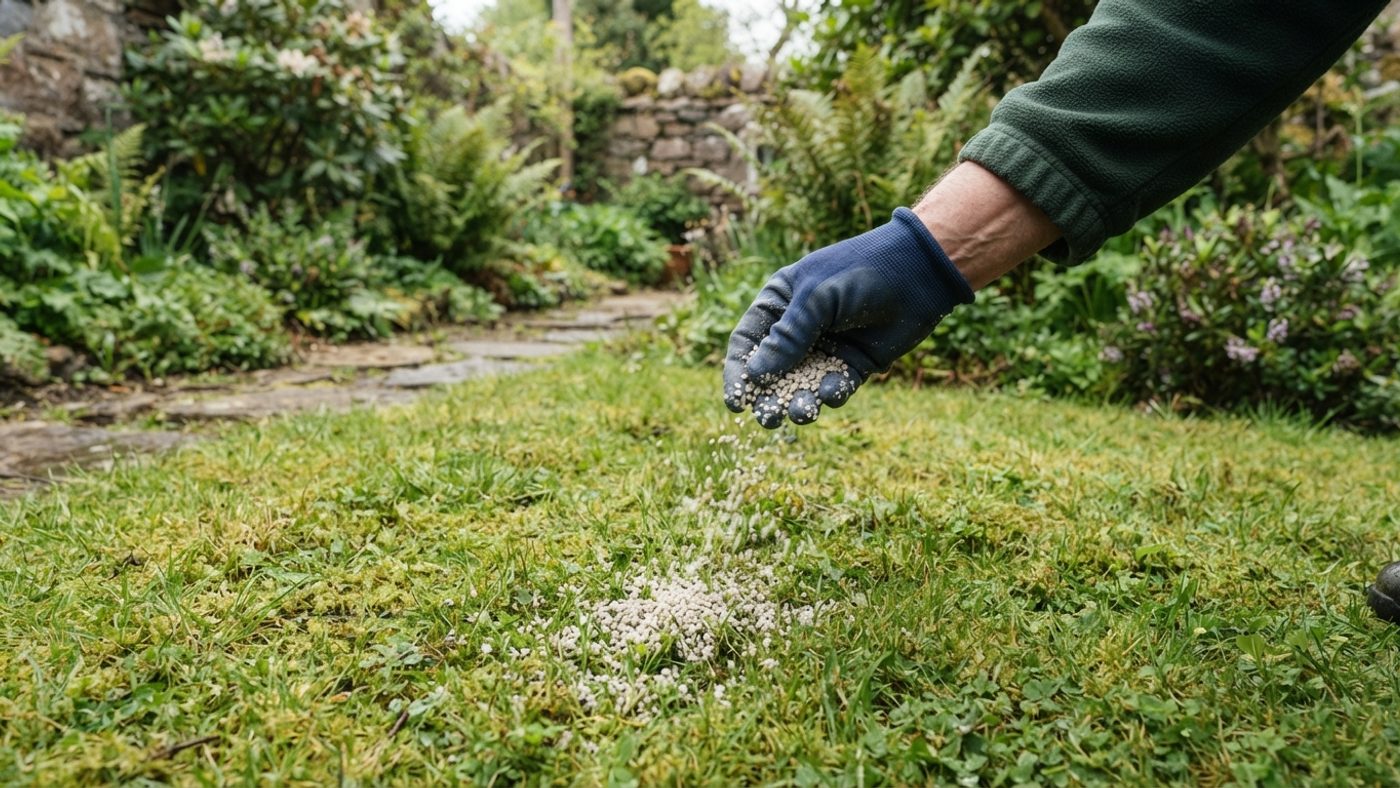
Because the underlying cause is nearly always nitrogen deficiency, the practical fix follows directly: applying nitrogen to the affected area is often enough to control it on its own, without any fungicide involved. Sulphate of ammonia, a straightforward nitrogen fertiliser sold at garden centres, at around 15g per square metre, is the specific rate given for a spot treatment, any straight nitrogen feed at an equivalent rate does the same job; it doesn't need to be that exact product by name. Beyond a one-off application, keeping the lawn on a proper ongoing feeding programme, alongside aerating compacted ground, is what stops the pattern repeating year after year.
There are currently no fungicides available to home gardeners for controlling lawn diseases in the UK, only to professional lawn-care companies under separate rules, which makes feeding, and aerating where the ground is compacted, the practical treatment for most gardens.
One caution worth carrying into that feeding routine: an autumn lawn feed and a summer one aren't the same product, and shouldn't be. Autumn lawn feed is formulated to encourage root growth through winter, low in nitrogen and higher in potassium and phosphorus, applied roughly from September to mid-October before the first frosts, rather than the high-nitrogen mix used to green up a lawn in spring and summer. A spot dose of nitrogen on an active red thread patch is a targeted treatment for the outbreak in front of you; the ongoing autumn feeding programme that follows it is a different, lower-nitrogen product doing a different job.
Fusarium patch: the autumn disease with the opposite trigger
Red thread has close company through a Scottish autumn. Fusarium patch, also called snow mould, causes small patches of yellowing, dying grass that turn brown and can reach 30cm or more across, often merging together, with a white or pinkish cottony growth noticeable at the margins in wet conditions, similar enough in colour to be mistaken for red thread at a glance, but a genuinely different problem underneath.
Fusarium patch favours grass that's particularly lush from high nitrogen levels, the opposite of red thread's nitrogen-starved turf, developing in the 12-19°C range as growth slows into autumn, or under prolonged snow cover in winter. Avoiding high doses of nitrogen fertiliser late in the season, and using a proper low-nitrogen autumn feed instead, is the main way to prevent it. As with red thread, prevention through drainage, aeration, and getting the feeding balance right is the whole toolkit.
| Red thread | Fusarium patch / snow mould | |
|---|---|---|
| Appearance | Pink/red gelatinous thread-like strands; patches 7.5-25cm, becoming bleached | Yellow patches turning brown, 30cm+, white/pink cottony margins |
| Nitrogen link | Caused by too little nitrogen | Made worse by too much nitrogen |
| Peak conditions | Prolonged leaf wetness; wet summers, damp autumn dew | 12-19°C with surface moisture; also under snow cover |
| Fungicide available to home gardeners | None | None |
Feeding the lawn correctly, on the right autumn product at the right rate, guards against both problems at once, rather than either starving it or over-feeding it into a different disease entirely.
Putting it together this autumn
If pink or rust-coloured patches show up on your lawn in September or October, the sequence that actually matters is: confirm it's red thread by looking for the pink gelatinous threads rather than assuming; don't panic about the grass dying, since the roots are almost always untouched; apply a nitrogen feed to the affected patch if you want to speed recovery, or a proper low-nitrogen autumn feed across the whole lawn if you'd rather address the underlying cause directly; aerate if the ground underneath is compacted; and skip the fungicide aisle entirely, since nothing there will do the job regardless of what the packaging suggests. In a wetter, dewier part of the country, that feeding and aeration routine carries more weight than it would somewhere drier, simply because the weather is handing the fungus more chances to find a weak lawn, which makes it worth keeping to, not skipping, the year the lawn seems to be coping fine without it.
Common questions
Does red thread kill grass?
Almost never on its own, it’s a cosmetic and recovery problem, not a lethal one, for the vast majority of lawns. The only lawns that need closer attention are ones with persistent, repeated outbreaks year after year, which usually points to an underlying feeding or aeration problem that hasn’t been addressed.
My lawn has gone pink in September, is it too late to do anything this year?
No. Applying nitrogen to the affected patch (around 15g per square metre of sulphate of ammonia) can still speed recovery, and a proper autumn feed across the whole lawn addresses the underlying cause going into winter.
Should I buy a fungicide for red thread?
No fungicides are currently available to home gardeners for treating lawn diseases in the UK, so this isn’t really a choice to weigh, feeding the lawn correctly is the only practical treatment available.
Is wet weather or poor feeding the real cause of red thread?
Both play a part, but they’re not equal. Nitrogen-deficient turf is the underlying vulnerability; damp, humid weather is what turns that vulnerability into a visible outbreak. A well-fed lawn in the same wet weather is much less likely to show symptoms at all.
Why does my lawn get red thread every autumn?
Recurring outbreaks usually point to a lawn that’s consistently under-fed rather than one unlucky season. Moving to a proper ongoing feeding programme, rather than a single spot treatment after the fact, is what actually breaks the pattern.
Dealing with a different lawn problem? See moss in your lawn, mushrooms and fairy rings, worm casts, chafer grubs, drought or the dog, iron sulphate overuse, and moles.
Sources
5 sources, recorded with what each was used for
- RHS: Red thread: Appearance and identification, the nitrogen-deficiency and poor-aeration cause, the leaf-wetness/humidity trigger, recovery without treatment, the nitrogen spot-treatment rate (sulphate of ammonia, 15g/sq m), and confirmation that no fungicides are currently available to home gardeners for lawn diseases
- RHS: Fusarium patch and snow mould: Symptoms and appearance, temperature/moisture triggers, the excess-nitrogen susceptibility link (the contrast with red thread), and prevention advice
- RHS: Lawn Care in Autumn: Autumn feed timing (September-mid-October), why autumn feed is formulated for root growth rather than leaf growth, and general mention of red thread among autumn lawn fungal problems
- Met Office: Fort Augustus location-specific long-term averages: September/October/November rain-day (≥1mm) figures for a west Highland station, 1991-2020 average
- Met Office: Aboyne No 2 location-specific long-term averages: September/October/November rain-day (≥1mm) figures for an Aberdeenshire (east) station, 1991-2020 average