
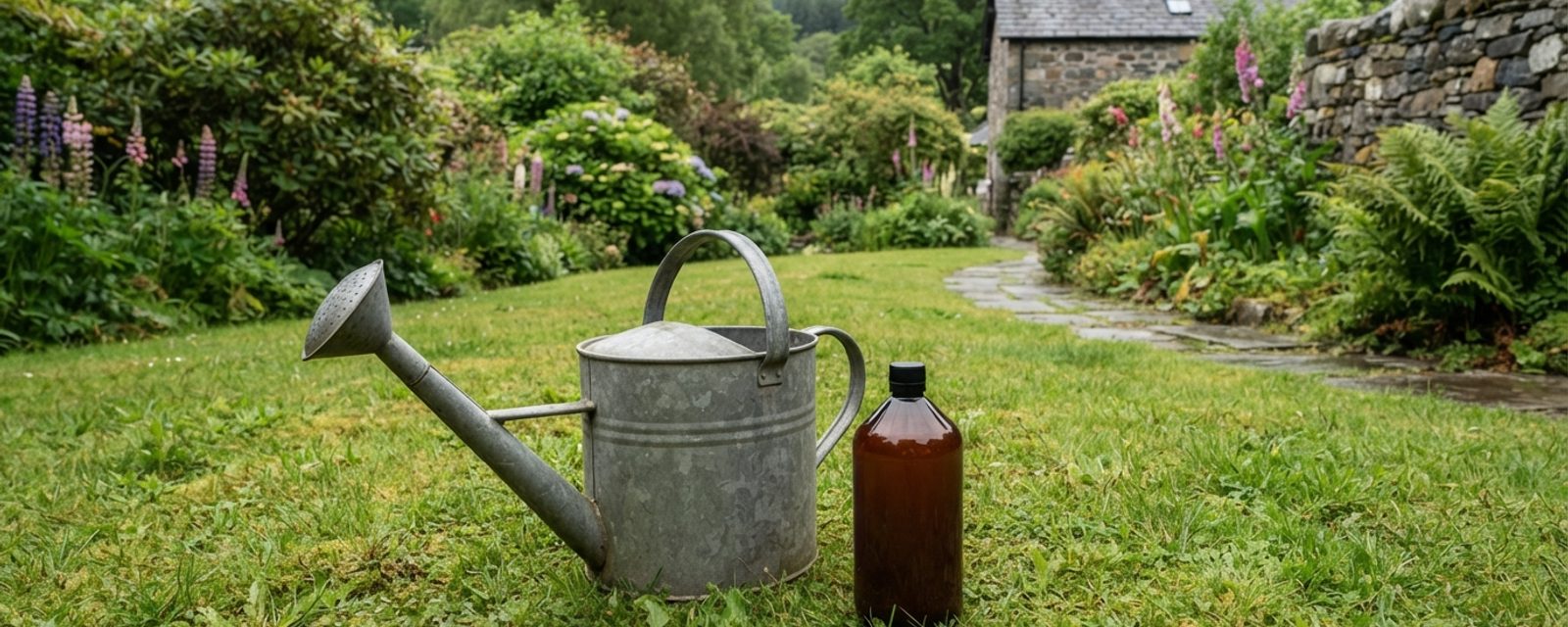
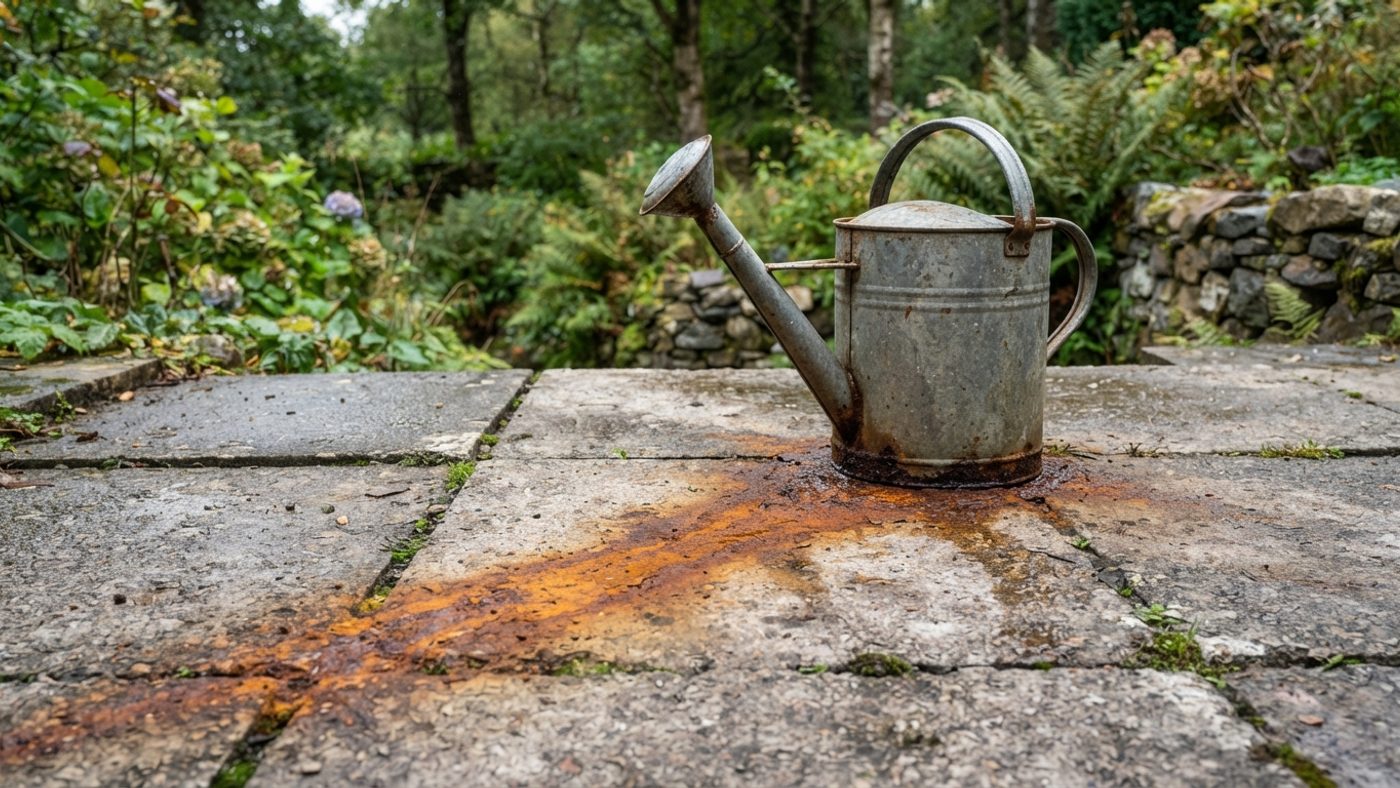
You treated the moss a week ago. Now there's a rust-orange stain spreading across the patio slabs by the back door, exactly where the watering can sat while you mixed up the solution. Or the moss patches on the lawn haven't just gone black, the grass around them has too, in blotchy stripes that match the path your spreader took. Either way, the instinct is the same: something's gone wrong, and it feels like it must be the chemical's fault.
It isn't, not really. Iron sulphate is a genuinely useful, widely used, safe-when-correctly-used lawn treatment, covered in detail as the standard chemical route for killing lawn moss. What's gone wrong is one of a small, predictable set of mistakes: too strong a mix, too much product, applied too close to paving, or handled without a couple of basic precautions. All of them are avoidable once you know what they look like.
Staining: the complaint everyone eventually has
Iron sulphate stains concrete, natural stone, paving slabs, and clothing or shoes a rust-orange to brownish-black colour, and it does not wash out with soap and water. This is a genuine and very common complaint, not a rare mishap: a spilled dribble from a watering can on the way to the lawn, a gust of wind carrying spray droplets onto an adjacent path, an overfilled spreader dragged across a patio edge, any of these leaves a permanent mark. Splash reaching nearby border plants, especially ericaceous ones (rhododendrons, azaleas, camellias, and other lime-hating shrubs, which are more tolerant of iron than most plants but not immune to a concentrated splash), can still mark or scorch foliage the same way it marks paving, so the same care applies at a bed edge as at a path edge.
The practical prevention is straightforward:
- Mix the solution well away from paving, patios, or anything you don't want stained, over grass or bare soil rather than a hard surface.
- Cover the edges of adjacent paths, patios, and nearby borders with plastic sheeting or an old tarpaulin before spraying or spreading near them, rather than trusting a steady hand.
- Rinse any spill on a hard surface immediately, with plenty of water, before it has time to react and set. Once it's dried in, it's essentially permanent.
- Treat clothing and footwear the same way, rinse a splash straight away rather than waiting until you've finished the job.
- Keep surplus product and any runoff away from drains, ponds, and watercourses, iron sulphate is harmful to aquatic life, not just hard surfaces.
Grass scorch and blackening: too much of a good thing
The other common mistake sits on the opposite side of the same error: applying the solution too strong, or going over the same patch twice, doesn't just kill more moss, it damages the grass itself. An overdose of lawn mosskiller shows up as regular stripes or patches of dead, blackened grass, often in a pattern that matches the route the spreader or sprayer took, and the same overlap problem happens if you go back over ground you've already covered because you weren't confident it was even the first time.
Product transferred on footwear is a separate but related route: iron sulphate carried on boots from a treated area onto lawn that wasn't meant to be treated shows up as footprint-shaped dead patches days later. It's the same underlying lesson as the staining problem: this product does exactly what it's supposed to where you put it, and exactly the same thing wherever else it ends up.
A related, less obvious version of the same mistake is reapplying too soon. Moss blackened by iron sulphate can take a week or more to visibly die back and needs raking out afterwards, scarifying, dragging a spring-tined rake or mechanical scarifier through the dead moss to physically remove it, it doesn't simply vanish on its own. A patch that still looks dark a few days after treatment usually means "give it time, then scarify," not "it didn't work, treat it again." Reapplying before the product label's minimum interval has passed is the same overdose problem as mixing it too strong in the first place, just spread across two applications instead of one.
| Outcome | What's happening |
|---|---|
| Too weak | Little or no effect on moss; wasted application |
| Correct rate, as labelled | Moss blackens and dies; grass unaffected |
| Overdose or repeat pass | Grass scorches and blackens alongside the moss, in stripes or patches matching the application pattern |
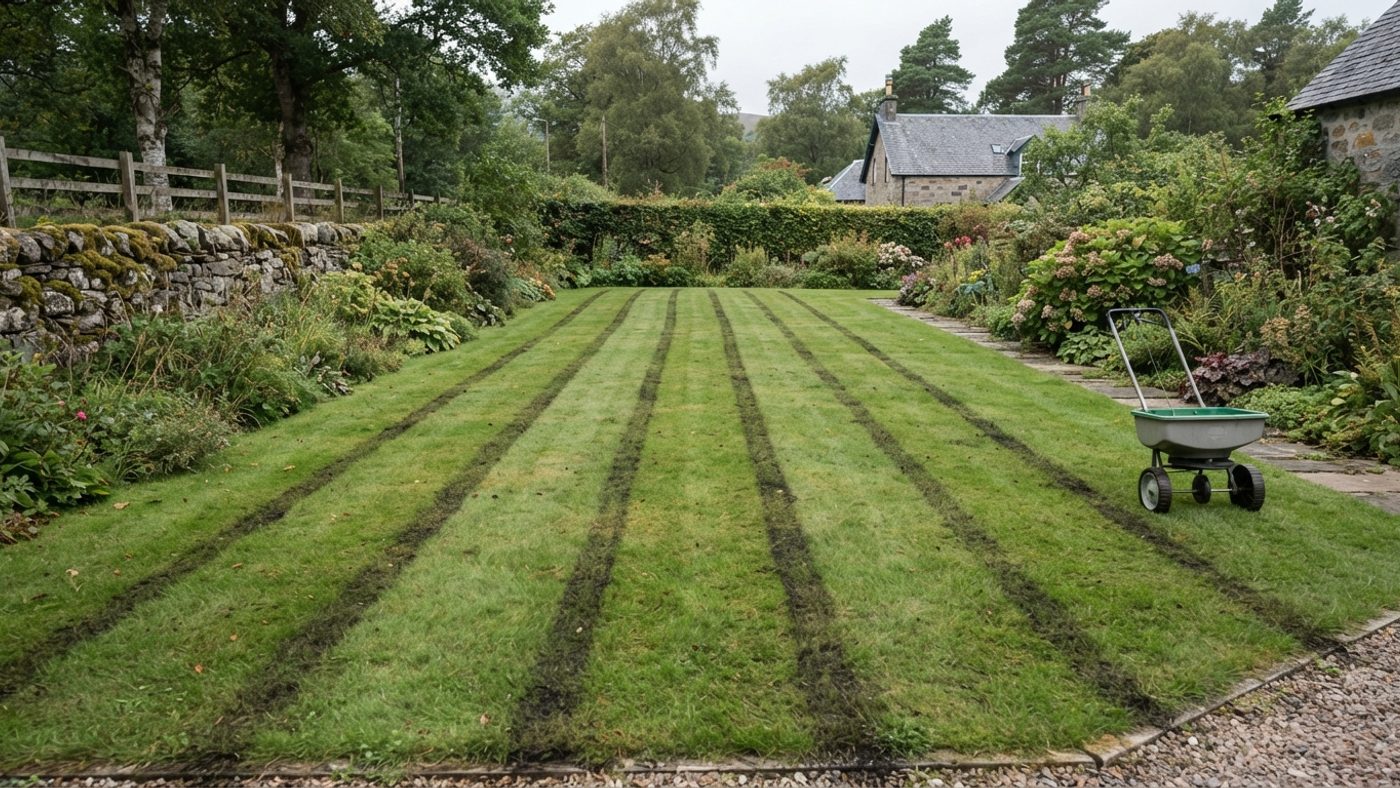
Scorched grass from an overdose isn't automatically permanent damage to the lawn as a whole, but it is a section that now needs to recover or be reseeded, exactly the extra work the treatment was meant to avoid.
Most overdosing comes down to eyeballing rather than measuring: guessing a spreader's setting instead of calibrating it against the product's own label rate, or mixing "roughly" the right strength in a watering can instead of using a proper measuring jug. Granular products (including lawn sand) and liquid concentrates carry different practical risks here, granular is easier to under- or over-apply unevenly by hand, liquid is easier to over-concentrate in the mix, so read the specific product's own instructions rather than assume the same rough method works for both. Applying to grass that's actively growing rather than frosted, drought-stressed, or dormant also matters: stressed grass has far less tolerance for the same dose that healthy grass shrugs off.
Handling it safely, without being alarmist
Concentrated iron sulphate is a mild skin and eye irritant, not a substance to be casual with, but not one that calls for special protective equipment beyond ordinary sense either. The basics: wear rubber gloves when mixing and applying it, avoid contact with eyes and mouth, and wash off any splash immediately rather than waiting until you're done. Keep children, other people, and pets off the treated area during application and until it's dried in. Store the product in its original, tightly closed container, somewhere cool and dark that children and pets can't get into, the same storage standard as any other garden chemical.
None of this is specific to iron sulphate, it's the same handling discipline that applies to any HSE-approved lawn product, and following it removes essentially all of the personal-safety risk. The staining and scorch mistakes above are about where and how much you apply; this section is about handling the concentrate itself, and the two aren't the same failure mode. A Scottish lawn treated several times across a longer, wetter moss season simply means this handling routine, gloves on, splash rinsed off, product stored properly, gets repeated more often here than in a garden that only needs one or two treatments a year, not that it changes in any way.
Does repeated use build up in the soil?
Iron sulphate works partly by acidifying the soil it's watered into, releasing acid as it breaks down, which is exactly why it's also sold separately as a soil acidifier for lime-hating plants, at far higher rates (over a kilogram per square metre for a real soil pH shift) than a moss treatment ever uses. At those higher acidifying rates, large quantities can measurably interfere with phosphorus availability in the soil.
Season-after-season moss treatment uses far smaller doses than deliberate soil acidification, but it's the same chemistry each time, acidifying and iron-binding, just repeated. That makes a cumulative effect over years of treatment plausible without being a documented, measured one at ordinary moss-treatment rates. Where a lawn has had years of iron sulphate treatment and the moss keeps coming back regardless, testing soil pH directly is a better next step than assuming more iron sulphate is the answer, particularly on soil that already starts more acidic than most of the UK's, as much of Scotland's does, since there's less headroom before the phosphorus-availability problem that shows up at high acidifying doses starts to matter at ordinary ones too.
The Scottish angle: more applications, more chances to get it wrong
Moss keeps coming back more persistently in a Scottish garden than in much of the rest of the UK: a wetter climate and, in many areas, more acidic soil both weaken grass's ability to compete with moss in the first place. A lawn that goes mossy more readily is one a gardener treats more often, and more repeatedly across a season, than a lawn in a drier part of the UK where moss is more of an occasional nuisance than a standing one, a reasonable inference from that pattern rather than a measured figure. The mistakes above aren't any different in Scotland; there's just more opportunity to make one, somewhere in a longer, wetter treatment season.
Rainfall also raises the staining risk directly, through wash-off rather than frequency. Cool, moist soil conditions are the general guidance for getting a lawn treatment to work into the soil rather than sitting on the leaf surface, and applying it just before genuinely heavy rain could wash unabsorbed product off the grass and onto an adjacent path faster than it would in lighter rain. Scotland's west in particular sees both more rainfall overall than the rest of the UK and, over the last thirty years, a bigger year-on-year increase in it, so checking the forecast for genuinely heavy rain, not just "some rain," before applying is a sensible extra precaution here.
The actual takeaway
Calibrate the spreader or measure the mix, apply away from paving and borders, rinse a spill straight away, and give it the label's full interval before considering a second application. Staining, scorch, and footprint patches all trace back to one of those four habits slipping, not to anything wrong with the product. For the correct application method, rates, and timing in the first place, the main moss treatment guide covers that ground; this piece is about the handful of ways gardeners go wrong once they're already holding the product.
Common questions
Will an iron sulphate stain on my patio ever fade or come out?
Rarely completely, and not with ordinary soap and water. Once it’s dried in, a stiff brush with a proprietary rust or iron-stain remover, the same kind sold for removing rust marks from patios generally, is worth trying, and a professional pressure wash can lighten a fresh stain if it’s caught quickly. Concrete and manufactured paving generally respond better than natural stone, which can hold the stain permanently regardless of what’s tried. Prevention (mixing and applying well away from hard surfaces, rinsing spills immediately) is far more reliable than any cure, which is worth knowing before the next application rather than after.
My grass has gone black in patches after treating moss, is it dead for good?
Blackened grass from an overdose or an overlapped pass usually recovers with time and watering, but the patch will look worse before it looks better, and a badly scorched area may need reseeding rather than simply waiting it out.
Is it safe to let my dog on the lawn after applying iron sulphate?
Keep pets off the treated area until it has dried in, the same precaution that applies to any lawn chemical. Once it’s dry, ordinary use of the lawn is fine.
Can I just use garden centre "sulphate of iron" instead of a proprietary mosskiller to save money?
Only if it’s a constituent of a proprietary, HSE-approved lawn mosskiller with its own instructions. Plain iron sulphate sold as a lawn fertiliser isn’t labelled or dosed for moss control, and using it as one risks exactly the overdose and scorch problems covered above.
Does Scotland’s rain make iron sulphate more likely to stain my paving than it would elsewhere in the UK?
It’s a reasonable extra precaution to take, even though no source states the exact mechanism: heavier, more frequent rain gives unabsorbed product more chances to wash off treated grass onto an adjacent path than in a drier climate, so checking the forecast for genuinely heavy rain before applying is worth doing here specifically.
Dealing with a different lawn problem? See moss in your lawn, mushrooms and fairy rings, red thread, worm casts, chafer grubs, drought or the dog, and moles.
Sources
5 sources, recorded with what each was used for
- RHS: Moss in Lawns: Keep or Remove?: The HSE-approved product requirement and the instruction to apply proprietary mosskillers strictly as labelled
- RHS: Lawns: Dead Patches and Fixes: The overdose-causing-stripes/patches mechanism and the footwear-transfer dead-patch pattern
- RHS: Understanding and Avoiding Chemical Use: Gloves/PPE guidance, keeping children and pets away until dry, storage requirements, avoiding runoff onto hard surfaces and drains, and keeping product out of watercourses
- RHS: Acidifying Soil: The ferrous sulphate soil-acidification mechanism, application rates at that higher dose, and the phosphorus-availability interference note
- Met Office: Charting the UK's changing climate: The west/north Scotland rainfall trend (higher overall rainfall and a bigger increase over the 1991-2020 averaging period compared with the rest of the UK)