
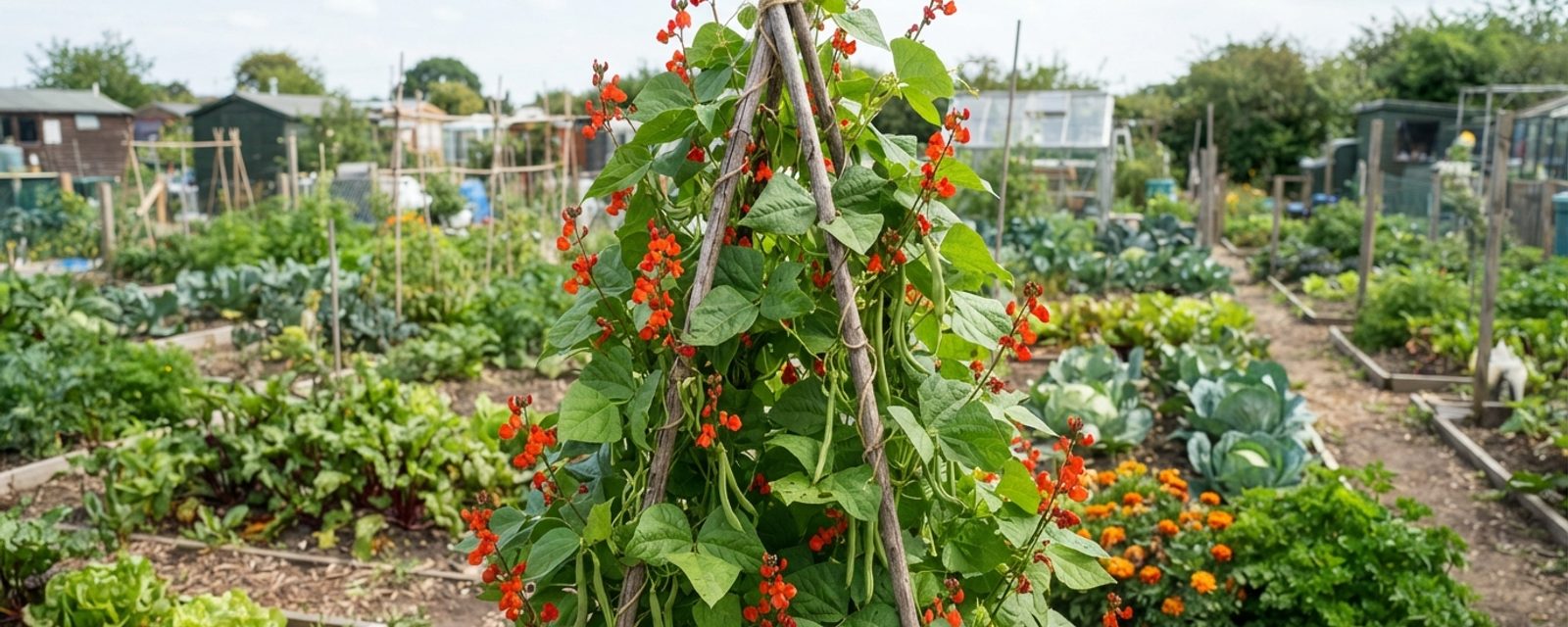
A vegetable bed only has so much ground. It doesn't have a ceiling. Every runner bean, pea, and cucumber trained upward frees the soil beneath it for something else, and the plant itself gets more light, more airflow, and a cleaner ride to harvest. That's the whole appeal of vertical growing in one sentence: it turns a two-dimensional plot into a three-dimensional one.
But height cuts both ways. A row of French beans on canes barely notices a stiff breeze, netting and foliage let most of the wind straight through. A 2m obelisk wrapped in sweet peas, or a solid trellis panel standing alone in open ground, behaves more like a sail. The taller and more solid a structure is, the more wind force it has to resist. As the guide to allotment layout and orientation covers, a lot of Scottish allotment and garden sites sit open to hillside, coastal, or farmland exposure in a way a plot tucked into a sheltered suburban street rarely does, so on that kind of ground, wind resistance is what decides whether a structure survives its first real gale rather than just its first summer.
Which crops actually benefit from going vertical
Not every crop that can climb should be made to. Height is worth building for when it solves a real problem: not enough ground space, fruit that needs to hang clean, or a plant that's structurally incapable of standing on its own.
| Crop | Needs vertical support? | Typical trained height | Why |
|---|---|---|---|
| Runner beans / climbing French beans | Yes, always | Up to 2.5m | Climb by nature, can't be grown any other way |
| Dwarf French beans | No | Under 45cm | Self-supporting; at most a few short twiggy sticks |
| Tall/maincropThe main, usually latest-sown and longest-growing type of a crop, grown for bulk and storage rather than an early harvest. Full definition → peas | Yes, especially in windy spots | Up to 1.8m | Become top-heavy without support |
| Dwarf/early peas | No | Low-growing | Lightweight pea sticks are enough |
| Cucumbers | Optional, but worth it | Tall cane height | Cleaner fruit, smaller footprint |
| CordonA fruit tree or bush trained as a single main stem with short fruiting side-spurs, usually grown at an angle against a wall, fence or wire. Full definition → tomatoes | Yes | Tall, vigorous | Can't stand upright unsupported; need tying in |
| Bush tomatoes | No | Low, bushy | Bred to be self-supporting |
| Compact/smaller-fruited squash | Optional, genuinely beneficial | Trained up a support | Saves space, avoids a one-sided scar from lying on wet soil |
| Large-fruited pumpkins | No, grow flat instead | Ground-trailing | RHS suggests sprawling on the ground where space allows |
| Cordon/espalierA fruit tree trained flat against a wall or wire framework with horizontal tiers of branches, most often apples and pears. Full definition →/stepover fruit trees | Yes (by definition of the form) | Varies by form | Fits several fruit trees into a fraction of the space a free-standing tree needs |
Runner beans and climbing French beans are the clearest case, they climb by nature and need tall supports in place before sowing or planting. Dwarf French bean varieties, by contrast, need no support at all.
Peas split the same way: tall and maincrop varieties become top-heavy and need sturdy, tall netting or posts, particularly in windy spots, RHS is explicit that this matters more "in windy locations," a condition an exposed Scottish plot meets more often than a sheltered one does, while dwarf and early varieties get by with lightweight pea sticks.
Cucumbers reward training with cleaner fruit and a smaller footprint, which matters in a compact garden or a greenhouse. Cordon (single-stemmed) tomatoes are vigorous, fast-growing plants that get very tall and need a tall, sturdy cane or a vertical string anchored in the soil, and unlike a pea or bean they don't cling on their own, so have to be tied in by hand. Bush tomato varieties don't need any of this.
Squash and pumpkins are the crop where "vertical" is a genuine choice rather than a given. Compact and smaller-fruited trailing varieties do well trained upward, as long as the developing fruit is supported, often in a sling made from netting or hessian. Where there's plenty of ground to spare, RHS notes trailing types can equally be left to sprawl over the soil instead, the largest, heaviest-fruited varieties are the ones where that's the more practical option, since a vertical support carrying that much weight is a bigger build than a wigwam or A-frame.
Trained fruit forms belong in this conversation too, even though they're rarely thought of as "vertical growing." A cordon is a single stem grown at an angle, carrying short fruiting side-shoots; an espalier trains branches out flat in horizontal tiers; a stepover is the same idea kept to knee height, low enough to step over. All three let you fit fruit trees into a fraction of the space a free-standing tree needs, at the cost of pruning mainly in late summer to hold the shape rather than the winter pruning a free-standing tree gets. Full detail on each form, plus the related fan shape used for wall-trained stone fruit, is in the apple growing guide and the guide to fan-training fruit trees.
Build detail for each vegetable above, exact cane spacing, tying method, and when to put supports in, is in that crop's own growing guide: runner beans, French beans, peas, cucumbers, tomatoes, and squash.
Choosing a structure: cost, durability, and wind stability
The right structure depends on what's being grown, how exposed the site is, and how long the structure needs to last. The table below compares the main options on the three things that actually matter when deciding what to build.
| Structure | Typical cost | Durability | Wind stability on an exposed plot |
|---|---|---|---|
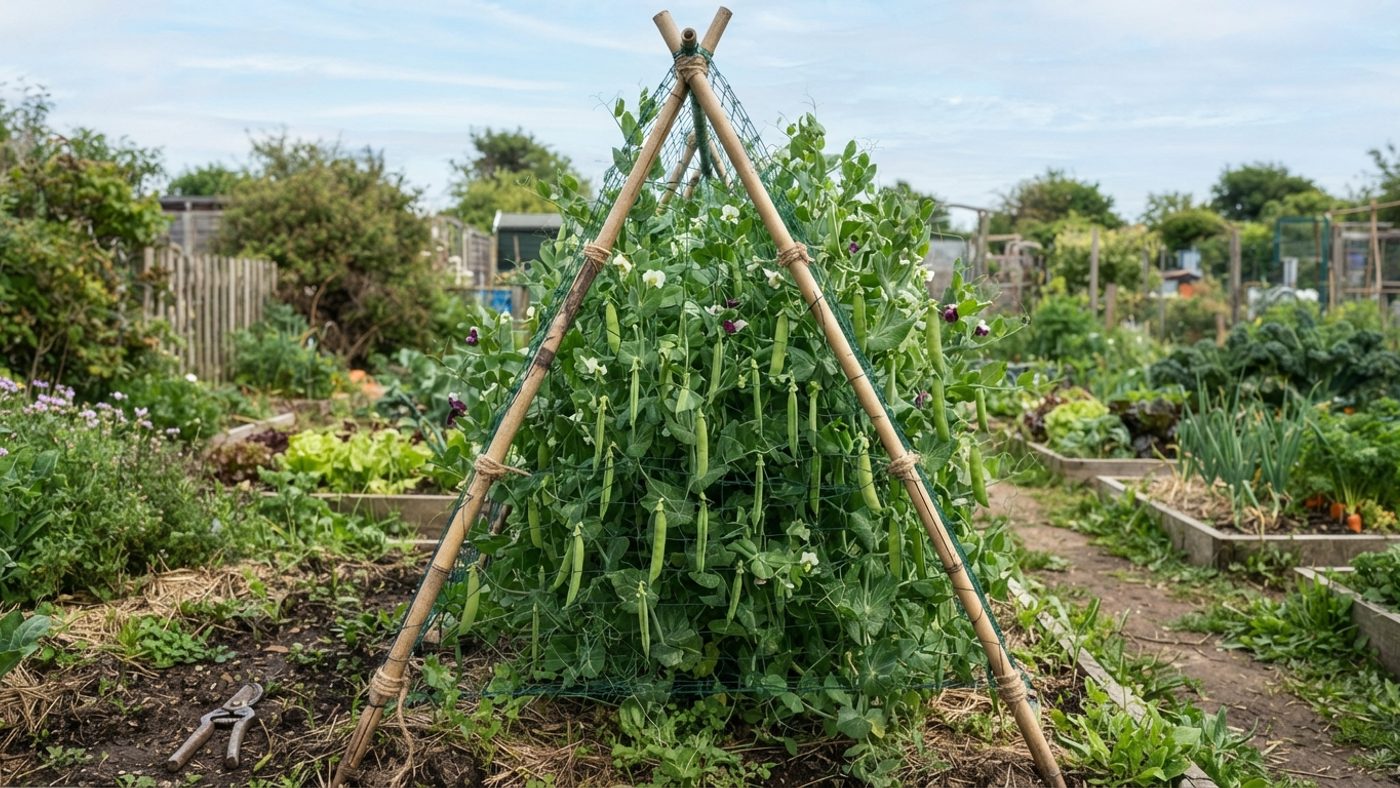
| Cane wigwam/teepee | Low | Reusable for years if stored dry | Good: low profile, tie point at the top distributes load across all the canes |
| Cane double-row A-frame | Low | Reusable for years if stored dry | Good: sloped, tied near the top; the X-frame variant is easier to harvest from but can be less stable |
| Netting on posts | Low | Reusable netting, posts may need replacing | Best of the low-cost options, netting sheds rather than catches wind; RHS recommends this for tall peas "especially in windy locations" |
| Repurposed rabbit-run panel A-frame | Free/low (upcycled) | Durable, holds heavy fruit weight well | Good: low profile keeps wind exposure well below a tall obelisk |
| Trellis panel against a wall or fence | Moderate | Long-lived if bottom edge kept 30cm off soil | Good: the wall or fence takes most of the wind load; not freestanding |
| Freestanding trellis/wire screen (post-mounted) | Moderate | Long-lived if properly anchored | Poor unless braced: RHS restricts this design to "sheltered sites only" |
| Obelisk or pergola | Moderate/high | Durable, often permanent | Depends entirely on anchoring: small obelisks can be pushed into soil, larger ones need concrete footings |
Two material-choice points are worth weighing alongside the table above. Bamboo canes and jute netting are the cheapest materials here, and also the most weather-dependent: left outdoors over a wet Scottish winter rather than brought in and dried, they're likely to rot and split faster than the same materials stored under cover. On a coastal plot, a plain steel obelisk or wire support is worth a spring check for rust spots and a repaint or rust-inhibiting treatment where it's started, since salt air tends to corrode bare metal faster than an inland garden's air does; galvanised or powder-coated metalwork needs less of that upkeep. And on wetter, heavier soil generally, an untreated timber post set directly in the ground rots at the waterline years before a pressure-treated one does, worth the extra cost on anything meant to stay up for more than a season or two.
Anchoring tall freestanding structures against wind
This is a different question from siting a windbreak. Windbreak theory is about filtering wind before it reaches your crops across the whole plot, that's covered separately in the guide to allotment layout and orientation. What follows here is about a single structure staying upright and square: an obelisk, arch, wigwam, or trellis panel resisting the load the wind puts directly on it.
RHS guidance on freestanding trellis and wire screens is blunt about the risk: this design is recommended for "sheltered sites only." The same logic scales up: RHS notes that small obelisks can simply be pushed into the soil, but larger structures may need anchorage into concrete footings.
No source gives a specific height at which a freestanding structure crosses from push-it-into-the-soil to concrete-footings-needed. On an exposed plot, the sensible response to that gap is to build to the sturdier end of the options rather than the cheaper one: mutually braced structures (a wigwam or A-frame, where several canes tie together and hold each other up) cope with wind better than a single post or an unbraced panel of the same height, which has nothing bracing it but the ground it's set into.
Wind isn't the only load worth planning for. A netting-covered structure, in particular, can hold a surprising weight of wet snow across a hard winter, and the sagging that results puts a different kind of strain on posts and ties than a summer gale does. Taking netting down once the growing season is over, rather than leaving it up empty over winter, avoids that load altogether on any structure that doesn't need to stand all year.
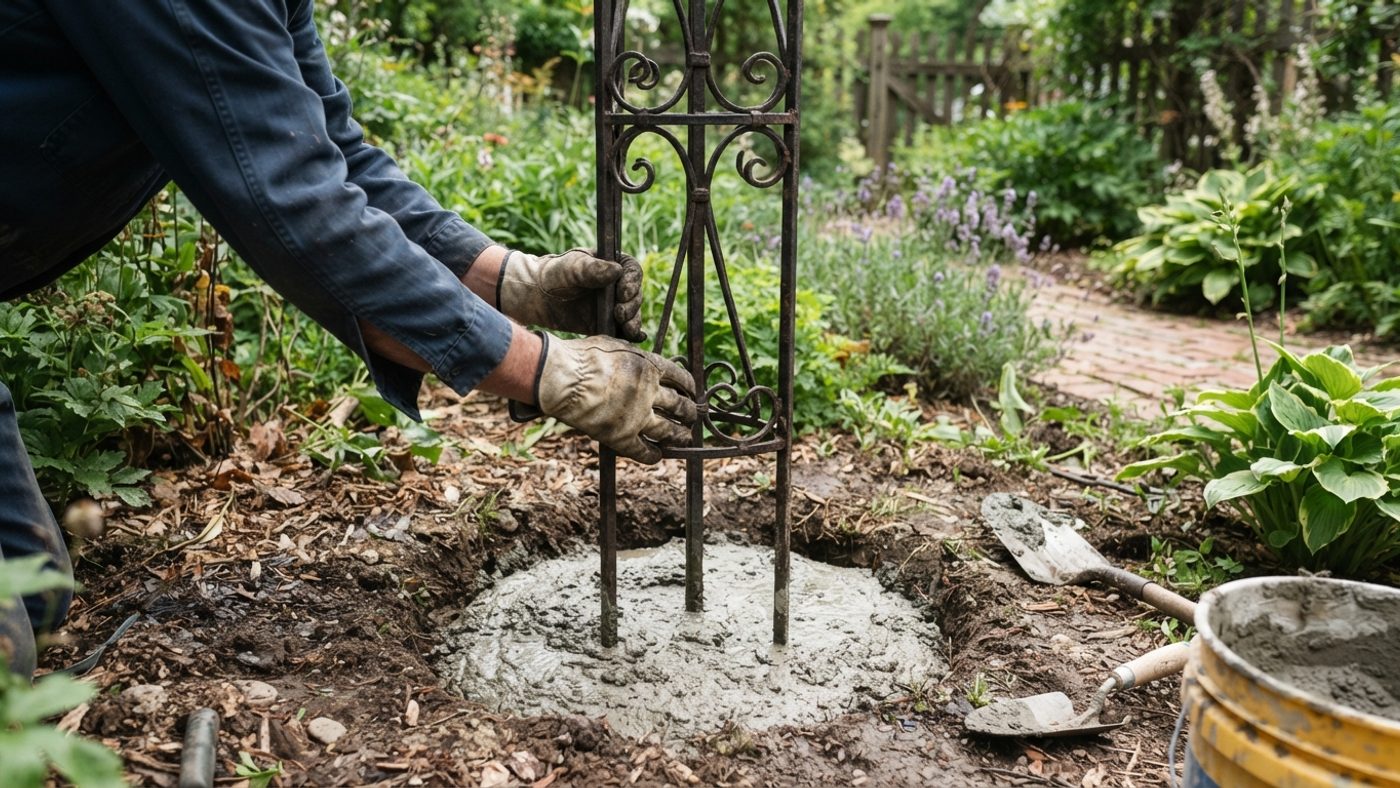
Where a concrete footing is the right call, a fence post facing the same physical problem, a tall post resisting sideways force, is normally buried to roughly a third of its total above-ground height, with extra depth again on an exposed site; the concrete itself is a standard postmix bag mixed and poured around the base, left to cure before the post takes any load. Treat that as a starting point to work from rather than an exact figure for every site.
The practical takeaway for a wigwam, A-frame, or obelisk on an open Scottish allotment: use the crop's own cane depth (see that crop's own guide for the exact figure), tie multiple canes together near the top so they brace each other rather than standing alone, and for any single-post or solid panel-style structure, set it in a concrete footing rather than relying on soil alone.
Timing matters as much as the anchoring method. Get supports up and firm before the crop needs them, at planting time in spring or early summer, since a support going in loose and being firmed up later after a plant is already climbing it is far harder than doing it properly from the start. The bigger risk to a freestanding structure, though, usually comes after the growing season: autumn and winter gales are what topple a wigwam or obelisk that coped fine all summer, so check anchoring is still solid going into autumn, not just when the structure first goes up. Structures also don't have to survive the whole winter standing. A wigwam or obelisk that's done its job by autumn can be dismantled and the canes stored dry, which sidesteps the worst of the winter gales entirely rather than betting on the anchoring holding through them; a permanent pergola or wall-fixed trellis doesn't have that option and is where solid anchoring matters most.
Where vertical growing falls short
Vertical growing isn't a universal upgrade. RHS's own trials found that pots and supports fixed high on a wall are more exposed to wind and dry out faster than at ground level, and in one trial runner beans grown against a hot wall gave a "small, rather tough" crop, with climbing French beans and nasturtiums also listed among that trial's disappointing performers in the same position. Height that helps in one respect, clearing ground space, catching more light, can work against a crop if it also means more wind exposure or a drier root run. The right response on an exposed plot is usually to choose the sturdier, lower-profile structures covered above (wigwams, A-frames, netting on posts) over tall wall-mounted or freestanding options, unless the site is genuinely sheltered.
Common questions
Do I need a windbreak as well as a sturdy trellis on a windy allotment?
They solve different problems. A windbreak filters wind across the whole plot before it reaches your crops; a well-anchored structure keeps one obelisk, arch, or trellis panel from blowing over regardless of what shelter exists elsewhere. General siting and windbreak theory for a whole plot is covered in the allotment layout planning guide. On an exposed site, the sturdiest approach is to do both: site the plot with some general shelter, and anchor tall structures properly regardless.
How deep should I push canes into the soil for a windy site?
RHS’s general figures vary by crop and cane height, the exact depth for each crop is in that crop’s own growing guide. What matters more on an exposed plot than depth alone is tying multiple canes together near the top, as in a wigwam or A-frame, so they brace each other rather than each standing alone.
Are freestanding trellis screens a bad idea in Scotland?
Not on a sheltered plot, which is exactly what RHS scopes the design to. It’s the open, exposed kind of Scottish site this article is mostly aimed at where a freestanding screen struggles: fixing the same trellis to a wall or fence instead removes the wind problem entirely, since the structure it’s attached to takes the load rather than the panel itself.
Which vegetables don’t need vertical support at all?
Dwarf French beans, dwarf and early pea varieties, bush tomatoes, and large-fruited pumpkin varieties are all normally grown without tall supports. RHS notes trailing pumpkin and squash types can simply be left to sprawl over the ground where there’s space for it, usually the simpler option for the largest, heaviest-fruited varieties rather than building a support big enough to carry them.
Do I need concrete footings for a garden obelisk?
Size and load are the real questions, not a fixed rule. A small, light obelisk holding an annual sweet pea can usually just be pushed into the soil; something taller carrying a mature clematis or grape vine, effectively a permanent, heavy structure, is a better candidate for footing it properly, especially on ground that catches the wind.
Sources
11 sources, recorded with what each was used for
- RHS: Vertical veg: General case for vertical growing, space/light/harvest benefits, crop list, cane specifications
- RHS: Making creative and sustainable veg supports: A-frame/teepee construction detail, rabbit-run panel A-frames, fruit slings
- RHS: Vertical vegetable gardening (veg on walls): Wall-mounted trellis wind/drying exposure, runner bean wall-trial underperformance
- RHS: Climbers, Training and Pruning: Freestanding screen caution, obelisk footing guidance
- RHS: Runner beans, Grow Your Own: A-frame/X-frame structure comparison
- RHS: French beans, Grow Your Own: Dwarf versus climbing variety support needs
- RHS: Peas, Grow Your Own: Tall versus dwarf pea variety support needs, windy-location netting recommendation
- RHS: Cucumbers, Grow Your Own: Cane requirements for climbing cucumbers
- RHS: Tomatoes, Grow Your Own: Cordon tomato support needs versus bush varieties
- RHS: Squash, Grow Your Own: Large pumpkin ground-growing recommendation
- RHS: Apples and pears, starting a cordon: Cordon fruit space-saving rationale