
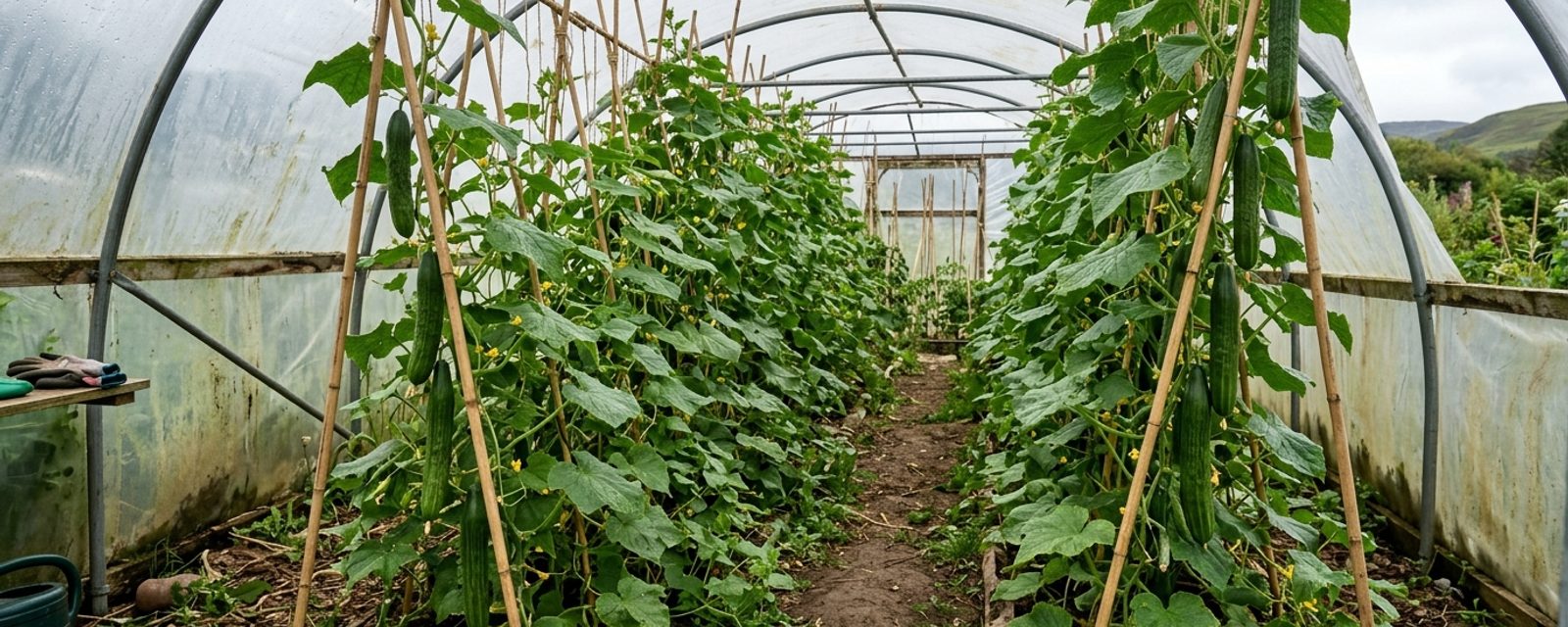
Cucumis sativus
Cucumbers are a genuinely two-sided crop: greenhouse and outdoor types need opposite treatment at flowering, and a polytunnel is often what separates a marginal harvest from a reliable one.
Cucumbers reward a bit of cover more than almost any other vegetable. Grown right, under glass or in a polytunnel, they're one of the most productive plants you can put in a small space. Grown outdoors in the open, they're a genuine gamble on the weather.
Choosing a type
Greenhouse (indoor) varieties are grown under glass, in a polytunnel or in a coldframe, and crop from mid-summer into early autumn; almost all are F1The first-generation offspring of two specific, deliberately chosen parent plants, bred for a predictable, uniform result but not worth saving seed from. Full definition → hybrids bred to produce nearly all-female flowers. Outdoor (ridge) varieties suit a sunny, sheltered spot, tolerate cooler conditions, and have a shorter, more weather-dependent season. Mini and gherkin types are smaller-fruited versions of either. The type you choose decides your sowing calendar, your spacing, and, critically, what you do at flowering time.
Preparing the ground
Dig in two bucketfuls of garden compost or well-rotted manure a few weeks before planting, or mulchA layer of material spread over the soil around plants to suppress weeds, retain moisture, and improve soil structure as it breaks down. Full definition → the surface for a no-digA growing method that avoids turning the soil over, building fertility instead by adding organic matter on the surface. Full definition → bed, spacing growing sites about 30cm apart as a starting point. Outdoor ridge cucumbers do better on a mounded ridge, which helps shed excess water and avoids the waterlogging that root rot needs. In containers, use a pot at least 30cm wide and deep, or a standard growing bag with two plants.
Sowing
Buying a graftedJoining a chosen fruiting variety onto a separate rootstock, so the tree grows the fruit of one plant on the roots of another. Full definition → plant instead of sowing from seed is a real option worth weighing, see Grafted Vegetable Plants in Scotland → for what grafting actually buys a grower here and when it's worth the extra cost.
Sow indoors: mid-February to mid-March in a heated greenhouse, or April in an unheated greenhouse, polytunnel or coldframe. Sow one seed on its side, 1-2cm deep, in a 10cm pot at around 20-21°C. GerminationA seed sprouting: breaking dormancy and putting out its first root and shoot, given the right warmth and moisture. Full definition → takes a week or two; keep seedlings warm, well lit and watered, and move them to their final position after about a month, once growing strongly.
Outdoor varieties can also be sown direct, late May or early June, three seeds to a station, thinned to the strongest seedling, and covered with clochesA small, portable clear cover placed over an individual plant or short row to trap warmth and keep off wind, rain and pests. Full definition → or fleeceA lightweight, breathable fabric laid or draped over plants to trap a little warmth and keep off frost, wind and some flying pests. Full definition →.
Planting out
Move greenhouse cucumbers to their final position from late May (late March if the greenhouse is heated). Plant outdoor cucumbers from early June, once local temperatures are reliably above 12°C: this threshold is a genuinely harder bar to clear reliably in Scotland than milder parts of the UK, so treat early June as the earliest realistic date rather than the target, and lean on a polytunnel or unheated greenhouse wherever one is available rather than fully open ground.
Space ground-planted cucumbers according to how you're growing them: about 60cm apart for a greenhouse plant trained up a support, 45cm for a trained outdoor plant, and 90cm, or roughly 2.5 square metres per plant, if you're letting an outdoor plant sprawl rather than training it. Water well before and after planting, firm gently, and watch for slugs straight away.
Supports
Growing vertically keeps fruit clean and saves ground space. In a greenhouse, train the main stem up a tall bamboo cane or vertical wire/string reaching the roof. Outdoors, use a wigwam of canes, netting on upright stakes, or a trellis against a wall or fence. If you'd rather let a plant trail on the ground, lay a weed-suppressing membraneA permeable fabric laid over soil to block weeds while still letting water and air through, often planted through with holes cut for each plant. Full definition → underneath first to keep the fruit clean and stop it rotting where it touches wet soil.
Growing Up on an Exposed Scottish Plot → covers which structures actually hold up in wind, and how to anchor a tall support properly.
Varieties
All three varieties below carry the RHS Award of Garden Merit, a UK-wide award rather than a Scottish one.
RHS also lists 'Emilie', 'Mini Munch' and 'Delistar' with AGMThe RHS's Award of Garden Merit: a UK-wide trials award for reliable performance, not a Scotland-specific recommendation. Full definition →, none carrying a Scotland-relevant trait beyond the three picks below. Gardener's World separately names F1 Bella for unheated-greenhouse tolerance and powdery mildew resistance, a genuinely useful trait, though without RHS AGM confirmation.
★ Our pick for Scotland
CarmenAGM
Greenhouse, long straight fruit, good disease resistance
The disease-resistant greenhouse pick.
Why this one: Named specifically for disease resistance, which matters more under cover in Scotland than in a drier climate: greenhouses and polytunnels here run more humid for longer through a cool, wet summer, exactly the conditions that favour powdery mildew and the other diseases this variety resists.
Also worth considering
MarketmoreAGM
Outdoor/ridge, medium fruit, dark green
RHS's outdoor AGM pick, and independently named by both Gardener's World and Teagasc, an unusually well-corroborated choice for anyone growing outdoors rather than under cover.
LiliAGM
Greenhouse/outdoor, predominantly female flowers, reliable crop of large fruit
The one RHS AGM variety named for both growing methods, a genuine edge here since the 12C outdoor-planting threshold is unreliable enough that hedging between a polytunnel and open ground with the same seed is a real, practical option. Predominantly female flowers also means less male-flower-spotting to worry about.
Best Cucumber Varieties for Scotland → compares all named cucumber varieties head-to-head, with the practical detail that doesn't fit in a summary card.
Care
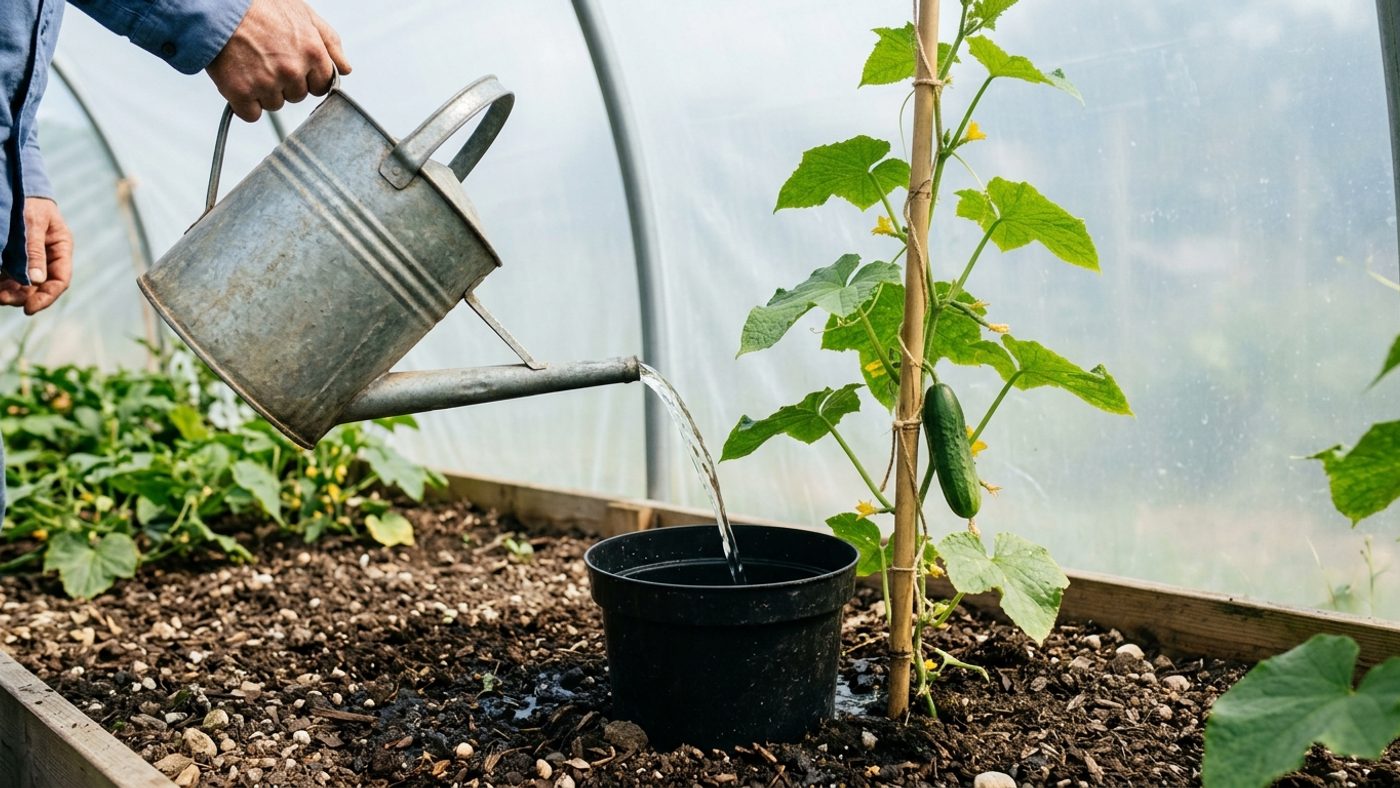
Keep the soil or compost evenly moist; greenhouse and container plants may need watering daily in hot spells. Water at the base rather than over the leaves, ideally in the morning with rainwater, to avoid fungal disease. A trick worth using: sink an empty plant pot into the ground beside each plant and water into that, so moisture reaches the roots directly. Mulch around the base with compost or well-rotted manure, leaving a gap right at the stem to avoid rot. Ground-planted cucumbers rarely need feeding unless the soil is poor; container plants do best fed every 10-14 days with a general liquid fertiliser, switching to a high-potash feed such as tomato food once flowering starts.
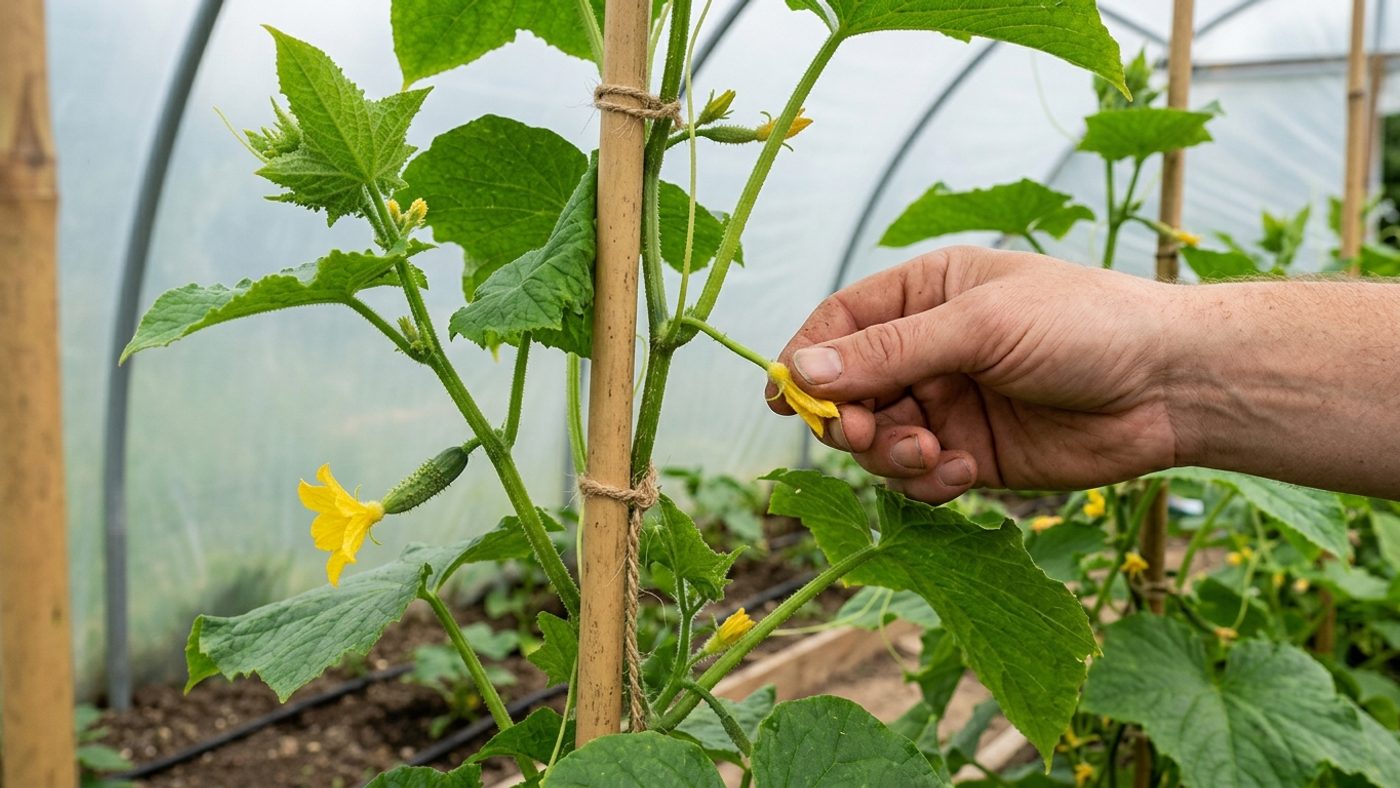
Pinching outRemoving the soft growing tip of a stem to stop upward growth and make the plant branch out sideways instead. Full definition →: on greenhouse plants, pinch out the growing point once it reaches the roof, pinch side-shoot tips two leaves beyond a female flower, and pinch flowerless side-shoots once they reach 60cm. On outdoor plants, pinch the growing tip once the plant has seven leaves, and pinch flowerless side-shoot tips at the same stage.
In a greenhouse, raise humidity in hot weather by pouring a full watering can over the floor or path, keep the temperature between 18-25°C where you can, and use shading to stop it overheating.
Harvesting
Ripens from mid-summer to mid-autumn under cover, about 12 weeks after sowing, with a shorter outdoor season depending on the weather and usually finishing by September. Mini cucumbers are ready at about 8cm long, small-fruited varieties around 15cm, and full-sized types at 20-25cm. Cut the stem cleanly with a sharp knife or secateurs rather than pulling, once fruit is uniformly green and firm with a slightly rounded tip. Check every few days, since fruit grows fast: left too long, cucumbers turn yellowish, bulbous and soft, and regular picking is what keeps the plant producing more.
Cucumbers are best eaten fresh, but will keep for a few days in the fridge.
Common problems
- Slugs and snails damage seedlings, particularly in damp weather.
- Powdery mildew shows as a white, dusty coating on leaves and is worse in low humidity; mildew-resistant varieties are available.
- Glasshouse whitefly feeds on sap and excretes sticky honeydew that leads to sooty mould.
See more problems
- Red spider mite causes mottled leaves and is a particular problem in greenhouses with low humidity.
- Cucumber mosaic virus is one of the most common plant viruses; affected plants should be destroyed rather than treated.
- Root rot takes hold in waterlogged soil; a mounded ridge or free-drainingSoil that lets water pass through quickly rather than pooling, so roots aren't sitting in wet ground after rain. Full definition → site for outdoor plants helps avoid it.
Common questions
Should I remove the male flowers from my cucumber plant?
Depends on the type: remove any male flowers on a greenhouse/all-female variety, since pollination makes the fruit bitter, but leave every flower alone on an outdoor variety, which needs insect pollination to fruit at all. Full sourced breakdown: <a href='/tools/garden-myths/cucumbers/'>Cucumber Myths →</a>
Why is my cucumber bitter and full of seeds?
Almost always a greenhouse all-female variety that's been pollinated: check for and remove any male flowers straight away, since on this type pollination is what causes the bitterness. Full sourced breakdown: <a href='/tools/garden-myths/cucumbers/'>Cucumber Myths →</a>
Can I grow cucumbers outdoors in Scotland without any cover?
You can, but the 12C threshold for planting out safely is a genuinely harder bar to clear reliably here than milder parts of the UK. A polytunnel or unheated greenhouse turns this from a marginal crop into a reliable one.
Is cucumber spacing the same whether I train it up a support or let it sprawl?
No: a trained plant under cover needs about 60cm, a trained outdoor plant about 45cm, but a sprawling outdoor plant needs roughly 90cm or more, closer to 2.5 square metres per plant. Full sourced breakdown: <a href='/tools/garden-myths/cucumbers/'>Cucumber Myths →</a>
Sources
3 sources, and what each was used for
- RHS: greenhouse vs outdoor/ridge distinction, soil prep, sowing method and temperature, transplant timing and the 12C outdoor threshold, spacing, supports, watering, mulching, feeding, pinching out for both types, the critical male-flower-removal-vs-pollination distinction between greenhouse and outdoor types, harvesting method and fruit-size guide, six named AGM varieties, powdery mildew, red spider mite, cucumber mosaic virus, whitefly, slug risk
- gardenersworld.com: independently corroborates the greenhouse/outdoor sowing calendar and the male-flower-removal rule; gives spacing broken down by growing method (60cm greenhouse, 45cm outdoor trained, 90cm outdoor sprawling) that RHS states only as a single 30cm figure; supplies a harvest-timing figure in weeks (about 12) that RHS doesn't give; independently names Marketmore
- Teagasc: independently corroborates sowing timing, germination temperature and the pollination distinction between glasshouse all-female and outdoor ridge types; gives outdoor ridge spacing as an area figure (2.5 square metres per plant) rather than linear spacing; adds ridging as a specific outdoor soil-prep step against waterlogging, and precise indoor pruning detail (leaving the first 100cm of stem bare, side branches stopped 30cm from the ground)