
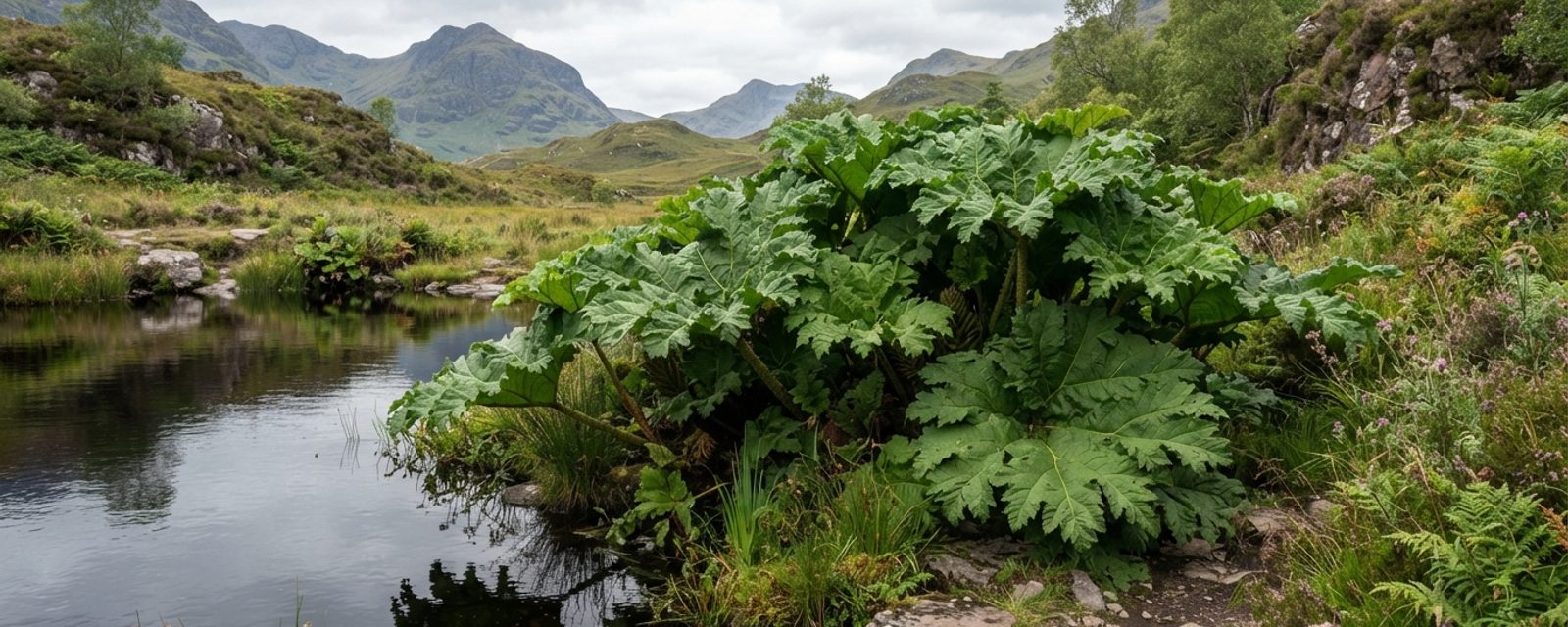
A single Gunnera tinctoria plant can produce hundreds of thousands of tiny seeds in a season, and any piece of its rhizome (the plant's thick underground stem) left in damp ground can root and grow into a new plant. That combination, prolific seed set plus regeneration from fragments, is what turned a Victorian ornamental introduction into one of the plants restricted by law across Great Britain, Scotland included. On the west coast, where mild, wet conditions closely match its native Chilean range, it forms dense stands up to 2.5m tall that shade out everything beneath them, including the low native vegetation that binds coastal and streamside ground together.
Two things get mixed up constantly with this plant: whether it's related to the rhubarb in your vegetable patch, and which of the large ornamental Gunnera species is actually restricted. The restriction itself is GB-wide, not a Scotland-only rule, but as the penalties below show, Scotland's own courts can go further than England and Wales when it's enforced.
First: this is not your vegetable patch
Despite the name, Gunnera tinctoria has nothing to do with edible rhubarb (Rheum rhabarbarum), the plant you grow for crumbles and compote. They're not related, Gunnera is a genus in its own family (Gunneraceae), while culinary rhubarb belongs to the knotweed family (Polygonaceae). The "giant rhubarb" nickname refers only to the huge, deeply lobed leaves that look rhubarb-like at a distance. If you grow rhubarb for eating, none of what follows applies to your crop.
Second, and more important: which Gunnera do you actually have?
There are two large ornamental Gunnera species commonly grown in UK gardens, and they have different legal status:
| Feature | Gunnera tinctoria (Chilean rhubarb) | Gunnera manicata (Brazilian giant-rhubarb) |
|---|---|---|
| Native range | Chile | Brazil |
| Legal status in Great Britain | Listed on Schedule 9, Part 2 of the Wildlife and Countryside Act 1981 (as amended) | Not listed on Schedule 9 |
| Leaf shape | Rounder, more deeply and sharply toothed lobes | Larger, more rounded lobes, less serrated |
| Flower spike | Shorter, denser, more conical | Taller, more tapering |
| Typical UK garden status | Restricted, illegal to plant or cause to grow in the wild, banned from sale | Widely grown ornamental for large ponds and bog gardens |
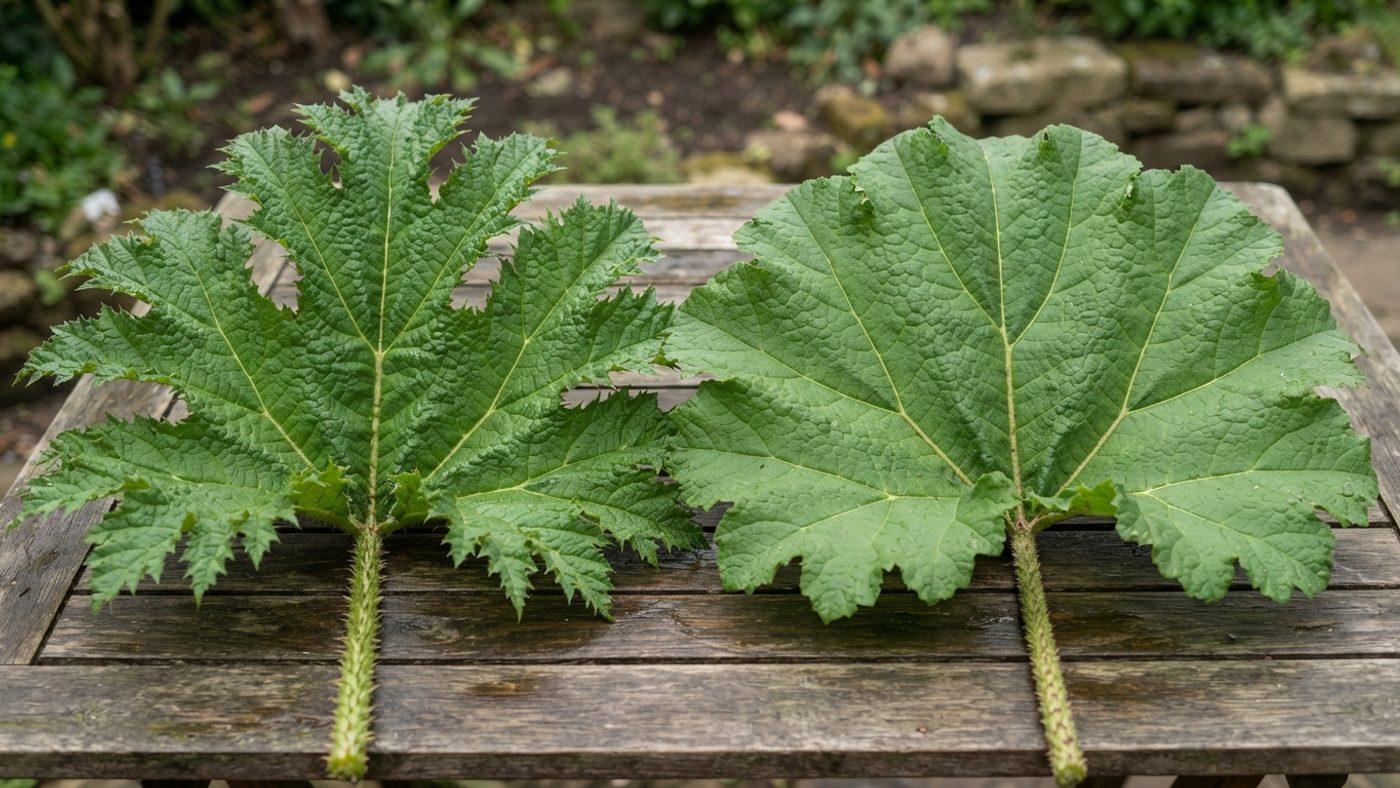
The identification differences between the two species, and between either and garden hybrids, can be genuinely subtle in a mature plant. If you're not certain which one is growing in your garden, treat anything already established near a watercourse, ditch, or boundary with wild ground with the same caution as the restricted species until you get a firm identification, a local ranger service or invasive species group can help.
What the law actually says
Gunnera tinctoria is listed as "Rhubarb, Giant" under Part 2 of Schedule 9 to the Wildlife and Countryside Act 1981. This entry was added to Schedule 9 by the Invasive Alien Species (Enforcement and Permitting) Order 2019, with effect from 1 December 2019.
Section 14(2) of the 1981 Act sets out the offence for any Schedule 9, Part 2 plant: "Subject to the provisions of this Part, if any person plants or otherwise causes to grow in the wild any plant which is included in Part II of Schedule 9, he shall be guilty of an offence."
In practice that means it is an offence to plant Gunnera tinctoria in the wild, or to cause it to grow there, which covers allowing garden waste, cut rhizome, or seed-bearing material to spread into a watercourse, hedge bank, or any other wild ground. It does not, on the current statutory text, make it an offence simply to keep an existing plant in a garden. It is also banned from sale in the UK, and gardeners who already have it are expected to take steps to control it.
Section 21 of the Act sets the penalty for a section 14 offence. A conviction at the lower level (in a Sheriff Court under summary procedure) carries a heavier maximum in Scotland than in England and Wales; a conviction at the higher level (on indictment) is the same across Great Britain:
| Conviction type | Scotland | England and Wales |
|---|---|---|
| Summary (lower court) | Up to 12 months’ imprisonment, or a fine up to £40,000, or both | Up to 6 months’ imprisonment, or a fine up to the statutory maximum, or both |
| Indictment (higher court) | Up to 2 years’ imprisonment, or an unlimited fine, or both | Up to 2 years’ imprisonment, or an unlimited fine, or both |
Scottish nature-agency guidance sums up the general legal duty on any landowner this way: "By law, you must ensure that any non-native plants growing on your land don't spread into the wild. This includes natural spread, e.g. by seed dispersal, and spread caused by the dumping of plant material or contaminated soil." That's guidance explaining the duty, not the statute itself, the section 14(2) wording quoted above is the actual legal text.
Gunnera manicata does not appear on Schedule 9, is not banned from sale, and is not subject to this restriction.
Absence from Schedule 9 isn't unique to Gunnera manicata, either. Russian Vine: The "Mile-a-Minute" Climber That Isn't Legally Notifiable → goes through another fast-growing garden plant with the same legal gap, and why that isn't the same thing as harmless.
How it actually gets into the wild
Both spread mechanisms have specific vectors worth knowing if you're trying to stop them: seed travels in water, in mud carried on machinery or footwear, and via birds; rhizome fragments travel through fly-tipped garden waste or when riverbank erosion carries broken pieces downstream. Either route is enough on its own to start a new colony some distance from the parent plant.
Once established, a stand shades the ground beneath its huge leaves so heavily that little native vegetation can persist under or around it. It's one of a number of non-native plants, alongside Japanese knotweed, giant hogweed, Himalayan balsam, and American skunk cabbage, flagged as having high potential to damage Scottish habitats, particularly on the coast and on islands, and giant rhubarb populations in the Western Isles specifically are named a control priority under current invasive-species restoration funding, alongside wider offshore-island eradication work.
Himalayan balsam spreads by an entirely different mechanism, explosive seed pods rather than regenerating rhizome fragments, and Scotland's version of the same section 14(2) offence covers it too, without needing a Schedule 9 listing the way England and Wales's does. See Himalayan Balsam: Identification, Removal and the Law in Scotland → for how to tell it apart and the detail of that broader Scottish duty.
If you already have Gunnera tinctoria
Keeping an established plant is not, on the current legal text, an offence in itself, the offence is planting it, or causing it to grow, in the wild, but you're still required by law to stop it spreading there.
Do not let it near water, ditches, or open ground. Its main routes into the wild are seed dispersal and rhizome fragments reaching a watercourse or waste ground, so cut off flower spikes as they appear in summer, before they set seed, and never compost or fly-tip any part of the plant.
If you want to remove it, dig out as much of the rhizome as possible, any fragment left in situ can regrow, and monitor the site for regrowth and seedlings for at least a season afterwards. For a large, established stand, a contractor holding a recognised invasive-weed-control qualification (a Certificate of Competence in pesticide use, or equivalent) can treat it more thoroughly than digging alone.
Herbicide near a watercourse has its own rule. A specific condition covering invasive non-native plants, Gunnera tinctoria named among them, permits treating a listed species within a metre of a watercourse or wetland without needing to apply to SEPA first, provided the applicator follows the conditions (avoiding application during rain, keeping pesticide out of the water itself).
If you're not sure whether you have G. tinctoria or G. manicata, get an identification before deciding what to do. The precautions above are worth following for either species if the plant sits near wild ground, but the legal obligation specifically attaches to G. tinctoria.
Safe disposal
Invasive plant material and any soil contaminated with it counts as controlled waste, meaning it can legally only be disposed of at an appropriately licensed landfill site, it should not go in a normal household green bin or be composted on site if there's any route from the compost heap to wild ground. If you're having a specialist contractor remove a large stand, they should be able to arrange controlled-waste disposal as part of the job.
Common questions
I spotted what looks like Gunnera tinctoria growing wild, not in anyone’s garden, what should I do?
Report it rather than trying to deal with it yourself, a local ranger service, invasive species group, or the relevant catchment or nature body can confirm the identification and decide whether it needs professional control. Wild-growing stands, especially near water, are exactly the kind of establishment the legal duty is aimed at preventing further spread from.
How do I tell Gunnera tinctoria and Gunnera manicata apart?
Gunnera tinctoria has rounder, more sharply toothed leaf lobes and a shorter, denser flower spike; Gunnera manicata has larger, more rounded, less serrated lobes and a taller, more tapering flower spike. If you’re not confident, get a specialist identification rather than guessing, since only G. tinctoria carries the legal restriction.
My Gunnera manicata has self-seeded a bit in my own garden, is that a problem?
Not a legal one, since Gunnera manicata isn’t subject to the same restriction, but keep an eye on any seedlings near a pond edge or boundary regardless of species, since a Gunnera stand of either kind can outcompete smaller planting nearby if left unchecked. If you’re not fully confident it’s manicata rather than tinctoria, that’s worth confirming, since only one of the two carries the legal duty.
Is this the same plant as culinary rhubarb?
No. Edible rhubarb (Rheum rhabarbarum) is an unrelated plant in a different family. The “giant rhubarb” name refers only to the resemblance of Gunnera’s huge leaves to rhubarb leaves.
Can I still buy Gunnera tinctoria from a nursery or garden centre?
No, it’s banned from sale in the UK, on top of the restriction on planting it in the wild. Gunnera manicata is not affected and remains widely available.
How should I dispose of Gunnera tinctoria if I remove it?
Treat all plant material and any contaminated soil as controlled waste and take it to an appropriately licensed landfill site, do not compost it or put it in a normal green waste bin, especially if there’s any risk of runoff reaching a watercourse.
Sources
9 sources, recorded with what each was used for
- Wildlife and Countryside Act 1981, Schedule 9: Confirms Gunnera tinctoria (“Rhubarb, Giant”) is listed under Part 2, added by amendment effective 1 December 2019
- Wildlife and Countryside Act 1981, Section 14: Exact wording of the section 14(2) offence for Schedule 9, Part 2 plants
- Wildlife and Countryside Act 1981, Section 21: Penalty provisions for a section 14 offence, including the Scotland-specific summary conviction figures compared with England and Wales
- The Invasive Alien Species (Enforcement and Permitting) Order 2019: The statutory instrument that added Gunnera tinctoria to Schedule 9 and amended the Wildlife and Countryside Act 1981
- RHS: Invasive non-native plants: Confirms Gunnera tinctoria’s inclusion on the UK regulated invasive plant list, general control/disposal advice, and use of a contractor with a Certificate of Competence for large infestations
- RHS: Gunnera tinctoria: Species-specific plant page: confirms the plant is banned from sale, that it should not be planted or caused to grow in the wild, its Schedule 9 listing, and that flower spikes appear in summer
- NatureScot: Invasive non-native plants: Scottish framing: lists giant rhubarb (Gunnera tinctoria) among plants with high invasive potential in Scotland, sets out the legal duty to prevent spread into the wild, and the controlled-waste disposal requirement
- NatureScot: Nature Restoration Fund (NRF) – Priorities for Action: Names giant rhubarb populations in the Western Isles as an invasive non-native species control priority for funding
- SEPA: The storage and application of pesticides (General Binding Rules): Confirms the invasive-non-native-plant condition permits treating a species named in it (Gunnera specifically) within a metre of a watercourse without prior SEPA authorisation, subject to conditions