
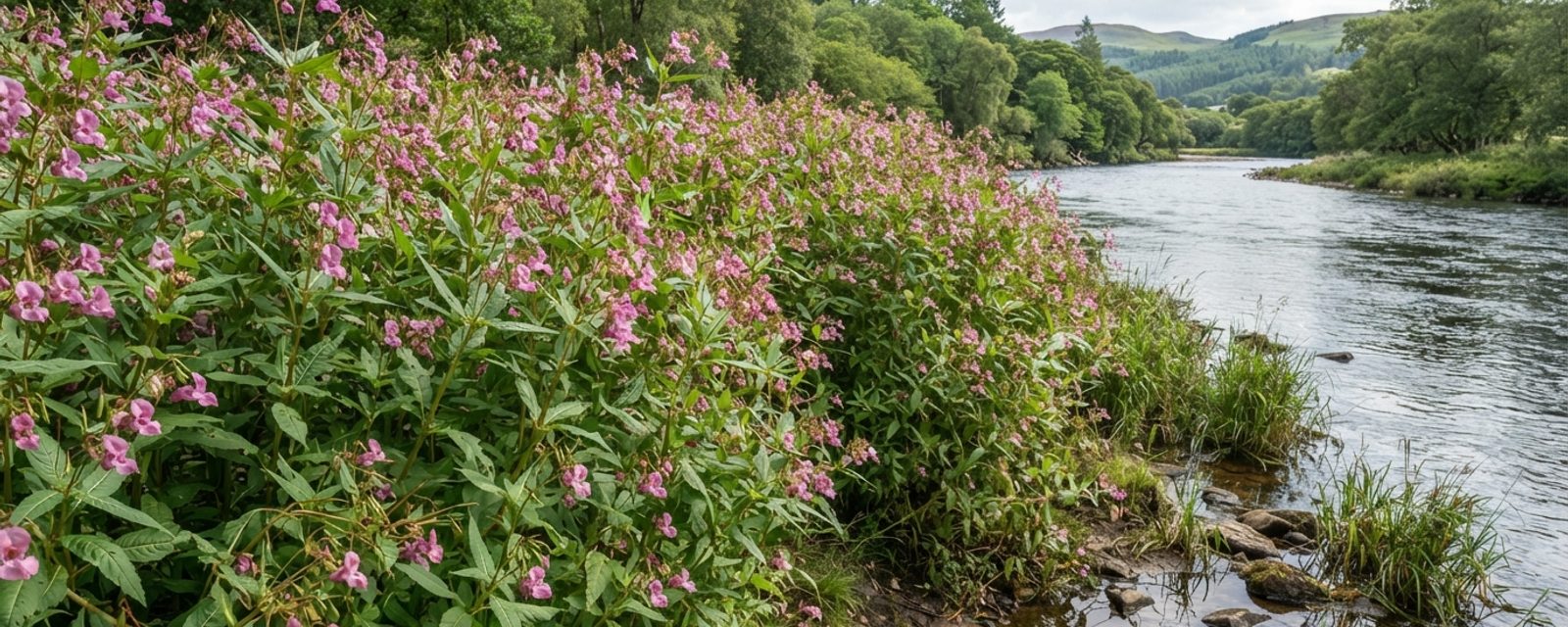
You notice it in July, usually. A stretch of bank behind the fence, along the burn at the bottom of the garden, that was brambles and nettles last summer is now a wall of pink, shoulder-high, flowers hanging like little pink helmets among the stems. It wasn't there two years ago. Now it's between you and the water.
That's the shape most people's first encounter with Himalayan balsam takes: not a plant bought and planted, but one that turned up on its own, from upstream, and is suddenly thick enough to wonder about. What follows is what it is, why it spreads the way it does, what you're allowed to do about it under Scots law, and how to actually clear it without making the problem worse.
Identifying Himalayan balsam
Himalayan balsam (Impatiens glandulifera) is a tall annual, reaching around 2 metres by late summer. It's most often confused with purple loosestrife and rosebay willowherb, two other tall, pink-to-purple bankside flowerers, but both differ in ways that separate them at a glance once you know what to check: purple loosestrife has narrow spikes of small star-shaped flowers rather than balsam's larger helmet-shaped blooms, and rosebay willowherb's flowers are a looser four-petalled shape on a tall spike, with none of balsam's hollow, reddish, brittle stem. The features that separate it from other tall bankside plants generally:
| Feature | Himalayan balsam |
|---|---|
| Flowers | Pink or purple (occasionally white), helmet- or bonnet-shaped, June to November |
| Stems | Hollow, often with a distinct reddish tint, brittle and easily snapped |
| Leaves | Lance-shaped, finely serrated edges, in whorls or opposite pairs |
| Height | Up to 2m by late summer |
| Roots | Shallow, rarely deeper than 15cm |
| Seed pods | Green, hang below the flowers, burst explosively on contact |
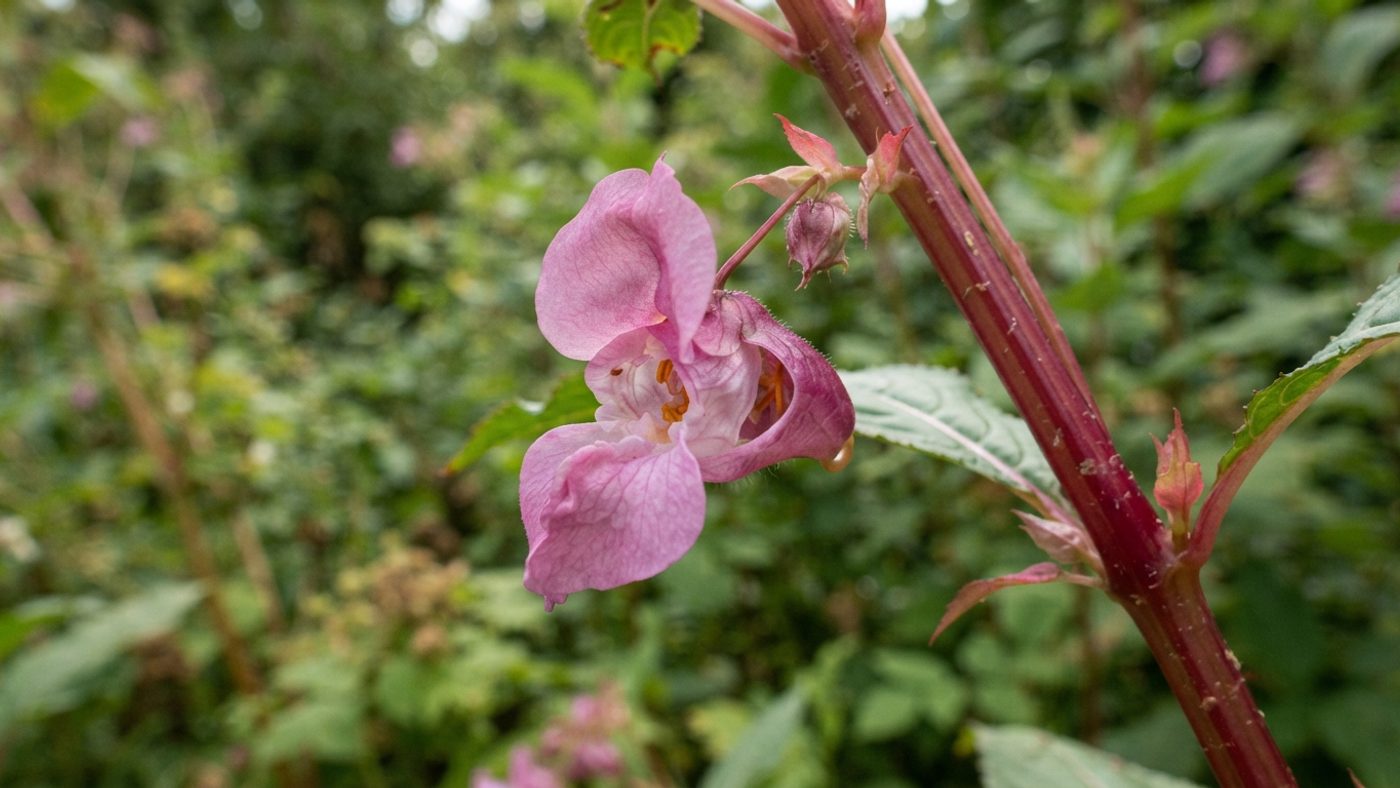
This is the wild riverbank species. Ordinary garden and container Busy Lizzies (Impatiens walleriana and its bedding-plant relatives) are a different species, don't self-seed into the wild the same way, and aren't what the law below is aimed at.
As the pods ripen they build up internal tension in the pod wall; the lightest touch, a brush of fur, a boot, a raindrop, triggers the wall to split and curl back on itself in a fraction of a second, flinging the seeds outward, some pods can launch seed as far as 7m. Near water, that explosive throw is only the start of the journey: seeds that land in or near the burn are carried downstream and redistributed along the bank, which is a large part of why the plant colonises watercourses so efficiently.
Ordinary gardening gloves are sensible when pulling a large patch, partly for grip and partly because a pod bursting at close range can flick seed and sap into your face, eye protection is worth adding if you're working through a dense, flowering stand rather than a handful of plants. Streamside ground is often uneven and can be soft or undercut right at the water's edge, so work with solid footing and don't lean out over the bank to reach a patch; it isn't worth the fall risk for a few extra plants.
Why it spreads the way it does
There's a paradox at the centre of this plant that's worth knowing before you start pulling: it is, root for root, one of the easier invasive plants to remove by hand. A shallow root system rarely reaching 15cm deep gives way easily, especially in damp streamside soil. It isn't a plant that snaps off at the base and regrows from a root fragment the way some perennial invasives do.
The problem is entirely about seed. A single plant can produce several thousand seeds in a season, each pod ready to launch on contact, and the seeds themselves stay viable in the soil for around two years. That combination, easy to pull but explosively prolific, means the plant rewards early action and punishes delay: a patch that's manageable in June becomes a much bigger job once the pods start splitting, because every disturbed plant is now firing its own seed bank into the ground and downstream.
Being an annual compounds the riverbank problem specifically. The whole plant dies back completely every winter, leaving bare ground exactly where perennial bank vegetation would otherwise still be holding the soil together through the winter months, a shallow-rooted annual stand does little to prevent the bank eroding once it's died back. Its flowers are also genuinely nectar-rich, popular enough with bees that beekeepers value it, but that doesn't outweigh the erosion risk and the crowding-out of native bank plants underneath it.
When and how to remove it
The best window is before flowering and well before seed set: late spring through to around late June, depending on the season and how far north or inland the site is, flowering runs later in a cooler Highland glen than it will in the Central Belt. At this stage the plant hasn't yet built up the pod tension that makes disturbed removal risky, and the shallow roots mean hand-pulling is usually sufficient. Cutting or hoeing at ground level or below the lowest node works as an alternative where a patch is too dense or established to pull by hand, and either method should ideally be repeated through the growing season, since seed already in the ground from previous years will keep germinatingA seed sprouting: breaking dormancy and putting out its first root and shoot, given the right warmth and moisture. Full definition →.
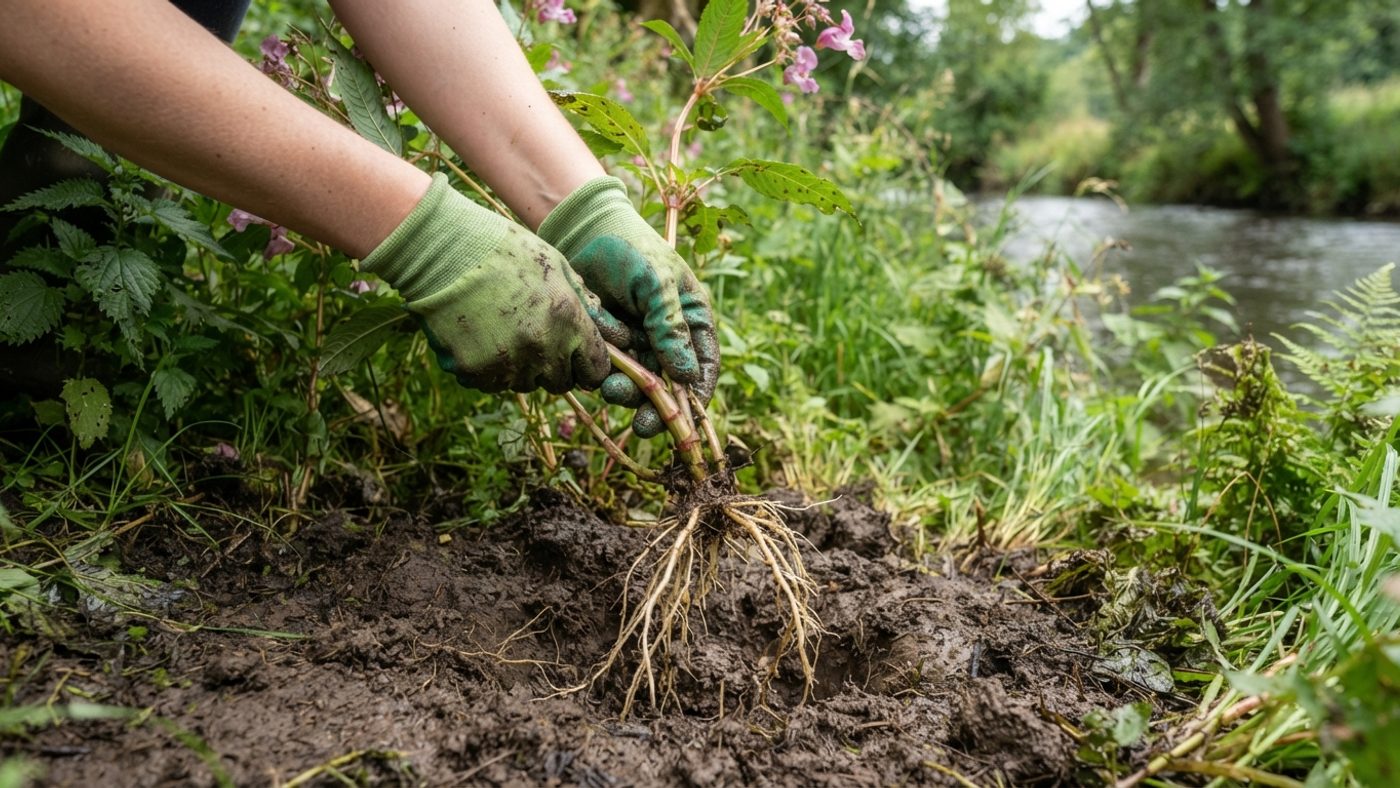
If flowering has already started by the time you tackle a patch, work from the edges of the stand inward, and handle plants carefully rather than thrashing through them, so you're not deliberately triggering pods you haven't yet accounted for. Pulled or cut plants left lying in situ can still flower and set seed from ground contact if left too long, so removal timing and follow-through matter as much as the initial pull.
What to do with the material afterwards
This step is easy to treat as an afterthought once the pulling itself is done, but it matters just as much. Himalayan balsam can reroot from stem fragments left in contact with damp ground or water, so cut or pulled material is still a live risk until it has properly dried out.
In practice:
- Pile pulled or cut material somewhere it will dry out completely, away from the watercourse, ditches and damp soil, not left where a stem end can touch wet ground and take root again.
- Don't leave it on the bank itself or toss it back toward the burn: fragments in or near water can drift downstream and start a new patch exactly where you don't want one.
- Don't add fresh green material straight to a home compost heap, where damp conditions can let stem fragments survive; let it die back and dry out somewhere separate first.
- For larger clearances, a bonfire once the material is thoroughly dried, or council green waste collection, are reasonable routes; check locally what your council accepts.
It's worth being clear that this isn't the same regime as Japanese knotweed. Knotweed is separately classed as controlled waste, a formal legal category that fixes how, and by whom, it has to be disposed of once cut, with rules on licensed carriers and disposal sites. Himalayan balsam isn't subject to that controlled-waste classification; its legal duty is about preventing it from growing in the wild in the first place, not a fixed disposal category for the cut material. Disposal still matters: dry the material out fully, away from water and damp ground, before treating it as safe to leave or burn.
The law in Scotland
This is where Scotland's position genuinely diverges from England and Wales.
| England & Wales | Scotland | |
|---|---|---|
| Legal basis | Wildlife and Countryside Act 1981, Section 14(2) | Same Act and section, as amended by the Wildlife and Natural Environment (Scotland) Act 2011 |
| What triggers the offence | Planting, or causing to grow in the wild, a species named on Schedule 9 to the Act | Planting, or causing to grow in the wild, any plant at a place outwith its native range, no list required |
| Schedule 9’s role | Still the trigger list | Repealed for Scotland entirely |
South of the border, Schedule 9 does the work: a species has to be named on it before planting or causing it to grow in the wild is an offence.
Scotland doesn't work that way any more. Schedule 9 was repealed north of the border, and the duty was broadened instead: an offence is committed by planting, or otherwise causing to grow, any plant in the wild at a place outwith its native range, regardless of whether that species appears on any list. Himalayan balsam, native to the Himalayas and nowhere near its native range on a Scottish riverbank, falls squarely within that broader duty. A defence is available where reasonable steps were taken to prevent the offence, and licences can be issued in specific circumstances such as reintroduction projects, but the core duty is the same: don't cause it to spread in the wild.
In practice, that duty falls on cause, not on the plant simply existing on your land already. Removing what's there, carefully, as above, is the way to comply with it, not a separate legal obligation layeredPropagating a new plant by pinning a low, flexible stem into the soil while still attached to the parent, so it roots before being cut free. Full definition → on top.
The Scottish catchment picture
Three Scottish catchments have organised, ongoing balsam control programmes running on them, a genuine indicator of where it's established as enough of a problem to warrant coordinated work, even if it isn't proof of exactly how the plant's total distribution compares catchment to catchment. A partnership project funded through Scotland's Nature Restoration Fund works on rivers in northern and central Scotland to control it alongside American mink, giant hogweed, Japanese knotweed and American skunk cabbage, and describes the River Tay as having balsam that is "an extensive problem and widespread throughout the Tay system," with volunteer removal work targeted at upstream locations including Pitlochry and Blairgowrie.
A dedicated invasive non-native species strategy has separately been commissioned for the Clyde catchment, and the Spey Fishery Board runs its own invasive non-native species control programme across the Spey Fishery District.
Biosecurity guidance for work carried out near Scottish watercourses covers how to avoid spreading invasive species like Himalayan balsam further while working on or near a bank. Any more substantial streamside work, beyond hand-pulling a garden-scale patch, can also fall under Scotland's Controlled Activities Regulations (CAR), which govern activities in or near the water environment, worth a check with SEPA before anything more involved than hand-clearance on a riverbank.
Common questions
What if it’s spreading in from a neighbour’s land or a stretch of riverbank I don’t own?
There’s no formal notice or enforcement route aimed at a neighbouring landowner the way there sometimes is for other nuisance plants, so a friendly conversation about the shared source is usually the practical first step. If the source is a section of riverbank managed by a landowner, council, or catchment body rather than a private garden, contacting the relevant catchment partnership is often more effective than raising it as an individual, since they may already have a control programme running nearby.
Can I just strim or mow it instead of pulling it?
Cutting works, ideally at or below the lowest node, but it needs repeating through the season, since any stem left standing or regrowing from the base can still flower. Hand-pulling before flowering is generally more thorough for smaller patches, given how shallow and easy the root system is to lift.
Does having Himalayan balsam on a property affect a house sale or mortgage the way Japanese knotweed can?
Not in the same way. Japanese knotweed’s structural-damage reputation and its own dedicated disposal category have made it a standard item on property surveys and mortgage lender checklists; Himalayan balsam doesn’t carry that same property-market profile, since it doesn’t damage structures and isn’t subject to the same controlled-waste rules. That doesn’t mean it’s worth ignoring on a property you’re selling, but it isn’t the same red flag to a buyer or lender that knotweed is.
Won’t removing it take away a food source for bees?
It does remove one source, but not the only one available late in the season, ivy, heather, and asters are among the native and garden plants still flowering into autumn once balsam is cleared. Timing removal for before flowering, the same window recommended above for other reasons, sidesteps this trade-off almost entirely, since the plant hasn’t yet started producing nectar at that stage.
What if it’s a large infestation, not just a garden patch?
For a stand too large to clear by hand, a local catchment partnership or invasive-species initiative is worth contacting before tackling it alone, coordinated volunteer removal work already runs on rivers including the Tay, and equivalent catchment groups exist elsewhere. They can advise on scale-appropriate control and may already be running organised clearance work nearby.
Sources
11 sources, recorded with what each was used for
- RHS: Himalayan balsam: Identification (flower colour/shape, stem, height), seed pod dispersal distance (7m), root depth, general control methods
- Wildlife Trusts: Himalayan balsam: Identification, explosive seed pod spread into watercourses, invasive/non-native status, UK distribution
- Wildlife and Countryside Act 1981, Section 14 (as amended for Scotland): Current Scottish wording of the offence (planting/causing to grow any plant in the wild outwith its native range)
- Wildlife and Countryside Act 1981, Schedule 9: Himalayan balsam’s original Schedule 9 listing and its repeal for Scotland
- Wildlife and Natural Environment (Scotland) Act 2011, Section 17: The amendment repealing Schedule 9 in Scotland and broadening Section 14
- gov.scot: Invasive non-native species: Confirms current Scottish legal wording and licensing provision under Section 16
- Scottish Invasive Species Initiative: River Tay: Tay catchment balsam control work, Pitlochry/Blairgowrie volunteer removal, SISI’s remit and funding via NatureScot/Nature Restoration Fund
- NatureScot: INNS Strategy for the Clyde Catchment (Research Report 979): Clyde catchment invasive species strategy including Himalayan balsam
- Spey Fishery Board: Invasive Non-Native Species (archived — site offline): Spey catchment control programme
- SEPA: Invasive non-native species: SEPA’s biosecurity guidance for work near Scottish watercourses
- SEPA: Water (Controlled Activities Regulations): CAR authorisation covering engineering and pollution-control activities in or near the water environment