
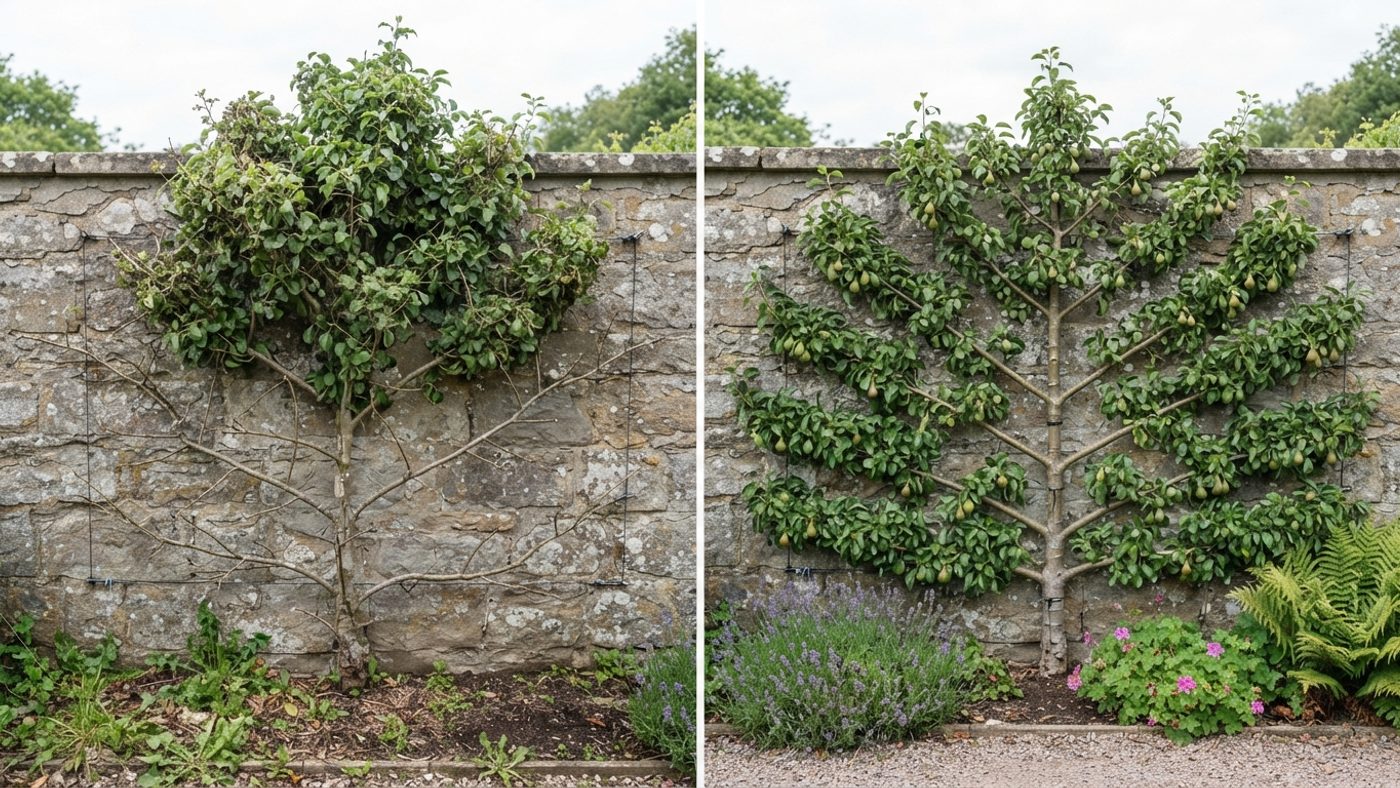
One side of the fan is dense with growth and carrying fruit; the other is bare wood with a couple of thin whips reaching for the light. What fruit there is sits in a cluster near the top of the framework, nothing lower down. There are gaps where a branch died back, or was cut out for disease and never replaced, and the whole shape has drifted from a fan into something closer to a hand missing a few fingers, pulling itself upward and away from the wall it's tied to.
That's not bad luck. It's what a fan does by default if the training and the annual replacement pruning aren't kept up: growth and vigour drift toward the top and the tips, the base goes bare, and one side gets away from the other the moment it's shaded, under-tied, or simply left to sort itself out for a season or two. Fixing it, and avoiding it from the start, both come down to the same thing: understanding what a fan is actually doing structurally, and matching that to a wall that's actually giving the tree something worth having.
What fan training actually is
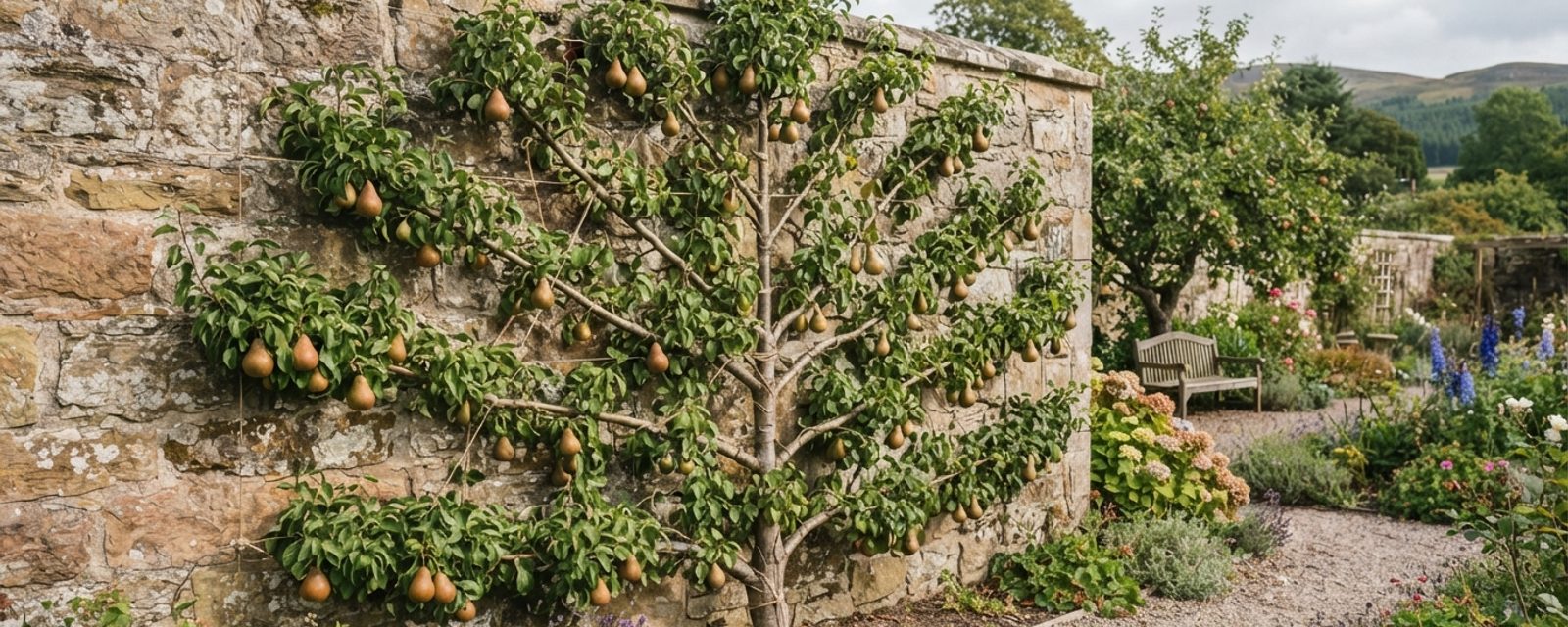
A fan-trainedA fruit tree or bush trained flat with branches radiating out from a low point, the standard shape for wall-grown stone fruit. Full definition → tree is grown with a short clear trunk, usually no more than about 45cm, splitting into two main arms that spread outward at an angle, with further branches tied in from each arm to fill the gaps between, radiating out flat against a support like the ribs of an open fan. It's a different shape from an espalierA fruit tree trained flat against a wall or wire framework with horizontal tiers of branches, most often apples and pears. Full definition →, which runs its branches out in flat horizontal tiers, and different again from a cordonA fruit tree or bush trained as a single main stem with short fruiting side-spurs, usually grown at an angle against a wall, fence or wire. Full definition →, a single stem grown at a slant with short fruiting spursWhether a fruit tree carries its fruit mainly on short side-shoots along older wood (spur-bearing) or at the tips of the previous year's growth (tip-bearing). Full definition → off it. Almonds, apples, cherries, figs, gooseberries, pears, peaches, nectarines, apricots, plums and redcurrants can all be fan-trained, but it's the standard, go-to form for stone fruit specifically, plums, cherries, apricots and peaches all fan well, and a fan is usually the first form recommended for any of them in a garden with limited space.
Building the framework
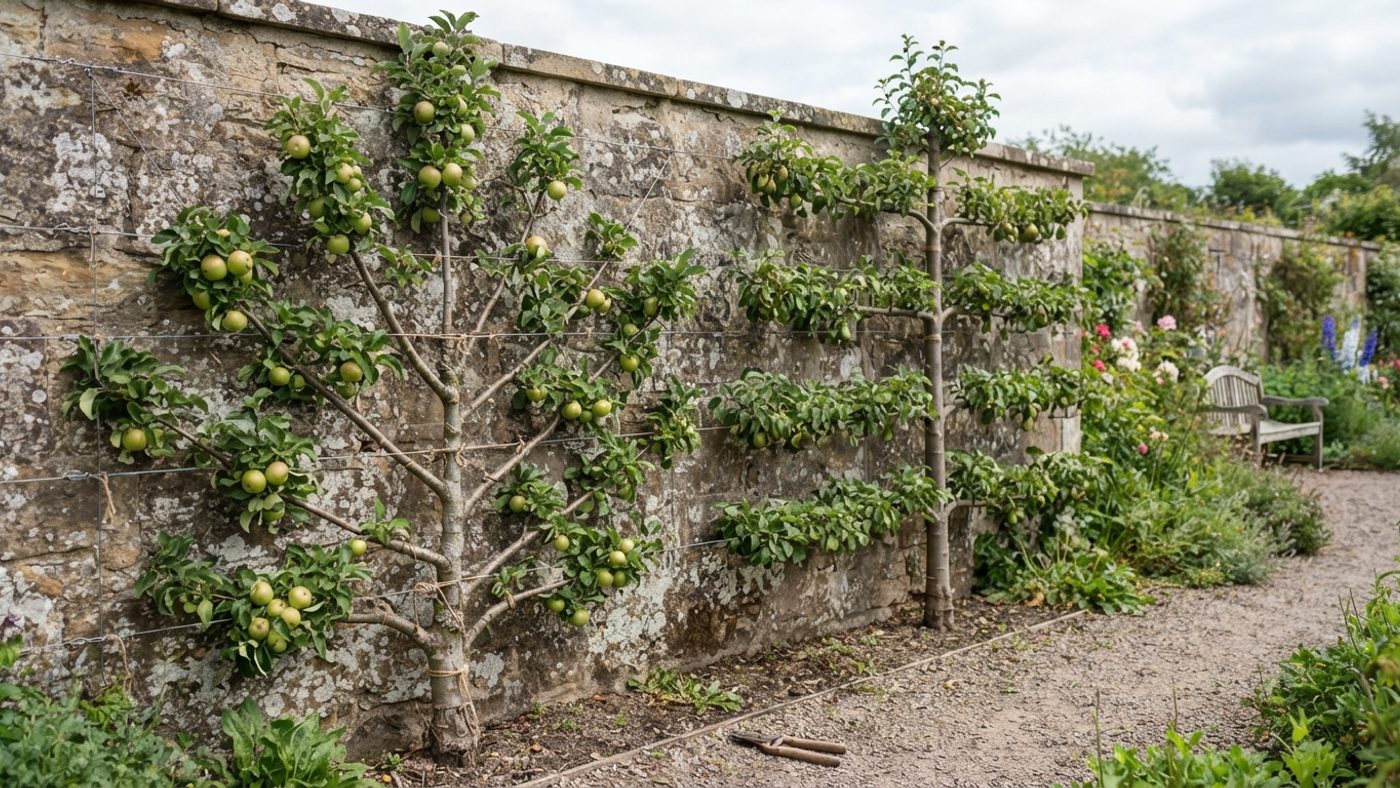
The framework goes up over two to three years, and every step exists to force the tree into that flat, evenly balanced Y-shape rather than letting it grow the way it would naturally, upward and outward in whatever direction is easiest.
| Stage | Timing | What happens |
|---|---|---|
| Year 1 | Spring | Main stem cut back to around 40cm with three strong buds; wires fitted from 40cm above ground, 15cm apart |
| Year 1 | Summer | Two shoots from those buds tied to canes at roughly 45 degrees to form the primary arms |
| Year 2 | Spring | Each arm cut back by about two-thirds to an upward-facing bud; other growth off the trunk removed |
| Year 2–3 | Summer | Four shoots selected per arm and tied in at around 30 degrees |
| Year 3 | Spring | Those four branches on each arm shortened by about a third, to an upward-facing bud |
Trees go in 15–30cm out from the wall or fence, angled slightly back toward it, on wire spaced 15cm apart starting 40cm off the ground, the same spacing whether the tree is a peach against a warm wall or a plum against an ordinary fence. Tie each shoot to its cane or wire with soft garden twine or a proper tree tie, not wire or anything that can cut in, loosely enough to allow the branch to thicken, and go back and loosen ties that are starting to bite as the tree grows. Getting the two primary arms even in year one matters more than almost anything else in the sequence: an arm that's tied in later, tied in slack, or left shaded by whatever's nearby gets away from its pair immediately, and that early imbalance is exactly what a lopsided, one-side-bare fan usually traces back to years later.
Keeping an established fan filled in
Once the framework is up, the job shifts from building the shape to stopping it from drifting out of shape, and this is where most neglected fans actually go wrong. Stone fruit is pruned by replacement: older, already-fruited wood is cut back to a strong new shoot lower down and that shoot is tied into the gap it leaves, so the fruiting wood keeps renewing itself from the base rather than migrating permanently upward. A strong replacement shoot is a vigorous, well-placed one growing roughly in the direction the gap needs filling, thick enough to hold its shape once tied in, not a thin, weak whip, and not one crossing back into the middle of the tree. Apples and pears fanned against a wall are treated differently, more like a spur system, cutting new sideshoots back to around three leaves so short fruiting spurs build up along the framework instead. Either way, a gap in the framework, a dead branch, a limb removed for disease, gets a replacement shoot deliberately trained into that exact space the next time it's available, not left for whatever grows nearby to wander into it eventually.
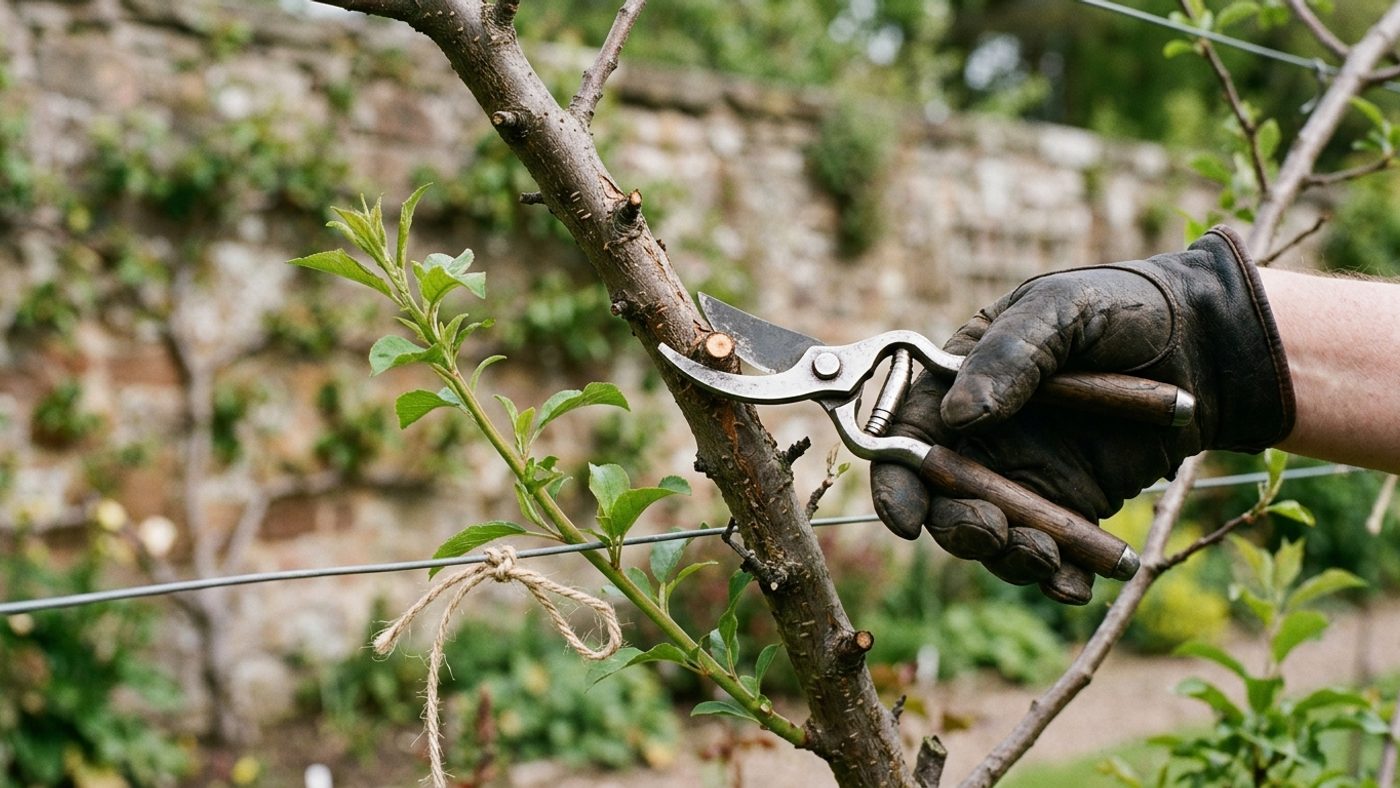
Timing follows the same split that governs the rest of fruit-tree pruning: stone fruit is never cut while dormant, since open wounds through autumn and winter sit exposed to silver leaf disease, a fungus that gets in through fresh cuts and can silver the foliage and kill branches, sometimes the whole tree, once established. It spreads by airborne spore from September to May, so fans are pruned in spring and summer instead, on dry days, finishing stone fruit by roughly the end of August. Apples and pears tolerate a later winter cut. A fan that's been badly neglected for several years is renovated the same way as an unshaped tree, spread over two or three seasons, cutting back a portion of the oldest, most overgrown wood each year to a strong replacement shoot inside the main framework, rather than attempting the whole thing in one go, which tends to provoke a flush of vigorous, upright, largely fruitless regrowth instead of settling the tree back into shape.
What the wall is actually buying you
None of this needs a wall in the sense of bricks and mortar, a stout fence or a post-and-wire frame works structurally, wire spacing and tension are the same either way. What a wall specifically buys, beyond somewhere to fix the wires to, is a warmer, calmer patch of garden than the open ground a few feet away from it: masonry absorbs heat through the day and gives it back slowly after dark, and the wall itself blocks the wind that would otherwise knock pollinating insects off the blossom or chill new growth. South- and west-facing positions are the ones worth having for anything sun-hungry, peaches, nectarines, apricots, grapes and figs are named specifically as the fruits that lean hardest on that extra warmth and shelter to ripen reliably and crop well.
The underlying pattern is well established: places in the east and south of the UK tend to be drier, warmer, sunnier and less windy than those further west and north. Scotland is both the most northerly part of the UK to start with, and, across a great deal of its populated west coast, islands and uplands, on the western side of that line as well, so a large share of Scottish gardens sit on the cooler, wetter, less sunny end of that pattern, before even accounting for how much further north the whole country sits. The reliably warm, sun-trap wall the whole technique assumes is a genuinely rarer thing to own here than most fan-training advice, written with a milder climate in mind, takes for granted. A warm wall in a Scottish garden is still doing real work for whichever fruit actually needs it, arguably worth more precisely because there are fewer of them to choose from, the practical task is matching the specific fruit to the specific resource on offer, rather than assuming any wall or fence will do. Where real heat and a genuinely good wall aren't available, glass is the standard fallback: RHS advice for both peaches and apricots is to grow them under a greenhouse or polytunnel in colder districts rather than force a fan onto a wall that was never going to ripen them.
Which fruit needs the warm wall, and which doesn't
| Fruit | Needs a genuinely warm, sheltered wall | Fans well without one |
|---|---|---|
| Peach, nectarine, apricot | Yes, early blossom is frost-sensitive and fruit needs sustained warmth to ripen | Only in exceptionally mild, sheltered gardens |
| Sweet cherry | Best against a south/south-west wall for flavour and ripening | Can be grown as a free-standing bush or pyramid if space allows |
| Acid (Morello) cherry | No | Tolerates shade well enough for a north-facing wall, or free-standing |
| Plum, damson, gage | No | Commonly grown fan-trained on an ordinary fence, or free-standing |
| Gooseberry, redcurrant | No | Fans readily on a post-and-wire frame with no wall at all |
| Fig | Benefits from wall heat, especially for ripening a useful crop | Restricting the roots matters at least as much as aspect in a cool climate |
In a Scottish garden without a strong south or south-west wall, don't force a peach or apricot fan onto a mediocre one and expect southern-England results, and don't rule fan training out either. Put the acid cherry, the plum, the gooseberries and the currants on the fence, wall or post-and-wire run available, and save the one genuinely warm wall, if there is one, for whichever of peach, nectarine, apricot or sweet cherry the garden can actually support. Where there's no wall worth the name at all, a free-standing fan on a post-and-wire frame, built to the same 15cm wire spacing, works for the hardier candidates in that list; it's the wrong choice for peaches and apricots without real shelter and reflected heat behind them, where a free-standing bush tree of a hardier fruit, a Morello cherry taking the shadiest wall in the garden, or growing the tender fruit under glass instead, is the more realistic route to an actual crop.
Looking after a fan once it's up
A wall does the tree a favour on heat and shelter, but it takes something away too: the soil right at its base sits in a rain shadow, drier than open ground because the wall itself sheds rain away from the root zone, on top of whatever the wall's own foundations or eaves are already intercepting. Water a newly planted fan generously through its first couple of summers and in any dry spell after that, and a mulchA layer of material spread over the soil around plants to suppress weeds, retain moisture, and improve soil structure as it breaks down. Full definition → over the root area in spring helps hold what moisture there is. Feed in spring as growth restarts, and once fruit is developing, water consistently rather than in one flood after a dry spell, since a sudden change after a dry period is what tends to split ripening stone fruit and cherries.
Early stone-fruit blossom is frost-vulnerable wherever it grows, wall or no wall, so cover it with fleeceA lightweight, breathable fabric laid or draped over plants to trap a little warmth and keep off frost, wind and some flying pests. Full definition → on cold nights during flowering if frost is forecast, and remove it again during the day so pollinating insects can reach the flowers. Last-frost timing for that protection window varies sharply across Scotland by altitude and distance from the coast, worth checking against Scotland's frost dates before deciding how much protection a given site and flowering-time variety are actually going to need. Peaches, nectarines and apricots flower early enough in the year that few insects are about at all; hand-pollinate with a small, soft paintbrush, dabbing gently into the centre of each open flower over a few dry days, rather than relying on insects to do the job.
Peach leaf curl is worth planning for specifically on an outdoor fan, and it's more of a live concern in a wet climate than further south: the fungus behind it needs wet conditions to infect emerging shoots each spring, distorting and reddening the leaves and weakening the tree if it happens year after year. A rain shelter, plastic sheeting rigged clear of the framework from leaf fall in November through to about mid-May, keeps the emerging growth dry enough to block infection while still leaving the tree open to pollinating insects, and is the standard fix for exactly the kind of damp spring that's more the rule than the exception on Scotland's wetter coasts.
Buying a tree already partly trained saves two or three years over starting from a maiden whip, and it's the more forgiving route for a first attempt, since the early framework, the step most likely to go wrong, is already in place. Whichever route is chosen, ask for it on a rootstock sized for a fan rather than a full-vigour seedling, the rootstock is what the fruiting variety is graftedJoining a chosen fruiting variety onto a separate rootstock, so the tree grows the fruit of one plant on the roots of another. Full definition → onto, and it controls how vigorously the tree grows regardless of the variety itself: St Julien A for a plum fan, or Colt or the smaller Gisela 5 for a cherry, both routinely offered as fan-trained on those rootstocksThe root system and lower stem a fruit tree is grafted onto, chosen to control the tree's eventual size rather than for its own fruit. Full definition → specifically and sized to stay manageable against a wall rather than outgrowing it. Once a fan is established, the plum, cherry and damson growing guides ( plums, cherries, damsons) each carry variety-specific pruning detail worth reading next, alongside Pruning Fruit Trees in Scotland for general timing beyond trained forms.
Common questions
Do I need a south-facing wall to fan-train fruit?
Only for the genuinely heat-hungry stone fruit: peaches, nectarines and apricots. Plums, gooseberries, redcurrants and acid cherries all fan well on an ordinary fence, a less favourable wall, or a free-standing post-and-wire frame.
Should I buy a fan already trained, or start from a young whip myself?
A partly trained fan, usually two or three years old with the primary framework already established, is the more forgiving choice for a first attempt and saves the years where the shape is most likely to go wrong. Training from a maiden whip is cheaper and lets a beginner learn the technique from year one, but expect the first couple of seasons to be about building the framework rather than picking fruit.
Can I fix a fan that's already badly lopsided or gappy?
Yes, over two or three seasons rather than in one go. Cut back a portion of the most overgrown wood each year to a strong replacement shoot inside the main framework, working the whole shape back into balance gradually.
Is it worth fan-training against a mediocre wall in Scotland?
For plums, gooseberries, redcurrants or a Morello cherry, yes, those don't need much extra warmth. For peaches and apricots, a lukewarm wall won't do what a genuinely warm, sheltered one does; either find the best wall in the garden for those specifically, or grow something hardier there instead.
What's the difference between a fan and an espalier?
A fan radiates branches out from a low point at angles, like the ribs of an open fan, the standard form for stone fruit. An espalier runs branches out in flat horizontal tiers from a central trunk, the more usual choice for apples and pears.
Sources
11 sources, recorded with what each was used for
- RHS: Fan-trained trees, initial training: Year-by-year framework-building steps, wire spacing, planting distance
- RHS: Fan-trained trees, pruning established fans: Replacement pruning, renovating a neglected fan, pruning timing
- RHS: Fruit basics, positioning your fruit trees and bushes: Why a south/west wall matters (heat, wind shelter), which fruits lean on it most
- RHS: How to grow apricots: Wall orientation, planting distance, blossom frost sensitivity, free-standing caveats, self-fertility
- RHS: How to grow peaches: Wall orientation, hand-pollination, greenhouse/polytunnel fallback, self-fertility
- RHS: How to grow cherries: Sweet vs acid (Morello) cherry aspect requirements, free-standing forms, bird netting
- RHS: Apples and pears, espalier pruning and training: Wire spacing comparison, permanent-support requirement for trained forms
- RHS: Silver leaf: Why stone fruit is never pruned dormant, spore timing
- RHS: Rootstocks for fruit: Named rootstocks suited to fan training (St Julien A, Colt, Gisela 5)
- RHS: Peach leaf curl: Disease mechanism, wet-weather infection, rain-shelter timing
- Met Office: UK regional climates: The east/south vs west/north UK climate pattern behind the Scottish-wall-scarcity point