
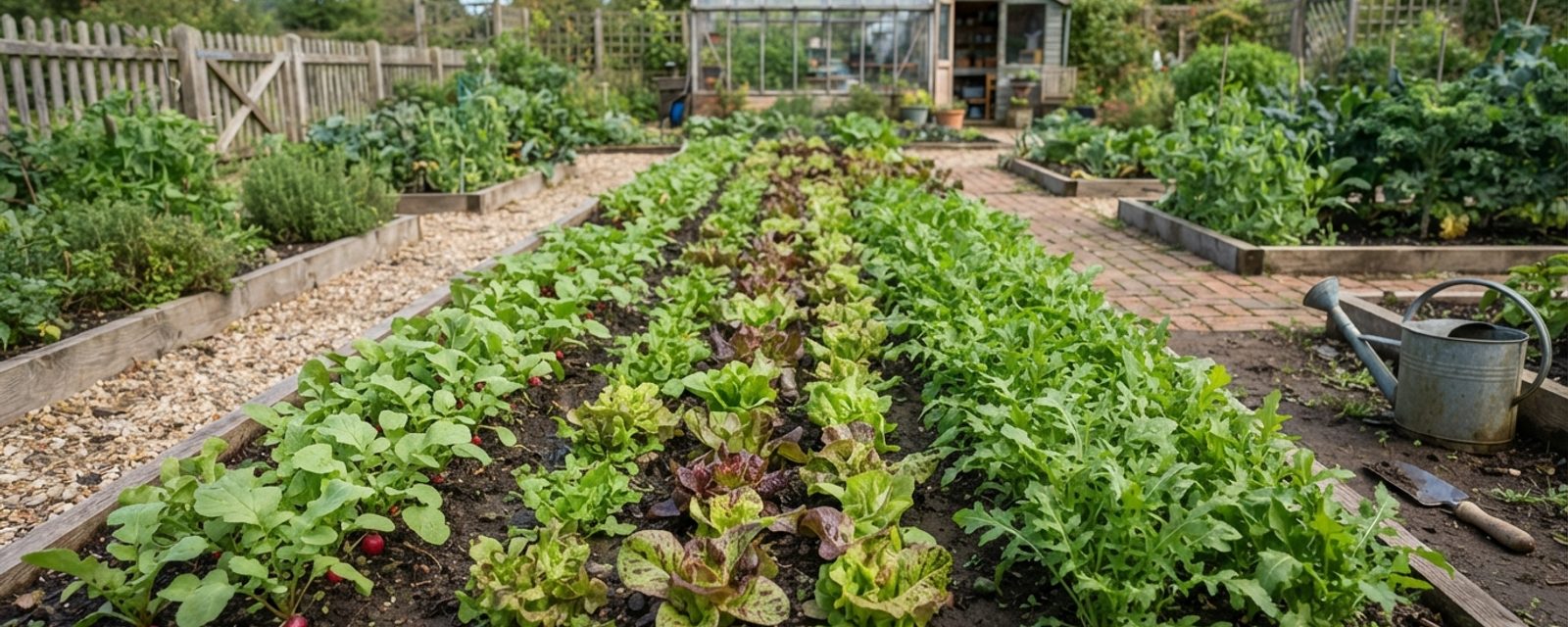
Some gardening problems aren't about skill, they're about the calendar. A bed empties out in June and there's a six-week window before the leeks need the space. A wet April pushes everything back and suddenly it's July with nothing in the ground. The growing season ends earlier here than further south, and once the light starts dropping away in September, a crop that needs ten weeks simply isn't going to make it.
In situations like that, "easy" isn't the question, speed is. The five below, ranked by RHS's own stated weeks from sowing to a real harvest, are genuinely the fastest route from an empty bed to something on the plate. A couple are fast but fussy once they're ready, so the trade-offs matter as much as the headline number. Two words come up repeatedly: "boltingA plant switching early into flowering and seed production, usually triggered by stress, after which leaves, roots or bulbs turn bitter or unusable. Full page →" means a plant rushes to flower and set seed early, usually triggered by heat, cold, or stress, and once it happens leaves and roots stop developing normally; "hearting" lettuce forms a single solid head, as opposed to the loose-leaf types this list focuses on.
1. Radishes: as little as 4 weeks
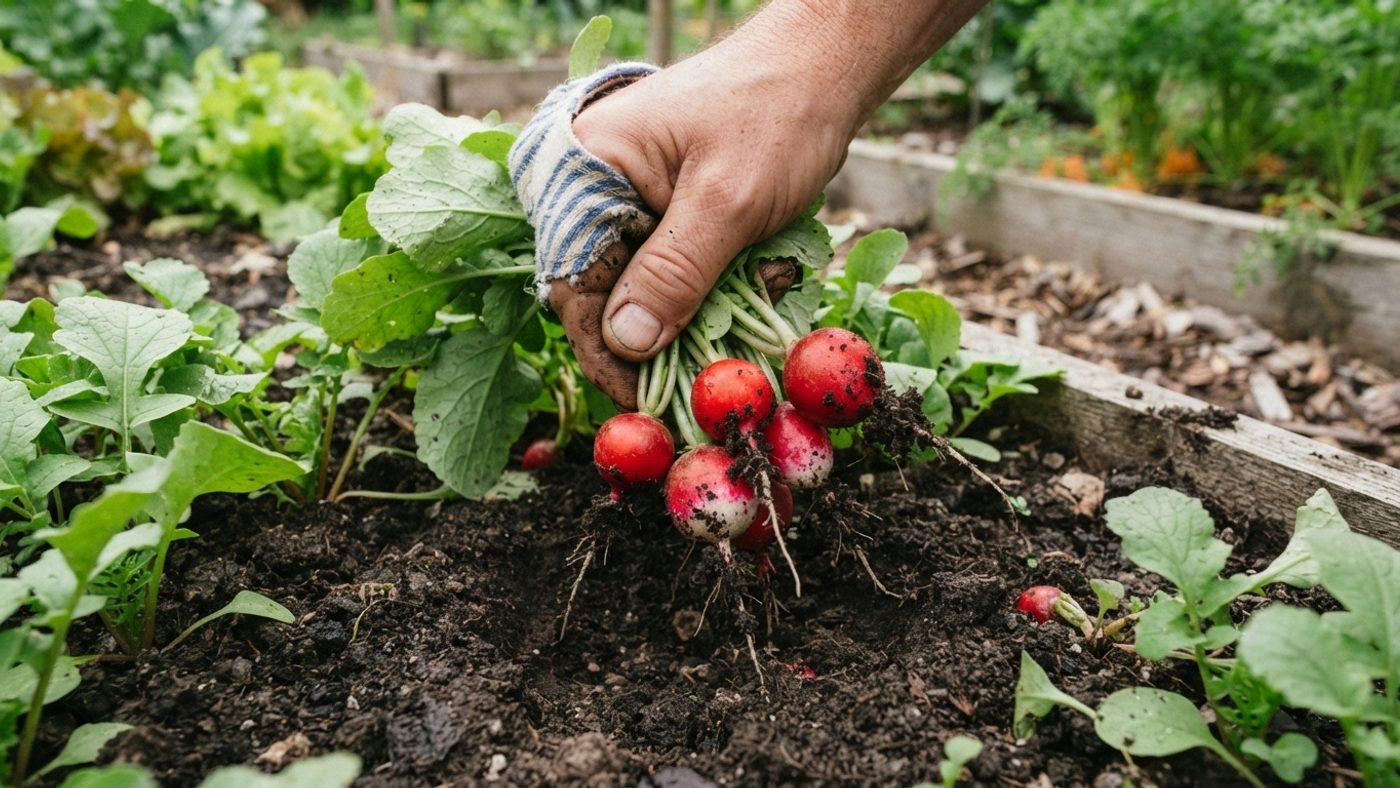
Salad radishes are the benchmark for fast: RHS states they're ready to eat in as little as four weeks from germinationA seed sprouting: breaking dormancy and putting out its first root and shoot, given the right warmth and moisture. Full definition →, though early spring sowings in cooler soil can take six to eight weeks to reach the same size.
Sow direct, 1cm deep and 2.5-5cm apart, from spring through early summer and again in late summer. No transplanting, no modulesA tray divided into small individual cells, each sown with its own seed or seedling, so each plant grows undisturbed roots until it's ready to plant out. Full definition →, straight into the ground where they'll crop. A March or early April sowing here is more likely to land on the six-to-eight-week end of RHS's figure than the four-week one, since cold soil slows germination, see Seed Germination Temperature in Scotland. A May or June sowing into warmer soil is more likely to hit the faster figure.
This is the crop that makes speed a double-edged sword. Left even a few days past the point where the root hits about 2.5cm across, radishes turn pithy, hot, and inedible. Hot weather also pushes them to bolt, at which point the root stops developing altogether. Fast only works here if you're checking the row every couple of days once it's close. Slugs go for the soft new growth just as it germinates, and flea beetle nibbles the leaves, though the damage is mostly cosmetic.
2. Spinach (baby leaf): as little as 4 weeks
RHS gives baby leaf spinach as ready in as little as a month after sowing, with full mature leaves at around two months if you let it grow on instead of cutting early.
Direct sow outdoors, seed scattered thinly along a 2.5cm-deep drillA shallow, straight groove made in prepared soil for sowing seed into, at a set depth so germination and rows are even. Full definition →, rows 20cm apart. Direct sowing is the better route here, module-raised plants disturbed at transplanting are more prone to bolting. Baby leaf is a genuinely different harvest target from a full head of anything, you're cutting young leaves rather than waiting for a mature plant, which is where most of the four-week figure comes from.
Spinach bolts hard in hot, dry weather, and once it flowers the leaves turn bitter and the plant is finished. Keeping the soil consistently moist matters more for spinach than for almost anything else on this list. Young spinach seedlings are also a slug target.
3. Rocket: 4 to 6 weeks
RHS states rocket is ready to start harvesting about four to six weeks after sowing.
Direct outdoors from April to early September (extend into autumn under clochesA small, portable clear cover placed over an individual plant or short row to trap warmth and keep off wind, rain and pests. Full definition → or fleeceA lightweight, breathable fabric laid or draped over plants to trap a little warmth and keep off frost, wind and some flying pests. Full definition →), or start indoors in February-March for an earlier crop. A cloche or fleece start is worth considering for an early April sowing, since cold soil slows germination, see the Seed Germination Temperature in Scotland article for how much this varies by area. Rocket is cut-and-come-again by design, you take a few leaves from each plant along the row rather than pulling the whole thing, so the first harvest comes quickly and repeat pickings keep coming after.
Salad (annual) rocket bolts quickly in hot weather, which ends that sowing. Wild rocket is perennial and keeps producing after flowering, but it's slower to establish, so it doesn't compete on raw speed. Repeat sowing matters for a long season of salad rocket specifically. Flea beetle also nibbles rocket leaves, but the damage is just cosmetic, not a threat to the crop.
4. Lettuce (loose-leaf, cut-and-come-again): 4 to 6 weeks
RHS puts loose-leaf and cut-and-come-again lettuce at ready to pick in as little as four to six weeks after sowing, against 10 to 14 weeks for hearting types, a big enough gap that the variety you choose matters more than almost anything else on this list.
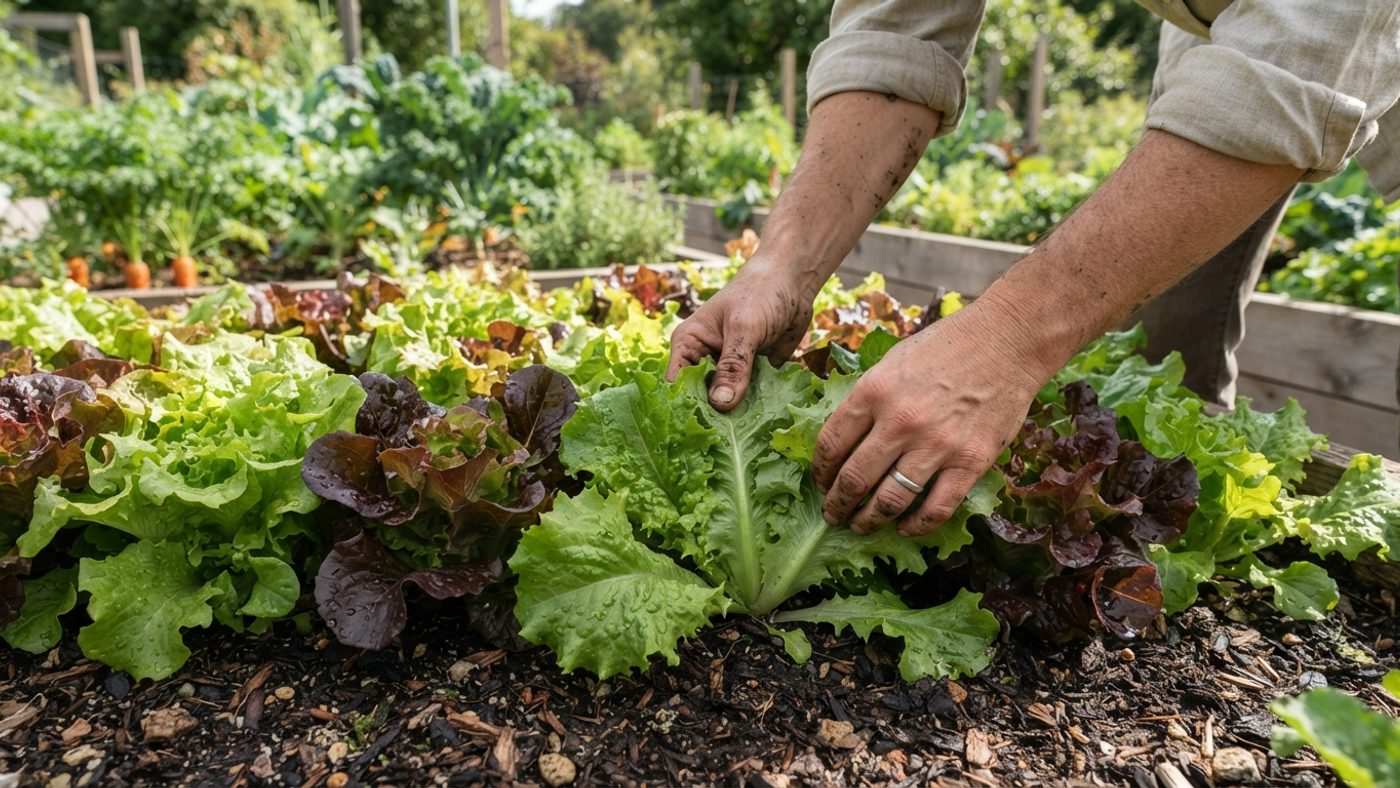
Direct outdoors from late March to late July, in rows 30cm apart, 1cm deep. RHS recommends sowing a short row every fortnight to keep up continuous picking rather than one large sowing. Loose-leaf types are harvested as individual leaves rather than a formed head, so there's no waiting for the plant to bulk up into anything solid.
Hot, dry weather triggers premature flowering. RHS's advice is to keep plants well-watered and lightly shaded in summer, choose bolt-resistant varieties, and not delay picking once a good head of leaves has formed. Slugs are the more routine risk day to day, young lettuce seedlings are one of their preferred targets, worth checking on damp evenings until plants are past their earliest stage.
5. Turnips (baby/early): 6 weeks
RHS states early turnip varieties can be ready to harvest in only six weeks, with maincropThe main, usually latest-sown and longest-growing type of a crop, grown for bulk and storage rather than an early harvest. Full definition → types taking around ten weeks depending on growing conditions.
Direct sow outdoors, drills about 1cm deep, rows 23-30cm apart. Early varieties go in from March to June (or February under cloches); maincrop varieties from July to mid-August. A cloche start suits an early Scottish sowing particularly well, since cold soil is what stands between an early sowing and the six-week figure. Pulled at baby (golf-ball) size rather than left to bulk up as a maincrop root, and the leaves are edible too, harvestable as a cut-and-come-again crop while the roots are still small.
Hot, dry weather can reduce germination success, and the six-week figure applies specifically to early varieties pulled young, leave them for the maincrop-style ten-week root and you lose the speed advantage entirely. Turnip is another flea-beetle target, and birds go for the leaves too, so netting or fleece over young seedlings is worth it where either has been a problem before.
How the five compare
| Crop | Sowing-to-harvest time | Method & season | Key trade-off |
|---|---|---|---|
| Radish (salad) | As little as 4 weeks (6-8 weeks for early spring sowings) | Direct sow, spring-early summer & late summer | Turns pithy, hot and inedible within days of peak size |
| Spinach (baby leaf) | As little as 1 month (mature leaves ~2 months) | Direct sow, mid-late spring or late summer/autumn | Bolts and turns bitter in hot, dry weather |
| Rocket | 4-6 weeks | Direct or indoor sow, Feb-Sept | Salad (annual) type bolts fast in heat, ending the crop |
| Lettuce (loose-leaf/cut-and-come-again) | 4-6 weeks (hearting types: 10-14 weeks) | Direct sow, late March-late July | Bolts in hot, dry conditions; don’t delay picking |
| Turnip (early/baby) | 6 weeks (maincrop: ~10 weeks) | Direct sow, March-June (early) or July-mid-Aug (maincrop) | Speed applies only to early varieties pulled young |
Spring onions are a common name on other fast-crop lists, but RHS states onions generally take about two months to reach harvesting size, slower than every crop above. In a genuinely short gap, that difference decides whether there's time to fit in a second sowing once the first is harvested, or only room for the one. See the spring onions growing guide for the full picture.
Keep it going with succession sowing
Every crop on this list benefits from sowing little and often rather than one big batch, the same short-window logic behind this whole list applies again here, just repeated every couple of weeks instead of once. RHS specifically recommends a short row of lettuce every fortnight and successive small turnip sowings to avoid a glut followed by a gap. Rocket needs repeat sowing too, since a single row of salad rocket only holds before bolting for so long. Done this way, a single bed can produce a rolling harvest through the season rather than one all-at-once crop that's over in a week. See Succession Planting for Beginners for the full technique.
Fast isn't the same as forgiving
Radishes are the clearest example of the trade-off running through this whole list: done in under a month, but leave them a few days past their peak in warm weather and they turn woody and hot. Spinach and lettuce both bolt if the weather turns hot and dry and watering slips, and all four leafy/root picks are vulnerable to slugs at the seedling stage. That speed is also why none of the five needs rich, heavily fed soil to start with: a crop this briefly in the ground doesn't have time to draw on the kind of deep fertility a slower crop would need. Speed and low-maintenance are two different qualities, and a crop can have one without the other.
Growing conditions vary within Scotland too, not just against the rest of the UK, see regional frost dates for how much a sheltered coastal garden and an exposed inland or upland plot can differ. Where a plot runs on the colder, later side of that range, the slower end of each crop's timeframe above is the safer planning assumption.
If what's actually needed is something that survives a missed watering or a fortnight of being forgotten about, that's a different list: Top 5 Low-Maintenance, Beginner-Proof Crops for Scotland covers the crops built for forgiveness rather than raw speed.
Common questions
Do any of these five need a specific soil pH or feeding before sowing?
No, none of the five is fussy about soil chemistry or needs feeding beforehand. Ordinary bed preparation, cleared of large stones and weeded, is enough. That’s part of why all five suit a quick-turnaround gap in a bed rather than a plot that’s been specially prepared.
Which of these five is the most forgiving if I’m away for a week during the growing period?
None of them are ideal for a week away right at harvest time, all five decline in quality if left too long past peak. Turnips are the mildest case: a baby turnip left too long just becomes a bigger root, not a ruined one. Radish is the harshest: a few days past peak and the root turns woody and hot.
Do any of these crops work well in containers or raised beds for a small Scottish garden or allotment plot?
Yes, radish, rocket, lettuce and baby turnips all suit containers at least 30-40cm wide, and none need deep soil since they’re all harvested young or as leaves rather than as large storage roots.
Is there a way to get an even faster harvest than four weeks from any of these?
Cutting rocket, lettuce or spinach at the seedling/microgreen stage rather than waiting for the stated baby-leaf harvest window will be faster still, though that’s a different style of harvest, a single small cutting rather than a repeat crop, and isn’t the figure RHS states for these as vegetable crops.
How much of a threat are slugs and flea beetle to these five specifically?
Slugs are a real threat to radish, spinach, lettuce, and turnip seedlings, all soft new growth at their most vulnerable stage. Checking rows on a mild, damp evening until seedlings are past their earliest stage is worth doing on all four. Flea beetle also feeds on radish, rocket, and turnip leaves, but this is largely cosmetic damage rather than crop-ending.
What happens if I leave one of the bolt-prone crops (lettuce, spinach, rocket) in the ground after it flowers?
Once any of these three flowers, leaf quality drops sharply, spinach and lettuce leaves turn bitter, and energy goes into seed production rather than leaf growth. They’re best pulled and composted at that point rather than left in place.
Sources
8 sources, recorded with what each was used for
- RHS: Radishes — grow your own: Sowing-to-harvest timeframe, sowing method/timing, bolting and quality-decline notes
- RHS: Spinach — grow your own: Baby leaf vs mature harvest timeframes, sowing method/timing, bolting notes
- RHS: Rocket — grow your own: Sowing-to-harvest timeframe, cut-and-come-again habit, bolting behaviour, succession sowing note
- RHS: Lettuce — grow your own: Loose-leaf vs hearting timeframes, sowing method/timing, succession sowing and bolting notes
- RHS: Turnips — grow your own: Early vs maincrop timeframes, sowing method/timing, baby turnip and succession sowing notes
- RHS: Onions — grow your own: Sowing-to-harvest timeframe used to explain why salad/spring onions are slower than the top five
- RHS: Slugs and snails: Slug vulnerability of young seedlings across radish, spinach, lettuce and turnip
- RHS: Flea beetles on brassicas and allied plants: Flea beetle damage on rocket, radish and turnip, and its largely cosmetic nature