
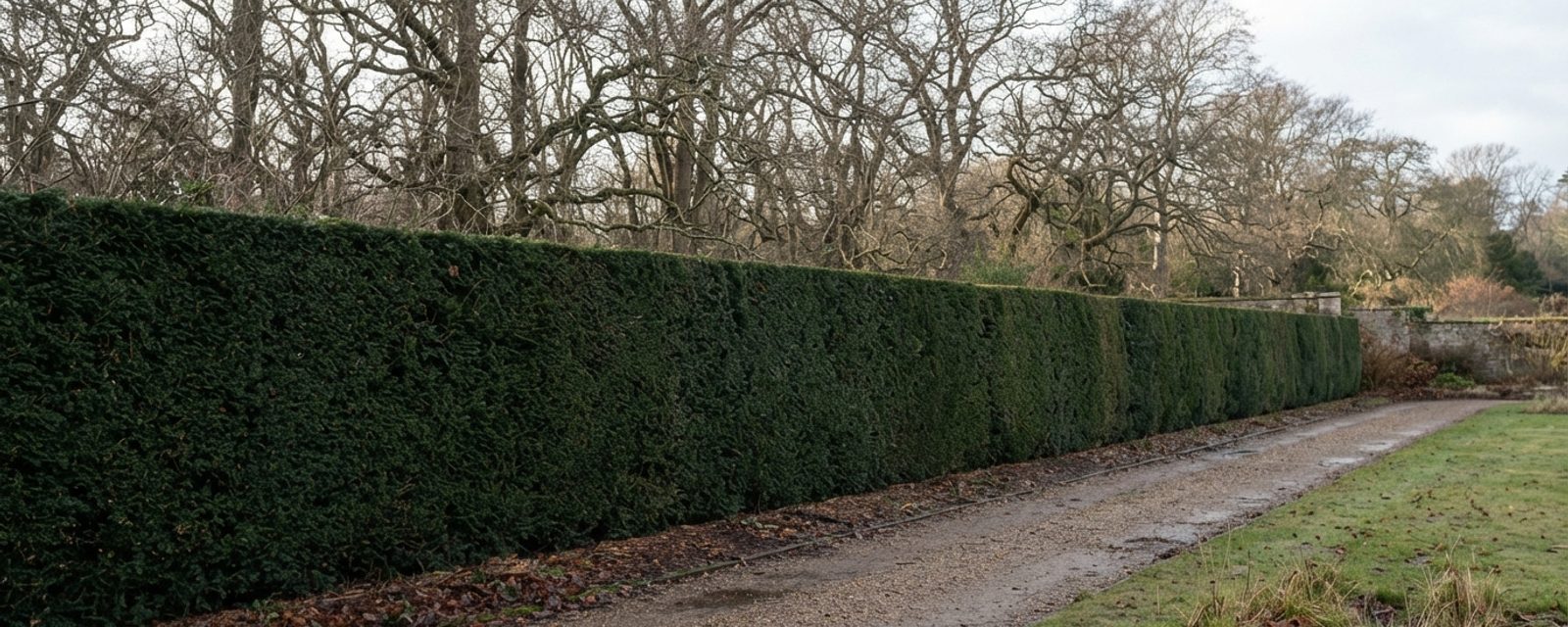
By November, a deciduous hedge is a row of bare stems. If your kitchen window looks straight into next door's, or your patio sits in view of a footpath or a rise in the road, that's exactly when the gap opens up, the leaves that gave you cover in July are gone, and the screen you were relying on for ten months of the year fails you for the other two. A hedge chosen only for "hardy" or "fast" can still leave you exposed all winter if it isn't genuinely evergreen. This article ranks the five conifers and broadleaf evergreens that hold full leaf cover through a Scottish winter and actually deliver on privacy, not just survival.
Quick answer
For most Scottish gardens, yew (Taxus baccata) is the best all-round pick, it's the hardiest of the five, tolerates exposure, heavy clay and dry soils, and forms the densest screen right down to ground level, with no legal complications. In sheltered gardens where speed matters more than patience, western red cedar reaches a tall, formal screen faster. In coastal or salt-exposed gardens, holm oak is the better choice, since it's the only one of the five named specifically for coastal hedging. Leyland cypress grows fastest of all but carries a real legal risk under Scottish high-hedges law.
Why genuinely evergreen matters for privacy
Beech (Fagus sylvatica) is often recommended for privacy hedging and deserves an honest caveat here: it is not evergreen. As a trimmed hedge it holds onto its dead, browned leaves through winter rather than dropping them in autumn, a trait called marcescence, which does give it useful winter screening, but the leaves are dead and brown, not the dense green cover a true evergreen provides. Cutting it in late summer encourages it to retain that recent flush of leaves through the cold months. It's a legitimate winter-screening compromise, but it isn't evergreen, and it doesn't belong on a list of true evergreens.
The five plants below hold live, green foliage in every month of the year, which is what separates a hedge that screens your garden in January from one that only screens it in June.
The five, compared
RHS hardiness ratings run from H1 (needs a heated greenhouse) to H7 (survives the harshest European winters), the higher the number, the more cold a plant shrugs off, so H7 is the toughest of the five below and H4The RHS's H1a–H7 scale for how much cold a plant can survive outdoors, H1a being tender indoor-only and H7 hardy anywhere in the UK. Full definition → the least cold-tolerant.
| Plant | Ultimate height | Hardiness | Wind exposure | Coastal/salt | Soil |
|---|---|---|---|---|---|
| Yew (Taxus baccata) | Over 12m untrimmed; kept at 1.5–4m as a hedge | H7 | Exposed or sheltered sites | Not specifically noted | Chalk, clay, loam, sand; any pH; well-drained |
| Western red cedar (Thuja plicata 'Atrovirens') | 20–35m untrimmed | H6 | Needs shelter from cold, drying winds | Not noted | Chalk, clay, loam, sand; any pH; moist but well-drained |
| Portuguese laurel (Prunus lusitanica) | Over 12m untrimmed | H5 | Exposed or sheltered sites | Not specifically noted | Even poor, shallow, chalky soils |
| Holm oak (Quercus ilex) | Over 12m untrimmed | H4 | Exposed or sheltered sites | Named by RHS for coastal hedging | Chalk, clay, loam, sand; moist to well-drained |
| Leyland cypress (x Cuprocyparis leylandii) | Over 30m if unchecked | H6 | Exposed or sheltered sites | Not specifically noted | Chalk, clay, loam, sand; well-drained |
Species pages give ultimate height and hardiness for the plant grown unchecked, not a cm-per-year figure for a trimmed hedge, because a maintained hedge is deliberately kept far below its untrimmed ultimate size. The table below is a planning guide only, actual speed depends heavily on soil, shelter and starting plant size:
| Plant | Roughly how long to reach 1.8–2m as a maintained hedge |
|---|---|
| Leyland cypress | 3–5 years — fastest of the five |
| Western red cedar | 3–5 years, given adequate shelter |
| Portuguese laurel | Mid-range |
| Holm oak | Mid-range |
| Yew | 8–10 years — slowest to establish, lowest-maintenance once it does |
1. Yew (Taxus baccata) — the all-rounder
Yew is a native, medium-sized evergreen tree with narrow, dark green leaves that, left untrimmed, exceeds 12m, but as a clipped hedge it's routinely kept at 1.5–4m. It holds the RHS Award of Garden Merit and the H7 hardiness rating, the highest on the RHS scale, meaning it copes with the severest winter conditions found anywhere in Europe. It tolerates exposure, dry soils and urban pollution, and grows in full sun, partial shade or full shade, on chalk, clay, loam or sand at acid, alkaline or neutral pH.
That combination of the top hardiness rating plus tolerance of exposed sites and heavy clay makes it a safe choice for gardens that get real wind but aren't directly coastal. It's also the densest of the five once established, filling in right to ground level, which matters if privacy from a low wall or a neighbour's ground-floor window is the goal. The trade-off is patience: yew is not a fast hedge, and gardeners wanting a screen within two or three years should look at western red cedar or Leyland cypress instead. Yew is also toxic if eaten, foliage, bark and seeds are all poisonous to people and pets, so it needs a moment's thought in a garden used by young children or grazing animals.
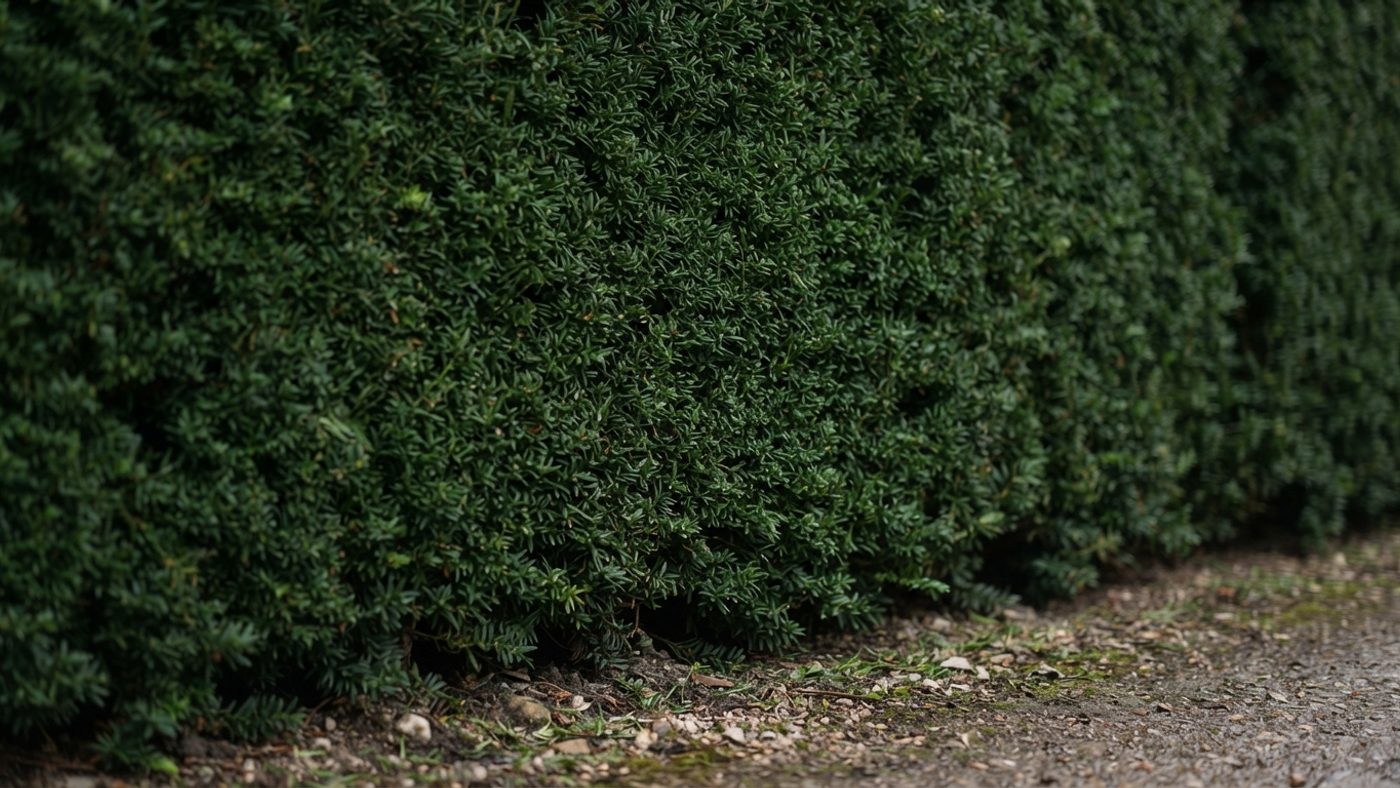
2. Western red cedar (Thuja plicata 'Atrovirens') — the fast, formal screen
Western red cedar is the cultivarA plant variety that arose or was bred under cultivation and is kept true by deliberate propagation, rather than a naturally occurring wild species. Full definition → described as fast-growing, with aromatic, glossy, dark green scale-like foliage held in large drooping sprays. It carries the RHS Award of Garden Merit and an H6 hardiness rating, hardy throughout the UK and northern Europe. It's recommended specifically for hedging and screens, and tolerates chalk, clay, loam or sand at any pH, in moist but well-drained soil.
The one real caveat for Scottish gardens: cultivation guidance specifies it should be grown with shelter from cold, drying winds. That's a meaningful distinction from yew, this is a plant for a reasonably sheltered garden, or one where a windbreak has already established, rather than a fully exposed hillside or an unshielded coastal plot. Its soil preference is moist but well-drained, worth reading carefully on heavy Scottish clay: moist is not the same as waterlogged, and a low, poorly draining spot that sits wet through winter will do it more harm than a merely damp one. Where shelter and drainage are both adequate, it gives one of the fastest routes to a tall, dense, formal green screen of the five options here, and it takes trimming well twice a year without the old-wood problem that limits Leyland cypress.
3. Portuguese laurel (Prunus lusitanica) — the broadleaf option for difficult soil
Portuguese laurel is a large evergreen shrub with dark red shoots and deep green, glossy leaves, plus fragrant white flower spikes up to 25cm long in early summer that are valuable for pollinators. It is rated H5, hardy in most UK locations even in severe winters, and tolerates exposed and sheltered sites in sun or partial shade. It holds the RHS Award of Garden Merit.
Its standout feature for difficult Scottish gardens is soil flexibility: it even thrives on poor, shallow, chalky soils, in addition to tolerating clay. As a broadleaf rather than a conifer, its screening character is softer and glossier than yew or the cypress-family conifers, which some gardeners prefer for a less formal boundary. It's also one of the more commonly suggested replacements where box (Buxus) hedging has failed to box blight or box tree caterpillar, since it takes clipping into a similarly tight formal shape but isn't susceptible to either problem. Its H5 rating is a step below yew's H7 and the conifers' H6, so in a severe inland frost pocketA low-lying spot where cold air drains and pools on still nights, making it noticeably more frost-prone than the surrounding area. Full definition → it's worth checking local minimum temperatures before committing, though it performs reliably across the great majority of the country.
4. Holm oak (Quercus ilex) — the coastal choice
Holm oak is an evergreen oak with glossy, dark green, leathery leaves and a bushy, easy-to-manage habit that responds well to formative pruning and clipping. What sets it apart from the other four is a direct claim behind it: it can be used as hedging in coastal areas and is suitable for most sites except the coldest inland areas. None of the other four plants on this list get that specific coastal endorsement.
It carries an H4 hardiness rating, hardy through most of the UK, to roughly -10°C to -5°C, which is lower than yew, the two conifers, or Portuguese laurel, so it's the one pick on this list to think twice about for a very cold, frost-prone inland site. For a milder, wetter west-coast garden taking salt-laden wind, it's the strongest match of the five; a colder, drier east-coast or inland garden should weigh its lower hardiness rating more carefully. It tolerates chalk, clay, loam and sand, in sun or partial shade, and is drought-resistant once established.
5. Leyland cypress (x Cuprocyparis leylandii) — fastest growth, real legal risk
Leyland cypress is a large, fast-growing, dense conifer capable of exceeding 30m if left unchecked, rated H6 and tolerant of exposed or sheltered sites on chalk, clay, loam or sand. It's the fastest route to a tall, opaque screen of anything on this list, which is exactly why it became the default UK privacy hedge from the 1970s onward.
It's flagged among "garden thugs" for having the potential to become a nuisance, and pruning must be confined to young green shoots, because old woodWhether a plant fruits on stems grown the previous year (young wood) or on older, established branches (old wood), which decides how it's pruned. Full definition → won't resprout, a neglected leylandii hedge can't simply be cut back hard and regrown the way a yew or laurel hedge can. An overgrown Leyland cypress hedge is also commonly the plant behind a formal high-hedges dispute with a neighbour, and can end in a council-ordered reduction under the legal process set out in the High Hedges (Scotland) Act 2013 guide, which covers what counts as a "high hedge," how the complaint and notice process works, and the risk of a staged hard reduction being ordered if a dispute reaches that stage. Damp, humid west-coast conditions also favour cypress aphid, which can brown and kill sections of a leylandii or western red cedar hedge from the inside out, worth checking for on either conifer if patches start browning rather than assuming it's simple winter scorch. If you choose Leyland cypress, plan on trimming it two to three times a year from the outset and keeping it at a height you're confident won't become a neighbour dispute, or choose one of the other four instead.
Which one for your situation
The five above cover most gardens, but two further points affect the decision in practice rather than on paper. First, budget: yew and Portuguese laurel are typically sold and planted as small, slower-starting whips, which cost less per plant but need more patience; western red cedar and Leyland cypress are more often planted as larger, faster-establishing, and pricier, pot-grown specimens, since speed is the point of choosing them. Second, if your garden is west-coast and mild rather than east-coast and cold, Griselinia littoralis is a widely planted evergreen salt-tolerant alternative worth knowing about even though it isn't one of the five ranked here, it's already covered in depth, alongside its wind and frost trade-offs, in the hedge planting species guide; holm oak is the pick on this list because it copes with a wider range of exposure and soil than Griselinia, not because Griselinia is a poor choice on the right coast.
Putting the five side by side: for most Scottish gardens with no strong constraint, yew is hardiest, tolerates exposure and heavy clay, forms the densest screen, and carries no legal risk, at the cost of a slower first several years. Where the garden is sheltered and speed matters more than patience, western red cedar gets there faster. On a coastal or salt-exposed site, holm oak is the strongest match. On difficult, poor or chalky soil, or where pollinator value matters, Portuguese laurel fits best. Where maximum speed is the priority and you're prepared to commit to strict, regular trimming and stay well clear of a high-hedges dispute, Leyland cypress delivers it fastest, with eyes open to the legal exposure covered above.
Planting and pruning for a dense, private hedge
Spacing determines density as much as species does. As a working guide, two plants per metre is typical for these five as young whips or small pot-grown plants, tightening to three per metre for a faster-knitting screen or widening to one per metre for larger, more expensive specimens. Dig the planting trench 60–90cm wide and one spade blade deep, and position it slightly back from the boundary line rather than hard against it. That matters for more than tidiness: a hedge planted on or over the boundary line, or one that's allowed to grow across it, is exactly the kind of thing that turns into a High Hedges (Scotland) Act 2013 dispute later, so leaving deliberate room on your own side from the outset is a genuine precaution, not just good manners. Two plants growing close enough to knit together will screen far sooner than the same number spaced generously apart.
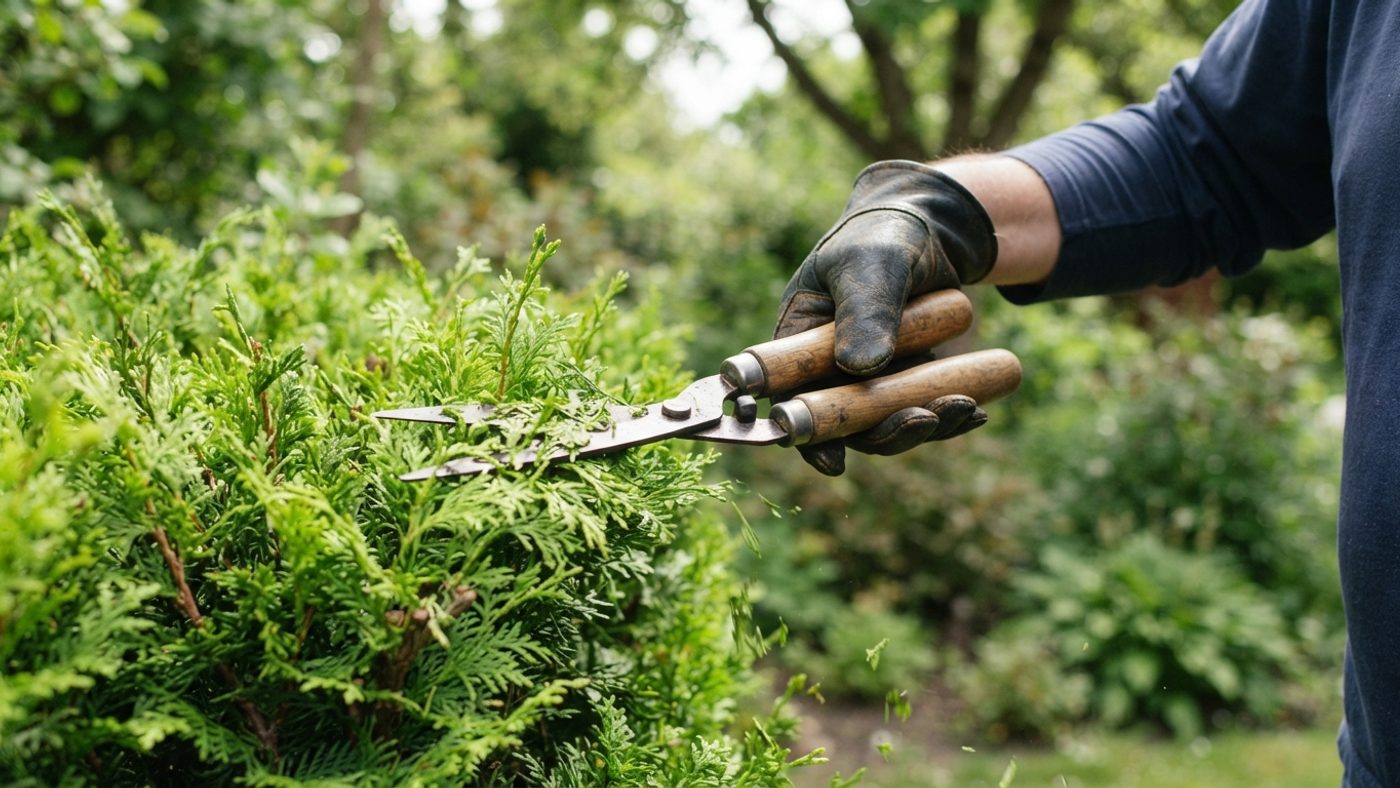
Formative pruning matters more for a privacy hedge than an ornamental one: trimming the sides and leading shoots in the first two to three years encourages branching low down, rather than a hedge that's leafy at head height and thin at the base, exactly the gap that defeats ground-level privacy. Evergreens generally need this kind of regular attention, ideally twice yearly, to stay dense, whereas deciduous hedges are more forgiving of a missed year. Conifers in particular, western red cedar and Leyland cypress here, should never be left to grow unchecked and then cut back hard, since neither reliably resprouts from bare old wood; broadleaf evergreens like yew and Portuguese laurel are more tolerant of harder renovation pruning if a hedge does get away from you. Whatever the species, avoid cutting between March and August: nesting birds are legally protected, and a hedge is one of the most common nesting sites in a garden.
Late winter to early spring is generally the recommended planting window for bare-rootA plant, usually a fruit tree or hedging, sold with its roots exposed rather than in a pot, and only available while dormant. Full definition → and rootballed hedging, giving roots time to establish before the summer's demand for water, though container-grown plants of any of these five can go in through more of the year if watered through dry spells. Smaller starter plants establish more readily than large, expensive specimens and often catch up in height within a few seasons. In a rural or semi-rural garden, protect young whips with spiral guards or temporary fencing through their first couple of seasons, deer and rabbits will readily strip new growth off a hedge that hasn't yet toughened up, undoing a year's establishment in a single winter. For more on that specific risk, see keeping deer out of a Scottish garden and keeping rabbits out of a Scottish garden.
Common questions
What's the fastest-growing genuinely evergreen hedge for privacy in Scotland?
Leyland cypress and western red cedar are the fastest of the five here, both fast-growing conifers. Leyland cypress grows quickest overall but carries real legal risk if left unmanaged; western red cedar is a safer fast option provided the site has some shelter from cold, drying winds.
Is beech a good evergreen privacy hedge in Scotland?
Not a true evergreen one. Beech is marcescent, as a clipped hedge it holds onto dead, brown leaves through winter rather than shedding them, which gives useful winter screening but not the live green cover of the five plants above. It's a reasonable compromise, not an evergreen.
Which of these hedges tolerates coastal, salt-laden wind best?
Holm oak is the only one of the five specifically named as suitable for coastal hedging. It's also less cold-hardy than the others (H4), so it suits milder coastal sites better than a severe inland frost pocket.
Can I get in legal trouble for a tall evergreen hedge in Scotland?
Potentially, yes, and it's most often an issue with fast-growing conifers like Leyland cypress left to grow unchecked. The High Hedges (Scotland) Act 2013 sets out how a neighbour dispute over a high hedge is handled, including the risk of a council-ordered reduction.
What soil should I check before choosing between these five?
Yew, holm oak and Leyland cypress tolerate chalk, clay, loam and sand at any pH. Portuguese laurel is notably tolerant of poor, shallow, chalky ground. Western red cedar prefers moist but well-drained soil and needs some shelter from wind, so it suits an exposed or very windy site less well than the others.
Sources
9 sources, recorded with what each was used for
- RHS: Taxus baccata (common yew): Yew's growth habitA plant's characteristic shape and manner of growth, such as upright, spreading, creeping or bushy. Full definition →, ultimate size, hardiness rating, soil and exposure tolerance, and AGMThe RHS's Award of Garden Merit: a UK-wide trials award for reliable performance, not a Scotland-specific recommendation. Full definition → status
- RHS: Thuja plicata 'Atrovirens' (western red cedar): Western red cedar's growth description, hardiness, wind-shelter requirement, soil tolerance and AGM status
- RHS: Prunus lusitanica (Portugal laurel): Portuguese laurel's description, hardiness, soil tolerance including poor/chalky soils, and AGM status
- RHS: Quercus ilex (holm oak): Holm oak's growth habit, hardiness, coastal hedging suitability and soil tolerance
- RHS: x Cuprocyparis leylandii (Leyland cypress): Leyland cypress's growth rate, ultimate size, hardiness, pruning limitations, and its own "potential to become a nuisance" characterisation
- RHS: How to grow beech: The beech marcescence caveat, retaining dead leaves through winter as a trimmed hedge
- RHS: Hedges — Selection Tips: General evergreen-vs-deciduous screening advice and pruning-forgiveness comparison
- RHS: How to grow hedges: Planting trench dimensions and general site/soil planting guidance
- Woodland Trust: Yew (Taxus baccata): Yew's density as a hedge and general hardiness background