
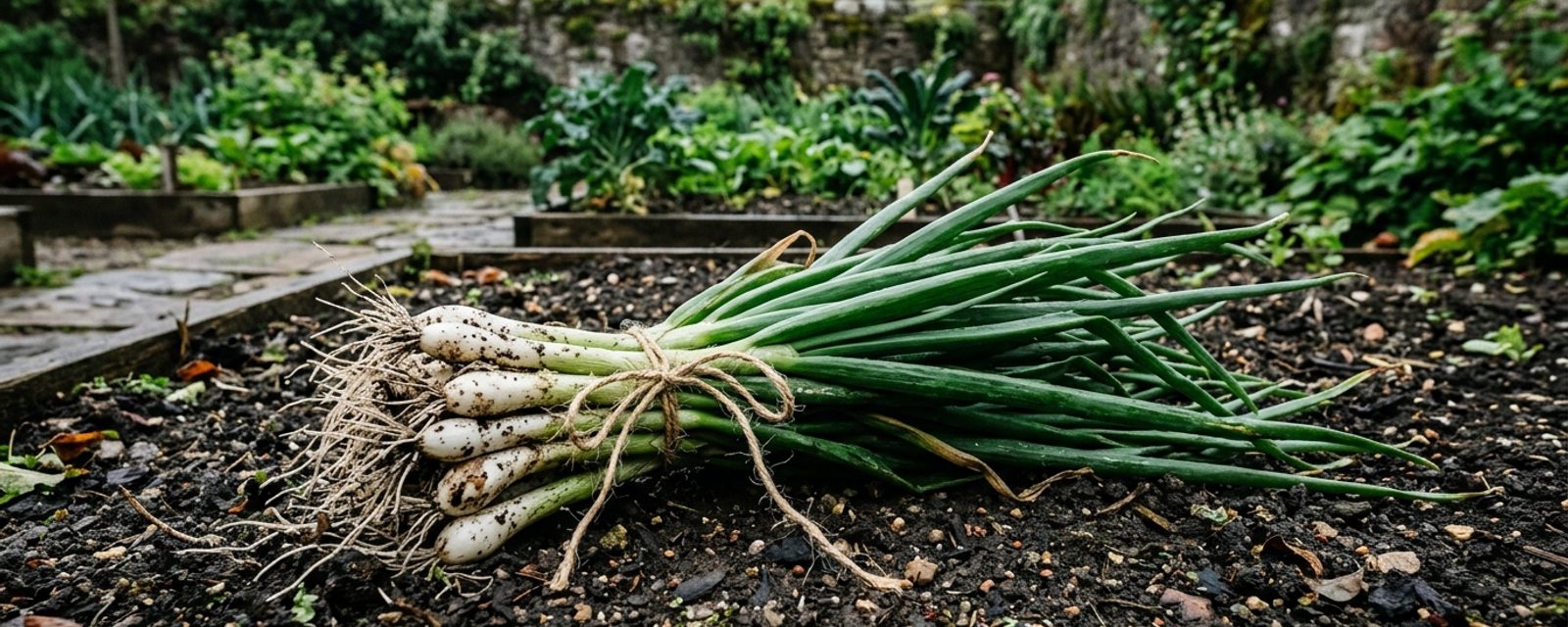
Allium cepa (immature bulb onion)
Spring onions are one of the quickest, lowest-effort crops you can grow, ready in about two months and easy to keep going from spring right through to a hardy overwinteredKeeping a plant alive and intact through the cold months, whether left outdoors, moved under cover, or stored dormant. Full definition → crop the following year.
Spring onions ask for almost nothing beyond regular small sowings and a weed-free row. The one habit worth unlearning is waiting for a bigger harvest: this is a crop where pulling them young is the whole point, not a compromise. Sow a batch every few weeks through the growing season, and add a hardy autumn sowing if you want a crop that's ready before anything else you've started fresh that year.
Sowing
Sow outdoors from March, in small batches every few weeks, for a steady supply from spring through autumn rather than one glut. An early indoor sowing in modulesA tray divided into small individual cells, each sown with its own seed or seedling, so each plant grows undisturbed roots until it's ready to plant out. Full definition → in March is also an option if you want a head start on the first batch. Make a shallow drillA shallow, straight groove made in prepared soil for sowing seed into, at a set depth so germination and rows are even. Full definition → 1cm deep, and thin seedlings to about 2.5cm apart once they come up, using the thinnings in salads rather than wasting them.
Row spacing is one place the sources genuinely differ: RHS gives 20cm between rows, while a tighter 10cm is also workable if you want a denser row of thinner onions. Both are valid choices, and which one suits you comes down to how much bed space you have rather than one being objectively correct.
Sowing a hardy, overwintering crop
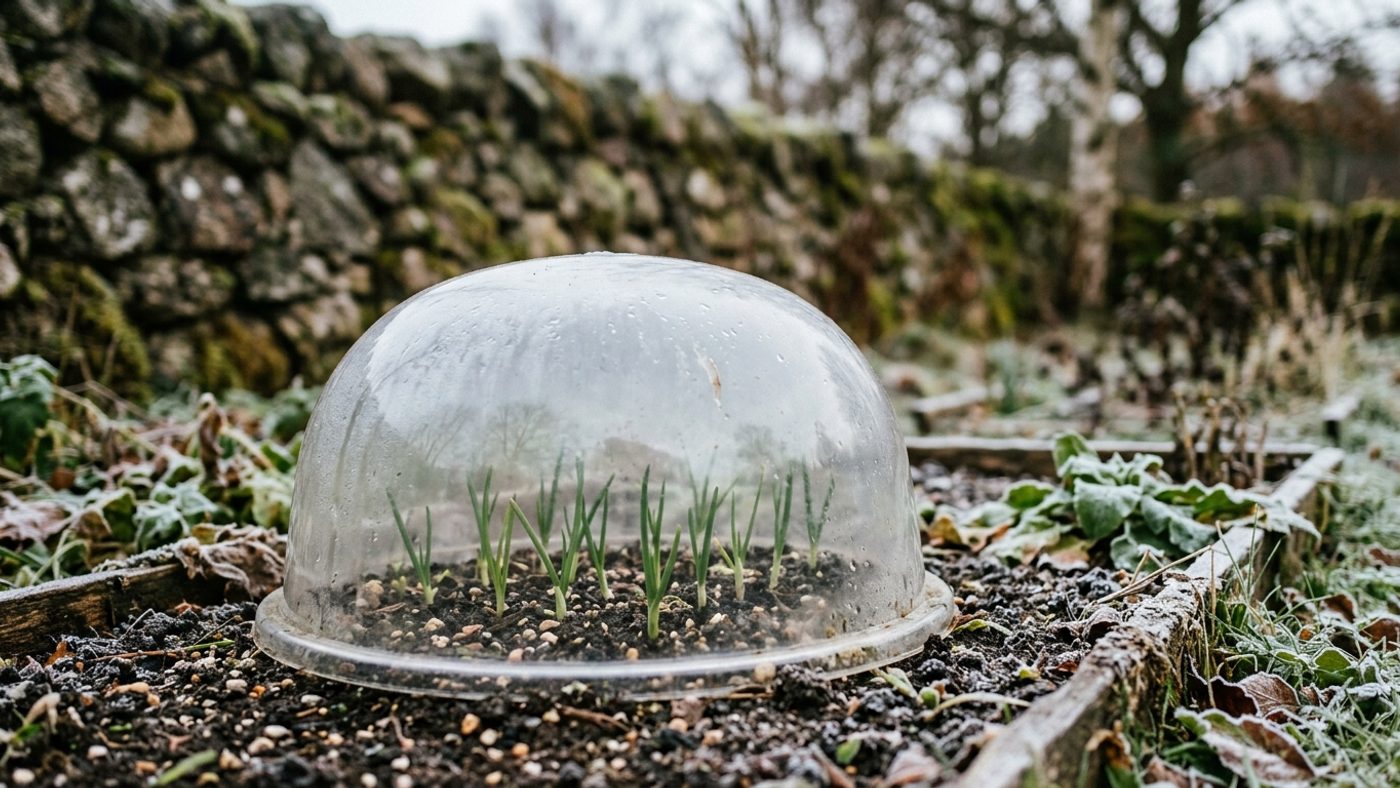
The name undersells this crop's range. A hardy variety such as White Lisbon can be sown in late summer or early autumn, protected through hard weather with a clocheA small, portable clear cover placed over an individual plant or short row to trap warmth and keep off wind, rain and pests. Full definition → or biodegradable fleeceA lightweight, breathable fabric laid or draped over plants to trap a little warmth and keep off frost, wind and some flying pests. Full definition →, and left to overwinter for harvest the following spring, well ahead of anything sown fresh that year. It's worth treating as a separate sowing on the calendar, not an afterthought to the main summer succession.
Rotation: spring onions share a family with onions and garlic
Track spring onions together with bulb onions, shallots and garlic in your rotationMoving each crop family to different ground each year, on a multi-year cycle, so pests and diseases that build up in soil don't get a repeat host. Full definition → plan, not as a separate, faster-growing exception. Leave a gap of 4-5 years before returning any of them to the same ground, to stop white rot building up in the soil.
Varieties
RHS also lists 'Guardsman' with AGMThe RHS's Award of Garden Merit: a UK-wide trials award for reliable performance, not a Scotland-specific recommendation. Full definition → (though the badge only appears on the general variety list, not its own individual plant page) and 'Photon' without AGM. The award is UK-wide, not a Scottish one. Some varieties can also be left to swell into a full bulb onion if you thin out every other seedling instead of pulling them all young.
★ Our pick for Scotland
White LisbonAGM
Quick-growing, suitable for successional sowingSowing a small batch of seed every couple of weeks, rather than all at once, so crops mature in a staggered sequence instead of a single glut. Full definition → and overwintering
Covers both the summer succession crop and a hardy autumn sowing.
Why this one: White Lisbon is the one AGM variety named for both jobs this crop does well in Scotland: a fast, repeatable summer supply from successive sowings, and a hardy late-summer sowing that overwinters for an early spring crop.
Also worth considering
IshikuraAGM
Long stalks without bulb swelling
Stays usable for longer without swelling into a bulb, useful insurance while you work through a run of succession sowings.
Best Spring Onion Varieties for Scotland → compares all named spring onion varieties head-to-head, with the practical detail that doesn't fit in a summary card.
Care
Water young plants until they're established, then only during prolonged dry spells; container-grown plants need watering more often than anything in the ground. Hoe between rows and hand-weed close to the plants, since a crowded row of spring onions has little room to compete with weeds on its own.
Harvesting
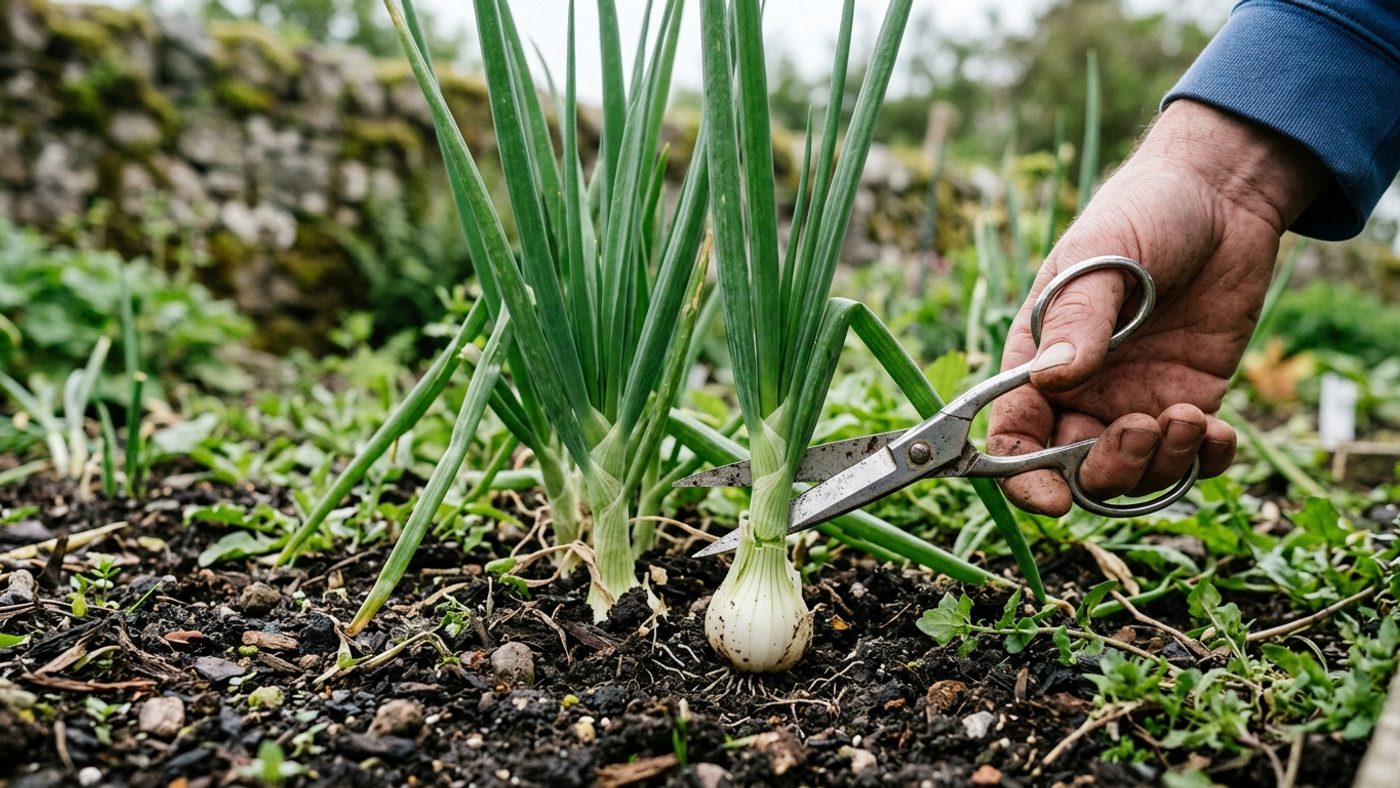
Pull at two months from sowing, young and small, around 15cm tall with the bulb no more than 1-2.5cm across, for the sweetest, mildest flavour. A 3m row sown thickly can give somewhere in the region of 250-300 onions across a season of repeat pulling.
Worth knowing: a perennial alternative
If replanting every few weeks isn't for you, bunching onions are a perennial alternative in the same family: you cut the leaves for use and leave the bulb in the ground to keep producing, rather than pulling the whole plant. Only one source mentions it, so treat it as worth trying rather than a fully proven option.
Common problems
- Slugs and snails are the main risk to young seedlings, particularly in a wet spring.
- Onion downy mildew damages foliage and bulbs and is encouraged by overcrowding. Thin seedlings properly rather than leaving a dense row.
- Onion fly maggots damage roots and bulbs and can kill seedlings outright. Fine mesh or fleece from sowing is the reliable defence, not a companion plant.
See more problems
- Onion white rot is the reason a proper rotation matters: once established in the soil, there's no chemical treatment, and it can persist for years.
Common questions
Should I leave spring onions in the ground to grow bigger?
No: they're best pulled young and small, about 15cm tall with the bulb no more than 1-2.5cm across; left longer the bulb swells and the flavour coarsens. Full sourced breakdown: <a href='/tools/garden-myths/spring-onions/'>Spring Onion Myths →</a>
Does growing mint next to spring onions keep onion fly away?
Unproven: only one source makes the claim, and neither RHS's growing guide nor its companion planting feature backs it up, so don't rely on it in place of proper crop covers. Full sourced breakdown: <a href='/tools/garden-myths/spring-onions/'>Spring Onion Myths →</a>
Can spring onions only be sown in spring?
No: a hardy variety such as White Lisbon can be sown in late summer or early autumn and left to overwinter, cropping the following spring well ahead of anything sown fresh that year. Full sourced breakdown: <a href='/tools/garden-myths/spring-onions/'>Spring Onion Myths →</a>
Do spring onions need the same rotation break as bulb onions?
Yes: they're the same species as bulb onions, just harvested young, and carry the same soil-borne disease risk, so track them in the same rotation slot as onions, shallots and garlic with a 4-5 year gap. Full sourced breakdown: <a href='/tools/garden-myths/spring-onions/'>Spring Onion Myths →</a>
Sources
4 sources, and what each was used for
- RHS: sowing timing and succession, indoor and container sowing options, spacing, depth, thinning, watering, weeding, winter protection for hardy varieties, harvest timing and size, five named varieties with exact AGM status, pest and disease list
- gardenersworld.com: gives a tighter row spacing (10cm) than RHS's 20cm, shown as a genuine difference rather than resolved one way; adds a concrete yield figure (250-300 per 3m row) RHS doesn't give
- Teagasc: explicitly names 'scallions' (spring onions) alongside onions, shallots and garlic in its 4-5 year onion-family rotation guidance
- Garden Organic: one-sentence mention of bunching onions as a perennial alternative that's cut for leaves rather than pulled whole — too thin to build a section on, flagged honestly as a single-source aside rather than expanded into more than the source actually supports