
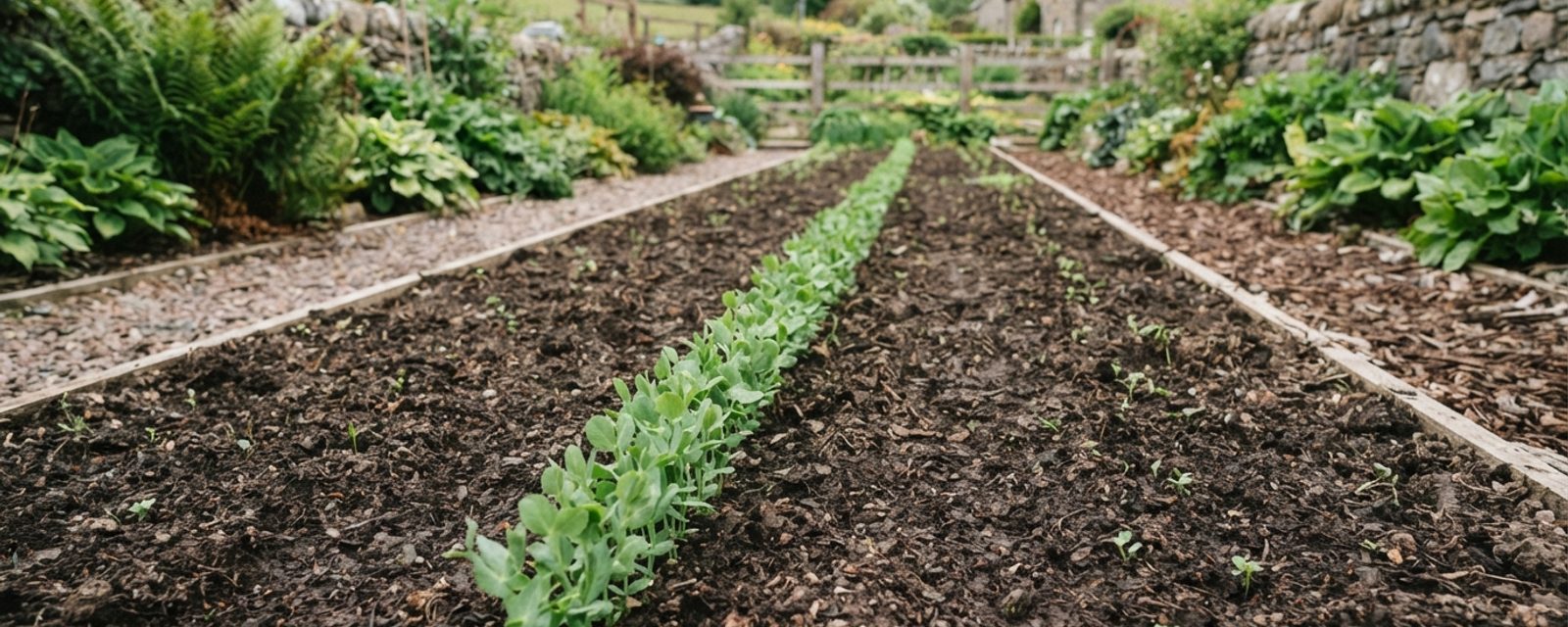
A seed sitting in cold soil is not simply "waiting", it is actively taking on water. The first stage of germinationA seed sprouting: breaking dormancy and putting out its first root and shoot, given the right warmth and moisture. Full definition →, imbibition, happens whether or not the temperature is right, because it's a physical process driven by the seed coat's permeability, not a biological switch. Once water has been absorbed, the seed's stored enzymes are supposed to activate and start converting starches into the sugars that fuel the embryo's first root and shoot. That enzyme activation is temperature-dependent.
Below a crop's minimum threshold, the seed has already taken on water it can't yet use, it's swollen, softened, and metabolically stalled, sitting in damp soil with no active growth to protect it. That combination is exactly what soil-borne fungi and bacteria exploit, causing seed rot and damping-offA fungal disease that kills seedlings at soil level, usually caused by overwatering, poor airflow, or reused unsterilised compost or trays. Full definition → (a fungal infection that kills seeds before or just after they emerge, rather than simply slowing them down). This is why sowing into cold soil doesn't just mean "slower" germination, it changes what actually happens to the seed while it waits.
That mechanism is the reason a genuine soil-temperature figure matters more than a calendar date, and why a UK-average seed-packet date and a realistic Scottish sowing date can be several weeks apart.
Germination temperature reference table
The figures below are the RHS's own stated minimum and optimal soil temperatures for each crop, not a rounded average across broad categories, so they're specific to what each crop actually needs. A dash means that particular figure isn't published for that crop, treat it as unknown, not as "no risk."
| Crop | Minimum soil temperature | Optimal / stated range | Typical days to germinate |
|---|---|---|---|
| Chilli pepper | not separately stated | around 21°C (70°F) | not stated |
| Courgette | not separately stated | 18-21°C (65-70°F) | not stated |
| Tomato | not separately stated | about 18°C (64°F) | usually within a fortnight (~14 days) |
| Sweetcorn | 10°C (50°F) | 18-21°C (65-70°F) | about two weeks |
| Runner bean | 12°C (54°F) | — | not stated |
| Parsnip | around 12°C (54°F) | — | 14-30 days, depending on conditions |
| Pea | around 10°C (50°F) | — | not stated |
| Beetroot | 7°C (45°F) | — | not stated (ready to harvest in 40-60 days from sowing, which includes growing-on time, not just germination) |
| Radish | not stated (general vegetable minimum of about 7°C applies) | — | 7-10 days |
As a general baseline across vegetable crops, most seeds won't germinate below a soil temperature of about 7°C (45°F), per RHS guidance, that's the floor, not a target, and several crops above need considerably more warmth than that floor to get going reliably.
The table splits into two clear tiers rather than a smooth scale: beetroot, radish, pea and parsnip germinate not far above the soil temperatures Scotland typically reaches in early-to-mid spring (see the regional evidence further down), while tomato, courgette, sweetcorn and chilli need soil in the high teens Celsius, warmer than most Scottish outdoor soil reaches until late spring or early summer, hence the standard advice to start those under cover.
Minimum versus optimal isn't just "warmer is faster"
The gap between a crop's stated minimum and its optimal or preferred temperature isn't decorative. Parsnip is the clearest example in the data above: germination can take anywhere from 14 to 30 days "depending on conditions," more than double the time at the slow end. That's not a quirk of parsnip; it reflects that enzyme reaction rates in the seed genuinely speed up with warmth, up to a point, so a seed sown right at its minimum threshold can sit doing very little for weeks, while the same seed sown once the soil is comfortably above that minimum gets moving in days. Sowing "as soon as it's technically possible" and sowing at the crop's actual optimum are two different decisions with a real time cost attached to the first one.
Air temperature and soil temperature are not the same measurement
A weather forecast reports air temperature, usually measured about 1.2 metres above ground in shade. That number can swing by 10°C or more within a single day, and it responds to a passing warm spell within hours. Soil is a different physical system: it has far greater thermal mass, so it heats and cools much more slowly than the air above it, and that lag is more pronounced through spring than at other times of year. The Met Office's own explanation of late-spring ground frost makes the underlying reason plain: at this point in the year the ground has not yet accumulated as much stored warmth as it does later in summer, which means air temperature and ground conditions can diverge, mild afternoon air overlying soil, and especially the ground surface overnight, that hasn't caught up.
Practically, this means a mild, sunny week in April is not proof the soil is ready. It's evidence the air is ready. The two numbers move together over a season, but not in lockstep from day to day, and it's the soil number that actually governs whether a seed rots or grows.
How to actually measure soil temperature
A soil thermometer is the only reliable way to know where you stand, and it's a cheap, simple tool rather than specialist kit. The practical method:
- Depth: push the probe into undisturbed soil at the depth you'll actually be sowing at, commonly around 2.5-5cm (1-2in) for most vegetable seeds, though a 10cm depth is used for more stable readings where growth thresholds (rather than surface-level sowing depth) are the concern.
- Timing: take the reading in the morning, before the sun has warmed the surface, so you're not measuring a temporary daytime spike.
- Consistency: don't act on a single reading. Take readings over several consecutive days, the point is to confirm the soil has settled above the threshold, not that it touched it briefly on one mild afternoon.
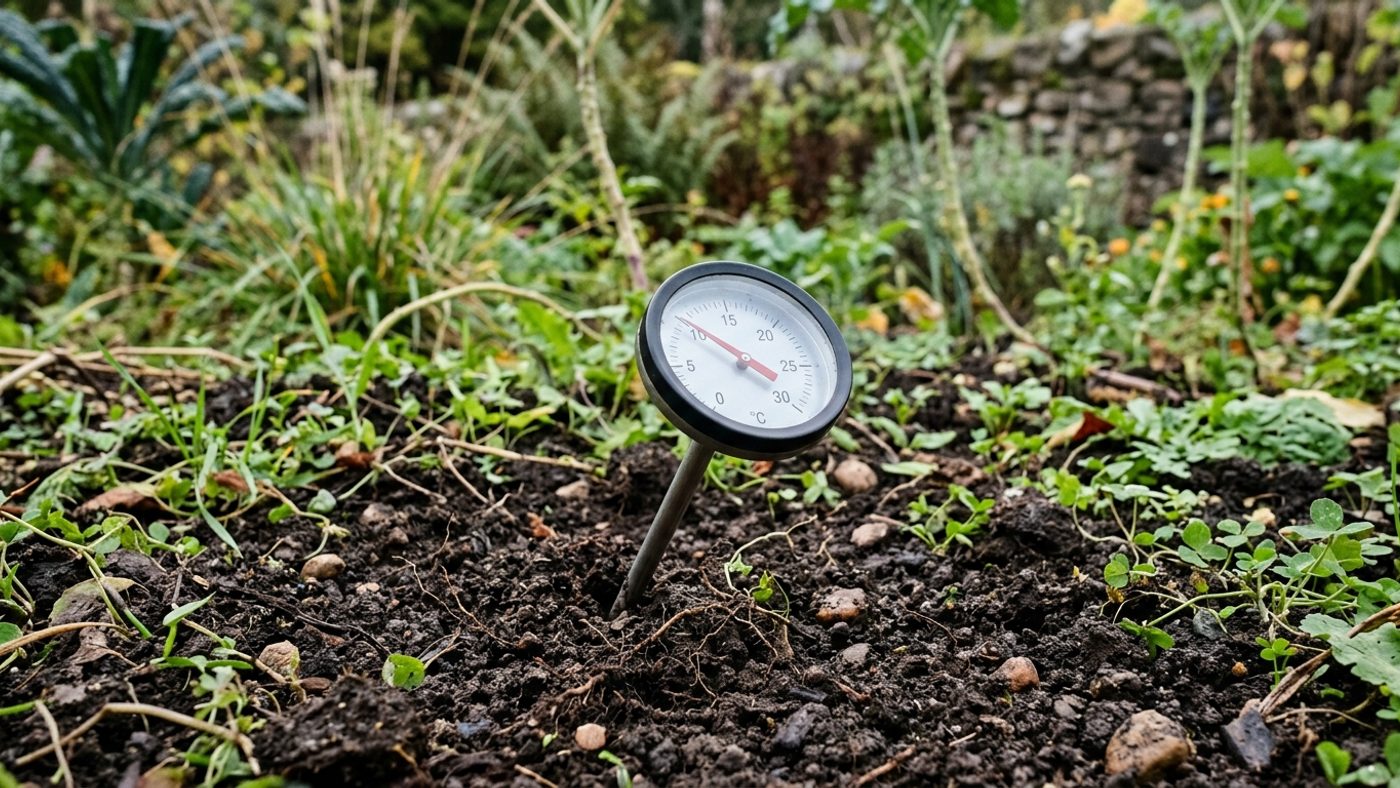
This routine, a cheap thermometer, a sensible depth, and multiple days of readings rather than one, is standard practice in cool, wet, Atlantic-influenced climates for tracking soil temperature ahead of a growth decision. Ireland's Teagasc, advising growers in conditions close to Scotland's own (cool, wet, maritime, short summer), uses soil temperature rather than the calendar as the trigger for spring growth decisions, the same logic holds in a Scottish garden.
Warming soil faster, rather than just waiting
Where soil is close to a crop's minimum but not quite there, warming it artificially can bring sowing forward by a useful margin rather than losing the wait entirely. RHS guidance for speeding this up is straightforward: put clochesA small, portable clear cover placed over an individual plant or short row to trap warmth and keep off wind, rain and pests. Full definition →, clear plastic sheeting, or even bottomless plastic bottles over the soil a few weeks before sowing or planting, and keep the cover in place after sowing too, removing it gradually rather than all at once, since a sudden drop back to unprotected outdoor temperatures can set young growth back hard.
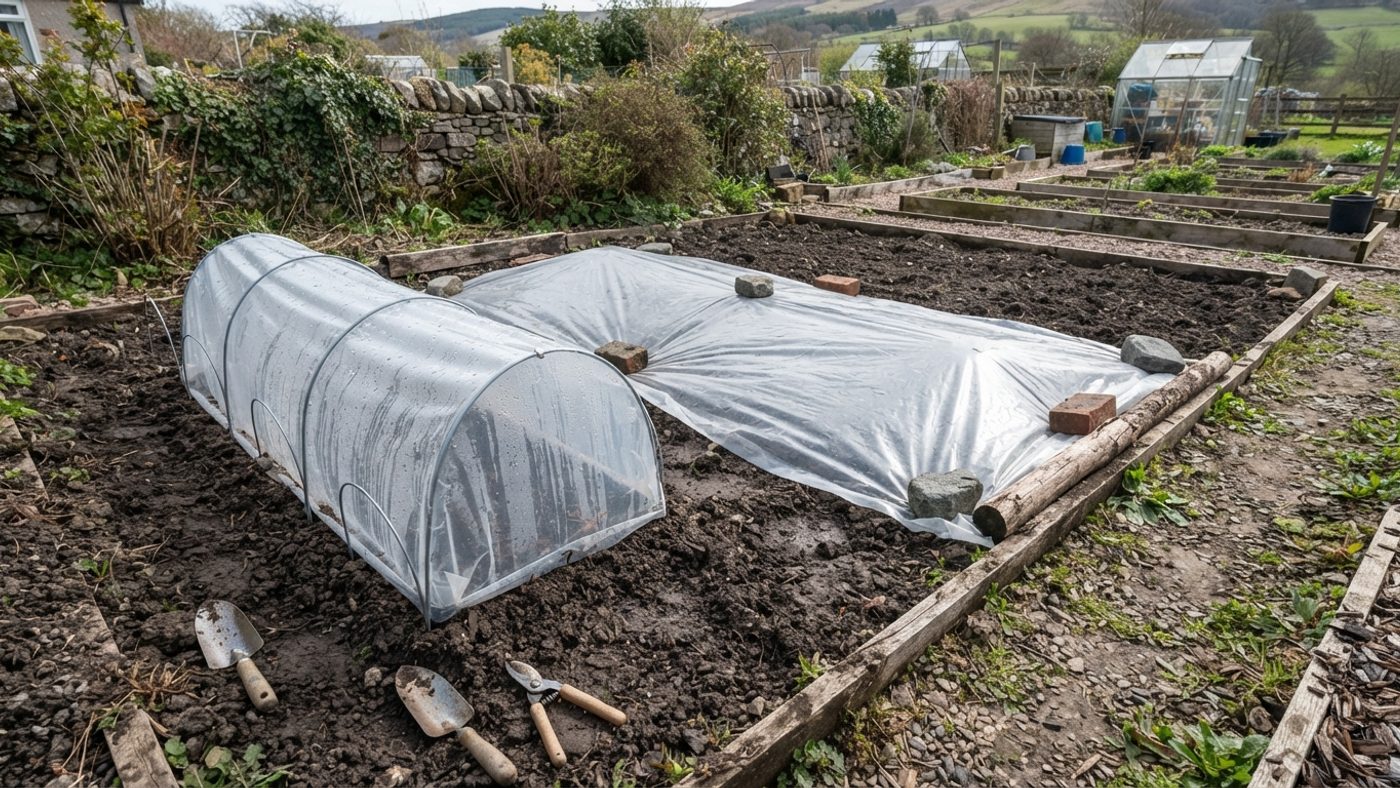
An unheated greenhouse or polytunnel bed works on the same principle at a larger scale, trapped solar heat under cover rather than open air, so soil inside one typically reaches germination thresholds ahead of an open bed outdoors, worth using instead of an open bed if you have one. This is worth doing routinely on the crops in the table above that sit in the high-teens tier (tomato, courgette, sweetcorn, chilli) if you're sowing or planting them out directly rather than starting them indoors, since a Scottish outdoor bed is exactly the situation where a few degrees' head start matters most. Where suppliers offer an early or quick-maturing variety of a given crop, that's a further way to work with a shorter effective warm season rather than fighting it, though no institutional source publishes a "recommended for Scotland" variety list to point to here.
Sowing indoors ahead of the soil being ready, rather than waiting it out, only solves half the problem: seedlings raised on a windowsill or in a propagator still need hardening off before they go into open ground, and shouldn't be planted out before the soil itself is warm enough regardless of how established they look.
What too-cold soil actually does to a seed
"Slower germination" understates what's going on: the extended vulnerable period described above is why cold-soil sowings tend to come up patchy rather than uniformly late. It isn't that every seed germinates on the same slow schedule, some rot outright while others, marginally better positioned or slightly more vigorous, scrape through. The gappy rows and scattered missing seedlings gardeners actually see are the visible outcome of that uneven survival, not a sign the crop was simply sown a bit early.
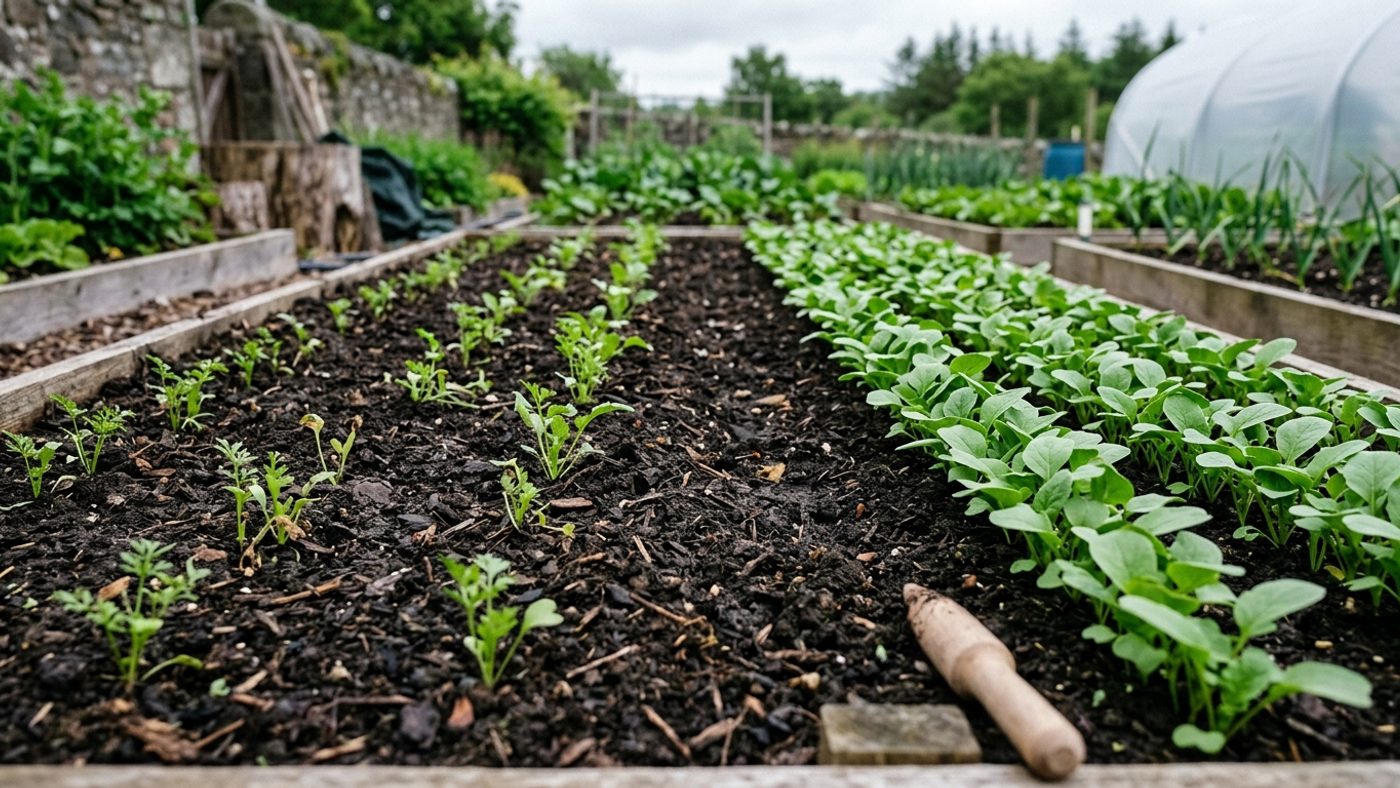
Heavy, poorly drained soil, common on Scottish clay, compounds this risk beyond temperature alone: it holds more water for longer than free-drainingSoil that lets water pass through quickly rather than pooling, so roots aren't sitting in wet ground after rain. Full definition →, sandy soil, which is exactly the damp, saturated environment the rot organisms above need, on top of being slower to warm in the first place. A raised bed warms and drains faster than flat, undrained clay for the same reason a cloche does, more exposed surface, less standing water, and is worth using for the crops in this article's higher-threshold tier if your own ground is heavy; see improving clay soil for the fuller fix.
Scotland's spring lag: what the real numbers show
No public dataset measures Scottish soil temperature directly, so the comparison below uses Met Office air-temperature data as a proxy instead. These are air temperatures, 1991-2020 long-term averages, not soil readings, treat the comparison as directional rather than as a substitute for an actual soil-temperature reading in your own garden.
| Location | March (max / min °C) | April (max / min °C) | May (max / min °C) |
|---|---|---|---|
| Camborne, Cornwall | 10.2 / 5.4 | 12.1 / 6.6 | 14.5 / 8.8 |
| Edinburgh, Royal Botanic Garden | 9.7 / 2.9 | 12.2 / 4.7 | 14.9 / 7.1 |
The pattern in the table: daytime highs are close between the two (Edinburgh's April maximum, 12.2°C, is essentially Camborne's, 12.1°C), but nights are where the real gap sits, Edinburgh runs 1.9-3.7°C colder overnight than Camborne every month shown. That overnight gap matters more than the similar daytime highs suggest, because soil temperature reflects day and night together, not just the afternoon peak, so a mild-day, cold-night spot like Edinburgh doesn't build up soil warmth as fast as a location that's mild around the clock.
One way to read the scale of it: Edinburgh's April overnight low (4.7°C) is close to Camborne's March overnight low (5.4°C), a rough month's difference on the coldest part of the daily cycle, which is the part that most directly threatens seeds sitting in damp ground overnight. This is air-temperature data from a single Scottish station (Edinburgh's Royal Botanic Garden, in the milder Central Belt), not a measured soil-temperature gap, and it doesn't speak for the whole country, Scotland's real spread runs from the Gulf-Stream-moderated west coast to the colder Highlands and upland interior. Taken together with the general fact that soil itself further lags the air above it, particularly in spring, it's a reasonable (not proven) indication that the Central Belt specifically reaches common vegetable germination thresholds later than a UK-average seed packet date assumes.
For the rest of Scotland, Met Office frost-risk data for named stations (Edinburgh, Inverness, Aberdeen/Dyce, and the inland stations Eskdalemuir and Braemar) shows the same coastal-versus- inland and lowland-versus-upland pattern that also governs soil warming, and gives a reasonable starting point for when to begin checking soil in your own area:
| Region | Safe planting-out date (frost-based) | What it means for outdoor sowing |
|---|---|---|
| Central Belt & Moray Firth coast (Edinburgh, Inverness) | Mid May | Earliest realistic point to start checking soil for lower-threshold crops (peas, beetroot, radish) |
| Northeast lowland (Aberdeen/Dyce) | Late May | Roughly two weeks behind the Central Belt |
| Upland/inland (Eskdalemuir, Braemar) | Early-to-mid June | Three to four weeks behind the Central Belt; hold off outdoor sowing of most crops until then |
These dates come from average last-frost timing, not measured soil temperature, so treat them as a starting point for when to bring out the thermometer, not a substitute for reading it. The full station-by-station breakdown, including the Hebrides, Shetland and Borders, is at the regional frost-dates page.
The practical takeaway for sowing dates in Scotland
Two adjustments follow from the data above:
- For crops with a genuinely high minimum threshold, tomato, chilli, courgette, sweetcorn, sowing under cover indoors and planting out once outdoor soil has demonstrably warmed (checked with a thermometer, not guessed from a mild day) is the safer default in Scotland specifically, not just a "belt and braces" precaution.
- For crops with a lower minimum, pea, beetroot, radish, parsnip, outdoor sowing is realistic earlier, but the seed-packet's "early spring" date is worth treating as a starting point to check against actual soil readings rather than a fixed instruction, given the later spring warming shown above and the regional spread in the table above.
Frost risk and soil-temperature risk are related but separate checks, and both are worth doing before an outdoor sowing rather than relying on either alone.
Common questions
Is soil temperature or air temperature more important for deciding when to sow?
Soil temperature is what actually governs germination, since that's the environment the seed sits in. Air temperature is a useful early signal that spring is progressing, but a mild, sunny spell doesn't mean the soil underneath has caught up yet, soil has far more thermal mass and warms more slowly than the air above it.
How many days of soil-temperature readings should I take before sowing?
A single reading, especially on a warm afternoon, isn't reliable, take morning readings on several consecutive days to confirm the soil has genuinely settled above the crop's minimum, rather than briefly touched it.
Can I sow at the minimum temperature listed, or should I wait for the optimal range?
You can sow at the minimum, but expect it to be slow and, for some crops, more uneven, parsnip, for example, can take anywhere from 14 to 30 days depending on conditions. Waiting until the soil is comfortably within the crop's preferred range generally means faster, more even germination.
My garden's on the west coast or in the Highlands — does the Edinburgh comparison still apply to me?
Not directly. Edinburgh represents the Central Belt specifically, and Scotland's regional spread is wide: the Gulf-Stream-moderated west coast and Moray Firth coast tend to run closer to Central Belt timing, while the Northeast lowland typically lags by around two weeks and upland or inland ground by three to four weeks, going by the Met Office frost-risk data in the regional table above. Use that table as a starting point, then confirm with your own thermometer.
What actually causes patchy or gappy germination when soil is too cold?
A seed that has absorbed water but is held below its activation temperature stays swollen and metabolically inactive for longer, which extends the window in which fungal and bacterial rot organisms in cool, damp soil can attack it. Some seeds succumb and others survive, which shows up as a patchy, gappy row rather than uniform late germination.
Sources
14 sources, recorded with what each was used for
- RHS: How to grow Tomatoes: Sowing temperature (18°C) and germination time for tomato
- RHS: How to grow chilli peppers: Germination temperature (around 21°C) for chilli
- RHS: How to grow courgettes: Germination temperature range (18-21°C) for courgette
- RHS: How to grow sweetcorn: Minimum and optimal germination temperature and germination time for sweetcorn
- RHS: How to grow runner beans: Minimum soil temperature (12°C) for runner bean
- RHS: How to grow Parsnips: Minimum temperature and germination time (14-30 days) for parsnip
- RHS: How to grow peas: Minimum soil temperature (~10°C) for pea
- RHS: How to grow Beetroot: Minimum soil temperature and days-to-harvest figure for beetroot
- RHS: How to grow radishes: Germination time (7-10 days) for radish
- RHS: Getting started with vegetables — seed sowing techniques: The general baseline that most seeds won't germinate below about 7°C, and the cloche/clear-plastic-sheeting/bottomless-bottle soil-warming method
- Met Office: Camborne, location-specific long-term averages (1991-2020): March/April/May max and min air-temperature normals for the Cornwall comparator
- Met Office: Edinburgh, Royal Botanic Garden, location-specific long-term averages (1991-2020): March/April/May max and min air-temperature normals for the Edinburgh comparator
- Met Office blog: Why frost can still occur in late Spring: Explanation that the ground has not yet accumulated stored warmth in spring, causing air and ground conditions to diverge
- Teagasc: How Does Grass Grow? (Irish agricultural authority): Soil-thermometer measurement method (10cm depth) from a comparable cool, wet, maritime climate; used for method only, not as a Scottish figure