
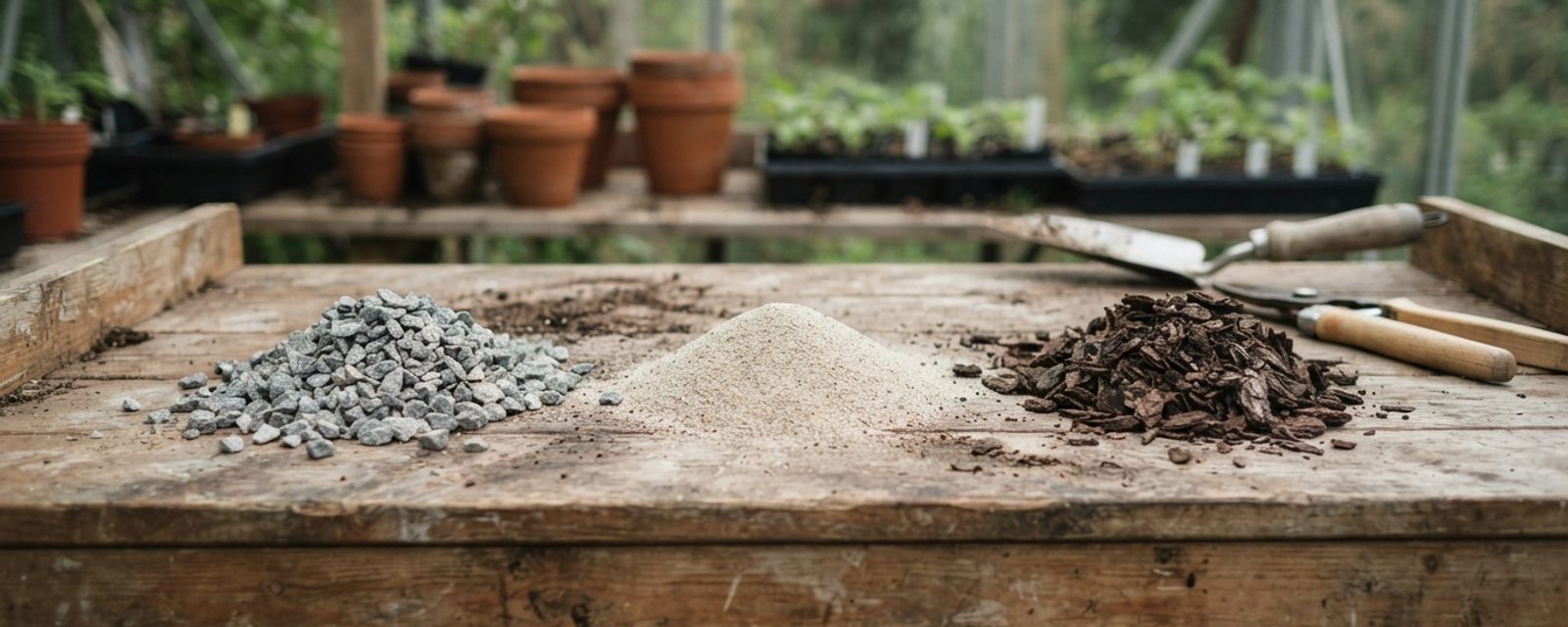
What actually improves drainage isn't the name on the bag, it's particle size and shape. Angular grains of a consistent size wedge apart, leaving air gaps between them; fine, rounded, or mixed-size particles slump together and pack down, sealing gaps rather than opening them. That single mechanism decides whether the material in your hand will do anything useful, and it's why horticultural grit, sharp sand, perlite, vermiculite and composted bark each earn a different job in the garden rather than being interchangeable "drainage stuff."
The mechanism, before the products
Soil drainage is really a question of pore space, the gaps between solid particles where water can move through and air can get in. Clay particles are flat, microscopic platelets that stack tightly against each other, leaving almost no space for water to pass. Adding something coarse and angular between those platelets props them apart and creates channels. Adding something fine, rounded, or that breaks down under pressure does the opposite: it fills whatever gaps existed and can compact into something closer to concrete than soil.
Lightweight porous particles (perlite, vermiculite) do something related but different, they hold their own internal air or water rather than propping apart the surrounding soil, which is why they behave differently in a pot than they do dug into a border. Bulky organic matter (composted bark, well-rotted manure) works through a third mechanism entirely: it feeds soil biology and binds clay particles into stable crumbs, rather than physically wedging them apart.
Getting that mechanism wrong is what costs gardeners money and, in clay soil, years of wasted digging.
What each material actually is
Horticultural grit
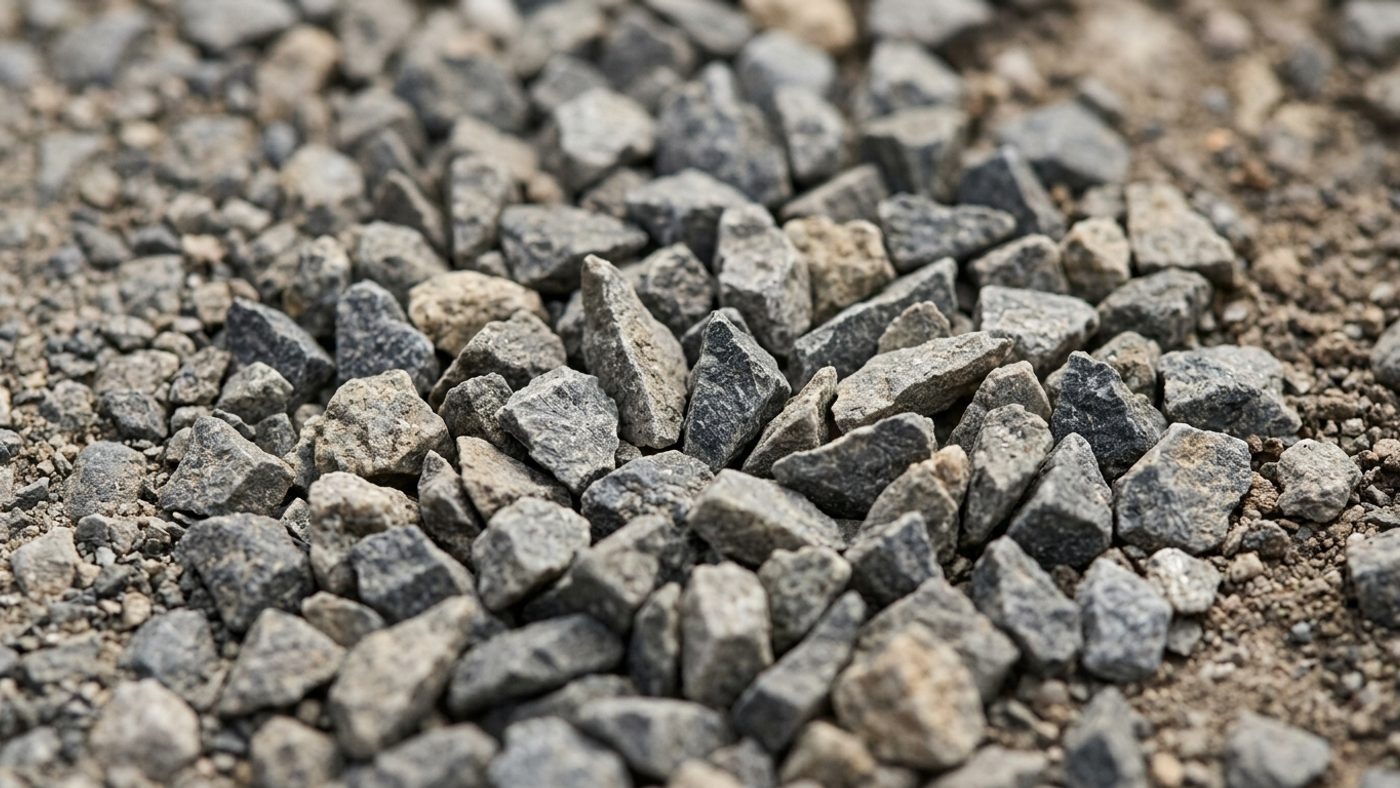
Crushed granite or limestone, screened to a consistent particle size, with sharp, angular fracture faces rather than the rounded edges you get from naturally weathered stone. UK suppliers typically sell it in the roughly 1–6mm range, grades vary by supplier, so check the bag, sold as "potting grit" for finer, more uniform seed and cutting mixes, or "horticultural grit"/"landscape grit" for slightly coarser mulchingA layer of material spread over the soil around plants to suppress weeds, retain moisture, and improve soil structure as it breaks down. Full definition → and border use. It's washed and graded for consistency, and reputable horticultural grit is sold at a neutral pH, which matters around lime-sensitive plants, a real consideration in Scotland, where much of the native soil already runs acidic and gardeners routinely grow ericaceous plants (rhododendrons, blueberries, heathers) that a lime-contaminated grit could upset.
Grit also does a second, less-discussed job worth knowing about in a wet, mild Scottish climate: a top-dressingAdding fresh compost, feed or grit to the soil surface around an established plant, rather than digging it in. Full definition → of grit around the crownThe base of a perennial plant where roots and shoots meet, often sold and planted as a ready-made dormant plant rather than grown from seed. Full definition → of alpines, sedums, and other plants prone to rotting off keeps foliage and stems away from standing surface moisture over winter, which is often what actually kills a borderline-hardy plant rather than cold itself. The same logic applies below a pot, not just inside it: raising a container onto pot feet or bricks stops its drainage holes sitting in a puddle on the patio through a wet winter, which otherwise undoes whatever free-drainingSoil that lets water pass through quickly rather than pooling, so roots aren't sitting in wet ground after rain. Full definition → mix is inside it.
Sharp sand (horticultural/washed sand)
Coarse, angular sand, washed to remove silt and clay "fines," the dust-fine particles left behind in unwashed sand that clog pore space rather than opening it, and sold specifically for potting and soil-improvement use. This "sharp sand" of the potting-compost world is a different product from builders' sharp sand sold at builders' merchants, even though the two share a name.
Perlite
A volcanic mineral (obsidian-type rock) that's crushed and then heated to around 850–900°C, at which point trapped water vaporises and the particles "pop" into lightweight, porous white granules, essentially tiny popcorn made of glass. It holds very little water and barely holds onto nutrients at all, low cation exchange capacity, dries out quickly, and its main job is aeration and fast drainage inside a growing medium rather than structural drainage in open ground. There's a sustainability caveat too: perlite's manufacture, packaging and transport carry a real environmental cost, and current guidance points growers toward locally sourced grit or gravel instead where perlite was traditionally used, in Scotland, that locally-sourced alternative is easy to find, since crushed granite and, in some areas, basalt or whin (dolerite) grit are quarried domestically rather than shipped in. Pumice, a lighter volcanic stone that does a similar aeration job without perlite's manufacturing footprint, is a less common but genuine alternative worth asking a supplier about. Perlite and vermiculite both turn up constantly in bagged peat-freeCompost made without peat, which is harvested from a slow-forming, carbon-storing wetland habitat that peat extraction damages. Full definition → compost as the ingredient doing the aeration or moisture-holding job peat used to do, worth knowing if a mix's drainage behaviour surprises you, since it's often down to how much of one or the other the manufacturer has used.
Vermiculite
A different mineral again, hydrated mica, heat-expanded into soft, spongy, silvery-brown flakes. Unlike perlite, it holds water readily and has meaningfully higher nutrient-holding capacity, so it behaves more like a moisture reservoir than a drainage channel. That's exactly why it's the standard choice folded into seed-starting and cutting mixes: it keeps germinatingA seed sprouting: breaking dormancy and putting out its first root and shoot, given the right warmth and moisture. Full definition → seed from drying out while still letting roots push through easily. It is not the material to reach for if the goal is getting water to move away faster, for that job it's the weaker choice of the two expanded minerals, not the stronger one.
Bark and composted organic matter
Composted bark, well-rotted manure, garden compost and leafmould aren't "drainage materials" in the particle-mechanics sense at all, they don't wedge soil apart the way grit does. Their effect on clay is biological and structural: organic matter feeds the soil organisms that bind clay particles into stable crumbs, opening up pore space from the inside as it breaks down, and it keeps doing this every time more is added. Bulky organic matter, ideally composted bark, is one of the core recommendations for genuinely improving heavy clay, ranked alongside raised beds and no-digA growing method that avoids turning the soil over, building fertility instead by adding organic matter on the surface. Full definition → as real fixes, rather than positioning grit or sand as the primary answer.
Which material for which job
| Material | Particle size/form | Best suited to | Not suited to |
|---|---|---|---|
| Horticultural grit | ~1–6mm, angular, crushed rock | Seed-sowing and cutting mixes, alpine/rockery top-dressing, pot drainage, mulching plants that hate wet necks | Fixing waterlogged clay at any meaningful scale |
| Sharp/washed sand | Coarse, angular, washed of fines | Raised bed fill mix, potting mixes, lightening the top layer of a border on a small scale | Using builders'/soft-play sand as a substitute |
| Perlite | Expanded volcanic glass, very light, porous | Container and compost mixes wanting fast drainage and aeration; cactus/succulent mixes | Outdoor structural drainage in open soil; anywhere you want moisture retained |
| Vermiculite | Expanded mica, spongy, absorbent | Seed-starting and cutting compost, moisture retention in containers | Free-draining bulk fill; clay soil improvement |
| Composted bark / organic matter | Bulky, variable particle size, biologically active | Genuine clay structure improvement over seasons, raised bed fill, mulching, no-dig systems | An instant fix, it works over a growing season or several, not overnight |
Grit and sharp sand also have a place outside clay or raised beds: worked into the top spit of an ordinary heavy loam border, in modest quantity, they can lighten how quickly the surface drains after rain, without needing the raised-bed or no-dig approach a genuinely heavy clay soil calls for. The scale problem below applies with full force to clay specifically; an already-workable loam that just drains a bit slowly needs far less material to notice a difference.
The horticultural sand vs builders'/play sand confusion
This is the mix-up gardeners actually make, usually because the sand aisle at a builders' merchant is cheaper and closer than the horticultural one at a garden centre. The definition draws the line clearly: "sharp sand" sold for potting and soil use is washed and gritty, and is explicitly not the same product as builders' sharp sand, even though both go by "sharp sand."
No published figure measures builders' sand against horticultural sand the way the clay figure below measures grit, but three real differences explain why gardeners are steered away from it:
- Particle uniformity. Horticultural sand is graded to a consistent particle size. Builders' sand is a mixed bag by design, it needs a range of particle sizes to compact well for concrete and mortar, which is precisely the opposite of what you want for drainage. A well-graded mix of particle sizes fills its own gaps; that's a feature in construction and a defect in a growing medium.
- Fines, silt and lime content. Builders' sand isn't washed to the same standard and can carry silt, clay fines, and traces of lime or other residues depending on its source, which can shift soil pH and encourage the very compaction you're trying to avoid, the same lime-sensitivity concern raised above for grit around ericaceous plants applies equally here.
- Sterility and origin. Horticultural sand sold for growing use is typically washed and screened specifically for that purpose; builders' sand has no such guarantee and isn't marketed or tested against gardening standards.
Soft play sand carries a related but separate problem: it's often extremely fine and rounded, sometimes kiln-dried and sieved for a soft texture underfoot, which is close to the opposite of what drainage needs, fine, rounded grains pack together rather than propping themselves apart.
None of this means builders' sand is toxic or unusable for every purpose, it has its own applications, but for potting mixes, seed compost, or anything going into direct root contact, it's a false economy against the horticultural product it's sometimes swapped for.
Cost and availability in Scotland
| Material | Typical bag size | Rough cost | Where sold |
|---|---|---|---|
| Horticultural grit / sharp sand | 20–25kg | £5–£10 per bag, better value in bulk/trade bags | Most Scottish garden centres and builders' merchants |
| Perlite / vermiculite | Small, lightweight (mostly air) | Higher cost per litre than grit or sand | Garden centres, online |
| Composted bark / soil improvers | Bagged, or loose bulk-delivered | Cheaper per litre once bought loose/bulk for larger projects | Garden centres; landscape suppliers for bulk |
Buy perlite and vermiculite only in the quantity a season's seed-sowing and potting actually needs, since both degrade in usefulness once compressed or repeatedly wet down. For any project needing grit or sand by the tonne bag rather than a few 25kg sacks, a local quarry or aggregates supplier is usually cheaper per kilo than buying multiple garden-centre bags, worth a phone call before a large raised-bed or border project. For scale: in a 3:2:7 ratio (organic matter : sharp sand : topsoil), sand is only a sixth of the total fill by volume, so a typical 1.2m x 1.2m bed around 30cm deep needs several 25kg bags of sharp sand alongside the topsoil and compost, not a whole pallet, working out the bed's volume first (length x width x depth) and taking a sixth of that is the reliable way to size the sand order rather than guessing.
Scotland is, on average, the wettest part of the UK, though that's far from evenly spread: the west coast and Highlands see considerably more rain through the year than the drier east, around Fife, Aberdeenshire and the Lothians. Wherever a garden sits on that range, free drainage in pots and raised beds matters more the wetter the local climate runs, a container mix that copes fine through a dry spell can sit waterlogged for days after heavy rain on a west-coast plot, and slug pressure, which builds up in damp conditions generally, is another reason a grit mulch earns its keep on a wet plot: it's an uncomfortable surface for slugs to cross, on top of its drainage job.
Not every Scottish garden has the opposite problem to solve, either. Machair and other sandy coastal soils, common in parts of the Hebrides and along stretches of the west and north coasts, already drain too freely and dry out fast, there the priority is bulky organic matter to hold moisture and nutrients, not more grit or sand.
The caveat that matters most: grit alone won't fix clay
This is worth stating plainly because it's the mistake that wastes the most time and money: tipping bags of grit or sand into heavy clay soil, on its own, does not fix structural waterlogging. It's a mistake gardeners on the Central Belt's heavy clay, common ground around Glasgow, Edinburgh and Falkirk, run into often. For a soil that's 40% clay, halving that clay proportion enough to make the ground noticeably easier to work would take roughly 250kg of grit or gravel per square metre. That's not a typo-sized number; it's multiple full bulk bags per square metre, which is impractical and expensive across anything beyond a very small bed.
Worse, adding materials to clay can make it less stable rather than more, so the soil becomes harder to manage, a small or moderate quantity of grit dug into clay can behave like aggregate mixed into wet cement, locking the clay into a denser, harder-to-work mass rather than opening it up.
The materials that genuinely change clay soil are raised beds (so the problem soil is bypassed rather than amended), a no-dig approach (undisturbed soil structure improves on its own over time), gypsum or calcium additions to encourage clumping, and, repeated consistently, bulky organic matter such as manure or composted bark, plus organic mulches around permanent plantings. Grit and sand have a real role in this picture, but it's inside a raised bed fill mix or a pot, not as a stand-alone fix stirred into unimproved clay ground. For more on what does work, see the guide to raised bed materials compared.
Common questions
Can I use builders' sand instead of horticultural sand to save money?
Not for potting mixes, seed compost, or anything in direct contact with roots. Builders' sand is graded for construction, not growing, and may carry lime or silt residues that shift soil pH, and isn't washed or sterilised to a gardening standard. For a large-scale landscaping project where sand is being used purely as sub-base or bulk fill rather than a growing medium, the calculation is different, but for anything roots will sit in, pay the extra for the horticultural product.
How much horticultural grit do I need to fix waterlogged clay soil?
More than is practical to buy or dig in by hand. Roughly 250kg of grit per square metre just to halve the clay content of a 40%-clay soil makes grit amendment of open clay ground a non-starter at any normal budget or scale. For a genuinely waterlogged clay bed, a raised bed, no-dig management, or repeated organic matter additions over several seasons will do more than any quantity of grit dug in once.
What's the difference between perlite and vermiculite, and can I use them interchangeably?
Not really. Perlite is drier, lighter, and drains fast, good where you want a growing medium to dry out between waterings, like cactus or Mediterranean-herb mixes. Vermiculite holds water and some nutrients, which is why it's the standard choice for seed-starting mixes that need to stay evenly moist while seeds germinate. Swapping one for the other changes how often you'll need to water, not just the bag on the shelf.
Is horticultural grit the same as gravel or aquarium gravel?
No. Horticultural grit is specifically graded, washed, and usually pH-neutral for growing use. Aquarium gravel, decorative garden gravel, and general building aggregate can vary hugely in particle size, may not be washed to the same standard, and, particularly with some decorative or dyed gravels, may not be pH-neutral. If a project depends on a neutral, consistent product (seed compost, alpine troughs, lime-sensitive plants), buy grit sold specifically as horticultural or potting grit rather than substituting whatever gravel is cheapest.
Do I need grit in a raised bed if I'm already using good topsoil and compost?
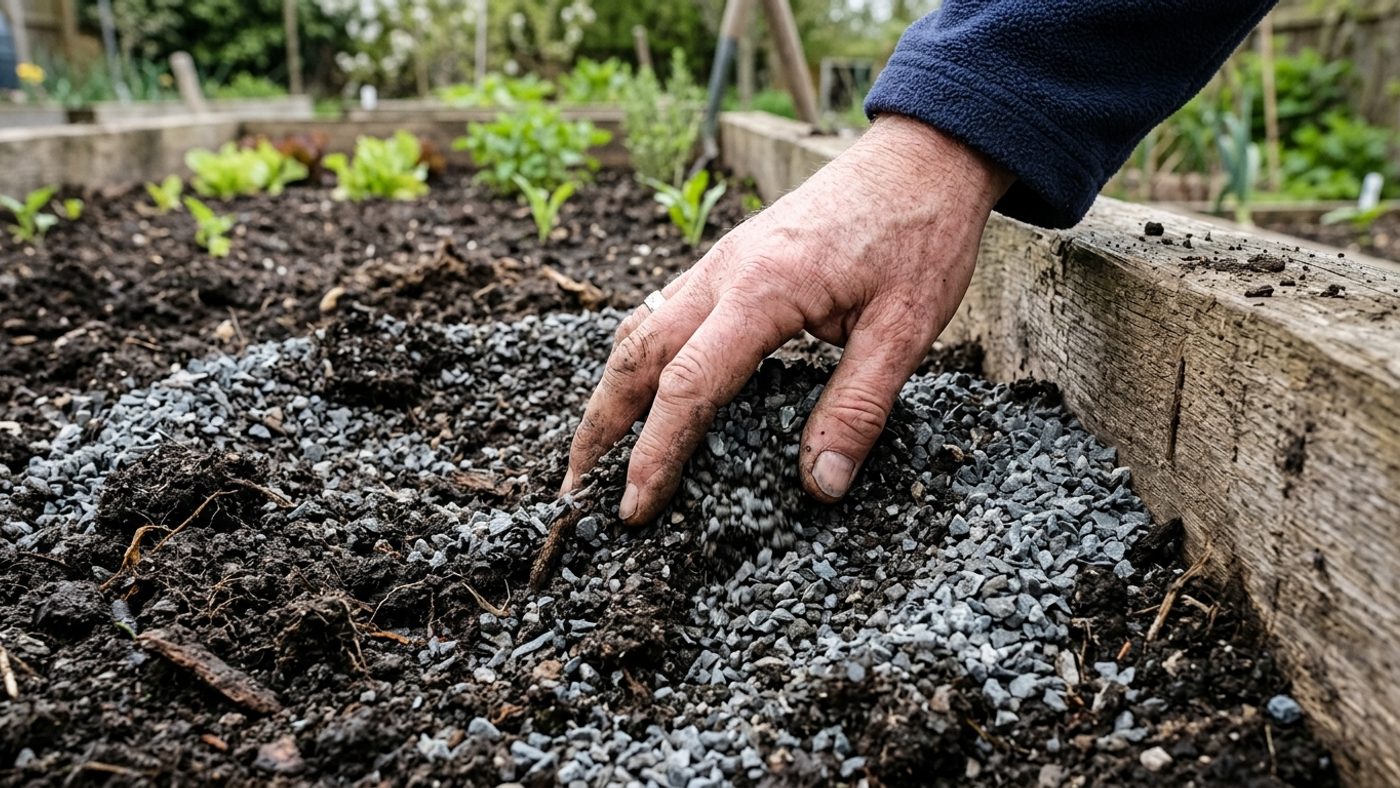
Usually yes, in modest quantity, as part of the fill mix rather than as an afterthought. A commonly used raised bed fill ratio is three parts organic matter to two parts sharp sand to seven parts topsoil, doubled to four parts sand for beds growing alpines, bulbs, or herbs that want extra drainage. That's a small, controlled amount of sand blended through good soil, a very different situation from dumping grit onto unimproved clay and hoping it works its way in.
Sources
3 sources, recorded with what each was used for
- RHS: Clay soils: The 250kg-per-sq-m grit/clay figure, the warning that added materials can make clay less stable, the sharp sand vs builders' sand definition, and the recommended fixes (raised beds, no-dig, gypsum/calcium, organic matter, mulches)
- RHS: How to make a raised bed: The 3:2:7 organic matter/sharp sand/topsoil fill ratio, the doubled-sand ratio for alpines/bulbs/herbs, and the builders' sand caveat
- RHS: Peat-free growing media: Perlite's composition, manufacturing process, and the sustainability caveat favouring locally sourced grit or gravel over perlite