
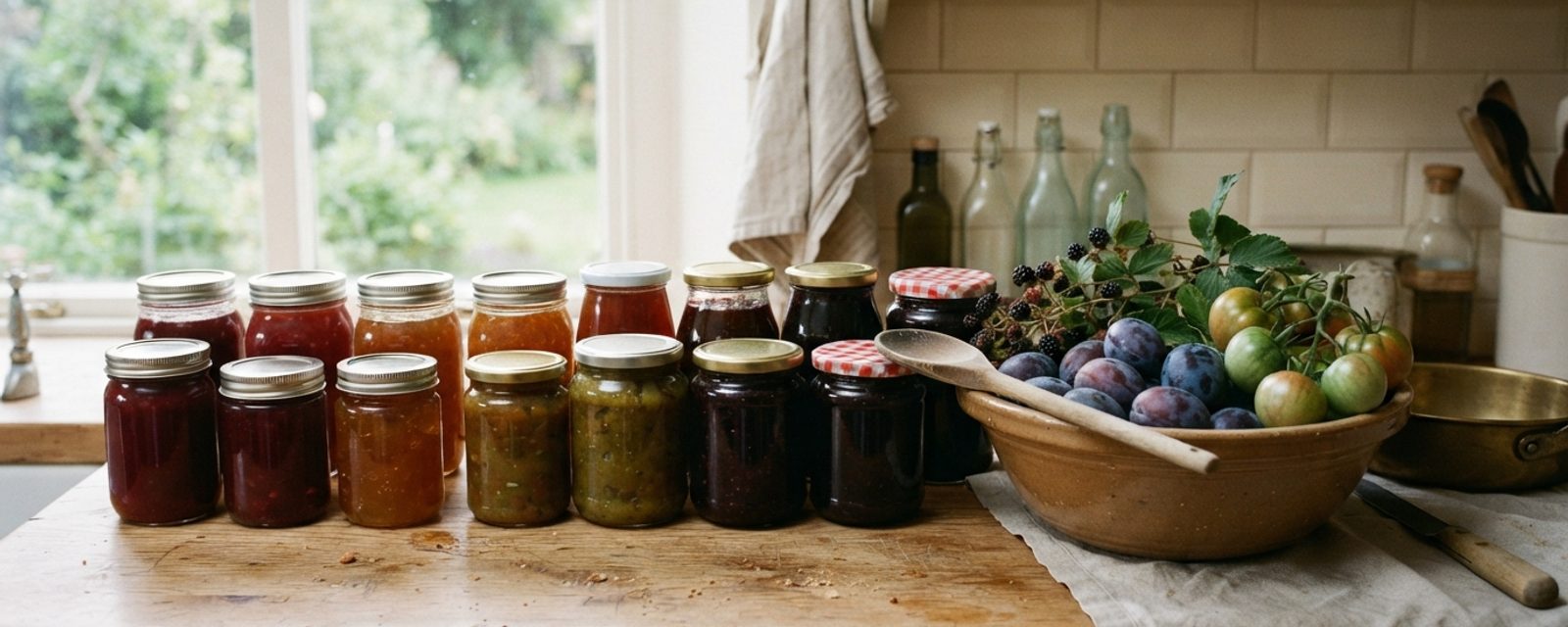
A jar of rhubarb jam that never set sits at the back of the cupboard for three weeks before anyone admits it's not going to happen. It's not spoiled, exactly, it just never crossed the line from "cooked fruit" to "jam," and it stays that way, runny and faintly sticky, no matter how long it waits. A batch of courgette chutney a few shelves along has a different problem: a thin grey-green bloom has appeared on the surface under the lid, and the question of whether to scrape it off and eat the rest underneath is exactly the wrong question to be asking.
Both of these are avoidable, and both come down to the same handful of variables: whether the sugar or vinegar ratio matched a tested recipe, whether the setting point was actually reached rather than guessed at, and whether the jar was properly sterilised before the hot jam went in. None of it is complicated once the mechanism is clear, but the mechanism is the part most jam-making advice skips past on the way to the recipe.
Why a short, hard glut points toward the jam pan
Scotland's growing season doesn't spread soft fruit and stone fruit out gently across summer the way a longer, milder season further south can. It compresses it. Currants ripen in one concentrated pulse rather than trickling in over weeks; raspberry and blackberry canes need deliberate staggering to avoid dumping the whole crop into a fortnight instead of spreading picking across the season. Rhubarb, gooseberries, plums and apples follow the same pattern in their own ways, a narrower window, a harder peak, more fruit ready at once than any one household eats fresh.
That's exactly the situation jam and chutney are built for: a fixed, urgent volume of fruit that has to be dealt with now, not a slow trickle you can keep pace with as it comes. It's also exactly the situation that tempts corner-cutting, a kitchen full of fruit and not enough jars or time pushes people toward guessing at sugar or vinegar quantities instead of weighing them out properly, and that guessing is where the real risk actually sits, not in the fruit itself.
The real reason jam and chutney are safer than plain vegetable canning
Home canning has a genuine reputation for risk, and the specific danger is Clostridium botulinum, the bacterium that produces the toxin causing botulism. Its spores are widespread in soil and can turn up on the surface of almost any garden produce. The reason plain low-acid vegetables, green beans, sweetcorn, that sort of thing, packed into jars with nothing but water are the classic botulism risk scenario is that this bacterium needs a fairly specific set of conditions to grow and produce toxin: an airtight, low-oxygen environment (which a sealed jar provides), a low-acid food, and a relatively high water activity, meaning water in a form the bacterium can actually use, not water that's chemically tied up and unavailable to it. Destroying its spores reliably needs sustained heat well above boiling point, the kind only a pressure canner delivers; a home water bath or open pan never gets hot enough.
Jam and chutney sidestep that risk by removing one of the conditions the bacterium needs, rather than by relying on heat alone. In jam, the high sugar content binds a large share of the available water, lowering water activity to a level the bacterium can't multiply in. In chutney, it's the vinegar that does the equivalent job from the other direction: dropping the pH low enough that the product is too acidic for C. botulinum, and most other spoilage bacteria, to grow. Scottish Borders Council's guidance for small-scale home preservers sets that out precisely: for pickles and chutneys, the pH needs to be 4.5 or lower, or the water activity below 0.9, throughout the product, to keep the risk under control.
That margin only holds, though, if the actual ratio in the pan matches what a tested recipe calls for. A jam made with noticeably less sugar than the recipe specifies, or a chutney simmered with less vinegar than it calls for, doesn't get the same protection, the safety isn't a property of "fruit boiled with some sugar," it's a property of hitting the specific ratio a recipe has actually been tested against. Cutting sugar or vinegar back "to taste" is one of the more common ways a homemade batch quietly loses the safety margin that made it a reasonable thing to make at home in the first place, which is exactly the kind of shortcut a rushed, glut-driven kitchen session makes tempting.
Getting jam to setting point
The runny-jam problem almost always comes down to one thing: the batch was taken off the heat before it actually reached setting point, often because there was no reliable way of telling it hadn't. Sugar concentration, not boiling time by the clock, is what determines set, so a timer alone isn't a substitute for a real test.
| Method | How it works | What to look for |
|---|---|---|
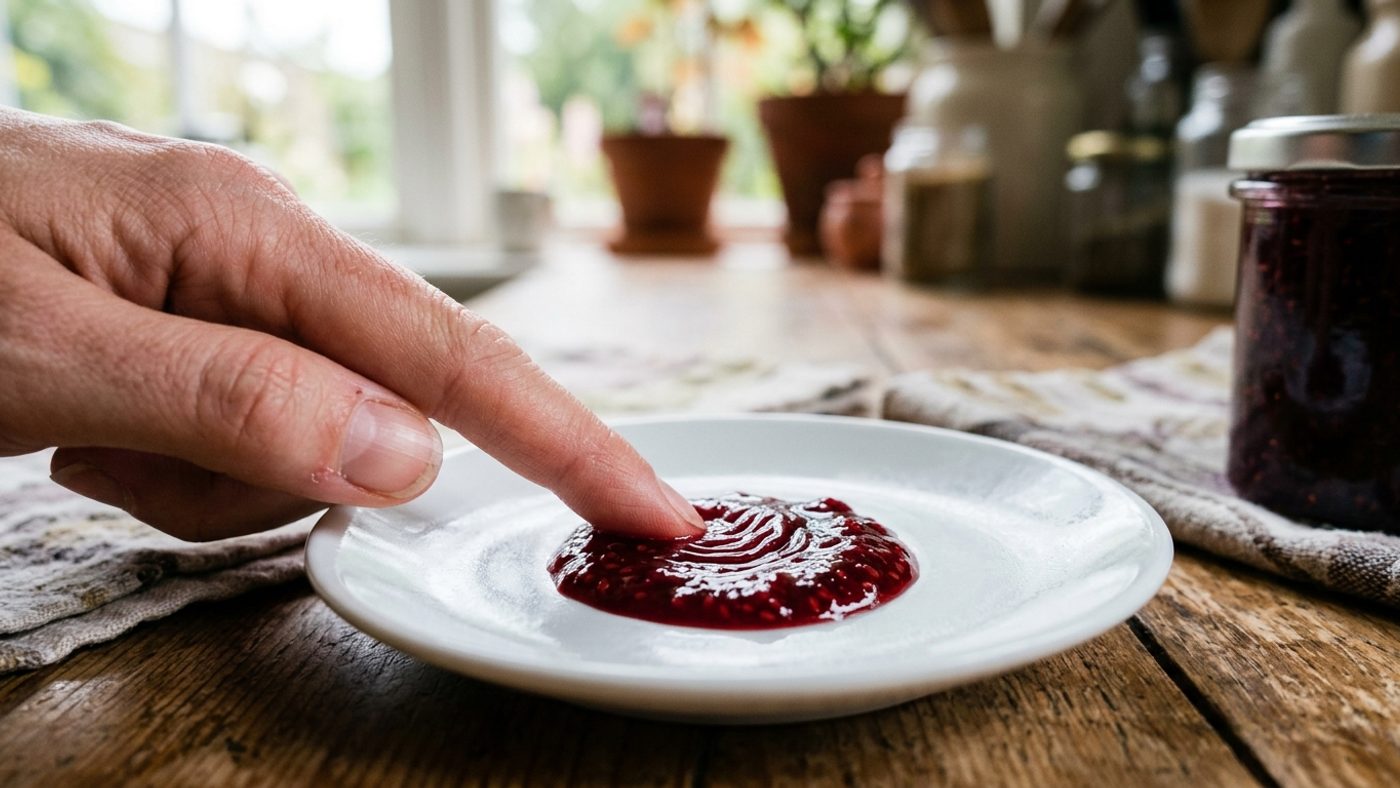
| Wrinkle (saucer) test | Chill two or three small plates in the freezer beforehand. Spoon a little jam onto a cold plate, let it stand a minute, then push it with a finger. | If the surface wrinkles rather than flowing back smoothly, setting point has been reached. |
| Temperature test | Clip a sugar thermometer reading up to at least 250°C into the pan, moving it through the mixture rather than leaving it in one spot. | Jams and marmalades set between roughly 104°C and 105.5°C (around 220°F); jellies slightly lower. 105°C (221°F) is the standard target. |
Both tests measure exactly the same thing, sugar concentration in the boiling mixture, so use whichever is easiest to manage at the stove, the thermometer if there's one to hand, the saucer test if not.
Start testing early rather than waiting for a fixed boiling time: some batches reach setting point in three to five minutes of a rolling boil, others take fifteen or more, depending on the fruit's own pectin and acid content. Testing too late risks overboiling into something closer to toffee than jam; testing too early just means testing again a minute later. A batch that's clearly gone past setting point and stiffened too far isn't wasted, loosened with a little warm water and reheated, it still works as a glaze or a sauce base even if it's no longer spreadable jam.
If a batch cools in the jar and turns out to have never reached setting point after all, it isn't ruined: tip it back into the pan, bring it back to a rolling boil, and retest every few minutes until it wrinkles or hits temperature. A squeeze of lemon juice added at this stage can help a low-acid fruit that struggled to set the first time.
As a rough starting point, most straightforward jam recipes use close to equal weights of prepared fruit and sugar, around 1kg of sugar to 1kg of fruit is a common baseline before adjusting for a specific fruit's sharpness or pectin level. A real recipe's exact ratio is what to actually follow rather than this rule of thumb.
Altitude affects boiling point, which matters for the 105°C target: water boils a little below 100°C at higher elevations, so jam will reach setting point at a correspondingly lower temperature too. It's a small effect at most Scottish garden elevations, but worth knowing if the thermometer reading never seems to match what a recipe describes.
Ordinary granulated sugar sets a jam fine as long as the fruit itself has enough natural pectin and acid, blackcurrants, gooseberries and cooking apples all do. Low-pectin fruit like strawberries or rhubarb sets more reliably with jam sugar (granulated sugar with added pectin) or a splash of lemon juice added alongside ordinary sugar, rather than relying on the fruit alone to reach setting point.
Sterilising jars: the step people skip
A jar that looks clean from a normal wash still isn't sterile, and skipping this step is one of the more common ways a batch fails a few weeks in rather than immediately, mould or bacteria already living in the jar getting a head start on a preserve that's meant to sit at room temperature for months.
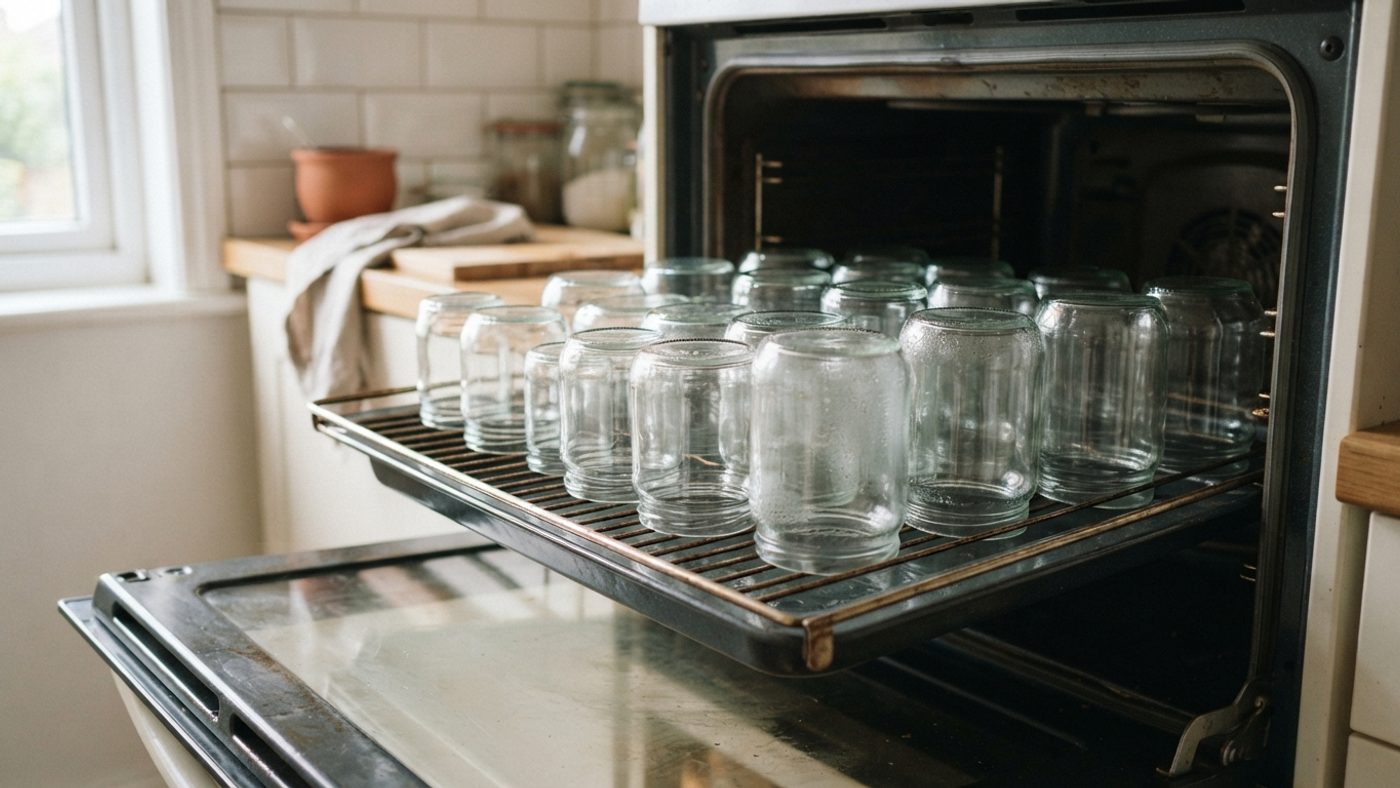
Wash jars and lids in hot soapy water and rinse first, then use one of three equivalent methods, all from Scottish Borders Council's guidance for home preservers:
| Method | Temperature | Time |
|---|---|---|
| Oven | Gas mark 3 (around 160°C) | 10 minutes |
| Dishwasher | Hottest cycle available | Full cycle |
| Submersion in water | Above 90°C | 10 minutes |
Metal lids and rubber seals shouldn't go in the oven, simmer them separately in a small pan of water instead. Jars need to be fully dry before filling.
Fill jars while still hot, right up to close to the rim (leaving too much empty headspace gives mould more air to grow into once the jar's opened), and put the lid on immediately, while the jam or chutney is still hot, that's what lets the vacuum seal actually form as it cools. A concave "dimple" in the centre of the lid once the jar has cooled fully, one that doesn't move when pressed, is the first sign the seal has taken; if a metal lid is still flat or springy the next day rather than pulled down, it hasn't sealed and the jar should go in the fridge and be used soon rather than stored on a shelf. Traditional waxed discs and cellophane covers still work for jam that will be eaten within a few weeks, but they don't give the same testable seal as a proper vacuum-sealing lid, so a metal lid is the safer choice for anything meant to keep for months. Chutney specifically needs a non-reactive pan, stainless steel or enamel, not aluminium, because the vinegar reacts with bare metal. It's worth writing the date on each jar as it's filled; a lid that seals today is not a guarantee for however long the jar sits unopened, and knowing roughly how old a jar is matters when deciding whether to trust it later.
When to bin it, not scrape it and carry on
Three signs mean a jar is done, full stop, not "probably fine once the bad bit's off":
- Any mould, however small the patch. Mould can send threads down through a soft product like jam well beyond what's visible on the surface, and scraping the top off gives no guarantee the rest is clean underneath, the Food Standards Agency's guidance on mouldy food is that removing the visible patch doesn't reliably remove everything with it, so the safe call is to discard the jar rather than salvage it.
- An off, sour, fizzy, or fermented smell when the jar is opened, even without visible mould. That's a sign fermentation or spoilage has started inside a jar that was meant to be sealed and stable.
- A lid that never sealed properly, or one that did seal but has since popped back up when pressed in the centre. A jar lid that stays flat and doesn't flex under light pressure has a working vacuum seal; one that clicks or gives has lost it, and the contents are no longer protected the way they were meant to be.
Any one of those three is reason enough to throw the jar out rather than taste-test it to see how bad it really is.
What to make it from
Rhubarb is one of the more forgiving starting points for jam, and its own peak comes early enough in the year to give a run at technique before the soft-fruit rush arrives. Dealing with a glut of rhubarb covers keeping the crownsThe base of a perennial plant where roots and shoots meet, often sold and planted as a ready-made dormant plant rather than grown from seed. Full definition → productive through the season.
Currants, black or red, are a classic jam and jelly fruit precisely because they arrive in one concentrated pulse rather than trickling in, which makes preserving a whole bush's worth in a single session more practical than trying to eat it fresh; see dealing with a glut of blackcurrants and redcurrants for picking and handling. Gooseberries, similarly concentrated in their ripening window, run naturally into jam too, dealing with a glut of gooseberries has the growing side.
Plums make a rich, deep-coloured jam and hold their own particularly well in chutney alongside spices and vinegar (dealing with a glut of plums). Raspberries and blackberries, which need deliberate staggering in the garden to avoid a single overwhelming picking week, are just as often preserved in one batch anyway once that week arrives (dealing with a glut of raspberries and blackberries). Apples, lower in acid on their own than most soft fruit, are frequently paired with something sharper, blackberries, plums, a good squeeze of lemon, to get pectin and acid levels into a range that sets reliably (dealing with a glut of apples).
On the savoury side, courgettes are one of the classic chutney vegetables, their high water content and mild flavour take spice and vinegar well, and it's one of the more useful ways to deal with the plant's habit of producing far more than any one household eats fresh (dealing with a glut of courgettes). Green tomatoes are the other classic chutney vegetable, and Scotland's shorter, cooler season often leaves unripened tomatoes still on the vine at the first frost, rather than losing them, they go straight into chutney.
None of this needs doing in one marathon session. Fruit that's come in faster than there's time to deal with properly freezes well and holds its pectin and acidity until there's a free evening to turn it into jam, a reasonable way to break a single overwhelming glut into a few smaller, less rushed batches rather than forcingCovering plants to exclude light and speed early, tender growth in the dark, most associated with rhubarb and sea kale in late winter. Full definition → it all through the pan at once.
Common questions
Can I reduce the sugar in a jam recipe to make it healthier?
Not by simply stirring in less than the recipe specifies. If a lower-sugar jam is genuinely wanted, look specifically for a recipe formulated for it, these use added pectin and sometimes a preservative like citric acid to compensate for the lost sugar, rather than just scaling down an ordinary recipe's sugar and hoping for the best.
How long does homemade jam or chutney actually keep?
Properly sterilised, sealed jars stored in a cool, dark cupboard generally keep for around a year unopened, though chutney is often better after resting for a couple of months first, as the vinegar mellows and the flavours settle. Once opened, both should go in the fridge and be used up within a few weeks.
Is a wooden spoon or an electronic thermometer more reliable for setting point?
Neither is inherently more reliable, the wrinkle (saucer) test and the temperature test both measure the same underlying thing, sugar concentration in the boiling mixture, just by different means. A thermometer gives an exact number, but it needs to be moved through the pan rather than left resting against one side. The saucer test needs no equipment beyond a couple of chilled plates.
Why did my chutney turn out watery instead of thick and glossy?
Usually either it wasn't simmered for long enough to reduce and thicken properly, or the vegetables used were unusually high in water content for the volume of vinegar in the recipe. If it's still thin after the recipe's stated cooking time, longer, gentle simmering, not higher heat, is usually the fix.
Sources
4 sources, recorded with what each was used for
- Food Standards Agency / GOV.UK: Botulism (Clostridium botulinum): What C. botulinum is, the conditions it needs to grow and produce toxin, and why home-preserved food carries more risk than commercially produced food
- Food Standards Agency / GOV.UK: Home food fact checker: The guidance that mould should not be scraped off and the rest of the food eaten
- Scottish Borders Council: Food Safety and Labelling Guidance for small scale home producers of chutneys, pickles, flavoured oils and jams: pH 4.5 / water activity 0.9 thresholds for chutneys and pickles, the sugar/vinegar-inhibits-bacterial-growth explanation, jam setting-point temperature, jar-sterilising methods and temperatures, and sticking to a tested recipe's ratios for safety
- Garden Organic: Tomatoes growing guide: Confirming green tomatoes as a recognised chutney ingredient