
Freezing is the simplest, safest way to make a glut last through winter, no botulism risk to manage, the way canning carries. Every vegetable is still alive when you pick it, and it stays biochemically active long after it goes in the freezer. Inside each leaf and root, enzymes keep working, the same enzymes that ripened the vegetable in the field, or that begin breaking it down the moment it's harvested. Freezing slows these enzymes down but doesn't switch them off. At normal freezer temperatures they carry on at a crawl, quietly converting sugars, breaking down cell walls and oxidising pigments and vitamins, for as long as the vegetable sits in the freezer.
That's why a bag of beans frozen straight off the plant, with no other treatment, tastes noticeably worse after a few weeks: duller in colour, softer or stringier in texture, and flatter in flavour, even though nothing dangerous has happened to it. Freezing does stop the growth of the bacteria that cause food poisoning, that part of the process is doing its job. It's the enzymes, not the microbes, that spoil unblanched frozen vegetables, and freezing on its own does nothing to them.
BlanchingExcluding light from part of a growing plant, usually by earthing up, wrapping or covering, so it grows pale, tender and less bitter. Full definition → solves this by heating the vegetable briefly, a short dunk in boiling water, or an equivalent spell in steam, long enough to denature those enzymes (unravel their working shape so they can no longer act on the vegetable's cells) and stop them working, but not so long that you actually cook the vegetable. Get the timing right and the vegetable goes into the freezer with its enzymes deactivated, ready to come out months later tasting close to how it went in. Get it wrong in either direction and you either haven't done the job (too short, the enzymes are barely slowed, not stopped) or you've pre-cooked your vegetables into mush before they've even reached the freezer (too long).
A Scottish growing season concentrates the problem
A shorter frost-free growing window tends to compress rather than spread out the harvest, a later last frost pushing planting-out back, and an earlier first autumn frost closing the season down sooner, both squeeze the same crops' cropping weeks into a narrower band. Courgettes, beans, chard and spinach are the ones most likely to hit their stride together as a result, rather than trickling in gently across a longer season, which is exactly the combination that turns "a bit of blanching some evening" into several kilograms across two or three vegetables needing dealt with at once. Blanching and freezing in batches as things ripen, rather than waiting for one calm weekend to deal with everything, is what keeps a freezer full of well-preserved vegetables instead of a backlog going soft on the kitchen counter, and the 8-12 months of good- quality storage that follows is what actually carries that glut through to next spring.
The glut of courgettes, glut of runner and French beans and glut of chard and spinach guides cover picking frequency and succession sowing in the garden; the blanching times below for beans, leafy greens and courgettes are the direct next step once those pile up faster than they can be eaten fresh.
The blanch, cool, dry, pack process
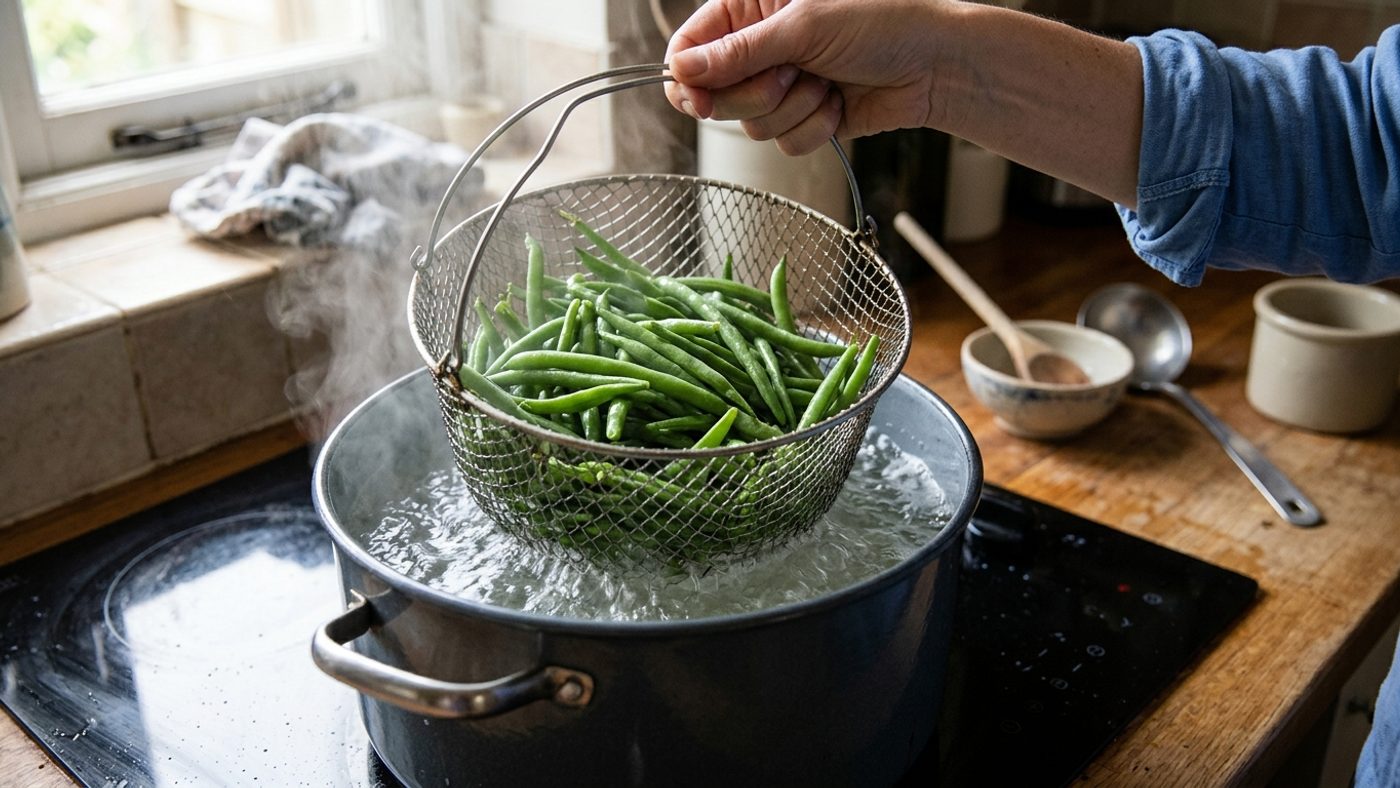
- Bring a large pan of water to a rolling boil. Use plenty of water relative to the vegetables, a crowded pan takes too long to return to the boil, and that delay eats into your timing.
- Add the vegetables and start timing once the water returns to the boil, not from the moment they go in.
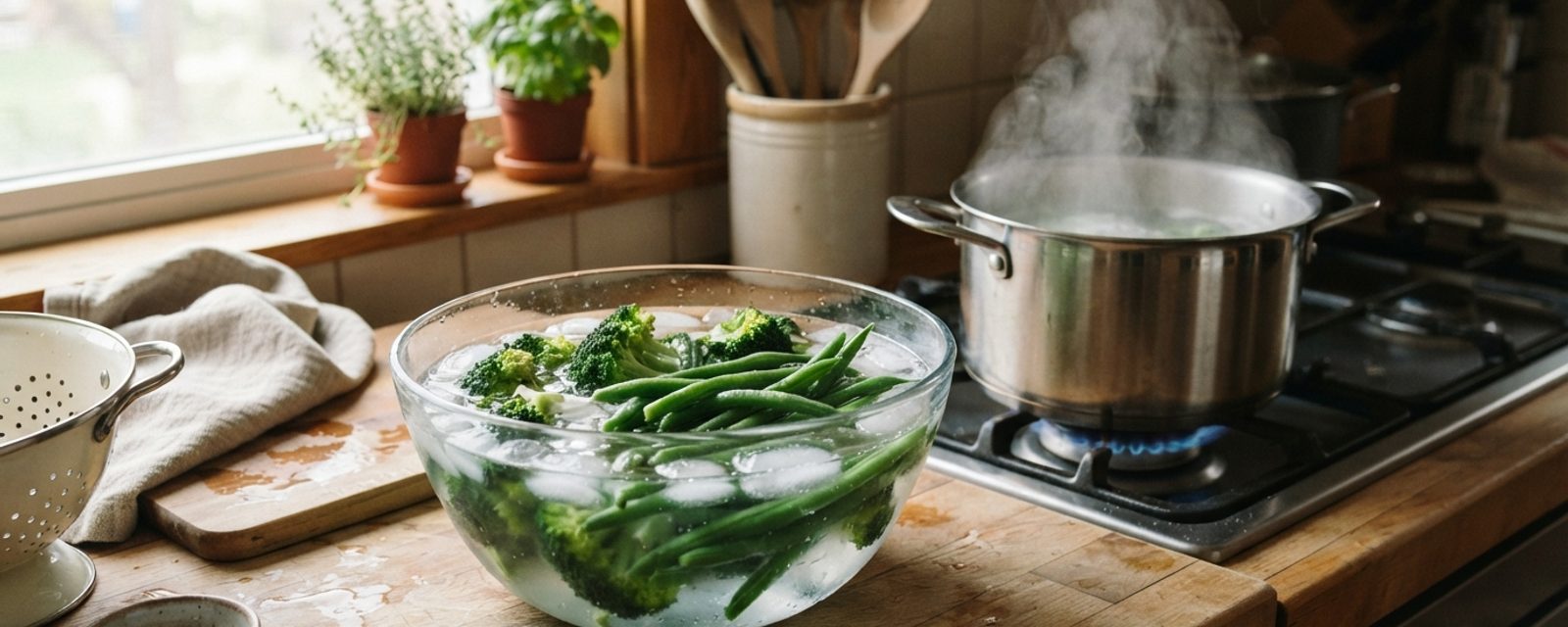
- Lift them out at the correct time for that vegetable (see the table below) and transfer them immediately to an ice bath, a large bowl of water with plenty of ice in it.
- Leave them in the ice bath for roughly the same length of time they were blanched. This is the step most often rushed or skipped, and it matters as much as the blanching itself: without a hard, fast chill, residual heat keeps cooking the vegetable from the inside, undoing the texture and colour you just blanched to protect.
- Drain thoroughly and pat dry. Excess water left on the vegetables turns to ice crystals in the freezer, which damages texture further and can weld pieces together in the bag.
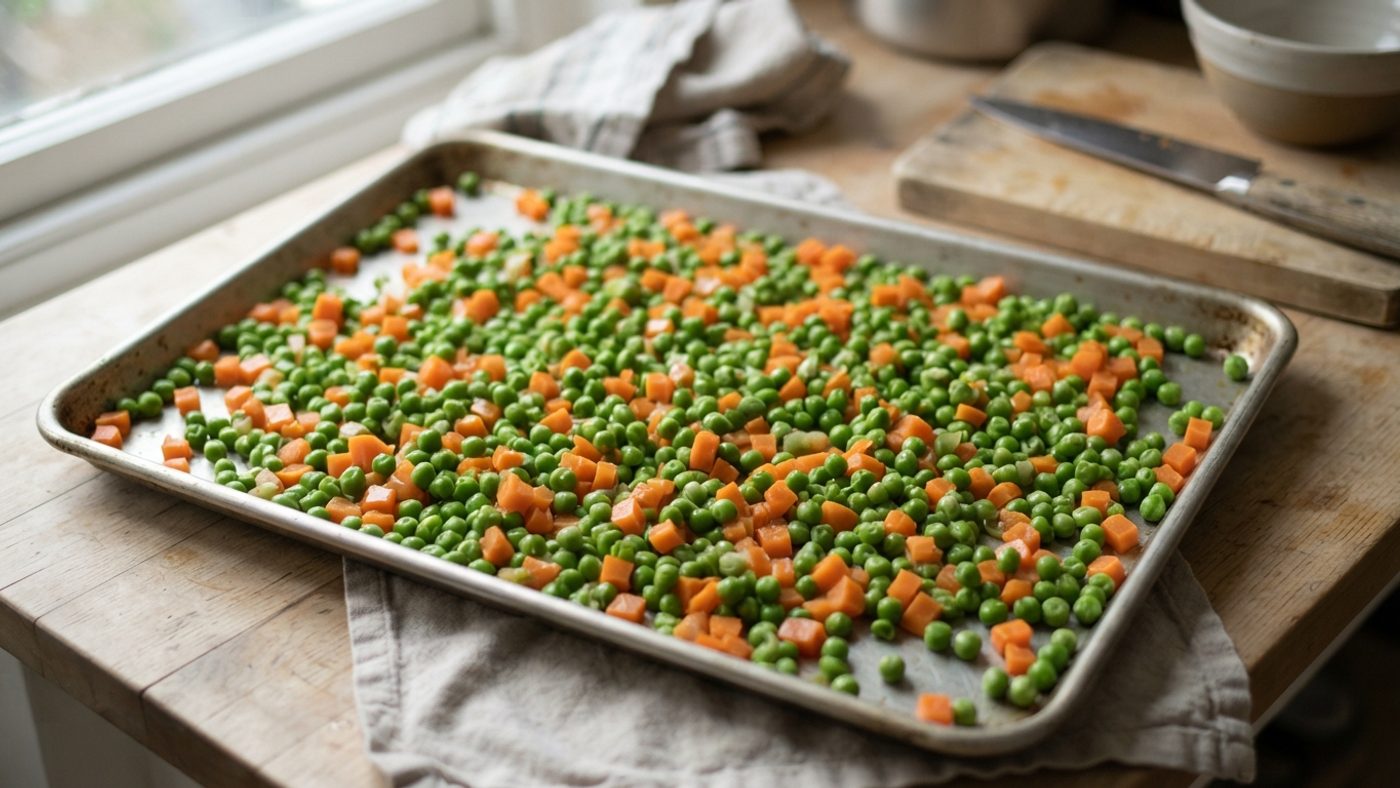
- Open-freeze on a tray before bagging. Spread the vegetables in a single layer on a baking tray and freeze for a couple of hours until solid, then transfer to bags or containers. Skip this and everything freezes into one solid block, which means defrosting the whole batch every time you want a handful for a stir-fry.
- Pack into freezer bags or rigid containers, pressing out as much air as possible, and label with the vegetable and date. Most blanched vegetables hold their quality well for around 8-12 months in a freezer running at 0°F (-18°C) or below, though flavour and texture are generally best within the first few months.
If the freezer's already full or there isn't time to bag everything up the same evening, drained and dried blanched vegetables can sit in the fridge overnight and go into the freezer the next day without a problem, the enzymes are already deactivated by that point, so it's an ordinary cooked-food fridge wait, not a race against spoilage.
Blanching times by vegetable type
Times are for water blanching, timed from when the water returns to the boil. Steam blanching takes roughly 1.5 times longer, because steam transfers heat into the vegetable more slowly than boiling water does.
| Vegetable type | Blanching time |
|---|---|
| Leafy greens (spinach, chard, kale) | 2 minutes |
| Collard-type greens | 3 minutes |
| Peas, shelled | 1½ minutes |
| Beans (green, French, sliced runner) | 3 minutes |
| BrassicasThe cabbage family: cabbage, kale, broccoli, cauliflower, Brussels sprouts, kohlrabi, swede, turnip and more, sharing the same pests, diseases and rotation rules. Full definition → (broccoli, cauliflower floretsThe individual small flower-bud clusters that make up a broccoli, cauliflower or romanesco head. Full definition →) | 3 minutes |
| Brussels sprouts, small (under 2.5cm) | 3 minutes |
| Brussels sprouts, medium (2.5-4cm) | 4 minutes |
| Brussels sprouts, large (over 4cm) | 5 minutes |
| Root vegetables, sliced or diced (e.g. carrots) | 2 minutes |
| Root vegetables, whole and small (e.g. baby carrots) | 5 minutes |
| Courgettes, sliced | 3 minutes |
| Corn on the cob, small ears (under 20cm) | 7 minutes |
| Corn on the cob, medium ears (20-25cm) | 9 minutes |
| Corn on the cob, large ears (over 25cm) | 11 minutes |
The pattern across this table is the one worth remembering even if you forget the exact numbers: leafy, thin-walled vegetables need barely any time at all, while dense or whole root vegetables and corn on the cob need considerably longer for the heat to penetrate through to the centre. Cutting root vegetables into smaller, uniform pieces before blanching shortens the time needed and gives a more even result than trying to blanch them whole. For a vegetable not listed here, leeks are a common one, that same rule of thumb is the safest guide: sliced into rounds, they behave like a thin, layeredPropagating a new plant by pinning a low, flexible stem into the soil while still attached to the parent, so it roots before being cut free. Full definition → vegetable rather than a dense root, so treat them closer to the 2-minute leafy/thin-sliced end of the table rather than the whole-root end, and check for a bright colour and slightly softened (not cooked) bite as the sign it's ready either way.
What doesn't need blanching
Not every vegetable needs this treatment, and treating all of them the same wastes time and can actually harm a few. Onions, peppers (sweet or hot), garlic, fresh herbs and tomatoes destined for cooking can all be frozen raw, without blanching first. These are generally vegetables used for flavour rather than eaten as a standalone dense vegetable, and their texture in the freezer matters less because they're usually going into a cooked dish rather than being served as-is. A caveat worth knowing: onion, garlic and some herbs can turn stronger or slightly bitter over time in the freezer, so it's worth seasoning lightly when cooking with them frozen and adjusting to taste rather than assuming the flavour will match a fresh version exactly. Tomatoes frozen raw for cooking will also collapse and release liquid on thawing, fine for going straight into a sauce or soup, not something you'd want to serve as a salad tomato.
Courgettes have a second raw-freezing option worth knowing alongside the sliced-and-blanched route above: grated raw and frozen in portions for use in baking (courgette cake, fritters), where the texture change from freezing is masked by the recipe anyway. For courgette destined to be served as a side dish or in a stir-fry, blanched slices hold their texture far better than grated raw.
Beans, peas, brassicas, leafy greens and whole/sliced root vegetables all lose quality quickly in the freezer without blanching first.
Storage and containers
Rigid freezer-safe containers and freezer bags both work; the main differences are space efficiency and how well they exclude air. Freezer bags, especially with the air pressed out or removed with a straw or vacuum sealer, pack flatter and more efficiently than rigid tubs, and flat bags also thaw faster. Rigid containers are sturdier for anything with liquid, like frozen soups or purées, and stack well if you have shelf space rather than drawer space. Whichever you use, exclude as much air as possible, air left in the bag or container is where freezer burn (pale, leathery patches caused by moisture loss) tends to start, and while it isn't a food safety issue, it does affect texture and flavour where it occurs. Open-freezing on trays first, as above, means only what's actually needed has to be tipped out and thawed at any one time, rather than a whole bag defrosting and needing to be used at once, a bag that's only partly thawed and still icy can go straight back into the freezer, but once vegetables have fully thawed they shouldn't be refrozen raw.
Common questions
Do I really need to blanch everything, or can I just freeze vegetables raw to save time?
For most vegetables, yes, the exceptions are onions, peppers, garlic, herbs, and tomatoes for cooking. Everything else loses noticeable flavour and texture within weeks to a couple of months if it goes into the freezer unblanched.
Can I blanch in the microwave instead of on the hob?
Boiling water or steam are the methods with well-established timings. A microwave heats unevenly enough that it's difficult to guarantee the centre of a piece has reached blanching temperature without overcooking the outside, so it isn't a reliable substitute for most vegetables.
How long can blanched vegetables stay in the freezer before quality drops?
Most blanched vegetables hold reasonably well for 8-12 months at 0°F (-18°C) or below. They remain safe to eat well beyond that, but flavour, colour and texture gradually decline the longer they sit, so it's worth using older bags first and labelling with the freezing date.
My frozen vegetables came out mushy, did I do something wrong?
Most likely over-blanching, or not chilling them fast or thoroughly enough afterwards. If the vegetables sit in the boiling water too long, or if the ice bath is too small, too warm, or too brief, residual heat keeps cooking them after you think you've stopped. Use plenty of ice, not just cold tap water, and time the ice bath for roughly as long as the blanch itself.
Should I cook frozen blanched vegetables from frozen, or thaw them first?
Most blanched vegetables go straight into cooking from frozen, into boiling water, a stir-fry pan or a soup, without thawing first, since blanching has already partly cooked them. The exception is anything going into a dish where excess water matters, such as a bake, where draining a partial thaw first avoids a soggy result.
Sources
6 sources, recorded with what each was used for
- RHS: Preserving autumn produce: The blanching rationale and a sweetcorn blanch/ice-bath example
- Garden Organic: Harvesting and storing vegetables: Which vegetables are commonly frozen, blanching before freezing in manageable quantities, tomatoes-as-sauce as a freezing exception
- Food Standards Agency / GOV.UK: How to chill, freeze and defrost food safely: Freezing stops bacterial growth, underpinning the safety/quality distinction drawn throughout
- National Center for Home Food Preservation (University of Georgia): Blanching Vegetables: The enzyme-deactivation mechanism, the per-category blanching-time table, the ice-bath cooling step
- National Center for Home Food Preservation: Blanching Vegetables (general information): The no-blanch exceptions and the flavour-change note on frozen onion/garlic/herbs
- National Center for Home Food Preservation: Freezing Pointers: Freezer loading, portioning, and packing guidance