
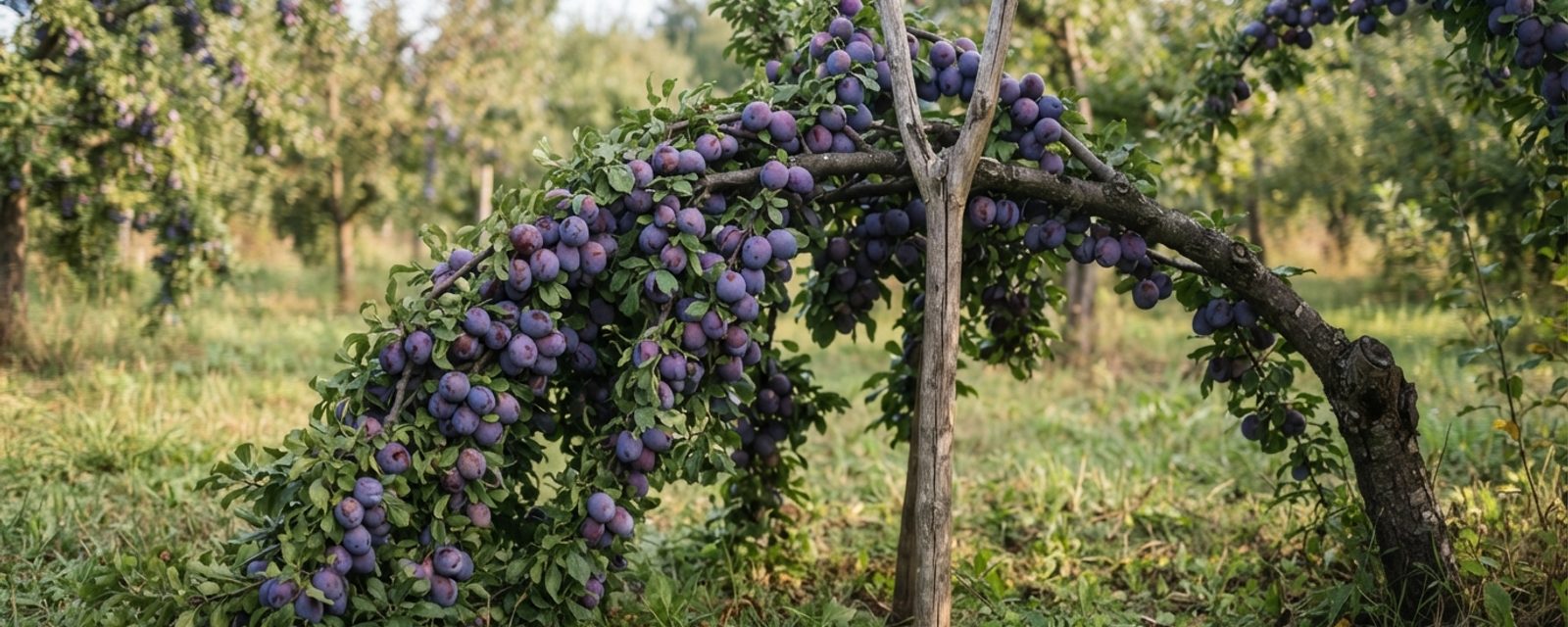
Stand under the tree and you can see the branches have dropped an inch or two since June, pulled down by the weight of fruit hanging in ripening clusters. This might be the one year in three when a Scottish plum tree actually delivers: the blossom escaped the frost, a decent run of warmth followed, and now there's more fruit than one household can eat fresh. It's a good problem, and an unfamiliar one if the tree has given you next to nothing the last two summers. The question isn't really what to do with all this fruit, it's how much time you actually have before it's on the ground or rotting on the branch, and why this happened now rather than last year or next.
How long a ripe plum actually waits for you
Plums don't ripen all at once and they don't hold indefinitely once they do. The fruit develops its best flavour left on the tree, and the test for readiness is a gentle squeeze: "if they feel soft when gently squeezed, they are ripe." Because individual fruits on the same tree, even the same branch, reach that point at different times, the tree needs checking over several times through the ripening weeks rather than harvested in one pass. There's no single harvest day for a plum tree the way there might be for a crop that ripens all at once; it's a rolling window, typically stretching over several weeks depending on variety and how mixed your tree's exposure is, branches on the sunnier side ripen ahead of shaded ones.
Left unchecked, ripe fruit doesn't sit patiently. It softens further, becomes more attractive to wasps and birds, and once it's fully ripe it bruises at the slightest knock, so the fruit that's ready today is genuinely more perishable than the fruit that will be ready in four days' time. In a heavy year, that rolling window is exactly what turns into a glut: you're not dealing with one bumper picking, you're dealing with a tree that keeps producing a next wave every time you think you've cleared it.
Does how often you pick actually matter?
With plums, unlike a crop such as currants, the driver is the fruit's own ripening state rather than your picking rhythm: RHS guidance on growing plums doesn't suggest that picking more or less often changes how the tree ripens its crop, only that fruit should be picked individually once fully coloured and soft, checking over the tree several times as the crop matures. In practice that means picking little and often is worth building into a routine rather than treating as optional, and a picking pole with a padded catching bag is worth having for fruit out of easy reach on a full-sized tree, rather than relying on a ladder for every check.
Why a proper glut is rarer here than general advice assumes
Plums are a more marginal crop in Scotland than currants or gooseberries. They blossom early, as early as March in a mild spell, which puts the flowers directly in the path of late-winter and early-spring frost, a familiar hazard in most Scottish gardens by the time March and April come round. A frosted blossom simply doesn't set fruit, so a cold snap at the wrong week in spring can wipe out most of a season's crop before it's even started, regardless of how the tree is pruned or fed. It isn't a pollination-partner problem doing this: RHS names all six of its recommended plum varieties as self-fertileA plant that can set fruit using its own pollen, without needing a second, different variety nearby to cross-pollinate it. Full definition →, so a single tree can crop perfectly well on its own, when frost hasn't taken the blossom out first.
That's one half of why some years give you nothing and other years bury you. The other half is biennial bearingA fruit tree's tendency to crop heavily one year and barely at all the next, then repeat that cycle rather than cropping evenly every year. Full definition →: a tree that carries a genuinely heavy crop one year tends to put a light crop, or none, the year after, because it spent that season's resources on ripening fruit rather than building the flower buds for the following spring. Plums are prone to this in the same way apples and pears are in some varieties. The full mechanism, what's actually happening inside the tree, and which triggers set it off, is covered in the biennial bearing article; the short version for anyone standing under a heavy crop this year is that this glut is very likely to be followed by a quiet year next year, and that's normal rather than a sign anything's gone wrong with the tree.
Add a frost risk at blossom time to a biennialA plant that completes its life cycle over two years: growth in year one, then flowering, seeding and dying in year two. Full definition → tendency stacked on top of it, and the shape you'd expect is a proper glut every second or third year rather than an annual one, for most gardens, not a figure either RHS source states outright, but the natural result of combining the two mechanisms above. Worth knowing before building equipment or habits around handling this every summer.
Thinning this year's fruit to protect next year's crop
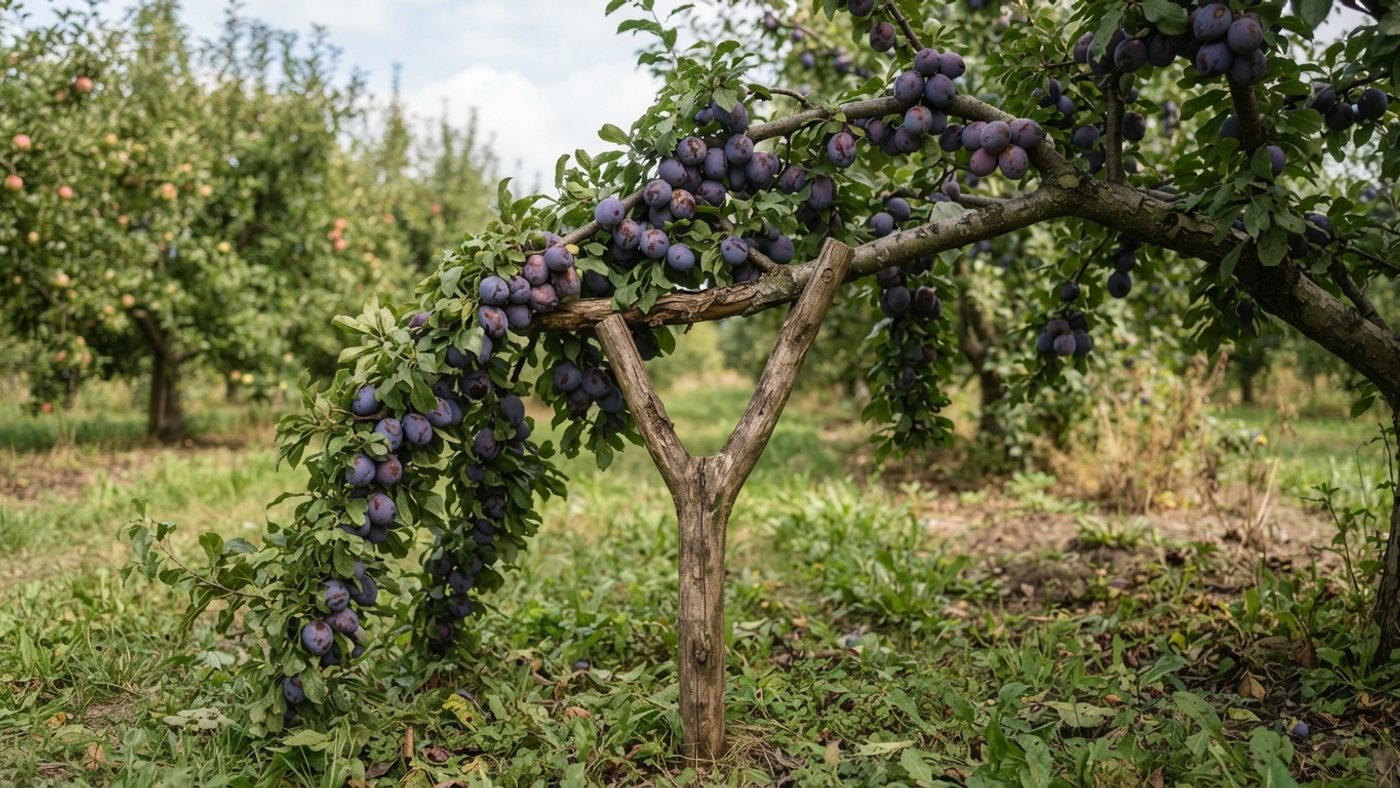
If the tree is carrying a heavy load, RHS guidance on growing plums recommends thinning in early summer, reducing fruit to "one fruit every 5-8cm (2-3in) or a pair every 15cm (6in)" where fruit is clustered. On anything but a small trained tree this is fiddly rather than difficult, it's most manageable on fans and pyramids, harder on a full-sized bush tree, and best done from a stable ladder or not at all on the higher branches. Where a tree crops heavily despite thinning, RHS also recommends propping up laden branches in mid- and late summer, since the sheer weight of a good plum crop can split or snap a branch that looks perfectly sound in a normal year. If a branch does split, resist the urge to tidy it up with secateurs there and then unless it's summer, any pruning wound made outside spring and summer is exactly how silver leaf and bacterial canker get into a plum tree, so an emergency cut is still worth timing around that rule where the damage allows it.
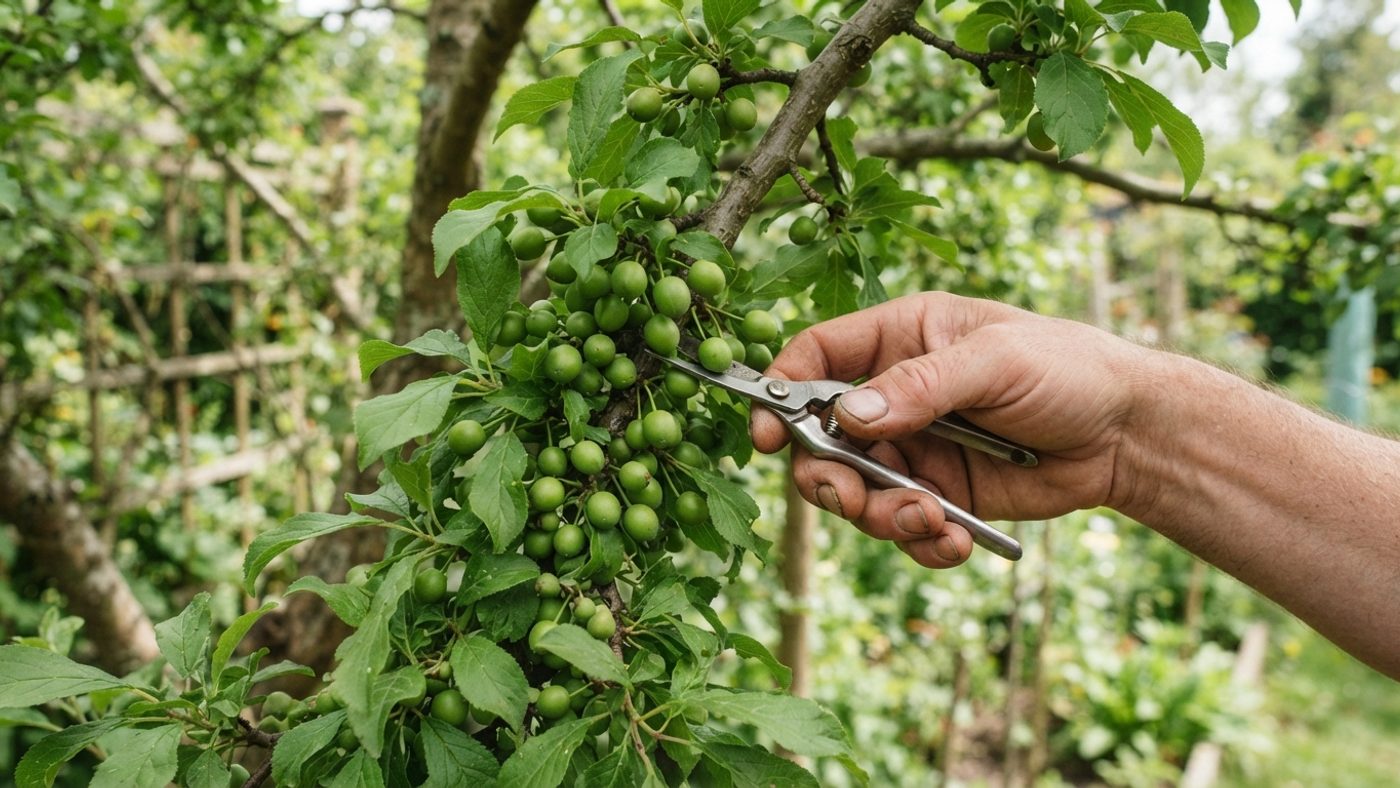
Thinning earlier in the season does two separate jobs, and it's worth being clear they're not the same thing. The first is immediate: fewer fruits on the branch means each one gets a larger share of the tree's sugars and water, so the remaining plums size up better and ripen more evenly. The second is longer-term, and it's the connection worth understanding if this year's glut followed a bare year: by reducing how much of the tree's energy goes into this year's fruit, thinning leaves more for the tree to put into next year's flower buds instead. It won't turn a biennial tree into an annual one overnight, but a consistently thinned tree tends to swing less wildly between a smothering crop and an empty one, the same principle the biennial bearing article sets out in more detail for apples and pears.
For general planting, pruning, and variety information beyond this glut-specific ground, the plum growing guide covers training forms, rootstocksThe root system and lower stem a fruit tree is grafted onto, chosen to control the tree's eventual size rather than for its own fruit. Full definition →, and routine care.
Wet weeks at ripening time
A spell of unsettled, showery weather in late summer is a familiar pattern in much of Scotland, and it lands at exactly the point when plums are most vulnerable to brown rot. RHS confirms brown rot is "usually seen under wet conditions," and that once it takes hold in a fruit, buff-coloured fungal pustules typically appear in concentric rings on the skin. It spreads readily between fruits that are touching in a cluster, which is exactly how plums grow, and it tends to start from a wound, most often bird pecks, wasp damage, or an entry point left by codling moth or scab. A simple hung trap near the tree, a jar of sugary water or diluted jam with a few small holes punched in the lid, draws wasps away from the fruit and cuts down one of the main routes the wound gets started in the first place. Affected fruit either drops or stays hanging on the branch in a shrivelled, mummified state, and either way it's no longer edible.
The single most useful thing you can do about it in the garden is remove and dispose of infected fruit as soon as you spot it, rather than leaving it in place to touch and infect its neighbours. RHS recommends burying rotted fruit at least 30cm down or sending it to council green waste, rather than composting it in the open. There's no fungicide available to home gardeners for brown rot, so prevention, netting against birds, prompt removal of any damaged or infected fruit, is the only real lever. RHS names Czar, Jefferson, Ontario and President as varieties with some resistance, a genuine plus to weigh up, though RHS's guidance is UK-wide rather than tested against a Scottish growing season specifically. For choosing what to grow more broadly, the best plum varieties for Scotland article covers that ground.
Keeping picked plums for a few days
Plums don't hold anywhere near as long once picked as they do on the tree, and how long depends heavily on what state they were in when picked. Fruit picked slightly under-ripe will continue to soften at room temperature over a couple of days; fruit picked fully ripe is best moved somewhere cool straight away, since it's already at the point where bruising and further softening happen fast. A single layer in a shallow container, not stacked or crammed together, keeps the ripest fruit from bruising itself under its own weight, the same touching-fruit vulnerability that lets brown rot spread on the tree keeps applying after picking.
| Fruit condition | Where to keep it | Roughly how long it holds |
|---|---|---|
| Picked slightly under-ripe | Room temperature, single layer | 2–4 days to finish ripening |
| Picked fully ripe | Fridge or a cool shed/garage | A few days before texture noticeably declines |
| Any fruit with rot or skin damage | Remove and dispose of immediately | Not worth keeping, discard promptly |
Common questions
Why has my plum tree gone from bare to overloaded in the space of a year?
Most likely biennial bearing: a heavy crop this year followed a light or absent one last year (or is often followed by a lighter one next year), because the tree redirects its resources between fruiting and flower-bud formation from one season to the next. A spring frost during blossom can also wipe out an entire year’s crop on its own, which exaggerates the swing between good and bad years even further.
Should I pick plums slightly before they’re fully ripe to spread out the glut?
You can, and it’s a reasonable way to manage a heavy crop, but it’s a trade-off rather than a free win, fruit picked under-ripe won’t develop quite the same flavour it would ripening on the tree. It’s a sensible move for fruit on branches that are visibly overloaded or where wasps and birds are already active, less necessary for fruit you can get to promptly.
Do I need to thin plums every year, even in a light-cropping year?
There’s little point thinning an already-light crop, thinning matters when the tree has set more fruit than it can properly support or ripen. In a year the tree is clearly cropping heavily, thinning in early summer is worth doing both for fruit size this year and to ease the following year’s recovery.
Is it normal for ripe plums to split on the tree?
Splitting is a known issue in stone fruit generally, but it isn’t something RHS’s plum guidance sets out a specific mechanism for, so it’s worth not over-attributing every split fruit to one cause. What is confirmed is that damaged or wounded fruit, whatever caused the wound, is the entry point brown rot uses to spread, so any split or pecked fruit is worth removing promptly rather than left on the tree.
Can I stop biennial bearing altogether once it starts?
Not reliably in a single season, but consistent thinning over a few years tends to even out the swings, removing surplus fruit before the tree overcommits its resources to one bumper year. The full range of thinning approaches and how to time them is covered in the biennial bearing article.
Sources
2 sources, recorded with what each was used for
- RHS: Plums, grow your own: Ripening behaviour and the need to pick over several times, fruit thinning spacing and timing, propping up heavily laden branches, frost and pollination risk, self-fertility of named varieties, biennial bearing
- RHS: Brown rot: Brown rot symptoms on plums, spread between touching fruit, wet-weather conditions, disposal method, resistant varieties (Czar, Jefferson, Ontario, President)