
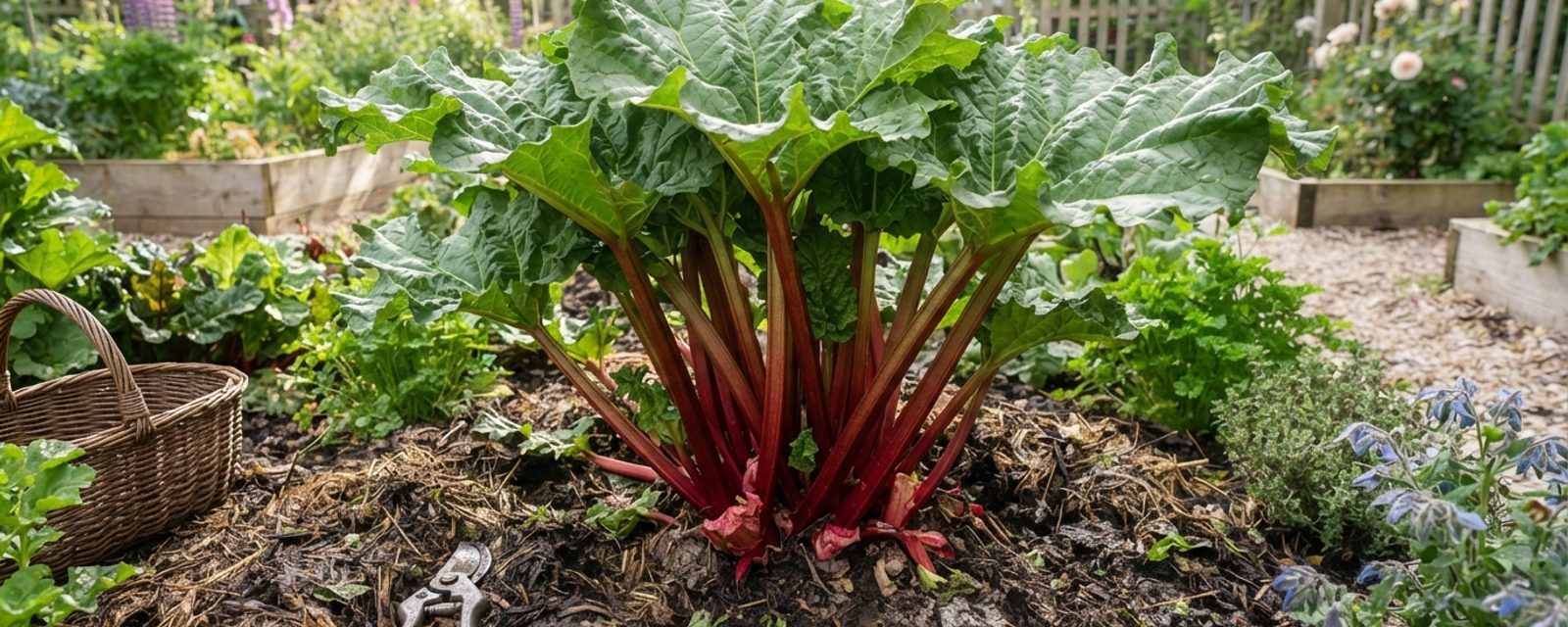
Stand in front of a well-established rhubarb crownThe base of a perennial plant where roots and shoots meet, often sold and planted as a ready-made dormant plant rather than grown from seed. Full definition → in late May and the problem is obvious: a fat cluster of thick, red-flushed stalks, more than any one household is going to get through fresh before the next batch is ready to pull. Unlike a courgette plant that ambushes you for one overwhelming week, an established rhubarb crown does this for months on end, from the first stalks in spring right through to the point in summer when convention says to stop pulling altogether. The too-much-rhubarb problem isn't a single glut week; it's a whole season's worth of a plant that, once mature, is genuinely one of the most reliably heavy-cropping things you can grow in a Scottish garden.
Rhubarb's real requirement is a properly cold winter to break dormancy, something most of Scotland supplies without effort, and it keeps producing hard through a cool, damp summer that would stress plants further south into stopping earlier. A crown that keeps throwing up new stalks for months, with nothing in the local climate to slow it down, is a crown it's easy to over-harvest without noticing, simply because it never gives you an obvious signal to stop.
For planting, the first-two-years rule, and general harvest technique, see the rhubarb growing guide; for the physiology and methods behind forcingCovering plants to exclude light and speed early, tender growth in the dark, most associated with rhubarb and sea kale in late winter. Full definition → specifically, see forcing rhubarb in Scotland.
How long pulled stalks actually hold
Cut rhubarb has no dormancy mechanism to slow it down once separated from the crown, it's mostly water-filled leaf stalk, not a storage organ, so quality drops fairly quickly. Stalks are at their best used within a few days of pulling, and start to soften and lose crispness noticeably after about a week even refrigerated.
Two things extend the window a little:
- Leave the leaf on until you're ready to use the stalk, then trim it off just before cooking. The leaf keeps drawing a small amount of moisture out of the stalk while attached, but removing it early doesn't meaningfully help, the bigger factor is temperature.
- Keep stalks cold and slightly humid, the fridge salad drawer, loosely wrapped rather than sealed airtight, works better than a countertop or an unrefrigerated shed.
Because the keeping window is short, the more useful lever isn't storage, it's not pulling more than you'll use in the next few days in the first place, which is where staggering the harvest across the plant, and across multiple plants, does the real work.
Does hard early picking cost you yield later?
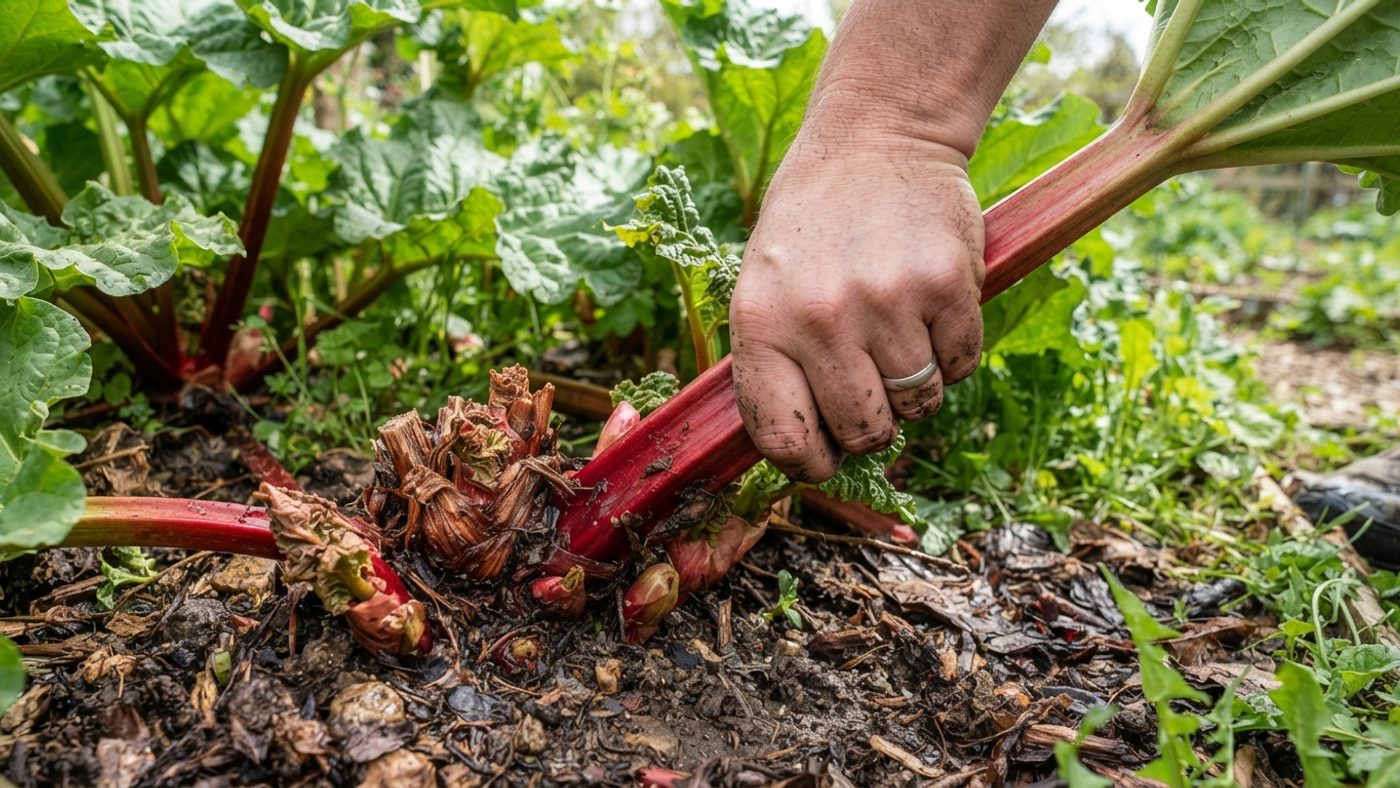
It's tempting to keep pulling stalks as fast as they appear, especially early in the season when they're at their thickest and reddest, and especially on a crown that seems to keep producing however much you take. RHS guidance is explicit that you shouldn't: take "about a third of the plant's stems" at a time, leaving the rest to keep photosynthesising and feeding the crown underground. Garden Organic recommends a more conservative limit still, leaving at least half the stems growing.
The consequence of ignoring this isn't subtle. A crown that's stripped too hard, too often, starts producing thin, weak stalks, a sign the plant no longer has enough leaf area left to build up the food reserves it needs for strong growth. It's a compounding problem: a depleted crown produces worse the following year too, not just for the rest of the current season. If you're already seeing thin stalks on an established plant, that's a signal to ease off immediately and consider dividingPropagating a clump-forming perennial by digging it up and splitting it into several smaller pieces, each with roots and shoots attached. Full definition → the clump rather than push it harder.
How much you can take, by crown age
| Crown age | What to take |
|---|---|
| Year 1 (just planted) | Nothing, let it establish |
| Year 2 | A handful of stalks at most, taken lightly |
| Year 3 onwards | Up to a third of the total stalks at any one pulling, repeated through the season |
A three-year-old crown and a ten-year-old clump aren't the same plant, but the same proportion rule holds for both once a crown is established.
Feeding the crown that's feeding you
A crown asked to keep most of its stalks and its full canopy working still needs the reserves it's drawing on replaced. An annual mulchA layer of material spread over the soil around plants to suppress weeds, retain moisture, and improve soil structure as it breaks down. Full definition → of well-rotted manure or garden compost, applied in spring and kept clear of the crown itself, is the standard way of doing that, it's the other half of the over-picking equation: leaving enough leaf matters, but so does giving the plant something to rebuild with. Waterlogged, poorly drained soil works against the same goal by encouraging crown rot, a real risk on the heavier, wetter soils common in many Scottish gardens, so a bed that drains well, or a raised bed on heavy clay, does as much for next year's harvest as correct picking does.
Spreading the harvest: multiple crowns and forcing
| Period | Source | What's happening |
|---|---|---|
| Late winter–early spring | One forced crown | Shorter, sweeter stalks, weeks ahead of anything outdoors |
| Spring (March–April) | Early unforced varieties, e.g. Timperley Early | First stalks from established crowns cropping normally |
| Late spring–early summer | MaincropThe main, usually latest-sown and longest-growing type of a crop, grown for bulk and storage rather than an early harvest. Full definition → crowns | Peak production, thickest stalks, the point most gardens feel gluttish |
| By late June–July | All crowns | Last light pulls before stopping for the year |
If one crown produces more than you can use fresh within its short keeping window, the fix isn't storage, it's spreading when the stalks actually arrive so they never all turn up at once. Two tools get you there.
Grow more than one crown, and don't force them all. A garden with two or three established crowns of similar variety, cropping on the same natural calendar, just multiplies the glut rather than spreading it. What actually staggers the harvest is choosing crowns that crop at different times: an early variety like Timperley Early alongside a later-cropping maincrop such as Victoria gives two separate windows instead of one shared peak.
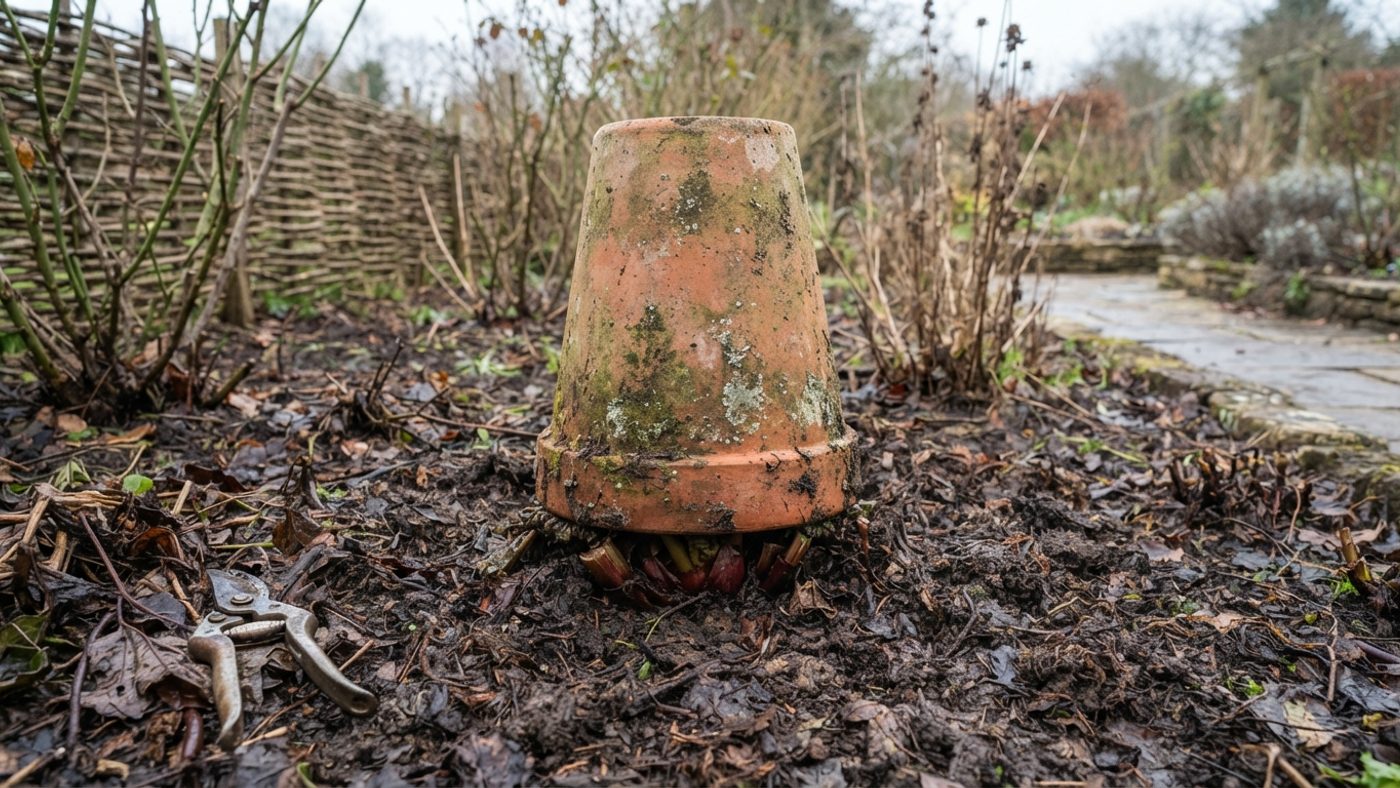
Force one crown deliberately early. This covers a strong, established crown in mid-winter with a forcing jar or bucket, bringing it into production in late winter or early spring, weeks before an unforced crown outdoors has even started. Scotland's ordinary winter cold already does the dormancy-breaking work forcing depends on, so there's no extra chilling step to engineer here. A forced crown is picked differently from the one-third rule above: once covered, all the stems it sends up are taken, and the covering comes off and picking stops for good that year as soon as the flush is over, rather than leaving a share standing, the crown is already committed to a full rest afterwards, so there's nothing to protect mid-harvest the way there is on an unforced plant. The full mechanism, both forcing methods, and the timing detail are covered in forcing rhubarb in Scotland; for glut management, one forced crown plus your remaining unforced crowns gives a rolling harvest across several months instead of every plant peaking together in May and June.
The forced crown itself then needs a genuine rest, it shouldn't be forced again the following year, and the more intensive lift-and-pot method usually weakens the crown enough that it's discarded rather than replanted, both covered in full in the forcing article.
When to stop pulling, and why it isn't optional
RHS guidance puts the last harvest in late summer, around July or August, though growth can taper off earlier in a hot, dry spell. That natural heat-driven stop is exactly the thing most Scottish gardens rarely get, which is why the calendar cutoff matters more here than the grows-until-the-weather-stops-it framing suggests: without a hot, dry spell to slow things down, a Scottish crown will often keep producing right through the date it should be left alone, so stopping has to be a deliberate decision rather than something the season does for you. Once you stop pulling stalks, the plant needs its full leaf canopy left untouched for the rest of the growing season to photosynthesise and build up the food reserves stored in the crown over autumn and winter. Skip that recovery window, by pulling stalks right through late summer because the plant is still producing, and you're spending next year's vigour on this year's extra stalks: the same depletion mechanism as pulling too high a proportion at once, just spread over the calendar instead of a single harvest.
Two other risks worth watching alongside all this: a late spring frost can damage young stalks, forced ones especially, since they emerge earlier and softer than an unforced crown's growth would at the same date, so cover exposed new growth with straw or fleeceA lightweight, breathable fabric laid or draped over plants to trap a little warmth and keep off frost, wind and some flying pests. Full definition → if a frost is forecast. And slugs are drawn to the same tender young stalks, particularly the sheltered, humid space under a forcing cover, so check underneath it occasionally rather than leaving it undisturbed for weeks.
As for the stalks themselves once pulled: use them as you normally would. If a well-fed, well-managed crown still outproduces what one household eats fresh, an allotment society, neighbour, or local plant-swap is usually a quicker answer than trying to find another use for every stalk yourself.
Common questions
Can I keep pulling rhubarb all summer if the plant still looks strong?
No, even a crown that still looks vigorous in July or August needs its leaves left alone from that point to build reserves for the following year. A plant that looks fine through one over-extended season can show weaker, thinner stalks the year after, once the depletion catches up with it.
Is it better to pull a few stalks often, or wait and take a lot at once?
Neither extreme is right; the limit that matters is proportion, not frequency. Take no more than a third of the total stalks present at any single pulling, whether you’re doing that every few days or every couple of weeks, the plant needs most of its leaf area intact at all times to keep feeding the crown.
Will a second or third rhubarb crown really spread the harvest, or will they all just crop at once?
Left alone, unforced crowns of similar varieties on the same soil will crop on roughly the same calendar, so planting more crowns of the same kind doesn’t spread anything on its own. What actually spreads the harvest is forcing one crown for an earlier, separate cropping window, or deliberately choosing an early and a late variety so they peak at different times.
Does forced rhubarb taste or keep any differently once pulled?
Forced stalks are typically shorter, paler and sweeter than stalks grown outdoors, a result of being grown in darkness rather than a difference in how long they keep. Once pulled, forced and unforced stalks hold for about the same short window and should be treated the same way.
My rhubarb has started producing thin stalks, is it too late to fix?
Not too late, but it’s a sign to stop harvesting that crown for the rest of the season and let it recover fully, with a proper spring mulch to help rebuild its reserves. If thin stalks persist the following year even with lighter picking, the crown has likely become congested and is due for dividing, which the growing guide covers.
Sources
3 sources, recorded with what each was used for
- RHS: Rhubarb, grow your own: Harvest timing (spring to late summer), first- and second-year restraint rule, the "about a third of the plant's stems" limit, pull-don't-cut technique, thin-stalks-signal-lost-vigour link
- Garden Organic: rhubarb: Leave at least half the stems growing (a more conservative figure than RHS, both cited honestly), second-year harvest start, pull-don't-cut confirmation
- Gardener's World: How to grow rhubarb: Forced rhubarb's late winter/early spring timing and shorter-sweeter character, per-crown yield corroboration