
You're standing in the seed aisle with a six-pack of courgette plugs in one hand and a £3 seed packet in the other, doing the mental maths. The seeds are obviously cheaper, but it's the last week of May, your greenhouse windowsill is already full, and if you sow now and it fails, there's no August do-over up here.
That calculation, repeated at a dozen decision points across the growing year, is what budget gardening in Scotland actually comes down to. It isn't just "spend less." It's spending in a way that doesn't waste the one shot you get.
Most budget-gardening advice is written for a long, mild growing season where a failed sowing is a minor setback, pull it out, resow, try again in three weeks. In Scotland's shorter, cooler season, that "try again" window is frequently much tighter or missing altogether: a cold-damaged early sowing might be your only realistic attempt before the ground's too cold again, or before the days shorten past the point a crop can catch up. That changes which cheap option is actually the cheap option. Sometimes it's the seed packet. Sometimes, at a specific pinch-point in the calendar, it's the more expensive plug plant that guarantees you don't lose the whole slot.
Seeds vs plug plants: the real trade-off
The seed-cost advantage is real: RHS's own price comparison for French beans puts a packet of 70 'Cobra' seeds at £4.49 against £11.99 for 15 plug plants of the same variety, roughly a third of the cost per plant. But that comparison only holds if the seed sowing actually succeeds first time, and success rates for direct or early sowing drop with a shorter, cooler, wetter season. The frost dates guide has the full regional breakdown; the margin for error on an early sowing is tighter the further north and inland you are.
| Situation | Cheaper option | Why |
|---|---|---|
| Settled conditions, hardy or quick crop (salad, beetroot, peas) | Seed | Time to resow if a first attempt fails |
| Tender crop needing warmth you can't reliably give it (courgette, squash, tomato, French bean) sown early | Plug plant, bought once frost risk has passed | Skips the multi-week germinationA seed sprouting: breaking dormancy and putting out its first root and shoot, given the right warmth and moisture. Full definition →-and-hardening-off window where a cold snap can wipe out weeks of work |
| Long-season crop at the tail end of its sowing window (leeks, celeriac, some brassicasThe cabbage family: cabbage, kale, broccoli, cauliflower, Brussels sprouts, kohlrabi, swede, turnip and more, sharing the same pests, diseases and rotation rules. Full definition →) | Plug plant | Little to no room left to recover from a late or failed start |
| No frost risk, crop tolerant of a cool start | Seed | No premium for certainty needed |
The rule of thumb: spend on the plug when the sowing window is narrow and a failure is unrecoverable that season; spend on the seed packet when you have slack in the calendar to absorb a bad attempt. A cheap windowsill propagator, a length of black plastic sheeting to warm soil before sowing, or a homemade clocheA small, portable clear cover placed over an individual plant or short row to trap warmth and keep off wind, rain and pests. Full definition → (see the reclaimed-materials section below) can also buy a seed sowing a few extra weeks of safety margin for very little outlay, without the extra cost of a plug plant.
Seed swaps: free seed, and a reason to use it carefully
A seed swap works two ways. You bring spares from packets you'll never use up (most packets contain far more seed than a small plot needs in one year) and go home with varieties you didn't pay for. Garden Organic runs the Heritage Seed Library on this model, members are sent seed to grow and are encouraged to save and swap it onward, and lists community seed swap events UK-wide on its site, though listings for any given year and area are worth checking directly rather than assuming your nearest town has one running. Crop-by-crop technique for saving your own seed, which crops are easy, which need isolation distances, how to dry and store it, is covered in full in the guide to saving your own seed.
Two practical cautions for swaps:
- F1 hybridThe first-generation offspring of two specific, deliberately chosen parent plants, bred for a predictable, uniform result but not worth saving seed from. Full definition → seed doesn't come true. If a swapped packet or a home-saved seed came from an F1 variety, the plants you grow from it won't reliably match the parent, worth knowing before you build a season around a mystery seed. Non-hybrid ("open-pollinated") varieties don't have this problem, which is exactly why they're the ones worth swapping and saving. What the F1/open-pollinated difference means in practice is covered in F1 vs heirloom seed: what matters.
- Unlabelled or vaguely labelled seed is a timing risk, not just a variety risk. With more slack in the calendar, growing an unknown variety and finding out late that it's not what you expected is an inconvenience. In a tighter Scottish season, if that unknown variety turns out to need a longer run than you've got, you've lost the slot outright. Favour swapped seed with a variety name and, ideally, a sowing note from whoever grew it, over anonymous mixed envelopes, especially for anything going in early or needing a long run to harvest.
The same sharing principle works for seed potatoes and onion setsSmall immature bulbs planted directly rather than grown from seed, giving a faster, more reliable crop in a short growing season. Full definition →, which are usually sold in bag sizes far larger than one household needs: splitting a bag with a neighbour or an allotment plot next door cuts the cost per household without either side wasting seed.
Secondhand tools: what to buy used, what to walk away from
Not everything secondhand is a bargain, the judgement call is about what you can actually inspect and what you can't.
| Buy secondhand with confidence | Buy new, or inspect very carefully |
|---|---|
| Spades, forks, hoes, rakes (no moving parts, wear is visible) | Power tools with unknown service history |
| Hand trowels, dibbers, hand forks | Battery-powered tools (unknown battery age/health) |
| Wooden-handled tools with a sound, uncracked handle | Chainsaws or anything with a safety-critical mechanism |
| Wheelbarrows (check the frame, tyre is cheap to replace) | Secateurs/loppers/shears if the blade is badly pitted or the pivot is worn loose |
| Watering cans, trugs, pots, seed trays | Petrol tools (fuel system condition is hard to judge by eye) |
The general principle: tools with no moving parts and nothing safety-critical are easy to assess with your eyes and hands, so a worn but sound example is genuinely low-risk. A wooden handle should have no cracks, splits, or looseness where it meets the metal head, a loose head is a repair job, not necessarily a dealbreaker, but factor it into the price. Metal heads with surface rust are fine; rust that's pitted deep into the edge or the socket is a sign of long neglect and harder to trust.
For anything with a cutting edge, secateurs, shears, loppers, an old scythe, the buying decision is really about how far gone the edge and the pivot are, because restoring a badly damaged edge safely takes real technique. A slightly blunt edge with a tight, rust-free pivot is a good buy: sharpening it back to useful is straightforward. A pitted, notched, or badly rusted edge, or a pivot with play in it, is a much bigger job to bring back safely and often not worth the discount. Once you've decided a tool is worth taking home, the actual sharpening and restoration technique, grit selection, anvil vs bypass geometry, checking the bevel angle, is covered step by step in sharpening garden hand tools.
For power tools specifically: unless you can see it run and know roughly how old the battery or motor is, the "bargain" price is really a bet on a repair bill. A car boot sale or house-clearance strimmer with no history is a much bigger gamble than a well-worn but visibly sound spade from the same stall.
If you'd rather not own the risky category at all, borrowing sidesteps the problem entirely. The Edinburgh Tool Library lends from a stock of over 3,000 tools across its Portobello, Meadowbank, Colinton and Wester Hailes branches, with loans free for seven days on a membership. Glasgow Tool Library, based in Maryhill, lends garden and power tools alongside home and hobby equipment from a largely donated stock, for a low membership fee. Borrowing a power tool for the one or two days a year you actually need it avoids the secondhand power-tool gamble altogether, and avoids owning something that then needs storing, maintaining, and eventually disposing of.
DIY cold frames and structures from reclaimed materials
A cold frame extends the growing season at both ends, earlier hardening-off and tender-crop starts in spring, tender crops kept going later into autumn, which directly reduces how many bought-in plug plants you need each year.
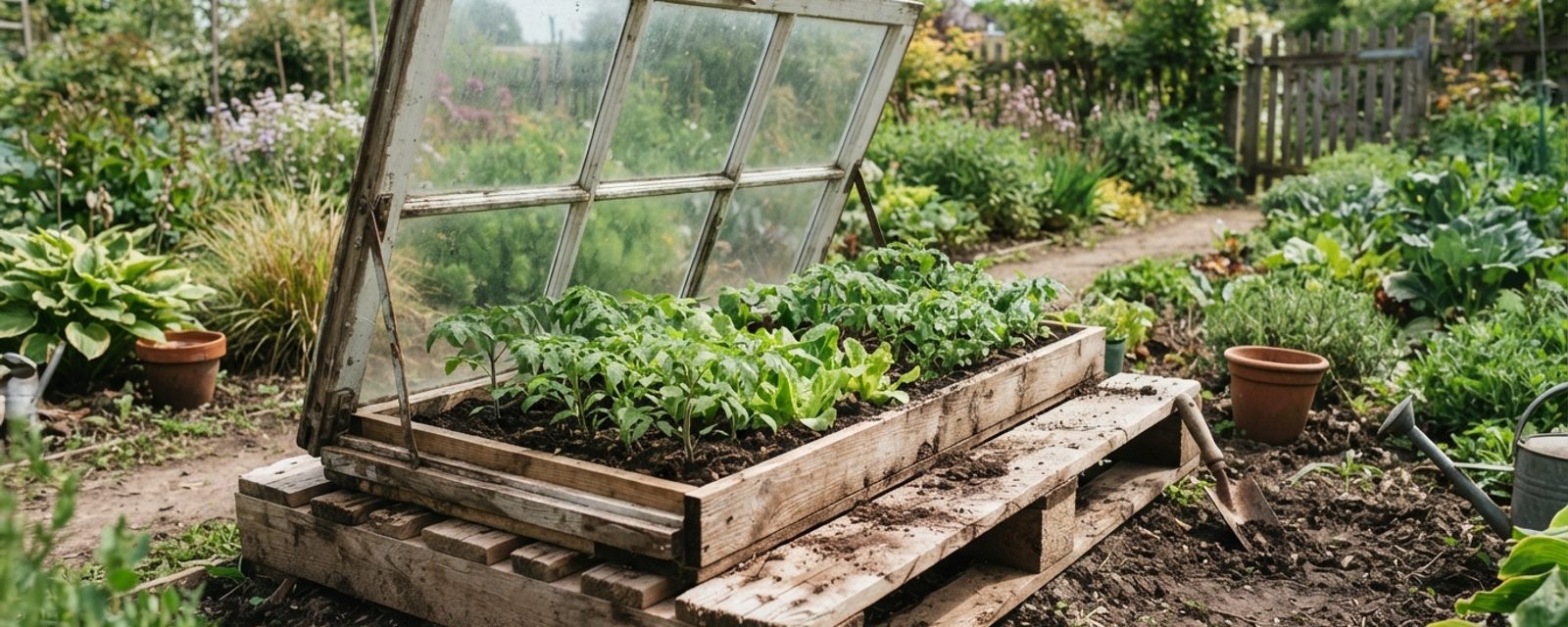
Building a cold frame from an old window and a pallet
Use a strong wooden pallet (roughly 100cm × 120cm) as the base footprint, and an old window frame slightly larger than the pallet (around 115cm × 130cm) as the hinged lid. Screw two sloped wall-support timbers (about 10cm × 5cm × 85cm, cut with the tops sawn at an angle) to the back of the pallet base so the frame slopes down toward the front, this sheds rain and angles the glass to catch low sun. Side timbers close the gap at roughly 23cm × 5cm. Attach the window to the top of the back wall using a pair of 7.5cm hinges, so it lifts like a lid. For ventilation, fix a block of wood to the wall and a swiveling prop stick that holds the window open at an adjustable height, worth checking daily even on a cool-looking day, since a closed frame in direct sun can still cook young plants inside. The whole build is straightforward enough to finish in well under an hour with basic tools.
Variations that work just as well if you don't have a pallet and window pairing to hand: four matching old window sashes leaned together and wired at the top corners into a simple pyramid; or a base built from bricks or concrete blocks stacked dry (no mortar needed for a temporary structure) with a single window laid across the top as the lid, propped open with a stick or brick for ventilation.
Checking pallet wood before you build with it
Not all pallets are safe to build with, and the check matters more here precisely because a cold frame is a soil-contact structure doing real work through a critical stretch of the growing calendar, not somewhere to risk chemical contamination. Pallets are stamped with either "HT" (heat-treated, heated to kill pests, no chemicals involved) or "MB" (methyl bromide fumigated, a chemical treatment you don't want anywhere near soil or food crops). Look for the stamp, usually on one of the end blocks. An "HT" mark is fine for garden building; an "MB" mark or an unmarked pallet should be avoided, especially for anything that will sit in contact with growing soil.
| Reclaimed material | Best use | What to check before using |
|---|---|---|
| Old window (single glazed, timber frame) | Cold frame lid | Frame not rotten, glass intact and safely puttied/beaded in, roughly matches your base dimensions |
| Wooden pallet | Cold frame base / compost bin sides | Stamped "HT", not "MB"; boards not split or rotten |
| Bricks or concrete blocks | Cold frame walls, raised bed edging | Stack dry for a temporary structure; no mortar needed unless it's permanent |
| Scaffold boards | Raised bed sides | Check for embedded nails/screws, sand rough edges |
Compost bins from pallets
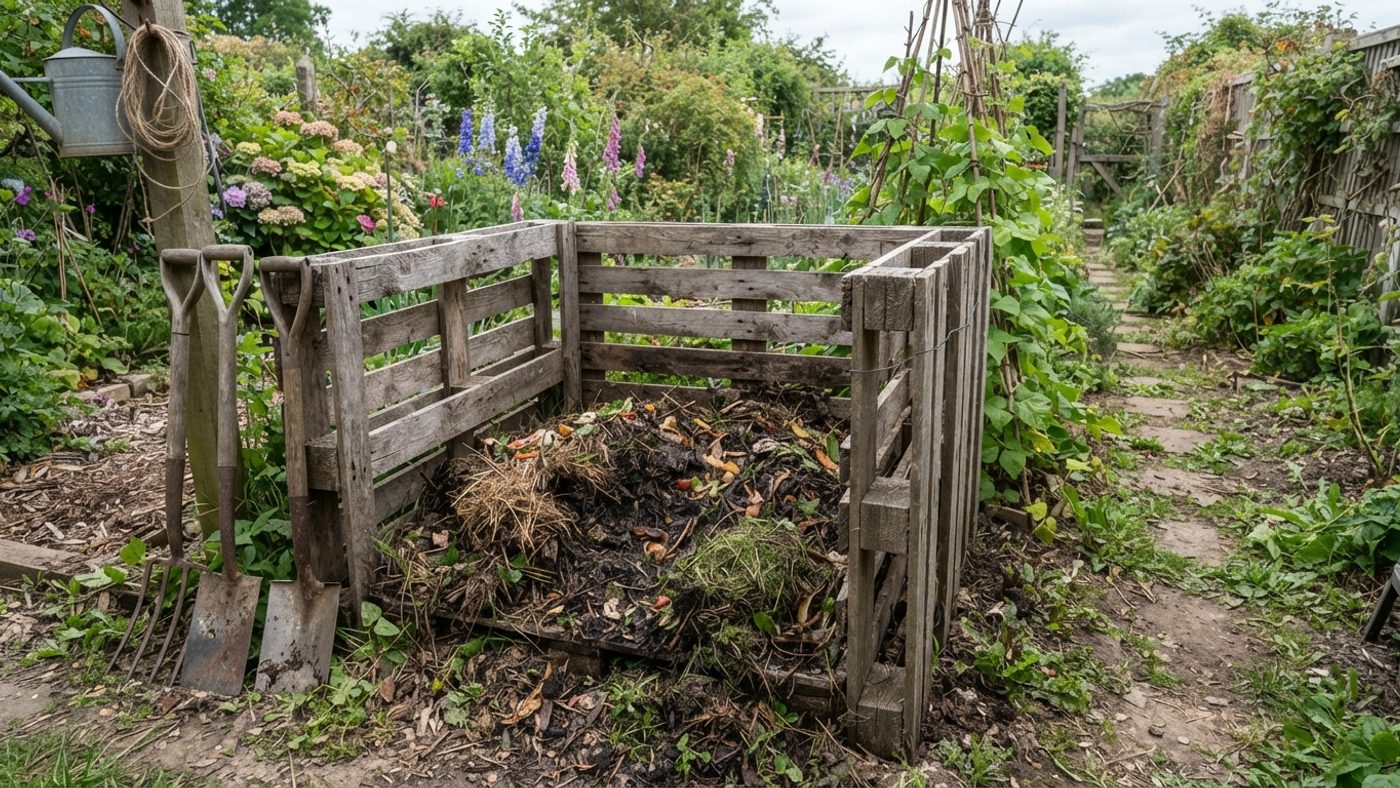
The simplest reclaimed-material win of all: three or four pallets stood on end and wired or screwed together at the corners make a serviceable compost bay with no cutting required. It's the lowest-effort, lowest-cost structure on this list, and a good first project if a cold frame feels like a bigger commitment.
A homemade cloche, for a single row or a single sowing
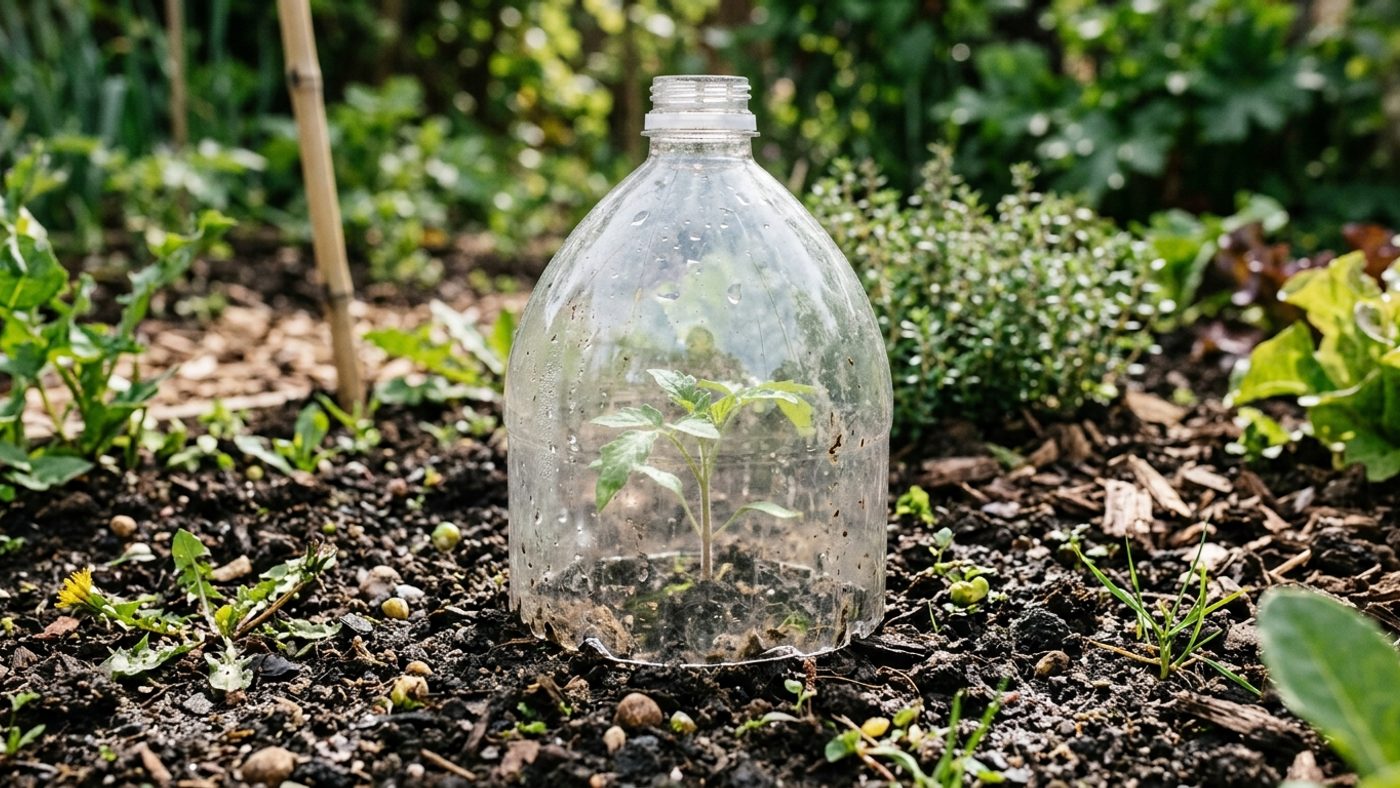
For protecting one row rather than building a whole frame, a cut-open large plastic bottle placed over a young seedling, or a sheet of clear plastic pegged over hoops of bent wire or flexible pipe, works as a cheap cloche, useful for buying an early or late sowing a few extra degrees of protection without the full cold-frame build. Remove or vent it on a mild day; like a cold frame, a sealed cloche in direct sun can scorch what's underneath. Horticultural fleeceA lightweight, breathable fabric laid or draped over plants to trap a little warmth and keep off frost, wind and some flying pests. Full definition →, draped loosely over a row and reused season after season, does a similar job for a whole bed rather than one plant, and is cheap enough to buy new if reclaimed cloche materials aren't to hand.
The polycrub, for scale
Scotland's biggest version of "build with what the sea gives you" is the polycrub, a named, purpose-built polytunnel developed in Shetland from waste marine pipe reclaimed from the salmon farming industry, strapped over with polycarbonate sheeting on a concrete base. SAC Consulting (part of SRUC) has helped crofters access Crofting Agricultural Grants Scheme funding to put one up, precisely because a normal greenhouse wouldn't hold up on the exposed, wind-battered ground where it's needed. Most are bought as a kit rather than self-built, so it's a different scale of project to the window-and-pallet cold frame above, but it's the same underlying idea taken as far as it goes in a Scottish context.
Free and cheap soil improvers and water
Before spending on bagged compost or fertiliser, it's worth finding out what the ground actually needs rather than guessing, a cheap soil pH test kit can save money on a lime or feed you didn't need in the first place, covered in full in identifying your soil type.
Beyond that, there's usually a free option. Leaf mould, fallen autumn leaves left to break down in a bin or bag, makes a genuinely useful soil conditioner for nothing but time; allow the full year or two RHS suggests, since a cooler Scottish autumn and winter breaks leaves down more slowly than the same pile further south. A spring nettle, comfrey, or grass-clipping brew, left to steep in a covered bucket of water for a couple of weeks, makes a passable free liquid feed. Spent potting compost from previous years doesn't need binning either, mixed with fresh material, or with sieved garden soil and homemade compost or leaf mould, it can be reused rather than replaced outright, though results are more variable than a fresh bag. Many Scottish local authorities also run a green-waste collection that composts garden and food waste centrally and sells or gives back the finished compost, worth checking what your own council offers before buying a bagged alternative.
A water butt connected to a shed or greenhouse downpipe is a one-off cost that then supplies free water for the rest of its life. It's a smaller saving in Scotland than somewhere reliant on metered mains water for the garden, given how often it rains here, but it's not nothing, and it's the only free backup during the dry spells that do happen.
Propagating for free: cuttings and division
Buying one plant and turning it into several, rather than buying several, is one of the oldest budget-gardening tricks and it still works. Perennials that have been in the ground two or three years, hardy geraniums, daylilies, many border perennials, can usually be lifted and split. Small clump-forming plants can often be teased apart by hand; larger, more fibrous-rooted clumps need two garden forks inserted back-to-back and levered apart, or a spade or knife for tougher, woodier crownsThe base of a perennial plant where roots and shoots meet, often sold and planted as a ready-made dormant plant rather than grown from seed. Full definition → like hellebores. Divide when the plant isn't in active growth, replanting the divisions as soon as possible so the roots don't dry out. A spring divisionPropagating a clump-forming perennial by digging it up and splitting it into several smaller pieces, each with roots and shoots attached. Full definition → is generally the safer choice: it gives the new plant a full growing season to establish roots before a Scottish winter, where a late-summer or autumn division goes into the cold with barely any root system built up yet.
Soft cuttings from tender perennials such as argyranthemums, taken in spring and rooted on a windowsill, turn one bought plant into several by early summer at minimal extra cost. Woody shrub cuttings, and even sprouting kitchen leftovers like a forgotten sweet potato or onion, are lower-effort ways to generate free plants without buying anything at all.
Community resources worth knowing about
Formal community support for budget gardening in Scotland is genuinely there, but patchy, worth checking what exists locally rather than assuming. Two named organisations are worth knowing:
- Tool libraries. Beyond the borrowing angle already covered above, both the Edinburgh Tool Library and Glasgow Tool Library exist specifically to reduce the need to own tools you'll use only occasionally, directly relevant to the secondhand-vs-borrow decision on power tools covered earlier.
- The Scottish Allotments and Gardens Society (SAGS) is the national body for allotment associations and community growers in Scotland, working on advocacy, site protection, and networking between local associations, with governance resources and advice available to member associations and individuals. It's a reasonable starting point if you're trying to find out whether a seed swap, tool share, or allotment association already exists near you, even though it isn't itself a seed-swap organiser. If you're weighing up an allotment plot against a community garden as a way to access shared resources and lower per-head costs, the trade-offs are set out in community gardens vs allotments, and the practical rules around what you can and can't do on an allotment plot are covered in allotment rules: what you can and can't do.
Beyond these two, assume there's more happening locally that isn't well indexed online, a garden centre noticeboard, a library, or a local Facebook group is often a better way to find an active seed swap or informal tool-share than a web search.
Common questions
Is it actually cheaper to grow from seed than to buy plug plants?
Usually, yes, per plant, a seed packet costing a few pounds can produce dozens of plants versus paying by the unit for plugs. The exception is a narrow, high-stakes sowing window, where a failed attempt can't be repeated that season: there, a guaranteed plug plant can work out the better spend even at a higher unit cost.
Where can I find a seed swap in Scotland?
Garden Organic lists seed swap events across the UK on its Heritage Seed Library pages, though coverage in any given year and area varies, so it's worth checking close to the time. Local gardening clubs, allotment associations, and community noticeboards are often a better source for informal, small-scale swaps than a national listing.
What garden tools are safe to buy secondhand?
Anything with no moving parts and nothing safety-critical, spades, forks, hoes, rakes, trowels, wheelbarrows, because wear and damage are easy to see and assess by eye. Power tools with unknown service or battery history, and anything with a cutting edge that's badly pitted, notched, or has a loose pivot, are the higher-risk categories.
Are pallets always safe to build with?
No. Check for a stamp reading "HT" (heat-treated, safe) rather than "MB" (chemically fumigated, avoid for anything touching soil or food crops). The stamp is usually on one of the end support blocks.
How does a DIY cold frame help with a tight Scottish growing season?
It extends the growing season at both ends, and in a shorter season that extra few weeks at each end is worth proportionally more than the same weeks would be further south. It also reduces how many plug plants you need to buy in each year, since more crops can be started and finished under cover.
Can I borrow tools instead of buying secondhand?
Yes, the Edinburgh Tool Library and Glasgow Tool Library both lend garden tools, including power tools, for free or a low membership fee. Borrowing sidesteps the main risk with secondhand power tools entirely, since you can see the tool run before you commit to using it.
Sources
12 sources, recorded with what each was used for
- RHS: 7 top budget tips for growing fruit and vegetables on your allotment: The French bean seed-vs-plug price comparison (£4.49 for 70 seeds vs £11.99 for 15 plugs) and pallet-based compost bins
- RHS: 8 money-saving gardening ideas for spring: Homemade liquid feed, reused potting compost, and other free/cheap propagation tips
- RHS: Leafmould: Leaf mould's roughly one-to-two-year breakdown time
- RHS: Perennials — Dividing for Vigour: Division method and timing (hand division, fork method, cutting method; divide when not in active growth)
- RHS: Plant propagation: The range of propagation methods (cuttings, division, layeringPropagating a new plant by pinning a low, flexible stem into the soil while still attached to the parent, so it roots before being cut free. Full definition →, graftingJoining a chosen fruiting variety onto a separate rootstock, so the tree grows the fruit of one plant on the roots of another. Full definition →) as a cost-saving approach
- Garden Organic: The Heritage Seed Library: How the seed-swap-club model works (members sent seed to grow, save, and swap it onward)
- Garden Organic: Seed Swap Events: Confirming seed swap events are listed UK-wide
- Edinburgh Tool Library: Tool stock size (3,000+ tools), branch locations, and free 7-day loan model
- Glasgow Tool Library: About: What's lent (including garden tools), donation-based stock model, and Maryhill location
- Scottish Allotments and Gardens Society (SAGS): SAGS's role as Scotland's national allotment advocacy and networking body
- Gardeners' World: How to Make a Cold Frame: The pallet-and-old-window cold frame build (dimensions, hinge size, ventilation prop method)
- SRUC: Polycrub pioneer joins SAC Consulting's Oban team: What a polycrub is made from, where it originated, and its role in crofters' Crofting Agricultural Grants Scheme funding