
You open the seed drawer in February and find it: a half-used packet of parsnip seed from two seasons ago, a few tomato packets with a sell-by date that's long gone, some onion seed you're fairly sure you bought "sometime after the pandemic." The packet looks fine. The seed inside looks fine. But looks tell you almost nothing about whether it will actually grow.
Sow it and hope, and you won't know you've got a problem until three or four weeks later, when the bed is still bare and everything else in the garden has moved on without it. That's a bigger setback here than it sounds: Scotland's frost-free window is shorter than most of the UK's (see the frost dates guide for how much that varies by region), so a failed early sowing often means there isn't enough season left to start again and still get a worthwhile crop, the space, the slot, and sometimes the variety are all gone for the year. Testing a pinch of seed first costs a fortnight and a damp paper towel. Sowing blind and finding out later can cost the whole slot.
The test and figures below are for shop-bought seed, a packet from a garden centre or catalogue that's been sitting since a previous year. Seed collected and dried from your own plants keeps differently, and has its own pitfalls before you even get to testing it (isolation, cross-pollinationPollen moving from one plant to a different, compatible variety, needed for fruit to set on any variety that isn't self-fertile. Full definition →, drying), the saving-your-own-seed guide covers that process and its own viability test.
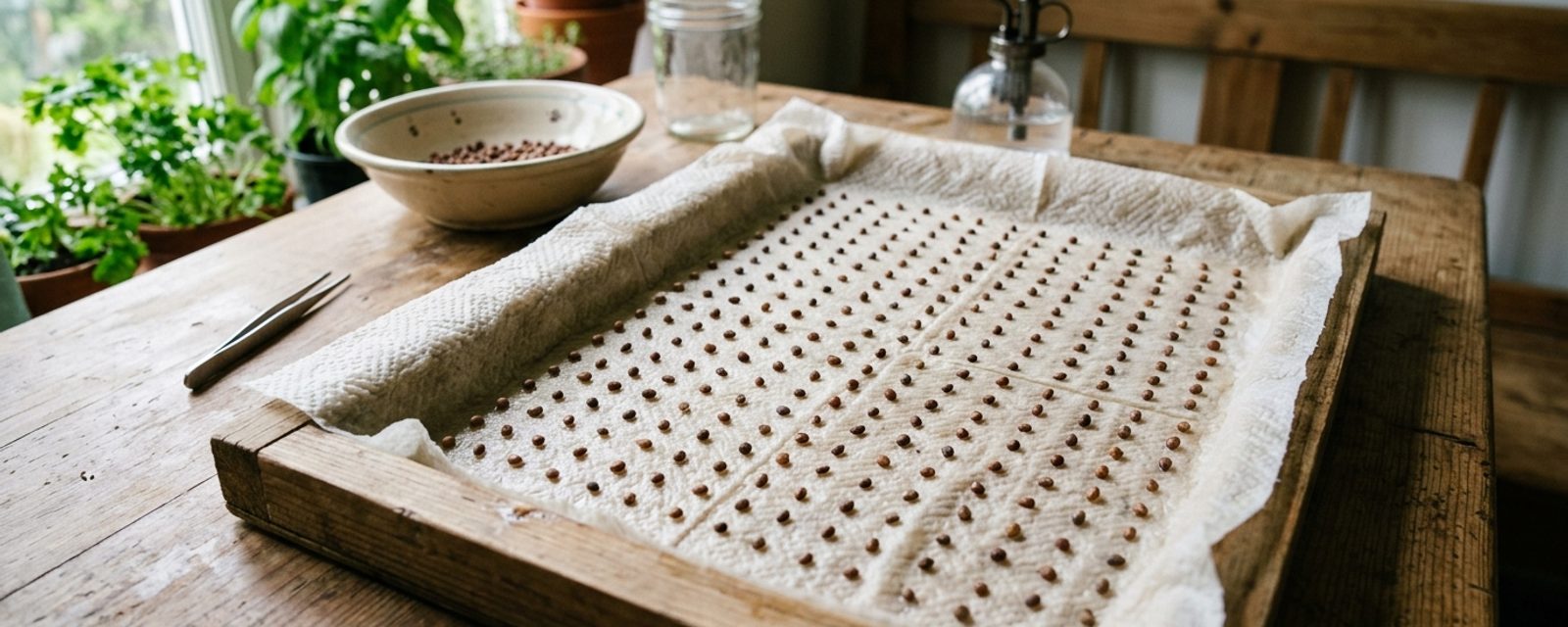
The paper towel germination test
This is the standard way to get a real answer, rather than a guess, about whether a packet is worth sowing.
- Count out 10 seeds from the packet. Ten is enough to give you a workable percentage without wasting seed you might still need.
- Dampen a paper towel so it's moist throughout but not dripping, squeeze out any excess water first.
- Space the seeds out on one half of the towel, then fold the other half over them (or lay a second damp sheet on top).
- Seal the towel inside a plastic bag or between a plate and clingfilm, and label it with the crop and the date, it's easy to lose track of which bag is which once you're testing several packets at once.
- Keep it somewhere warm, an airing cupboard, on top of the fridge, or near (not on) a radiator. Most vegetable seed germinatesA seed sprouting: breaking dormancy and putting out its first root and shoot, given the right warmth and moisture. Full definition → fastest in the high teens to low twenties °C.
- Check every day or two. Keep the towel damp, mist it or add a little water if it's drying out, but don't let it get waterlogged, since seed sitting in standing water can rot before it gets the chance to germinate.
- Give it a full two weeks before writing anything off. Gardeners' World's version of this test allows two weeks for germination to show, and some seed, especially anything on the slower side, like parsnip or celery, can take the best part of that to get going even when perfectly healthy. Don't judge the result at day four.
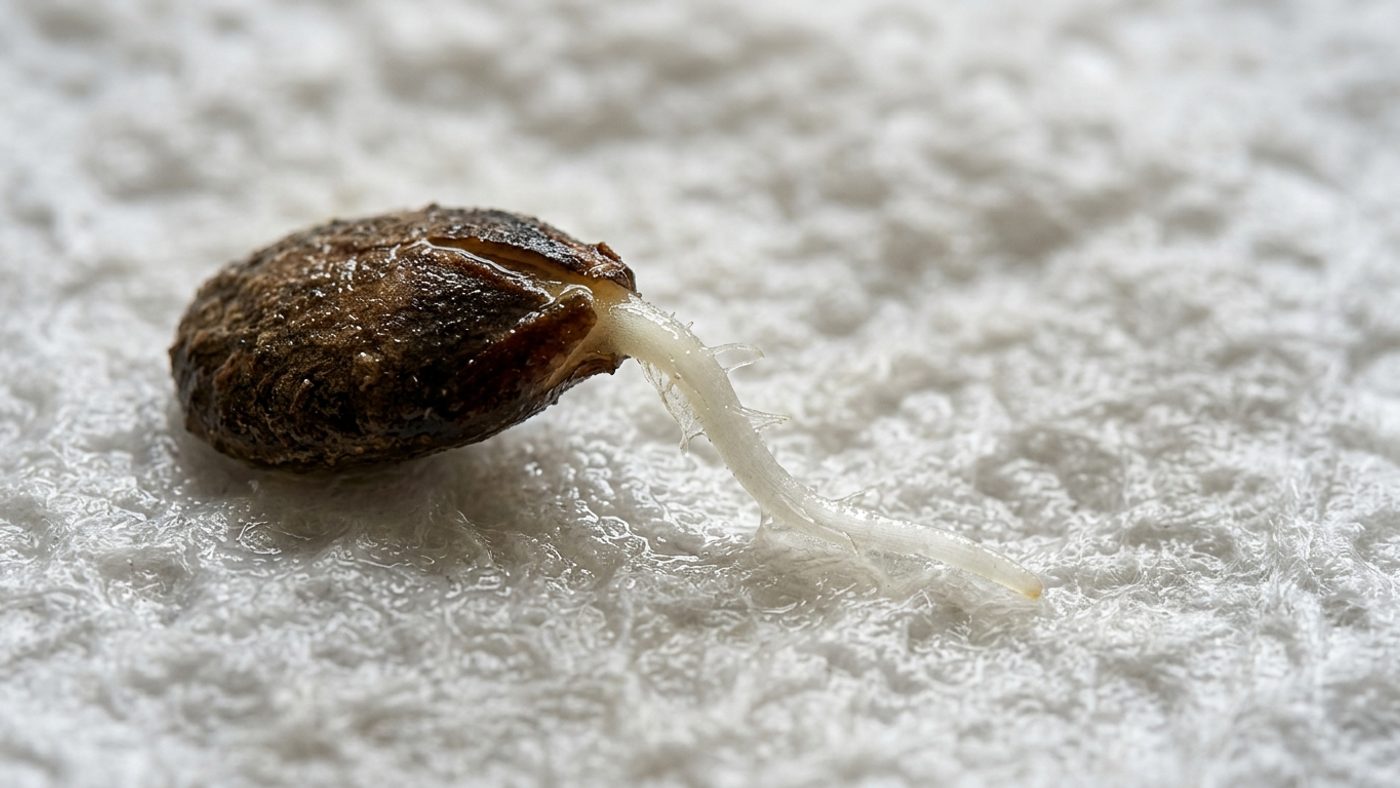
- Count what's germinated, a visible root (radicle) emerging is enough to count a seed as successful, you don't need to wait for leaves. Multiply the number of germinated seeds by 10 to get your percentage. Five out of ten germinated is 50% viability.
Test each variety separately, even if you're testing several packets in one session, germination speed and rate both vary enough between crops (and sometimes between varieties) that mixing them in one bag makes the count harder to trust.
What to do with the seeds that do sprout: they're proven viable, so it's worth gently potting them on into modulesA tray divided into small individual cells, each sown with its own seed or seedling, so each plant grows undisturbed roots until it's ready to plant out. Full definition → or small pots rather than discarding them, handle the emerging root carefully, as it's fragile and easily snapped. Ten seeds isn't enough of a sowing on its own, though: once you know the packet's real germination rate, sow the rest of it at the thicker or normal rate the result calls for (see below).
Pelleted or coated seed, common for carrot, and increasingly for onion and beetroot, can be tested the same way; just note which packets are pelleted, since the coating makes the seed inside harder to inspect by eye if you're also checking for the dead-seed signs below.
How long does shop-bought seed actually last?
This is where a lot of guesswork happens, and it's worth being specific, because the spread between species is much bigger than most people expect. Some vegetable seed is genuinely a use-it-or-lose-it purchase; other seed will still be worth testing years after the packet date.
| Seed type | Typical viability, stored well | What this means in practice |
|---|---|---|
| Parsnip | About 1 year | Treat parsnip seed as essentially single-season. RHS growing advice recommends buying only enough for the current year, since old seed germinates poorly, and parsnip's own long, slow season makes a wasted sowing hard to recover from. |
| Onion, leek, spring onion (alliums) | Often only 1–2 years | RHS growing advice notes onion seed doesn't stay viable for long, with germination rates declining after a year or two, testing before sowing is worth the fortnight rather than assuming a two-year-old packet is fine. |
| Most other vegetables (brassicasThe cabbage family: cabbage, kale, broccoli, cauliflower, Brussels sprouts, kohlrabi, swede, turnip and more, sharing the same pests, diseases and rotation rules. Full definition →, tomatoes, legumes, lettuce, beetroot, squash and similar) | Can remain usable for several years in good conditions | Garden Organic notes there's no single fixed figure, different authorities quote different spans. A two- or three-year-old packet of these is often still worth testing rather than binning. |
| Any seed in cool, consistent refrigerator storage | Can remain viable "for many years," per RHS | Good storage buys time across the board, but doesn't stop the decline, germination rate still drops gradually even under ideal conditions, so age is never a substitute for a test. |
The pattern worth remembering: parsnips and alliums are the ones to be suspicious of first. If you find old onion or parsnip seed in the drawer, don't assume it's fine just because everything else in there has kept for years, test it, or budget to buy fresh.
What "stored well" actually means
Seed longevity figures like the ones above only hold if the seed has actually been kept properly in the meantime. A packet that's spent two summers on a sunny windowsill or in a shed that swings from freezing to warm and back isn't the same as one kept consistently cool.
Garden Organic's guidance puts the two damaging factors plainly: moisture and warmth are what shorten a seed's life, and as a rough rule of thumb rather than a precise formula, storage life roughly doubles for every 5°C drop in temperature and every 1% drop in the seed's moisture content. RHS advice on seed storage recommends keeping seed in a refrigerator at around 5°C (41°F), in labelled paper packets or envelopes inside an airtight container with a desiccant (a moisture-absorbing packet or sachet, such as silica gel) to keep moisture out, under those conditions, seed can remain viable for many years.
In practice, "stored well" means:
- Cool, a cold cupboard, unheated room, or the fridge (specifically not the freezer for most vegetable seed unless it's been properly dried first).
- Dark, light and, more importantly, the heat that comes with a sunny spot both work against the seed.
- Dry, damp packets or high humidity are the single biggest cause of seed dying in storage; RHS advice notes that excess humidity or warmth can cause seed to deteriorate or die from fungal disease or rotting.
- Away from temperature swings, a shed, a garage, or a windowsill that heats up in the day and cools sharply at night is worse for seed than a steady, moderate cupboard, even if the cupboard isn't as cold as a fridge.
If your old packet has spent its life in anything other than these conditions, treat the "typical viability" figures above as optimistic best cases, not guarantees, that's exactly the seed worth testing rather than trusting.
Signs the seed is already dead: don't bother testing
Not every old packet needs the full two-week test. A couple of checks take seconds and can save you the trouble:
- Visible mould or fungal growth, either on the seed itself or inside the packet. This is a direct sign the seed has been exposed to damp at some point, RHS advice on seed storage notes that excess humidity or warmth causes seed to deteriorate or die from fungal disease or rotting, and once that's visibly happened, the seed underneath is very unlikely to be worth testing.
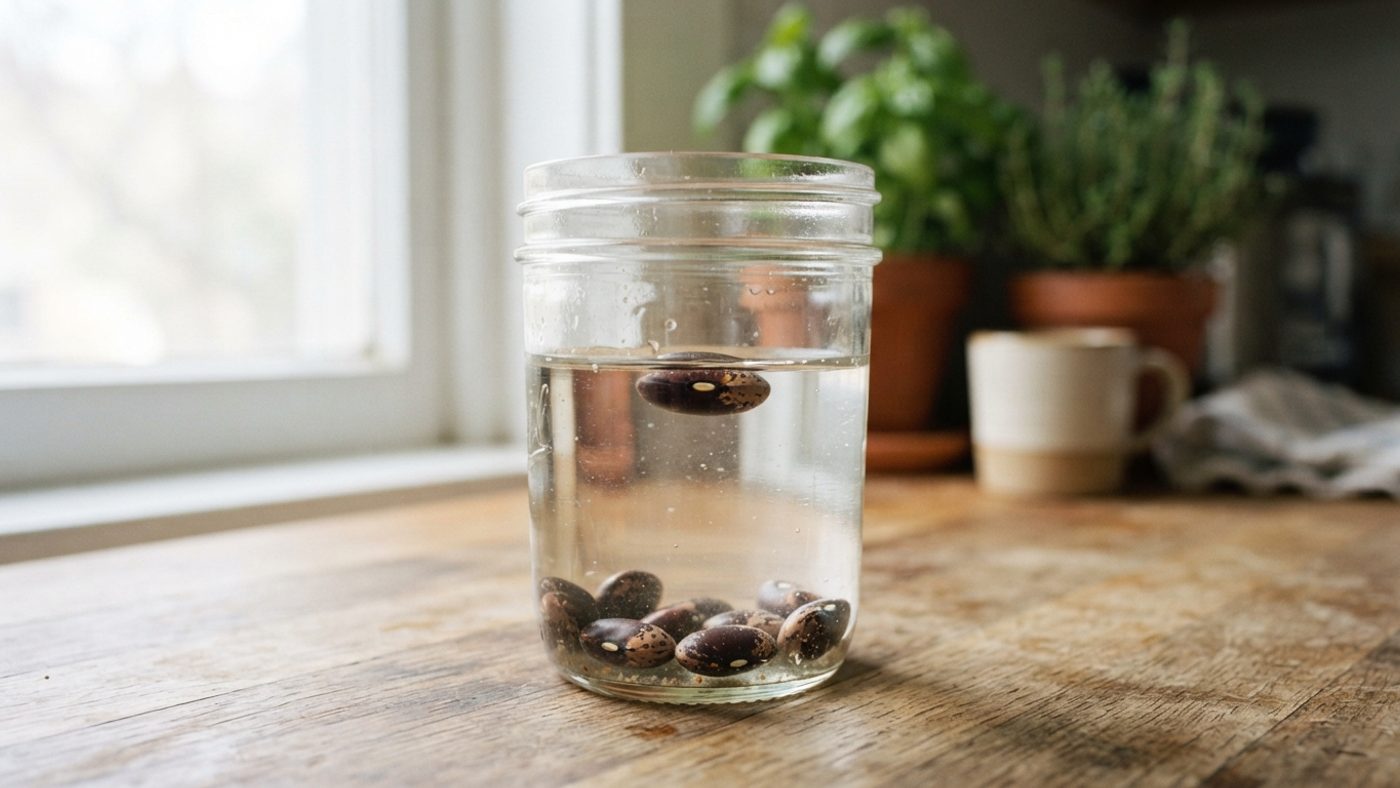
- The float test, for medium-to-large seeds (beans, peas, squash, sweetcorn and similar, this doesn't work reliably on very small or lightweight seed like carrot or lettuce). Drop a sample in a jar of water: RHS guidance on seed saving notes that viable seed will sink, while dead seed floats to the surface. It's not infallible, but for larger seed it's a genuinely useful first pass before committing two weeks to a full germination test.
If either of these shows up, skip the paper towel test and go straight to buying fresh.
Reading the result: sow as normal, sow extra, or bin it
Once you've got a percentage from the test, the decision is straightforward, it just needs translating into an actual sowing plan.
| Germination result | What to do |
|---|---|
| High (roughly 80%+) | Sow as normal, performing close to fresh seed, no benefit to sowing extra thickly. |
| Moderate (roughly 40–70%) | Still worth using, but sow noticeably thicker than the packet instructs, then thin once seedlings are up. At 50%, doubling the usual sowing rate is a reasonable starting point. |
| Low (roughly 10–30%) | Only worth sowing as a backup alongside fresh seed, not relied on alone, a bed sown at this rate can easily come up patchy or fail outright. |
| Very low or none (under 10%, or nothing after two full weeks) | Not worth sowing. Buy fresh, or check a local seed swap or seed library. |
These bands are guidance rather than an exact formula, and a crop that isn't your main harvest might be worth sowing at a lower rate than one you're relying on. But they turn "I think this seed is probably fine" into an actual number to act on.
A note for tomatoes, peppers and other seed that needs extra warmth
The table above covers general viability, but tomatoes, peppers and other seed that germinates best above 20°C need the test itself to run warmer than an ordinary cupboard reliably manages, a spot on top of the fridge, near (not on) a radiator, or a heated propagator lid is worth using for these specifically. If the test seed doesn't germinate at all, check the warmth before writing off the packet: a genuinely cold test environment can produce a false "dead seed" result for these crops in particular.
It's also worth separating a dead-seed result from cold, wet soil doing the same thing outdoors later: a packet that tests well can still sit and rot, or simply not come up, if it's sown into ground that's still too cold, the test only rules out the seed, not the conditions it goes into afterwards.
Regional variation within Scotland
A Highland or Aberdeenshire frost-free window runs shorter again than a milder coastal or Central Belt one, so a "moderate, sow-extra" result is a safer bet to act on in a garden with more spare season than one with less. The frost dates guide gives the actual figures by region, check it before deciding how much risk a lower-band result is worth taking on where you garden specifically.
If it's your own saved seed, not a shop packet
Everything above assumes seed in its original packet from a shop or catalogue. Seed collected and dried from your own plants needs the same paper towel test, but there's more to get right before that point, drying, avoiding cross-pollination between varieties, and storage from the point of collection. See the saving-your-own-seed guide for that in full.
Common questions
Do I need to test every old seed packet, or only some?
Not every packet needs the full test. If a packet shows visible mould, or you know it's spent a season somewhere damp or on a hot windowsill, it's often quicker to either do the float test (for larger seed) or just buy fresh. Save the full two-week paper towel test for packets where you genuinely don't know the storage history, or where the seed is expensive or hard to replace.
Can I speed up the two-week test if I'm in a hurry?
Not reliably. Most seed will show its result within two weeks, and some, parsnip especially, is naturally slow even when perfectly healthy. Cutting the test short risks writing off seed that just needed a few more days. If time is genuinely tight, start the test the moment you find the packet, well before your planned sowing date, rather than trying to compress it.
Does it matter if I test seed straight from the fridge, or should I let it warm up first?
Let the packet come up to room temperature before opening it and starting the test. Seed brought straight out of a cold fridge into a warm, humid test environment can pick up condensation, which risks the same damp-related deterioration you're trying to avoid.
My onion seed is only a year old, do I really need to test it?
It's worth it. Onion seed is one of the shortest-lived common vegetable seeds, with germination declining noticeably after just a year or two, so even a one-year-old packet can already have dropped well below the rate on the label. A quick test removes the guesswork.
Where can I get replacement seed if my test comes back too low?
Buying fresh from a garden centre or catalogue is the reliable option, but a local seed swap or seed library is also worth checking, they're a common route for replacing old vegetable seed cheaply, and often carry varieties suited to a shorter season.
Is a low germination result definitely the seed's fault, or could it be my test conditions?
It can be either, so keep the test conditions genuinely favourable, warm, consistently damp (not waterlogged), and given the full two weeks, before concluding the seed itself is at fault. If a fresh, in-date packet of the same crop also performs poorly under the same test, the problem is more likely your setup than the seed.
Sources
7 sources, recorded with what each was used for
- RHS: Seed — collecting and storing: Refrigerator storage temperature (5°C/41°F) and "many years" viability claim, desiccant/airtight container advice, and the note that excess humidity or warmth causes seed to deteriorate or die from fungal disease or rotting
- RHS: How to grow Parsnips: The recommendation to buy only enough parsnip seed for the current year and buy fresh every spring, since old seed germinates poorly
- RHS: How to grow Onions: The statement that onion seed doesn't stay viable for long, with germination rates declining after a year or two
- RHS: Tips on saving your own seeds: The float test (viable seed sinks, dead seed floats) for medium-to-large seed
- Garden Organic: Seed Storage for longer life: The doubling-rule guidance on temperature/moisture and storage life, and the caveat that different authorities give different lengths of time for seed viability
- Gardeners' World: How to Test Seed Viability: The damp kitchen towel germination test method, the two-week timing, and the percentage-to-sowing-rate interpretation
- Gardeners' World: Growing Parsnips from Seed: The statement that parsnip seed stays viable for only one year