
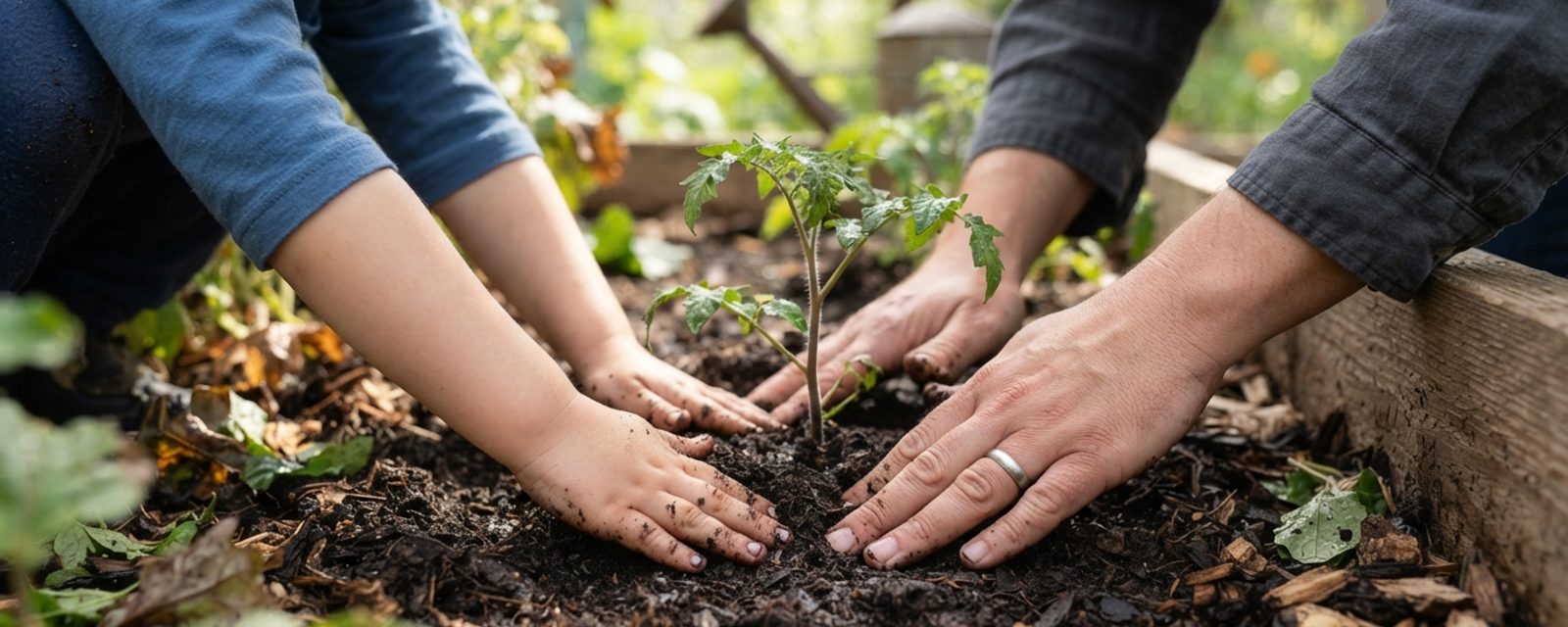
Watch a four-year-old pull a radish out of the ground for the first time and you'll see a very particular kind of delight, not quite the same as opening a present, because they made this happen.
What's really happening when a child gardens
That distinction matters more than it sounds. It's what developmental psychologists broadly describe as a sense that things happen because of what I did, not just to me, and gardening is one of the few activities that hands a small child that feeling in a form they can literally hold in their fist and eat.
The sensory side runs just as deep. Compost between the fingers, the smell of crushed tomato leaves, the papery rattle of a dried poppy seed head, the cold shock of the hose, none of this is incidental "fun." For a young child, hands-on contact with varied textures, smells and temperatures is genuine sensory-processing input, the same category of experience occupational therapists deliberately build into early years programmes. A garden delivers it for free, in a way a screen or a worksheet structurally cannot.
Then there's the waiting itself. Modern childhood is unusually saturated with instant results, a video loads, a level completes, a message arrives. A seed does not care about any of that. It germinatesA seed sprouting: breaking dormancy and putting out its first root and shoot, given the right warmth and moisture. Full definition → on its own schedule, and the only way to get to the radish, the sunflower, or the pumpkin is to keep showing up and watering it in between. That gap between action and reward, held open for days or weeks, is close to what's generally meant by delayed gratification, usually described as a skill built through repeated small experiences of waiting for something worthwhile, not a fixed trait a child either has or lacks. A garden bed is a low-stakes place to practise it.
Add in that a child who has grown a carrot understands, in a way no diagram fully replicates, that food comes out of soil rather than a shop shelf, and that all of this typically happens outdoors, moving, in weather, and you have an activity that is quietly doing several jobs at once. None of that requires an idealised country garden. It works in a windowbox, a raised bed, or a pot onMoving a plant into a larger pot as its roots fill the current one, giving it more room and fresh compost before it becomes pot-bound. Full definition → a tenement stair.
Why it matters more here: Scotland's growing season problem
All of the above is true everywhere. In Scotland it carries extra weight, for a fairly mundane reason: a Scottish spring tends to stay cold and wet for longer than gardening advice written for the UK as a whole usually assumes, so the outdoor part of gardening is genuinely harder to get to for weeks at a stretch. Asking a small child to "wait for the weather" on top of waiting for the seed is asking them to delay gratification twice over, once for the plant, once for a dry Saturday. That's a lot to ask of a five-year-old's patience, and it's exactly the gap cress on a windowsill or a bean growing against glass is built for: something to tend and watch while the ground outside is still too cold and sodden to sow into.
NHS inform's physical activity guidance sets targets of around 180 minutes of daily activity for under-5s (including at least 60 minutes of moderate-to-vigorous activity for pre-schoolers) and around 60 minutes a day of moderate-to-vigorous activity for children aged 5 to 18, outdoor play is named as one of the ways to meet that for younger children. The Scottish Government's early years policy goes further, stating an explicit ambition for children in early learning and childcare settings to spend as much time outdoors as indoors, every day, in every setting. Neither target gets any easier to hit through a grey, wet March and April, which is when a head start indoors matters most.
Different ages, genuinely different gardens
The single most common mistake with kids and gardening is treating it as one activity with one set of expectations. A two-year-old and a ten-year-old are not doing the same task even when they're both "helping in the garden," their attention spans, physical capability, and what actually holds their interest are completely different, and pretending otherwise is the fastest route to a bored toddler and a frustrated parent.
| Age band | Realistic attention span | What actually works | What to avoid |
|---|---|---|---|
| Toddlers & preschool (roughly 2–4) | A few minutes per task, in bursts | Pouring water from a small can, patting soil over a seed, pulling up something already loosened, splashing about with mud | Anything requiring them to wait quietly, fiddly small seeds, tools with sharp edges |
| Younger primary (roughly 5–7) | 10–20 minutes of focused activity | Planting large seeds (beans, sunflowers, pumpkins) by hand, watering their own patch, harvesting ready crops, simple digging with a child-sized trowel | Precision tasks like thinning seedlings or exact spacing, being handed the whole plot to manage |
| Older primary & early secondary (roughly 8–12) | 30 minutes or more, especially if there's a goal | Sowing rows from a seed packet, tracking a "biggest pumpkin" competition, managing their own small bed start to finish, using proper tools with supervision | Being treated as just an extra pair of hands on the adult's plot rather than having something of their own |
The exceptions are worth knowing too. A child who's normally restless will often sit still for far longer than usual watching a caterpillar, a worm, or bees on a flower, insects and other visible garden life reliably buy extra attention span at any age. Conversely, even a capable ten-year-old's interest in a slow-growing crop like a leek or a maincropThe main, usually latest-sown and longest-growing type of a crop, grown for bulk and storage rather than an early harvest. Full definition → potato can evaporate within a couple of weeks if nothing visible is happening, which is exactly why the fast crops below matter regardless of age.
Crops that reward a short attention span
Choosing the right crop does more for a child's engagement than almost anything else on this list. A child who sowed carrots and has to wait three months for a payoff will likely have lost interest long before harvest. Stick to crops where something visible happens within days, not months, and treat any UK-wide sowing date on a seed packet as a starting point rather than a rule, in cooler, later parts of Scotland outdoor sowing generally needs to wait longer than the packet suggests, so check frost dates for the actual area before sowing outdoors.
| Crop | Sow depth | Germination | Ready to use/harvest |
|---|---|---|---|
| Cress | Scatter on wet cotton wool or compost | A few days | 7–14 days |
| Salad leaves | 1cm (½in) | A few days | 4 weeks (summer), up to 8 weeks (cooler weather) |
| Radish | 1cm (½in), 2.5–5cm apart | 7–10 days | As little as 4 weeks from germination |
| Sunflowers | 12mm deep, 10cm apart, thin to 45cm | Days to a couple of weeks | Sown April–May, flowering by August |
| Pumpkins | 1cm (½in) indoors, 2.5cm (1in) outdoors | Roughly a week, given warmth | Weeks of visible daily growth once fruit sets |
Radish earns its reputation as the classic first crop for exactly the reason this shorter, weather-squeezed season rewards: it's genuinely one of the fastest edible plants there is, and pulling up the root is a satisfying, one-second payoff a four-year-old can manage alone. There's a slower winter radish form too, worth sowing later in the season once a child already trusts that the quick summer ones work, see the full radish growing guide for both.
Cress is even faster than radish and needs no garden at all, see the indoor activity below. Sunflowers and pumpkins work on a different, longer timescale, but they compensate with sheer visual drama: a sunflower can be checked with a tape measure every few days, which turns the wait itself into the game rather than something to endure. Giant varieties like 'American Giant' can reach around 4 metres, while shorter varieties such as 'Teddy Bear' (60–90cm) or 'Big Smile' (around 30cm) suit smaller spaces or younger children who want a sunflower they can actually see over. Pumpkins take the competitive angle further: the technique for growing one large fruit rather than several smaller ones, removing all but one developing pumpkin per plant and feeding it a high-potash liquid feed every 10 to 14 days once it starts swelling, set out in full in the pumpkin growing guide, turns "whose pumpkin is biggest" into a genuine multi-week family competition, with a tape measure or a set of kitchen scales doing the job a stopwatch does for a race.
Give them a patch that's actually theirs
Handing a child a trowel and asking them to help weed the adult's vegetable bed is not the same thing as giving them ownership, and children notice the difference. A small patch of ground, a single raised bed, or even one large pot that is explicitly theirs, to plant, to water, to sometimes neglect, and to harvest, does more for sustained interest than any amount of "helping." It doesn't need to be large or expensive: a single grow bag or a 30cm pot is enough space for a few radishes, a sunflower, or a trailing pumpkin trained up a support, and a packet of seeds for any of the fast crops above typically costs a few pounds, this is a cheap hobby to start, even if trowels, pots and compost add up over time. What matters is that the decisions (what goes in, when it gets watered, whether that weed stays or goes) are theirs to make and theirs to get wrong.
Families in a flat or tenement with no outdoor space at all aren't excluded from this, a windowsill or a shared close still allows a pot or two, but if a proper outdoor patch matters, an allotment plot is worth exploring. The Scottish Allotments and Gardens Society works with allotment sites and plot holders across Scotland and is a reasonable starting point for finding a local site and its waiting list, since provision and wait times vary a great deal by local authority.
Start indoors: two activities for the grey weeks
Given how much of the Scottish growing calendar is spent waiting for the weather to cooperate, it's worth having at least one indoor activity ready before outdoor sowing is realistic at all.
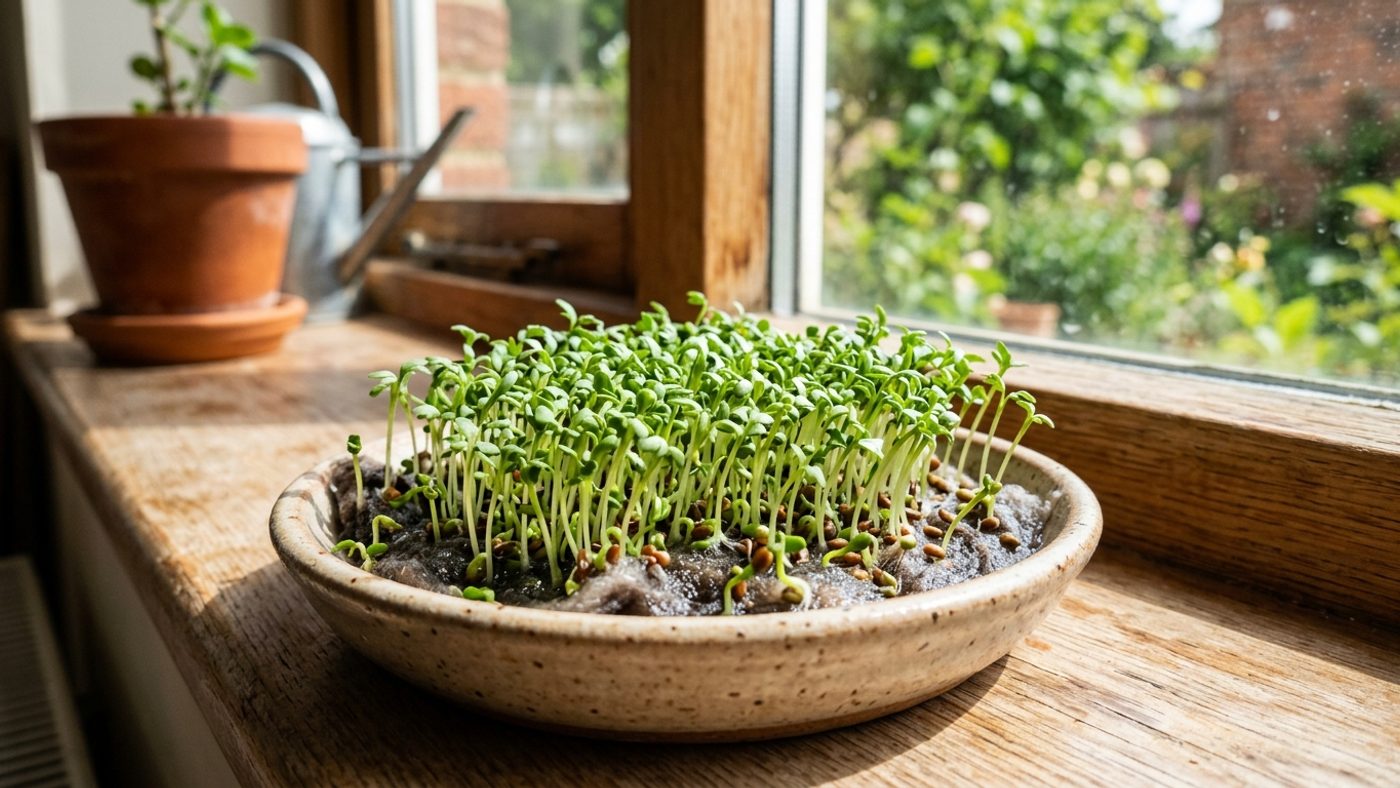
Cress on a windowsill. This needs no soil and almost no equipment: damp cotton wool (or kitchen roll, or a shallow layer of peat-freeCompost made without peat, which is harvested from a slow-forming, carbon-storing wetland habitat that peat extraction damages. Full definition → compost) in a container, cress seeds scattered thickly on top, and a warm, light spot such as a windowsill. Seeds germinate within a few days and are ready to snip and eat within 7 to 14 days, genuinely fast enough that a child sees a difference from one morning to the next. Growing it in a decorated eggshell, so the cress ends up looking like hair, is a well-established version of the activity that makes the payoff sillier and more memorable for younger children.
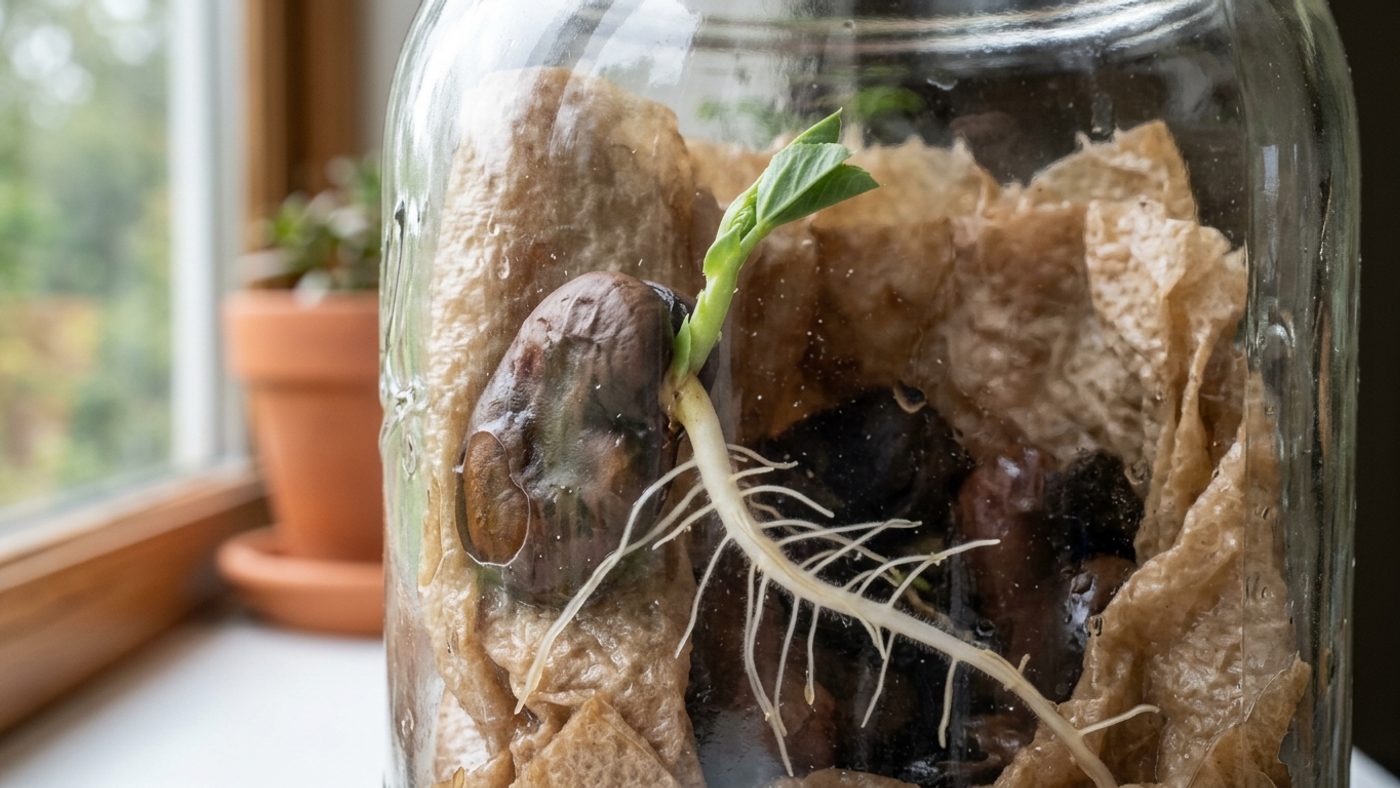
A bean against the glass. Line a clear jar with damp kitchen roll or blotting paper, tuck a broad bean or runner bean seed between the paper and the glass, and keep the paper moist. Because the seed sits pressed against clear glass rather than buried in soil, the child can watch the root emerge and the shoot unfurl from day one, the part of germination that's normally hidden entirely. It's slower to reach anything edible than cress, but it makes the invisible process of germination visible, which is exactly the point on a wet February afternoon when going outside isn't an option.
The honest bit: mess, failure and lost interest are normal
It would be dishonest to describe any of this without also saying plainly: a lot of it will not go to plan, and that's fine. Seeds will fail to come up. A sunflower a child was proud of will get slug-eaten to a stump overnight (if slugs are a real problem on a child's patch, keep any control child- and pet-safe, beer traps, copper tape, or picking them off by torchlight are all safer choices around young children than pellets). Compost will end up on the kitchen floor, on school clothes, and occasionally in someone's hair. A child who was fascinated by their radish patch in April may have completely lost interest by June, right when the second sowing needs thinning out. In parts of the west and Highlands, midges can cut a summer evening in the garden short regardless of how interested the child still is, worth having repellent or covering up ready rather than treating it as a reason to stay indoors.
None of that is a sign you're doing it wrong. It's what gardening with children actually looks like, as distinct from how it looks in a photograph. The value isn't in a flawless, fully-tended plot, it's in the accumulated small moments of digging, watching, and occasionally eating something they grew, spread out messily over a season with plenty of gaps and failures in between. Lowering the bar for what counts as success (one surviving sunflower out of six sown counts as success) makes it far more likely the child, and the adult, want to do it again next year.
Where to find more support
Schools and community groups can join the RHS Campaign for School Gardening free of charge, which provides a half-termly newsletter, seed starter packs, a five-level awards scheme, and free online training for staff; the RHS is registered as a charity in Scotland (SC038262) as well as England and Wales. Garden Organic runs a long-standing UK-wide schools programme, open to any school, active for more than two decades, offering growing cards, activity ideas and food-growing manuals developed through the Soil Association's Food for Life programme, aimed at helping schools run their own food-growing projects rather than just individual classroom activities.
Many Scottish primary schools still call the October mid-term break the "tattie holiday," a name left over from when the week was timed for children to help lift the potato harvest. Whatever the connection to actual farm labour looks like now, it's still a natural moment to have an older child dig up whatever's been growing in their own patch over summer.
Common questions
What's the best first plant to grow with a young child in Scotland?
For an indoor start, cress; for the first thing planted outside once the ground allows it, reach for a large seed over a small one. A broad bean or sunflower seed is easy for small fingers to place and hard to lose in the soil, where tiny seeds like carrot or lettuce are fiddly even for adults and easy for a toddler to scatter everywhere but the row.
How much garden space do I actually need to get a child interested?
None, technically, cress needs a windowsill, and a bean-in-a-jar needs a shelf. For anything grown to harvest outdoors, a single large pot or grow bag is genuinely enough for radishes, salad leaves, or one sunflower or pumpkin trained along the ground. Ownership of a small space matters more than the size of it.
My child loses interest after a couple of weeks, is that a problem?
No. Attention span for a slow process is genuinely limited at every age, and even adults find maincrop vegetables slow going. Choosing fast crops (radish, cress, salad leaves) keeps the gap between sowing and payoff short enough to hold interest, and it's completely normal for enthusiasm to come and go across a season rather than stay constant.
What tasks are actually safe for a toddler to do in the garden?
Watering with a small can, patting soil over a seed that's already been placed for them, and harvesting something ready to pick (pulling a radish, snipping cress) are all safe, satisfying, low-risk tasks for two- to four-year-olds. Digging with a proper (not toy) child-sized trowel under supervision is fine from around age three or four; anything involving secateurs, canes with sharp ends, or garden forks should wait for closer supervision and older children.
Is gardening actually worth it compared to other outdoor activities for kids?
It's not a replacement for general outdoor play, but it adds something most other activities don't: a reason to keep coming back to the same spot over days and weeks, watching one thing change, rather than a one-off trip to a park or a swimming pool. That repeat visiting is also what makes it forgiving of Scottish weather in a way a planned day out isn't, miss a week to rain and the plot is still there the next dry evening, whereas a cancelled outing is just cancelled.
How do I stop a "growing the biggest pumpkin" competition turning into a disappointment if it doesn't work?
Set the competition on effort and process rather than a guaranteed giant result from the outset, "let's see how big we can get it" rather than "we're growing the biggest pumpkin in Scotland." The giant-pumpkin technique (leaving just one fruit per plant and feeding it regularly) genuinely does produce a noticeably larger pumpkin than an unthinned plant, so there's a real, visible reward even if it's not record-breaking, and a modest pumpkin that a child fed and watered themselves is still a win worth celebrating.
Sources
13 sources, recorded with what each was used for
- RHS: Gardening for Kids — Fun Ways to Get Involved: General framing on why RHS encourages children's gardening and fast-crop/sensory-plant naming
- RHS: School gardening (Campaign for School Gardening): How the Campaign for School Gardening works, its free newsletter/awards/eLearning structure, and confirmation of RHS's Scottish charity registration (SC038262)
- RHS: Radish — grow your own: Radish sowing depth, germination time and days-to-harvest figures
- RHS: Salad leaves — grow your own: Salad leaf sowing depth, germination time and harvest timing
- RHS: Make a cress head: The cress-head activity method, materials, and germination/harvest timing
- RHS: Grow spicy mustard leaves with children: Mustard leaf sowing depth and spacing as a related quick salad crop
- RHS: Plants for kids — how to grow sunflowers: Sunflower sowing depth, spacing, sowing/flowering timing, and named variety heights
- RHS: Pumpkins — grow your own: Pumpkin sowing depth, indoor timing, and the giant-pumpkin fruit-thinning and feeding technique
- RHS: Grow broad beans with children: Broad bean sowing depth, indoor pot method, and outdoor sowing timing
- Garden Organic: Schools programme: Description of Garden Organic's schools food-growing programme and its Food for Life-linked resources
- Scottish Allotments and Gardens Society (SAGS): Confirmation that SAGS works with allotment sites and plot holders across Scotland, as a starting point for families looking for a local allotment plot
- NHS inform: Physical activity guidelines: Daily physical activity targets for under-5s and 5–18 year-olds
- Scottish Government (gov.scot): Outdoor play and learning: Scotland's early years policy ambition on daily outdoor time in early learning and childcare settings