
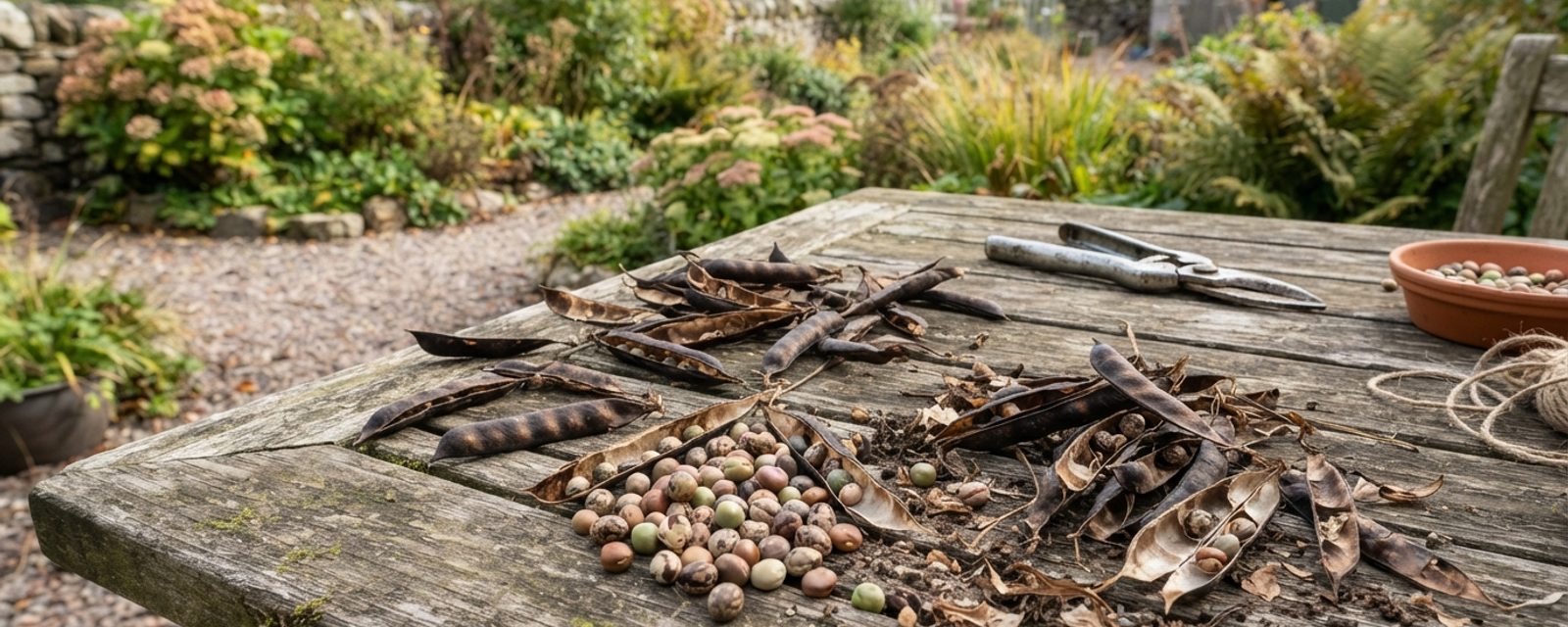
The seed you'll save from a pea plant isn't hiding among the pods you're picking for dinner. By the time a pea is worth eating, its seed is far too immature to store, and by the time that seed is actually ready to collect, the plant it came from is long past edible, its pods gone papery and brown weeks after the last worthwhile harvest. Seed-saving runs on its own calendar, one that overlaps only briefly with the eating calendar, and the gardeners who miss it are usually the ones who pulled the plant, composted the pods, and only remembered to look in October.
For biennialA plant that completes its life cycle over two years: growth in year one, then flowering, seeding and dying in year two. Full definition → crops the mismatch is worse: there's no seed to collect in year one at all. A carrot, an onion, a cabbage grown for the plate is harvested at exactly the point a seed-saver would need to leave it alone, its energy hasn't gone into flowering yet, it's gone into the root or the head. Seed only appears in year two, after the plant has overwinteredKeeping a plant alive and intact through the cold months, whether left outdoors, moved under cover, or stored dormant. Full definition → and boltedA plant switching early into flowering and seed production, usually triggered by stress, after which leaves, roots or bulbs turn bitter or unusable. Full page →. That's a second full growing season demanded of a crop that, in Scotland's shorter run to the first autumn frost, is already racing the clock once.
Which crops to start with
The realistic starting point is annual, self-pollinating, open-pollinated crops, meaning varieties that breed naturally rather than as a deliberate one-off cross, so the seed reliably reproduces the parent plant, because there's little or no risk of the flower being cross-pollinated by a different variety nearby. Peas, French and runner beans, tomatoes and lettuce all fall into this category, and all are practical for a first attempt.
With any crop, save seed from several plants rather than just one or two, narrowing a variety down to a single parent plant each year thins its genetic base and makes it more prone to weak or inconsistent offspring over time.
Harder are the outbreeding, cross-pollinating crops, squash and pumpkins, brassicasThe cabbage family: cabbage, kale, broccoli, cauliflower, Brussels sprouts, kohlrabi, swede, turnip and more, sharing the same pests, diseases and rotation rules. Full definition →, and most alliums, which need either serious isolation distance from other varieties or hand-pollination to keep the seed pure. Two courgette varieties flowering near each other, or a stray flowering leek left by a neighbour, and the resulting seed can throw offspring nothing like either parent.
And some seed won't work at all: F1 hybridThe first-generation offspring of two specific, deliberately chosen parent plants, bred for a predictable, uniform result but not worth saving seed from. Full definition → seed does not come true. An F1 variety is a one-off cross between two specific parent lines, bred for a particular combination of traits, the F1 label on the seed packet is the giveaway. Save seed from an F1 plant and the next generation reverts unpredictably toward one or other of those original parents, not the plant you grew. Only open-pollinated varieties are worth saving from.
| Category | Examples | Why |
|---|---|---|
| Easy — good starting point | Peas, French beans, runner beans, tomatoes, lettuce | Self-pollinating annuals; seed comes true with minimal isolation effort |
| Hard — needs isolation or hand-pollination | Squash/pumpkin family, brassicas, most alliums | Cross-pollinating; different varieties nearby will cross |
| Won't work | Any F1 hybrid variety | One-off cross, not a stable variety — offspring won't match the parent |
| Hard for a different reason — biennial | Carrots, onions, beetroot, brassicas (also cross-pollinating) | Need a full second season to bolt and ripen seed before flowering even starts |
Brassicas sit in two hard categories at once: they're both cross-pollinating and biennial, which is why they're usually the last crop a beginner tackles.
Biennials: the harder category, specifically in Scotland
The best specimens have to be left in the ground, or lifted and replanted the following spring, to overwinter, then flower and ripen seed through their second summer. Cauliflower is a partial exception, and the one that sidesteps most of the frost-timing risk: winter and early-summer varieties can flower and seed within a single year, while autumn varieties need the full two seasons like the rest.
A biennial seed crop needs to flower, be pollinated, and fully ripen its seed before the first hard autumn frost, a tighter finish in Scotland's shorter, cooler growing season than in a longer southern-England summer. An overwintered carrot or onion that flowers late has less margin left to mature seed before the weather turns, and a late-flowering brassica crop carries the same risk. Peas, beans, tomatoes and lettuce don't face this squeeze, they complete flowering and seed-ripening within one Scottish growing season without needing to survive a winter first.
Cross-pollination and keeping a variety pure
For outbreeders, isolation distance is what keeps a variety true, how far apart two different varieties of the same crop need to be so their flowers don't cross:
| Crop | Isolation distance | Alternative if space is tight |
|---|---|---|
| Brassicas | Up to 1,500m | Grow only one variety flowering at a time, or use a physical barrier |
| Tomatoes | Around 50m | Rarely needed on a normal plot — flower structure limits outcrossing anyway |
| Squash and pumpkins | No safe distance for a small plot | Hand-pollinate instead |
On an ordinary allotment or back garden, 1,500m is well beyond what most growers can manage, so the practical fallback for brassicas is timing rather than distance: grow only one variety through to flowering each year, or fence a variety off entirely with physical barriers, spun fleeceA lightweight, breathable fabric laid or draped over plants to trap a little warmth and keep off frost, wind and some flying pests. Full definition → or fine mesh draped over it, and introduce pollinators inside that enclosure by hand or with flies released under the cover. Flies are a fallback specifically because cool, wet weather, a regular feature of a Scottish flowering season, keeps bees grounded far more often than it stops flies, though flies only manage to pollinate around 40% of brassica flowers even so, well below what bees achieve in open, settled weather. Caged or not, most brassicas also need more than one plant of the same variety flowering together to set seed at all, they're largely self-incompatible, so a single isolated plant won't produce seed on its own. The more common real-world risk isn't a neighbour's deliberate crop anyway, it's a bolting brassica left too long, or feral oilseed rape, which can cross with brassicas in the same Brassica napus group and turns up readily on roadside verges and hedgerows. Before saving from any caged or isolated batch, rogue out, remove, any plant that's diseased, off-type, or has bolted early, so its traits don't end up in next year's seed.
Squash and pumpkins need a different fix, since their male and female flowers are separate on the same plant: hand-pollinate by picking a freshly opened male flower, stripping its petals, and dabbing pollen directly onto a female flower's stigma, the female flower has a small swelling, the immature fruit, behind the petals, then tape or tie the female flower shut for a day to keep bees from adding pollen from a different variety. This is the reliable option on a small plot with more than one squash variety, since there's no realistic isolation distance for a garden-sized space.
Tomatoes rarely need any of this, the flower structure limits outcrossing on its own, so even the modest 50m gap is more than most growers will ever need to think about.
Harvesting: let it fully mature on the plant
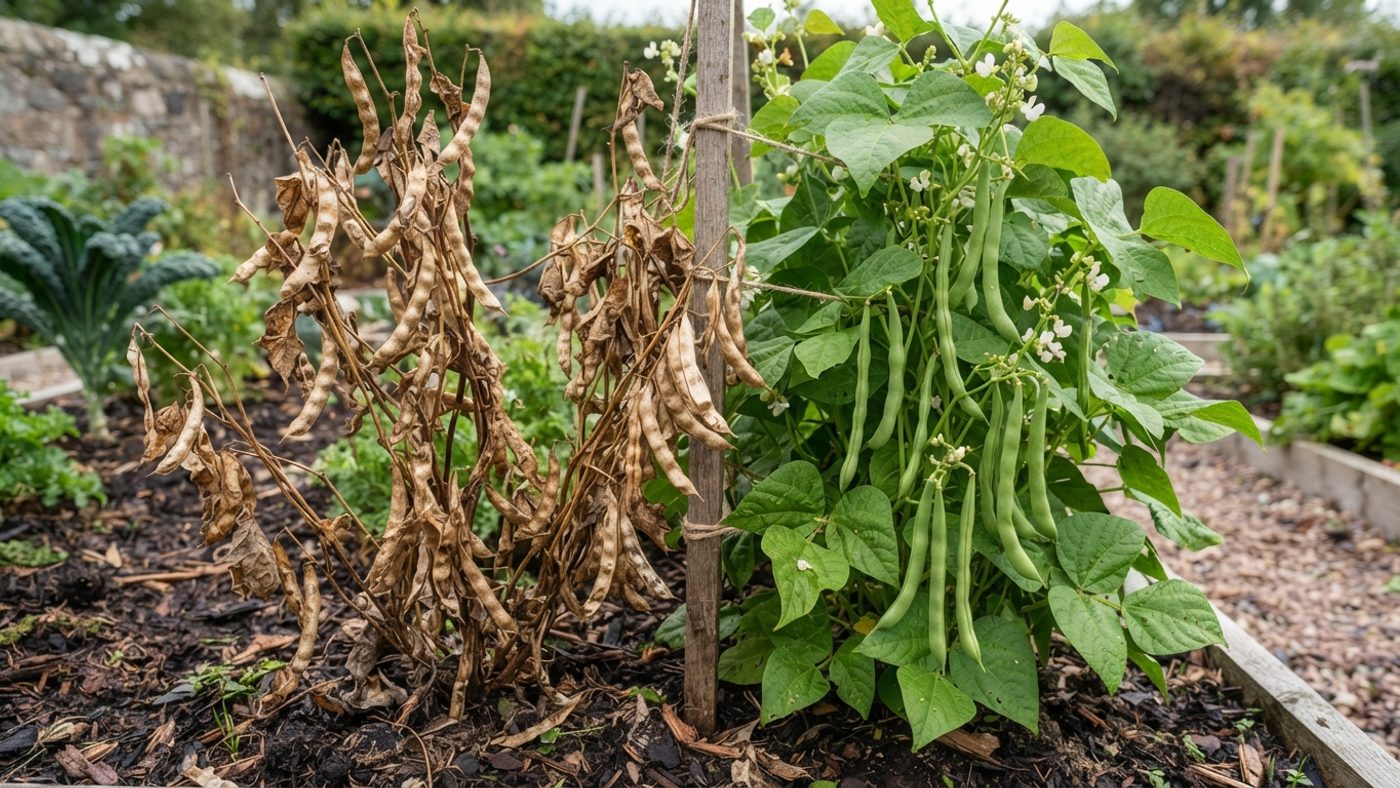
The single most important rule, common to nearly every crop, is not to cut anything early. Collect on a dry day, once the seed head, pod or fruit has ripened fully in place, a colour change from green to brown, black or red is usually the signal. For peas and beans, that means leaving pods on the plant until they've faded from green to a crisp, papery brown and rattle when the pod is shaken; picking green, unripe pods and expecting them to finish ripening off the plant doesn't work, seed development stops once the stem is cut. If weather threatens to take the whole crop, pull entire plants and hang them somewhere dry and airy, a shed roof or greenhouse rafters, to finish drying under cover rather than losing pods to shattering or rot outdoors.
Wet-processing (tomatoes and other fleshy fruit)
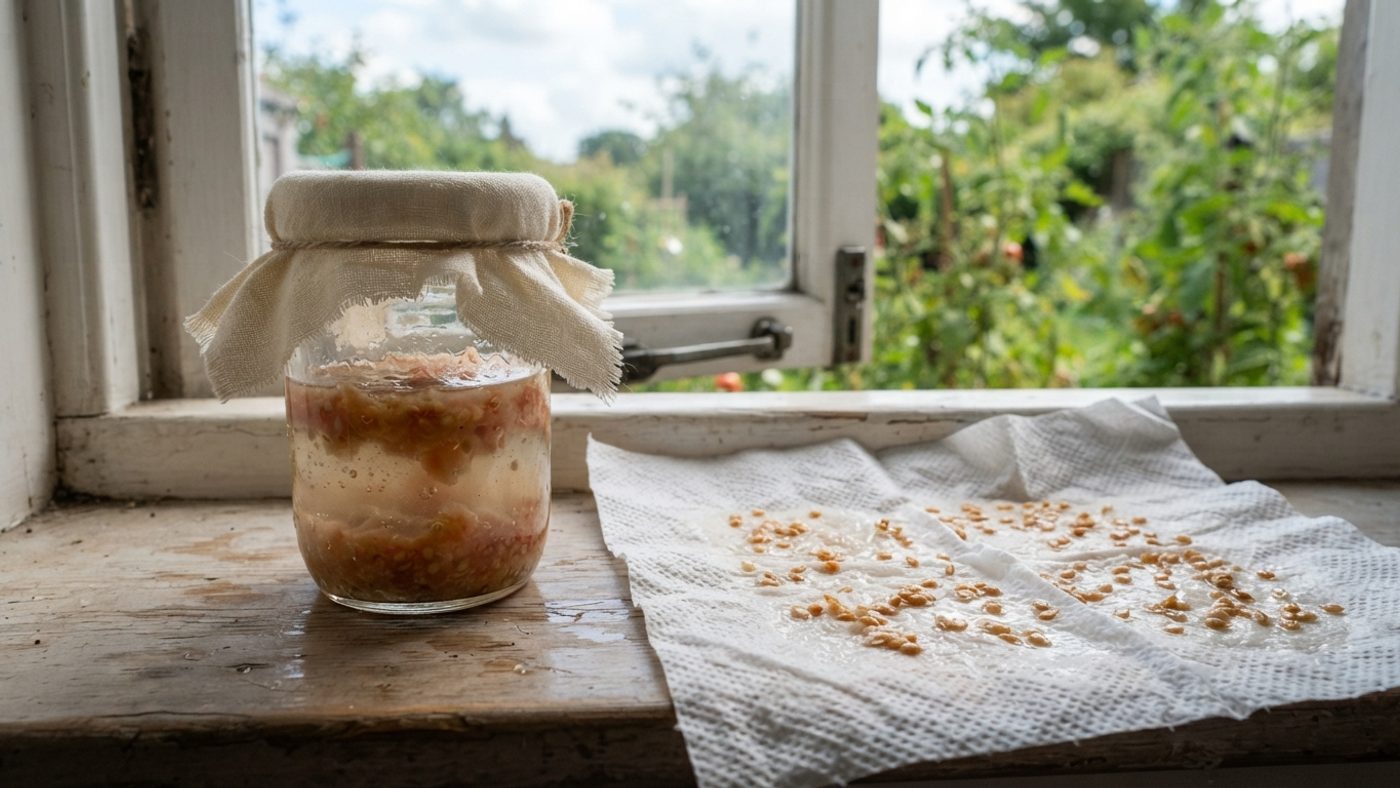
Tomato seed sits inside a gel coating that actively inhibits germinationA seed sprouting: breaking dormancy and putting out its first root and shoot, given the right warmth and moisture. Full definition →, so it needs to be fermented off rather than just rinsed away. Scoop the seed and surrounding pulp into a jar of water and leave it somewhere warm for two to four days, stirring occasionally; the mixture ferments, a light mould often forms on the surface, and the gel coating breaks down. Rinse the seed clean through a sieve, discarding anything that still floats, sound, viable seed sinks, then spread it out on a paper towel or kitchen roll to dry.
Dry-processing (pods and seed heads)
For peas, beans, lettuce and most seed-head crops, once the pod or head is fully dry it can usually be threshed by hand or in a sack, then winnowed, pouring seed between containers in a breeze so the lighter chaff blows away and the heavier seed drops through.
Drying: the step Scotland makes harder
This is where a damper, cooler climate changes the job. Everything above assumes a proper finish-drying stage before storage, and in a naturally damper Scottish garden that stage takes longer and matters more, seed that goes into storage even slightly damp is far more likely to mould than seed that's had a genuinely dry, warm spell to finish in.
Judge dryness by more than a calendar guess:
- Pods and seed heads should be crisp and papery, not leathery, and pea and bean pods should rattle audibly when shaken, a dull, silent pod usually means the seed inside is still soft.
- Fermented tomato-type seed should feel hard and separate, not tacky or squashy, once spread out to dry, expect roughly one to two weeks air-drying in a warm, bright, but not hot spot such as a windowsill.
- If in doubt, extend the drying time rather than store early. A few extra days of air-drying costs nothing; mould in a sealed envelope loses the whole batch.
A slower drying spell is frustrating when the whole reason it's dragging on is a damp Scottish stretch of weather, but do not rush it by using an oven or dehydrator: the heat is enough to kill viability outright, particularly in peas and beans, undoing the entire point of having waited.
Storage: envelopes first, airtight second
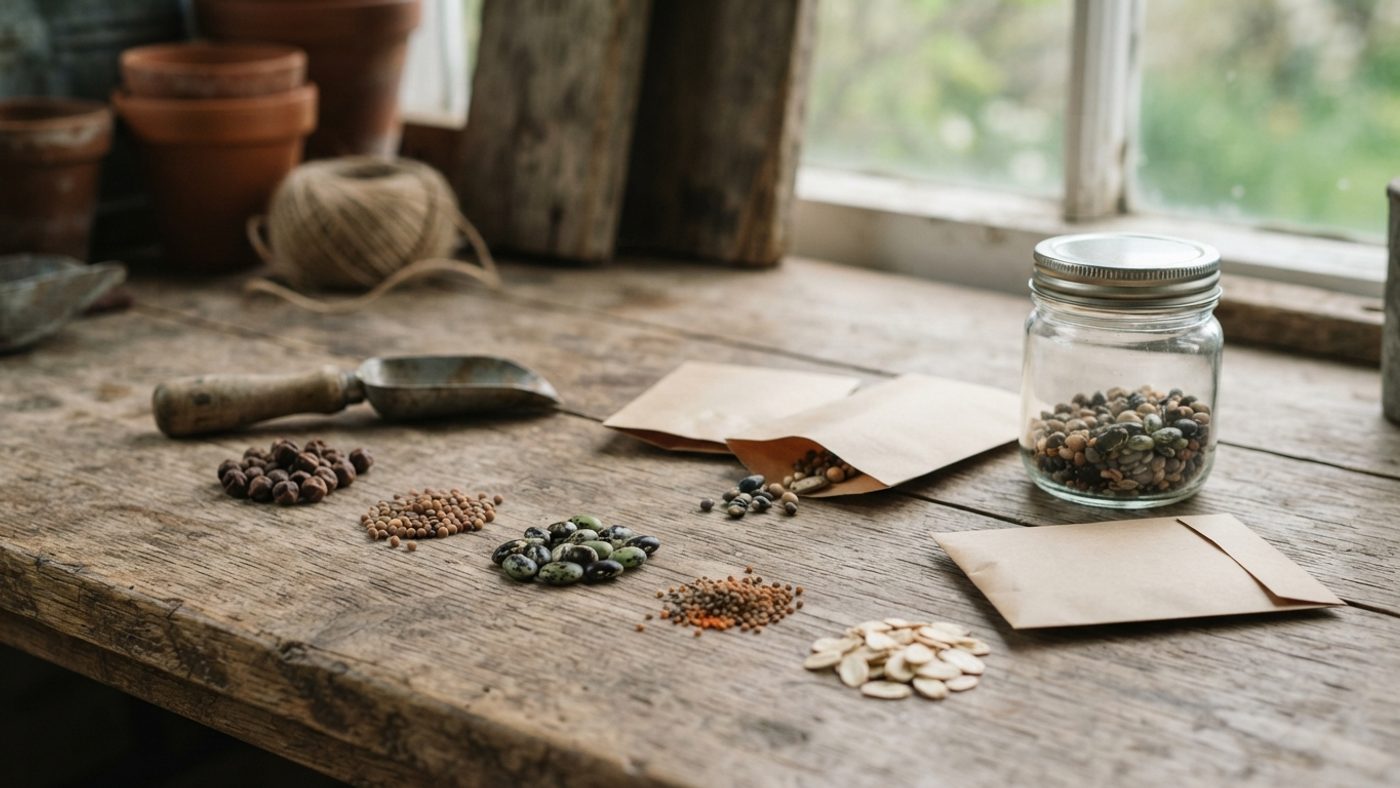
Seed still finishing its drying should go into breathable paper, an envelope or paper bag, never sealed plastic, because trapped moisture is exactly what causes mould in transit or storage. Only once seed is fully, completely dry should it move to its final storage: labelled paper packets inside an airtight container, ideally with a desiccant such as silica gel or calcium chloride to mop up any remaining humidity, kept somewhere cool, dark and dry, a refrigerator around 5°C works well if space allows. Every packet should be labelled with variety and year at the point of storage, not later from memory.
How long saved seed stays viable
Viability depends heavily on the crop and on how well it was dried and stored, so treat any figure as a guide rather than a guarantee:
| Crop / seed type | Typical viability | Note |
|---|---|---|
| Brassicas | At least 5 years | Given cool, dry storage and full germination at that point |
| Parsnip | Effectively one season | Germination drops sharply after a year even in good storage; buy or save fresh annually |
| Most well-dried, well-stored seed | Several years | Condition at storage, storage duration, and species all affect the result |
Parsnip is the standout exception: seed that's a year old already germinates poorly, so it's one crop where saved seed genuinely isn't worth keeping past its first season.
Before sowing seed that's been stored a while, it's worth testing a small batch rather than trusting the calendar: fold 10 seeds into a damp paper towel, seal it in a bag somewhere warm, and check after a week or two. A germination rate below about half is a sign to buy fresh rather than rely on the rest of the batch.
Common questions
How do I know my seed is dry enough to store, rather than just dry enough to look finished?
Look and listen rather than judging by time alone. Pods and seed heads should be crisp and papery and rattle when shaken, not just faded in colour. Fermented seed, once spread to dry, should feel hard and separate rather than tacky. If it's borderline, give it more time in a paper envelope before moving it to airtight storage, better to wait than to trap in moisture that turns to mould.
Can I save seed from an F1 variety if I really like it?
No, not reliably. F1 seed is a one-off cross between two specific parent lines, and the plants grown from saved F1 seed revert unpredictably toward those parents rather than repeating the plant you grew. Only open-pollinated (non-F1) varieties are worth saving from.
My carrots didn't flower this year, did I do something wrong?
Probably not. Carrots are biennial: the roots you'd harvest in year one aren't the seed source, and flowering only happens after a second season. A late-flowering plant can simply run out of season before frost, especially here, it isn't necessarily something you did wrong.
Do I need to isolate my tomato varieties from each other?
Only loosely. Tomatoes are largely self-pollinating, so a gap of around 50m between two different open-pollinated varieties is usually enough to keep them from crossing, nowhere near the isolation distance needed for brassicas or squash.
Why did my saved seed go mouldy in storage?
Almost always because it went into an airtight container before it was fully dry. Damp seed sealed away has nowhere for that moisture to go and moulds quickly, especially in a damp Scottish climate. Dry seed further in an open paper envelope first, and only move it to sealed, airtight storage once it's genuinely finished drying.
Sources
9 sources, recorded with what each was used for
- RHS: Tips on saving your own seeds: Easy vs. hard crops, biennials (leeks, onions, carrots, parsnips), fermentation duration for fleshy seed, storage in paper envelopes within an airtight container, viability testing by water float
- RHS: Seed, collecting and storing: Judging seedhead ripeness by colour change, drying location, paper packets inside airtight containers with desiccant, refrigerator storage at 5°C, general viability guidance
- RHS: How to grow parsnips: Parsnip seed germinating poorly after a year, buying or using fresh seed each year
- RHS: Saving beans for free plants next year: Letting bean pods dry fully on the plant, paper bag or envelope storage with variety and year label
- Garden Organic: Seed saving (Heritage Seed Library): Roguing and preventing cross-pollinationPollen moving from one plant to a different, compatible variety, needed for fruit to set on any variety that isn't self-fertile. Full definition → as the two core principles of varietal purity, tomato isolation distance and fermentation duration
- Garden Organic: Preserving varietal purity: Isolation methods, distance, timing, physical barriers, hand-pollination, caged pollinators
- Garden Organic: Seed Saving Guideline No. 18, Brassicas: Brassica biennial habit (except some cauliflower/turnip varieties), isolation distance, fly pollination rate, pod ripening and shattering signs, brassica seed viability
- Gardeners' World: Save your own vegetable seed: F1 hybrids only guaranteeing traits for one generation, biennial crop list, per-crop drying methods, tomato fermentation soak time, paper bag storage
- Gardeners' World: How to save tomato seed: Fermentation timing and mould development, drying on kitchen roll, paper envelope storage in a cool, dark place