
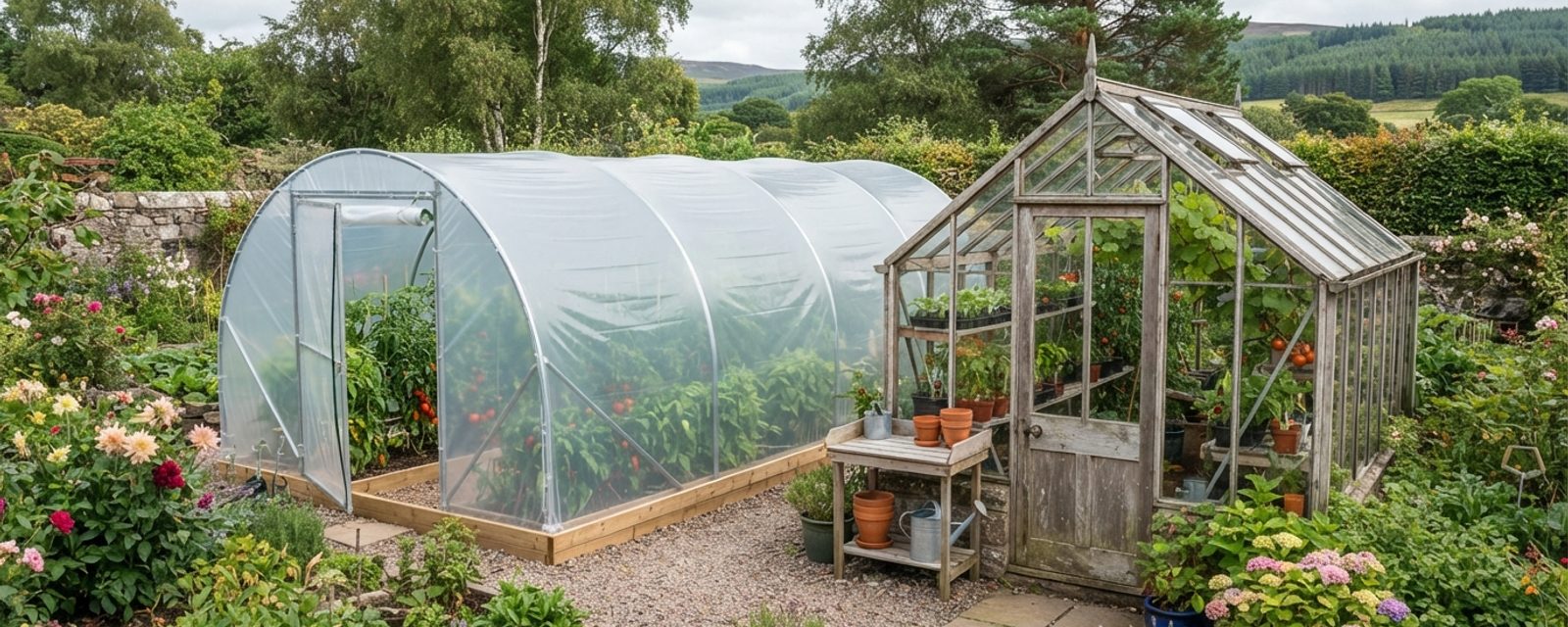
A polytunnel frame and a roll of polythene cost a few hundred pounds; a small glass greenhouse of similar size typically costs three times as much. Forum advice on which is "worth it" varies wildly, and a lot of that variation comes down to where the person posting actually gardens, since wind, light and frost pressure differ enough across Scotland alone to change the right answer.
This is a straight comparison, not a sales pitch for either structure: what each one actually costs over time, how long it lasts, how much light and heat it gives your plants, how it copes with wind and rain, and how hard it is to put up yourself. Extending Scotland's own short growing season is the reason either structure earns its keep at all, and the right choice for doing that depends on exactly where you garden.
Scotland's weather, station by station
The wind, light and rainfall sections below all draw on this same set of Met Office 1991-2020 station normals, gathered here so you can find your nearest station once:
| Station | Annual mean wind speed | Annual sunshine hours | Annual rainfall |
|---|---|---|---|
| Camborne, Cornwall (England comparator) | 10.53 knots (~12.1mph) | 1,672 hrs | 1,076mm |
| Edinburgh (Royal Botanic Garden) | - | 1,449 hrs | 728mm |
| Tiree (Argyll and Bute, west coast island) | - | 1,524 hrs | 1,275mm |
| Stornoway Airport (Outer Hebrides) | 11.90 knots (~13.7mph) | - | - |
| Lerwick (Shetland) | 14.73 knots (~17.0mph) | 1,158 hrs | 1,252mm |
| Aviemore (Cairngorms, inland) | 5.84 knots (~6.7mph) | - | - |
A dash means that figure wasn't needed for this comparison, not that it's zero. Read across it for a rough sense of where your own plot sits: broadly, the west and north (Tiree, Stornoway, Lerwick) run windier and wetter, the inland east and Highland-fringe (Aviemore, Edinburgh) run calmer and drier, and light drops the further north and west you go.
The short version
| Polytunnel | Greenhouse | |
|---|---|---|
| Upfront cost (6x8ft equivalent) | Roughly a third of an equivalent greenhouse (manufacturer-cited ratio); illustrative low-to-mid hundreds of pounds | Several hundred pounds more, often more again for aluminium/glass; check live listings |
| Cost over ownership | Lower upfront; recurring cover replacement | Higher upfront; few recurring parts |
| Cover/glazing lifespan | Polythene: 5-10 years depending on grade (some premium covers rated 8-12 years) | Toughened glass: 50+ years; polycarbonate panels: shorter, but still long-lived |
| Frame lifespan | Galvanised steel: 20+ years | Aluminium: 25+ years, often decades more |
| Light transmission (new) | High when new, but polythene loses roughly 10-15% transmission within 3-5 years | Glass transmits more consistently over time; a well-kept older glasshouse can out-perform a several-year-old tunnel cover |
| Wind vulnerability | Aerodynamic uplift on the whole skin, the cover itself can billow, tear, or lift the structure | Direct panel loading, individual panes/panels stressed or cracked, frame usually more rigid |
| Heat retention (unheated, baseline) | Loses heat faster than glass after dark | Retains heat better after dark, though single glazing still loses a lot without extra insulation |
| DIY installation | A determined gardener can put up a mid-size tunnel in a weekend with basic tools | Usually needs a level base, more precise assembly, sometimes two people minimum; glass panes add fragility risk |
Cost, cover lifespan and frame lifespan figures come from Premier Polytunnels' own comparison guide and general UK market pricing; treat them as a starting range, not a quote.
Cost: cheaper to buy, not necessarily cheaper to own
A polytunnel wins on the price tag. As a rough illustrative range from current UK retail listings, a tunnel around 6x8ft commonly costs somewhere in the low-to-mid hundreds of pounds, against several hundred pounds more for a similarly sized glass greenhouse, treat those as a starting ballpark to check against live listings, not a fixed quote. Premier Polytunnels, a polytunnel manufacturer, so read this as an interested party rather than a neutral referee, puts the gap more starkly, describing polytunnels as costing roughly a third of an equivalent greenhouse. On a hypothetical £600 mid-size greenhouse, that ratio puts an equivalent tunnel at around £200: a worked example of the ratio, not a price quote, since actual prices vary by size, brand and retailer.
The catch is that a polytunnel's biggest cost is deferred, not avoided. The polythene cover is a wear part: sunlight itself degrades the plastic over time, which is why manufacturers rate it with a UV warranty, a guarantee against sun damage, distinct from any guarantee against tearing or storm damage. Standard-grade covers carry UV warranties of around 4-5 years and a working life before replacement of roughly 7-10 years, according to Premier Polytunnels' own product specifications; heavier 200-micron covers are rated toward the top of that range, sometimes 8-12 years with good care. A storm-torn cover is a separate failure and can force an earlier, unplanned replacement regardless of how much of its UV warranty is left, covered in the wind-securing guide linked below, since anchoring and tensioning are what actually prevent it. Replacing a cover typically costs a proportion of the original tunnel price rather than the full amount, but it's a cost a greenhouse owner mostly doesn't face; toughened glass, absent breakage, needs no scheduled replacement at all. "Absent breakage" is doing real work in that sentence, though: on an exposed Scottish coastal or island site, wind-driven panel loading (covered below) makes cracked or blown-out panes a genuine recurring cost, not a rare accident, so a greenhouse's cost advantage over a polytunnel's scheduled cover replacement is narrower on a high-wind site than the "no scheduled replacement" framing suggests on its own.
So the real comparison isn't a straight price-tag comparison, it's an upfront saving plus a cover replacement roughly once a decade, against a higher upfront cost and very little scheduled spend afterwards. Over 20-25 years the total spend can converge more than the sticker prices suggest. Which one is cheaper depends on how long you actually keep the structure, and, as covered below, how well the cover survives your local wind, since storm damage is the one thing that forces an earlier replacement than the schedule above assumes.
Lifespan: frames outlast covers, glass outlasts everything
Strip the comparison down to materials and the pattern is consistent: whatever is rigid lasts decades, whatever is flexible or fragile is the limiting factor.
- Polytunnel frame (galvanised steel): manufacturer-rated at 20+ years (Premier Polytunnels' own specification, not an independent test).
- Polytunnel cover (polythene): manufacturer-rated 5-10 years for standard grades, up to around 12 years for premium thick-gauge covers, driven mainly by UV degradation and wind stress rather than age alone.
- Greenhouse frame (aluminium): routinely rated at 25+ years, often effectively the lifetime of the structure.
- Greenhouse glazing (toughened glass): 50+ years is a commonly cited figure, with the practical limit usually being breakage rather than material ageing. Polycarbonate-glazed greenhouses fall somewhere in between, more impact-resistant than glass but shorter-lived than it.
In practice this means a polytunnel is a structure you expect to re-skin at least once, maybe twice, over a couple of decades, while a well-built greenhouse is closer to a one-off purchase. Neither is wrong, it's a question of whether you'd rather pay less now and budget for a predictable cover swap later, or pay more now and mostly forget about it.
Light transmission: where the gap is bigger than people assume
This is the point most comparison pieces skate past, and it matters more in Scotland than it does further south.
A layer of plastic sheeting cuts out some light, about ten percent, which is the baseline light loss you accept the moment you choose polythene over glass, new-for-new. That gap widens with age: polytunnel covers commonly lose a further 10-15% of their light transmission within three to five years as the polythene weathers, meaning a several-year-old tunnel can be transmitting noticeably less light than a much older, well-maintained glasshouse. Glass doesn't degrade optically in the same way; a pane that's fifty years old transmits light much as it did when installed, provided it's kept clean.
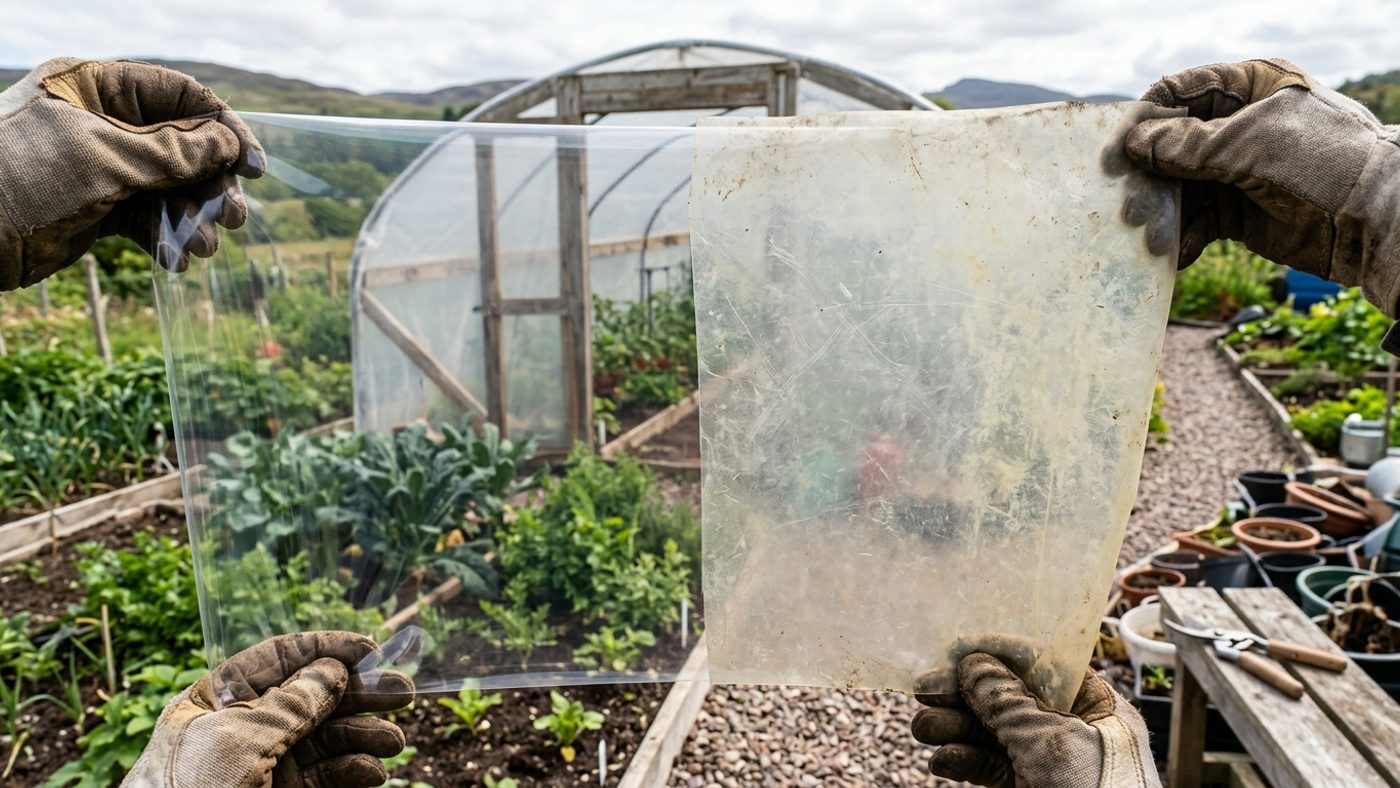
Where this bites specifically in Scotland is winter and early spring, when light is already the limiting factor for growth rather than heat. Against the sunshine-hours column in the table above, Edinburgh runs about 13% lower than Camborne, and Lerwick, further north, runs about 31% lower. Stack a fading polytunnel cover's 10-15% transmission loss on top of a location that's already receiving noticeably less light than southern England, and the combined effect on late-winter seedlings or overwinteringKeeping a plant alive and intact through the cold months, whether left outdoors, moved under cover, or stored dormant. Full definition → crops is real, not marginal. A gardener in Edinburgh or further north loses more by choosing an ageing tunnel cover over glass than a gardener in Kent would, simply because Kent starts with more daylight to spare. This doesn't make a greenhouse mandatory in Scotland, plenty of Scottish tunnel growers get excellent results, but it's a genuine reason to budget for cover replacement on schedule rather than let it run past its rated life, and a genuine point in glass's favour if your plot already sits in a shady or northerly spot.
Heat retention: a baseline difference, not the whole story
Glass retains heat overnight better than polythene, structure for structure, with no supplementary insulation in either. Polytunnels do not retain their heat as well as a glasshouse, and that gap in overnight heat retention costs more in Scotland than it does further south, for the same reason the light-transmission gap does: a Scottish winter has more cold nights to lose heat on. GrowScotland's own Met Office figures show lowland Scottish stations logging roughly 38-49 air-frost days a year against Cornwall's 7.38, every one of those extra frost nights is another night a glass structure's better heat retention is doing real work that a polytunnel's thinner skin isn't. That's a baseline, not the end of the story, though: both structures can be insulated, heated, and managed to change it substantially. For the detail on bubble-wrap glazing, thermal mass, heaters and the ventilation- versus-heat-loss trade-off, see Insulating a Greenhouse for Winter — techniques that, with adaptation, apply to polytunnels too.
Worth noting: a polytunnel fitted with thermal (rather than standard) polythene and free of the draughts that can plague an older greenhouse's glazing bars and vents can perform respectably for overwintering, according to Premier Polytunnels' own comparison guide. So "glass retains heat better" is true as a baseline, unhelpful as an absolute rule once real-world draughtproofing and cover grade enter the picture.
Wind resistance: this is where Scotland's geography actually changes the calculation
Both structures fail differently in wind. A polytunnel is vulnerable to aerodynamic uplift, wind gets under or across the whole taut skin of the cover and can lift, balloon, or tear it, and in severe cases lift the anchored structure itself if anchoring is inadequate. A greenhouse takes wind as direct panel loading instead, individual panes or polycarbonate sheets are stressed, and the failure mode is usually a cracked or blown-out pane rather than the whole structure failing at once, because the frame itself is typically more rigid than a tunnel's hooped steel. Neither is inherently the safer structure in high wind; they simply fail in different ways. For how to anchor, tension, and storm-proof either structure once you've bought it, see Securing a Greenhouse or Polytunnel Against Wind.
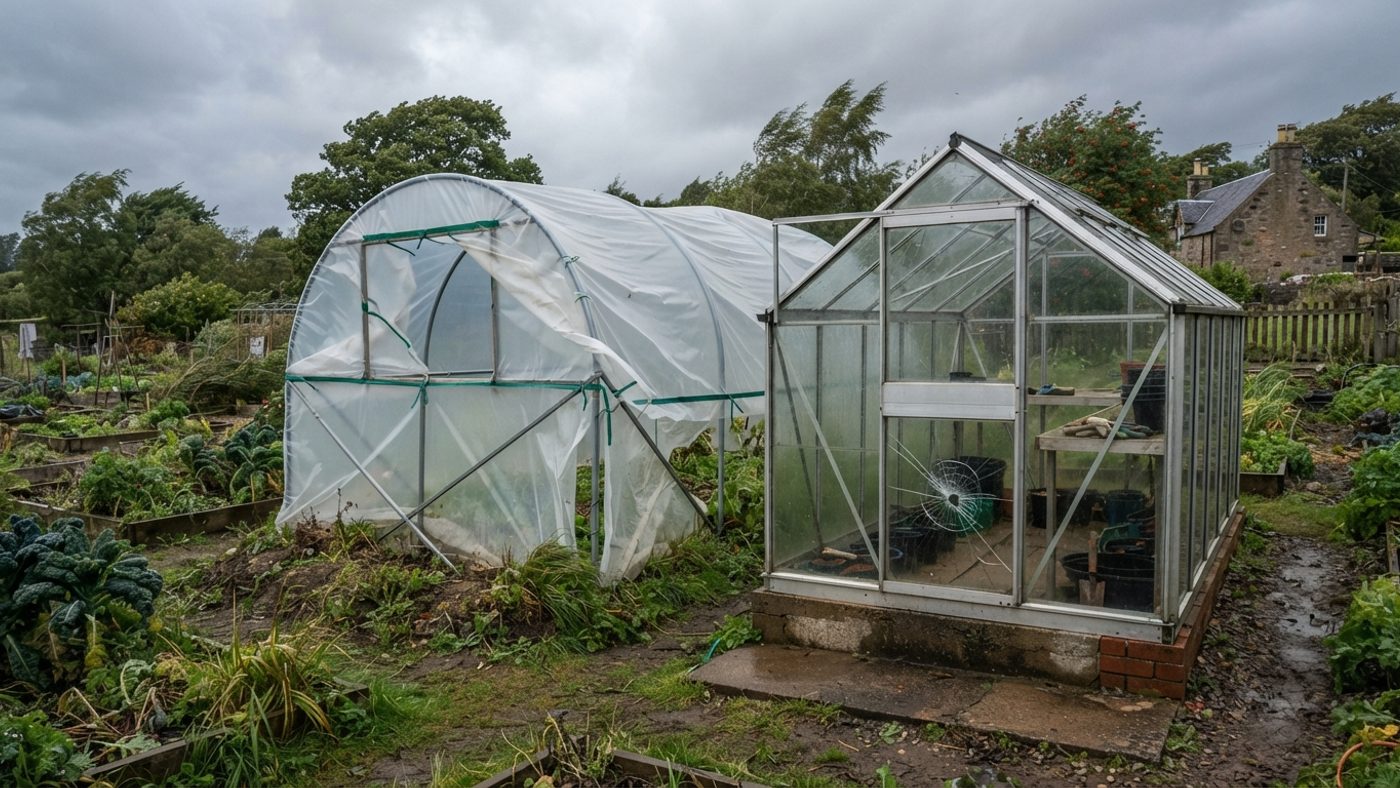
That baseline difference matters unevenly across Scotland. Against the wind-speed column in the table above, Stornoway runs roughly double Aviemore's annual mean, and Lerwick more than double, comfortably higher again than Camborne's English comparator figure. A polytunnel on a sheltered inland Perthshire or Speyside plot faces a genuinely different wind regime than one on an Outer Hebrides or Shetland croft, and a generic UK "polytunnels are more wind-vulnerable" line undersells how much that vulnerability compounds specifically on the west coast and islands. If you're gardening somewhere with Stornoway- or Lerwick-level average wind, and, more importantly, the storm gusts that sit well above the annual mean, a well-anchored greenhouse's direct-panel failure mode may be the more manageable risk than a tunnel cover's uplift failure mode, or at minimum it justifies spending on a heavier-gauge cover and serious anchoring rather than a budget kit. On a sheltered inland site closer to Aviemore's wind profile, the cost saving of a polytunnel comes with much less of that trade-off attached.
Wind isn't the only load worth planning for, though, and a low-wind site isn't automatically a low-risk site. A polytunnel's curved hoop frame sheds snow reasonably well on its own, but a greenhouse's flatter, pitched roof holds it for longer, and either structure can be damaged or collapse under wet, heavy snow left to build up. This matters most in inland Highland-fringe locations, Speyside and Perthshire among them, where cold nights and snow showers are a more routine winter feature than they are on the milder, wetter, windier west coast, so a site that's genuinely easier to live with for wind is not automatically one you can stop thinking about snow on. This article doesn't have region-by-region snowfall figures the way it does for wind, light and rain, so treat this as a real seasonal risk to plan for rather than a quantified one: clear snow off either structure's roof as it settles, whichever one you choose.
On corrosion: the same salt-laden coastal air that drives up wind exposure on Stornoway- and Lerwick-type sites also accelerates corrosion on a polytunnel's galvanised steel hoops and a greenhouse's metal glazing clips, faster than the "20+ years" frame-lifespan figure above assumes for an inland comparator. There's no manufacturer or institutional figure for exactly how much faster, so treat it as a reason to inspect fittings more often on a west-coast or island structure than an inland one, rather than a specific interval to follow.
Rainfall and condensation: not a uniform "Scotland is wetter" story
Rainfall in Scotland varies enormously by location, more than the light and wind figures above do, which rules out a tidy "Scotland is rainier, therefore structure X drains better" answer. Against the rainfall column in the table above, Tiree and Lerwick both sit well over 1,200mm a year, comfortably wetter than Camborne's 1,076mm, while Edinburgh, on the east coast, sits under 800mm, noticeably drier than Camborne. That west-to-east spread is the real Scottish rain-shadow pattern: the west and north take the brunt of Atlantic weather systems, and the eastern lowlands sit in their lee. Which coast you're on matters here more than being in Scotland at all.
Rainfall itself, though, isn't really the risk either structure has to manage, both are sealed against it by design, and neither material has an inherent drainage advantage for water hitting the outside. The real risk is what builds up on the inside regardless of how wet it is outside: humid air from watering and plant transpiration condenses on the coldest surfaces, and both polythene and glass bead it just as readily. Ventilation, sized to the structure, is what actually controls it, not the choice of covering material. A high-rainfall site doesn't need a different structure for this reason; it needs the same ventilation discipline either structure requires anywhere in Scotland.
Ease of DIY installation
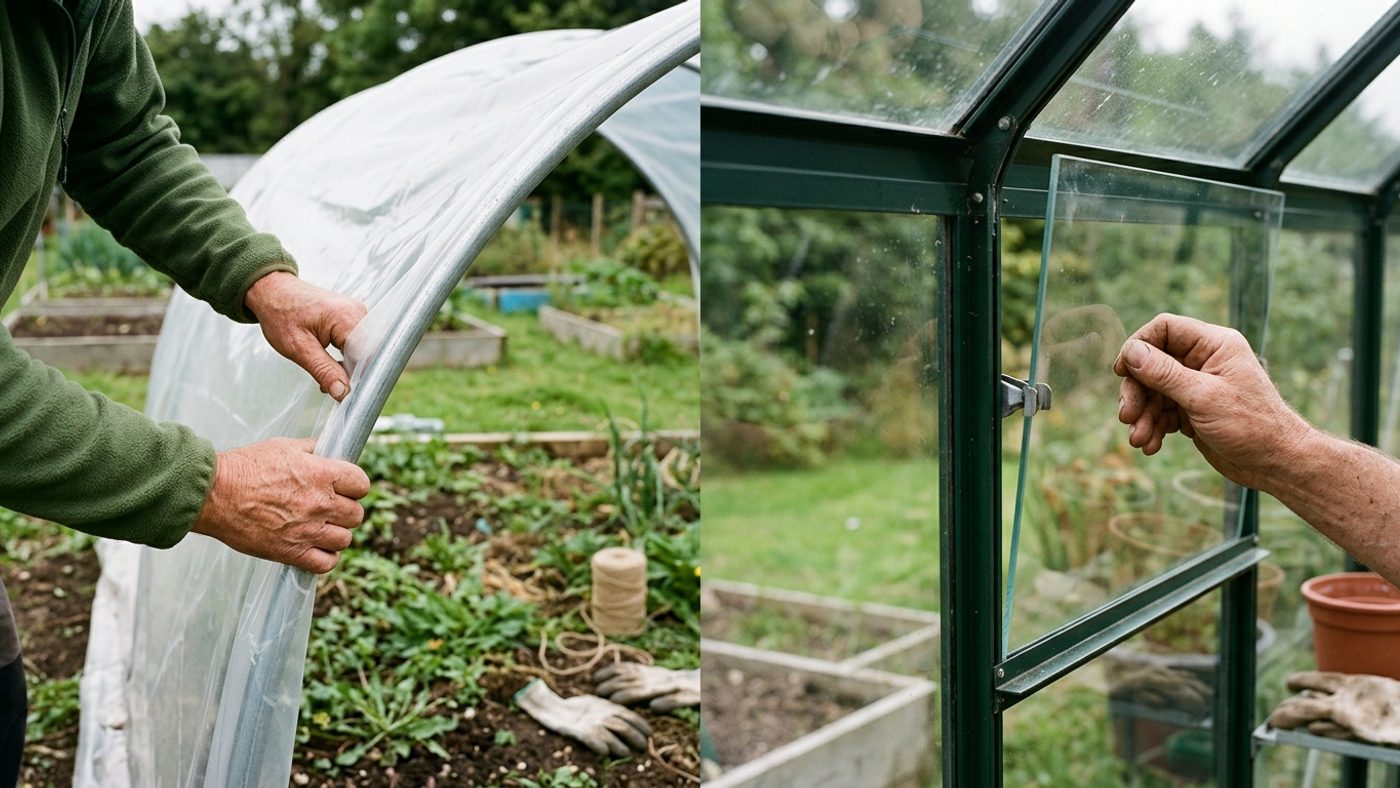
A polytunnel is generally the more forgiving self-build. A galvanised steel hoop frame with a polythene cover can typically go up over a weekend with basic tools and, ideally, a second pair of hands to pull the cover taut, no glass to handle, no precision glazing bars, more tolerance for a base that isn't perfectly level (though a level, well-drained base still matters for door alignment and drainage).
A greenhouse asks for more precision. A base needs to be properly level and square before the frame goes up, panes or polycarbonate sheets need careful handling and correct sealing to avoid leaks and heat loss at the joints, and glass introduces breakage risk during the build itself as well as afterwards. Aluminium-framed kit greenhouses are designed for self-assembly and plenty of gardeners manage them solo, but the margin for error is smaller than with a tunnel, and a windy exposed site makes handling large glass or polycarbonate panels during installation a real practical hazard, one more reason site wind conditions are worth weighing before you buy, not just after.
Slugs and ground-level pests
Worth knowing before you buy, and rarely mentioned: a polytunnel's growing surface is almost always open ground with no raised sill or solid floor threshold at the door, while many greenhouses sit on a low wall, base plate or raised staging that puts at least some of the growing area a step up from bare soil. That structural difference doesn't stop slugs and snails reaching either structure, they're the most common pest enquiry the RHS receives, in any garden, not just a Scottish or greenhouse-specific one, but a tunnel's ground-level beds put crops directly at soil level with nothing between them and whatever's already living in the ground, where a greenhouse grown partly on staging gives slugs one extra barrier to cross. If slug damage has already been a problem on your plot, it's a real point in the greenhouse's favour for anything grown at ground level, not a reason to avoid a polytunnel outright, the standard slug controls (encouraging predators, ferric-phosphate pellets, sturdy transplants rather than seedlings) work the same in either structure.
Which suits which use case
Vegetables, salad crops, season extension: Both structures work well; this is the classic polytunnel strength. The larger floor area per pound spent, and the ability to grow directly in the ground rather than staging, suits big, productive vegetable beds, tunnels are the default choice on allotments and smallholdings for exactly this reason.
Tender ornamentals, alpines, overwintering pot plants: A greenhouse's better light consistency and heat retention baseline suit plants that need steadier conditions and where appearance matters as much as yield. Glass also suits a garden setting where the structure sits close to the house and looks matter for the overall design.
Allotment plots: Space and budget rules often apply, and portability can matter if a tenancy changes. Polytunnels are lighter to relocate (though not trivial) and cheaper to replace if a plot is lost. Check your allotment's own site rules before buying either, some restrict structure height or footprint.
Small town gardens: A greenhouse's smaller footprint options, permanence, and better looks-per-square-metre often suit a garden that doubles as a place to sit, where a large polythene tunnel would dominate the space. It's also worth checking permitted development rules before you build anything of size, mygov.scot's guidance on sheds, garages and greenhouses names greenhouses specifically but does not mention polytunnels by name, so if you're planning a tunnel of any real size it's worth checking directly with your local council rather than assuming the same permitted-development thresholds apply.
Exposed rural, coastal, or island sites: Budget for the wind-proofing spend on top of the purchase price, whichever structure you choose, a heavier-gauge polytunnel cover with serious anchoring, or a well-secured greenhouse, both cost more than the base price suggests once wind and salt-air corrosion are accounted for. Inspect corrosion-prone fittings (glazing clips, hoop joints) more often here than you would inland.
Sheltered inland sites (Speyside, Perthshire, similar): Wind is less of a deciding factor, but don't skip winter snow-clearing on the assumption that a calm site is a low-risk site, these are exactly the locations that see the heaviest snow loads, and either structure needs its roof cleared before wet snow builds up.
A few more practical differences worth knowing before you buy
Rainwater harvesting. A greenhouse's rigid roofline takes guttering easily, so most greenhouse owners can run a downpipe straight into a water butt with no extra kit. A polytunnel's curved hoop roof doesn't take standard guttering the same way; dedicated polytunnel gutter kits exist, but it's an added purchase most buyers don't budget for at the outset. On a site where mains water is metered or a hosepipe ban is a real possibility, that's a genuine point in the greenhouse's favour, or a cost to add to the tunnel side of the ledger if rainwater harvesting matters to you.
Wildlife getting in. A greenhouse's door seals fully shut; a polytunnel's door and end panels are more often a flap or a loosely zipped gap left ajar for ventilation, which gives rabbits, birds and (on a rural plot) deer easier opportunistic access than a sealed greenhouse door does. Neither structure is wildlife-proof, but it's worth factoring in on a plot that already has a rabbit or deer problem.
Secondhand and reclaimed options. Reclaimed timber-and-glass greenhouses (a common find on Scottish allotments and in classified listings) and secondhand polytunnel frames both exist as a real budget route into either structure, often well below new-kit prices, worth checking before assuming new is the only option, whichever structure you're leaning toward.
Common questions
Is a polytunnel actually cheaper than a greenhouse in the long run?
Usually cheaper upfront, a polytunnel manufacturer's own figures put the gap at roughly a third of an equivalent greenhouse's price, but not necessarily cheaper over a 20-year ownership period once cover replacement (roughly every 7-10 years for standard-grade polythene) is factored in. A greenhouse's glass and frame need little scheduled replacement by comparison.
Do polytunnels really let in less light than greenhouses?
New polythene lets in slightly less light than glass, the RHS puts the baseline loss from plastic sheeting at around 10%. The bigger issue is that polythene continues losing transmission as it weathers, commonly a further 10-15% within three to five years, while glass doesn't degrade optically in the same way. A several-year-old tunnel cover can be transmitting meaningfully less light than an old, clean glasshouse.
Are polytunnels more likely to blow away in Scottish weather?
They're vulnerable to a different failure mode than greenhouses: wind gets under or across the cover and can lift or tear it, rather than stressing individual panels the way it does with glass. That risk scales with your local wind exposure: Met Office data shows Lerwick and Stornoway averaging roughly double to more than double the annual mean wind speed of a sheltered inland site like Aviemore, so the practical risk is far higher on an exposed west coast or island plot than an inland one. Proper anchoring and cover tensioning matters a lot more in windy locations, see our guide to securing a greenhouse or polytunnel against wind.
Do I need planning permission for a polytunnel in Scotland?
Sheds, garages and greenhouses are generally allowed without planning permission if placed at the rear of the property, under 4 metres high, and not covering more than half the garden, per the Scottish Government's permitted development rules. Polytunnels aren't named in that guidance specifically. Check with your local council before building a polytunnel of any size, rather than assuming the greenhouse rules apply automatically.
What grows better in a polytunnel versus a greenhouse?
Both suit most edible crops well. Polytunnels' larger ground-level growing area favours bulk vegetable and salad production, which is why they dominate allotments and smallholdings. Greenhouses' more stable light and heat retention baseline suit tender ornamentals, alpines, and overwintering pot plants where consistent conditions matter more than raw growing area.
Sources
12 sources, recorded with what each was used for
- RHS: Greenhouses - Heating Efficiently: The figure that plastic sheeting cuts light transmission by around 10%
- RHS: Greenhouse - Ventilation and Shading Tips: Ventilation/shading guidance applying equally to glasshouses, plastic greenhouses, and polytunnels, and the standard ventilation ratio (1m2 ridge vent per 5m2 floor area)
- RHS: How to make the most of your greenhouse in winter: The direct point that polytunnels do not retain their heat as well as a glasshouse
- RHS: How to stop slugs and snails: Standard slug-control methods (encouraging predators, ferric phosphate pellets, sturdy transplants over seedlings) and slugs/snails being the most common pest enquiry RHS receives
- Met Office: Camborne, Cornwall long-term averages (1991-2020): Southern England sunshine, rainfall and wind speed comparator figures
- Met Office: Edinburgh, Royal Botanic Garden long-term averages (1991-2020): Edinburgh sunshine and rainfall figures
- Met Office: Lerwick long-term averages (1991-2020): Lerwick sunshine, rainfall and wind speed figures
- Met Office: Tiree long-term averages (1991-2020): West-coast rainfall figure, supporting the east/west rain-shadow comparison
- Met Office: Stornoway Airport long-term averages (1991-2020): Annual mean wind speed, reused from the securing-greenhouse-polytunnel-wind sibling
- Met Office: Aviemore long-term averages (1991-2020): Annual mean wind speed, inland sheltered comparator, reused from the securing-greenhouse-polytunnel-wind sibling
- Premier Polytunnels: Polytunnel or Greenhouse? Key Factors to Decide (manufacturer technical documentation): Polytunnel-vs-greenhouse cost ratio, polythene replacement interval, steel frame lifespan, and thermal-polythene overwintering performance — clearly labelled throughout the body as manufacturer-claimed, not independently verified
- mygov.scot: Build a shed, garage or greenhouse at your house: Permitted development height/footprint rules; confirmed this page names greenhouses but not polytunnels specifically