
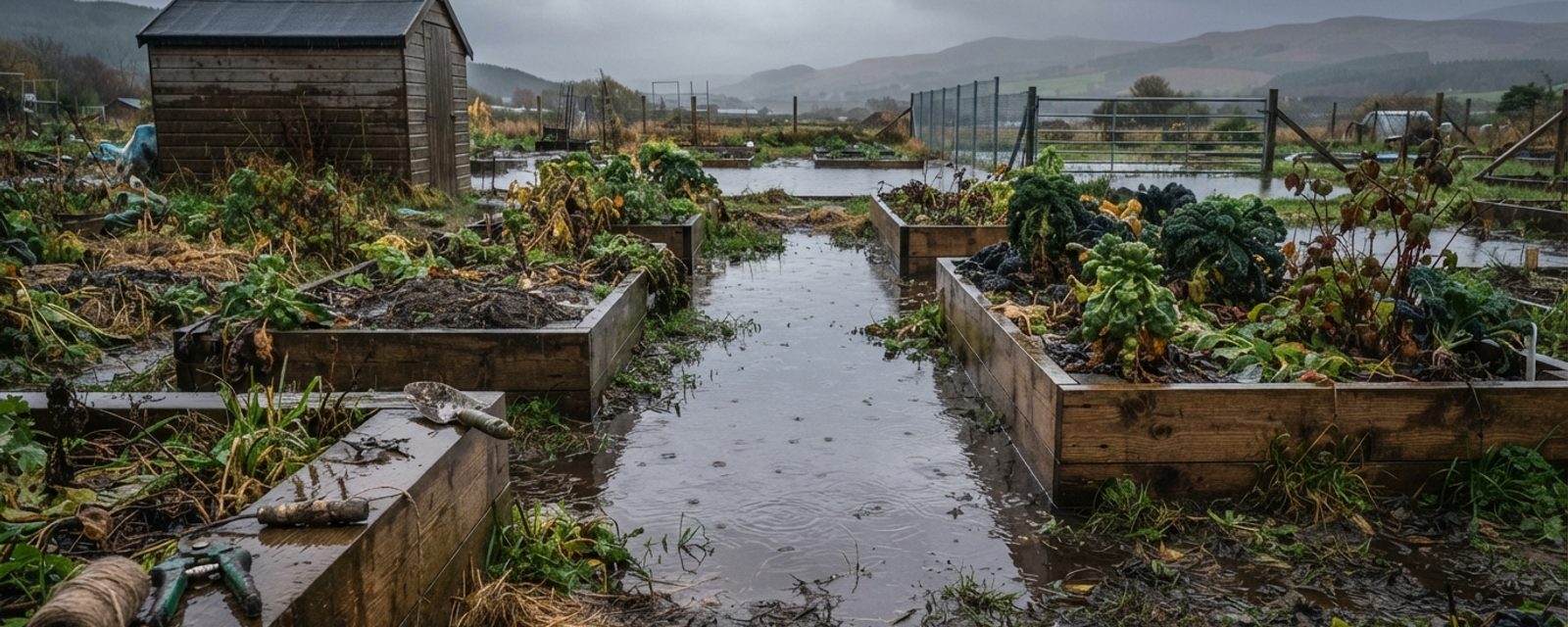
You go up after a few days of heavy rain and the bottom corner of the plot, or the whole thing, is standing in water. Boots sink to the ankle on the path. The bed nearest the hedge has gone from soil to something closer to a pond skin. The question isn't really "how do I drain my allotment", it's narrower and more awkward than that: this is a few square metres on a plot you rent, on a site you don't control, and whatever you do has to work within that.
That distinction matters more than it first appears. An allotment holder dealing with a wet corner is not in the same position as a homeowner dealing with a waterlogged lawn or a gardener whose whole back garden floods after a storm. You can't regrade the site. You often can't even find out where the site's shared drains run. And you can't solve your problem by pushing water onto the path or the next plot along. Below is what to try first, second, and only-if-you-have-to, in that order, matched to what most plot holders can actually get done with their own time, money and a rented patch of ground.
Work out what you're actually dealing with
Before digging anything, it's worth spending twenty minutes finding out what kind of wet you've got, because the three problems look similar on the surface but need different fixes.
Surface compaction. If water sits on top of the soil but drains away within a day or two once it stops raining, the topsoil itself is probably compacted or has lost structure, common on allotment ground that's been walked on, rotavated, or left bare over winter. This is a soil-structure problem, and organic matter does most of the work: roughly one barrow load of organic matter per square metre makes a meaningful difference to structure and drainage where the soil has poor drainage but no high water table.
A high water table. If the ground stays wet for a week or more after rain even where you haven't compacted it, or water reappears in a dug hole shortly after you bail it out, the water table itself is close to the surface for that part of the site, often because the plot sits in the lowest part of the field, over clay, or on ground that was never much good for drainage before it was an allotment. Where the topsoil sits on a thick layer of impervious clay or rock, deep digging won't help and raised beds may be the more realistic option.
A blocked or overwhelmed site drain. If a corner floods suddenly after rain that the rest of the plot copes with, or a ditch or drain along the boundary is silted, overgrown or crushed, the site's shared drainage infrastructure, not your soil, may be the actual cause. This is worth raising with your site committee before you spend money on your own plot, because no amount of individual drainage work fixes a blocked site drain.
A rough field test: dig a hole about 30cm deep, fill it with water, and see how fast it drains. If it's gone within a couple of hours, you're dealing with compaction or a temporary saturation event. If it's still sitting there the next day, you likely have a high water table or heavy clay subsoil, and that changes which of the fixes below is worth your time.
Timing matters for all three fixes below. Late summer and early autumn, once the main harvest is off the ground but before the wetter months set in, is the easiest window to dig a trench, build a bed or lay a path: the ground is drier and more workable than it will be once autumn and winter rain sets in, and whatever you build gets a season to settle before Scotland's wettest months put it to the test.
The realistic hierarchy: what to try first
The three options below run from lowest cost and effort, and lowest risk of falling foul of site rules, to highest. Many allotment holders find they don't need to go past the second step. Exact cost depends heavily on how much you can source second-hand (reclaimed timber, skip-sourced rubble, pallets) versus buying gravel, pipe and new timber in.
| Option | What it actually solves | Typical cost/effort | Permanence |
|---|---|---|---|
| Raised paths | Keeps you working the plot without standing in water; doesn’t touch the underlying wet ground | Low, a weekend, largely reclaimed materials | Semi-permanent, easy to lift if you give up the plot |
| Raised beds | Grows crops above the waterlogged level; sidesteps the drainage problem rather than solving it | Moderate, depends heavily on material | Semi-permanent to permanent, depending on material |
| French drain | Actively removes water from a genuinely persistent wet zone | Highest, trench digging, pipe, gravel, membrane, and somewhere for the water to go | Permanent structure, needs site permission |
Raised paths: the low-effort first move
Raising your paths even a little is an underrated fix, and it's worth doing on its own merits rather than as a stepping stone to something bigger. If the paths around your beds are the first thing to flood, a shallow bed of compacted hardcore or gravel topped with bark, gravel or reclaimed scaffold boards keeps you out of standing water while you get on with the actual growing, without committing you to any drainage work on the beds themselves.
A basic path build: mark out the width you need (60-90cm is enough for a wheelbarrow), excavate a few centimetres of the worst of the wet topsoil, lay a permeable membrane to stop the base disappearing into the mud beneath, and build up with compacted rubble or gravel before adding a walking surface. Allotment sites are generally forgiving about materials here, broken slabs, pallets laid flat, offcuts of scaffold board and skip-sourced rubble are all commonly used, and nobody expects a landscaped path on a rented plot. The point isn't drainage engineering; it's simply lifting your feet above the problem.
Raised beds: the most realistic fix for most plots
For many allotment holders, raised beds are the actual answer, not a fallback. If the diagnosis above points to a high water table or clay subsoil that deep digging won't fix, the direct advice is that raised beds may be necessary rather than optional. Rather than trying to correct the ground, you build up above it.
A few points specific to a wet plot rather than a dry one: build higher than you would on well-drained ground, 45cm or more, rather than the 30cm that's enough for salad leaves and strawberries on normal soil, so the growing medium stays clear of the saturated layer underneath even after heavy rain. If the bed sits on hard standing or genuinely waterlogged ground rather than open soil, timber-sided beds need drainage holes drilled in the sides, and stone or brick beds need gaps left at roughly 45cm intervals in the first two courses, covered on the inside with fine mesh to stop soil washing through. Fill to around 5cm below the rim to allow for settling.
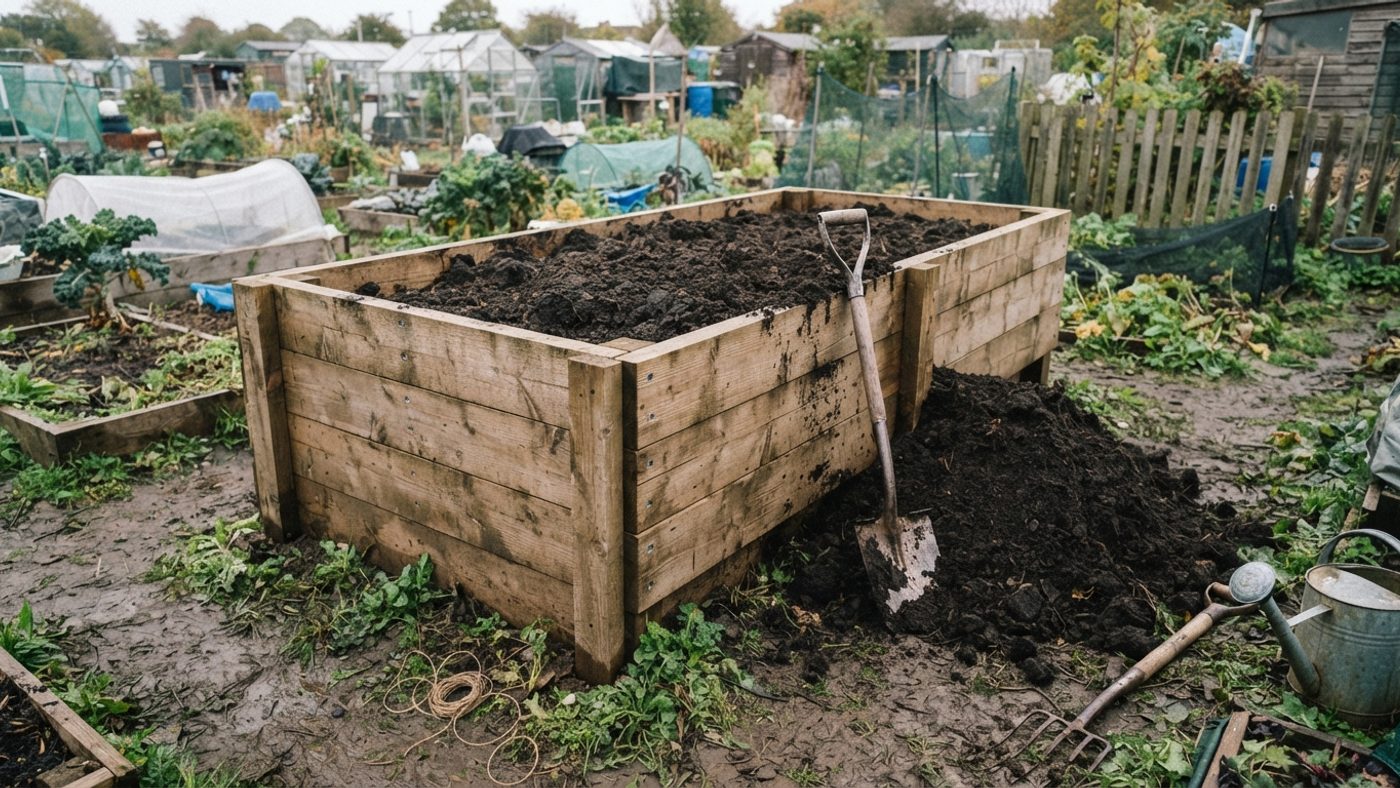
Wood, sleepers, metal and stone all behave differently on a wet plot specifically, some rot faster in permanently damp ground, some warm up faster in a cold spring, and the full comparison of raised bed materials covers the trade-offs and costs in depth.
French drains: the last resort for a genuinely persistent wet zone
If you've ruled out compaction, raised the paths, and still have a specific zone that stays wet and unworkable even in a raised bed, a French drain is the remaining option, but it's the most involved of the three, and on an allotment it comes with a problem the other two don't: somewhere for the water to actually go.
Before any of this, check for buried services. A trench 40-60cm deep can easily reach a water supply pipe, and on some allotment sites, especially older ones, buried electricity or gas connections too. Ask your site committee or landlord whether plans exist for what runs under your plot, and if nothing's on record, a cable/pipe locator or a free service such as LinesearchBeforeUdig is worth using before the first spade goes in, not after.
How it's built.
| Element | Spec |
|---|---|
| Trench depth | Around 40–60cm |
| Gravel bedding (below pipe) | 5cm layer |
| Pipe | Perforated, laid on the bedding with holes facing down |
| Gravel backfillThe soil (sometimes improved with grit or compost) used to fill the gap around a plant's roots after it's placed in its planting hole. Full definition → (above pipe) | A further 10cm, roughly |
| Finish | Permeable membrane or turf, to stop soil washing into the gravel |
| Fall (gradient) | Around 1:40 |
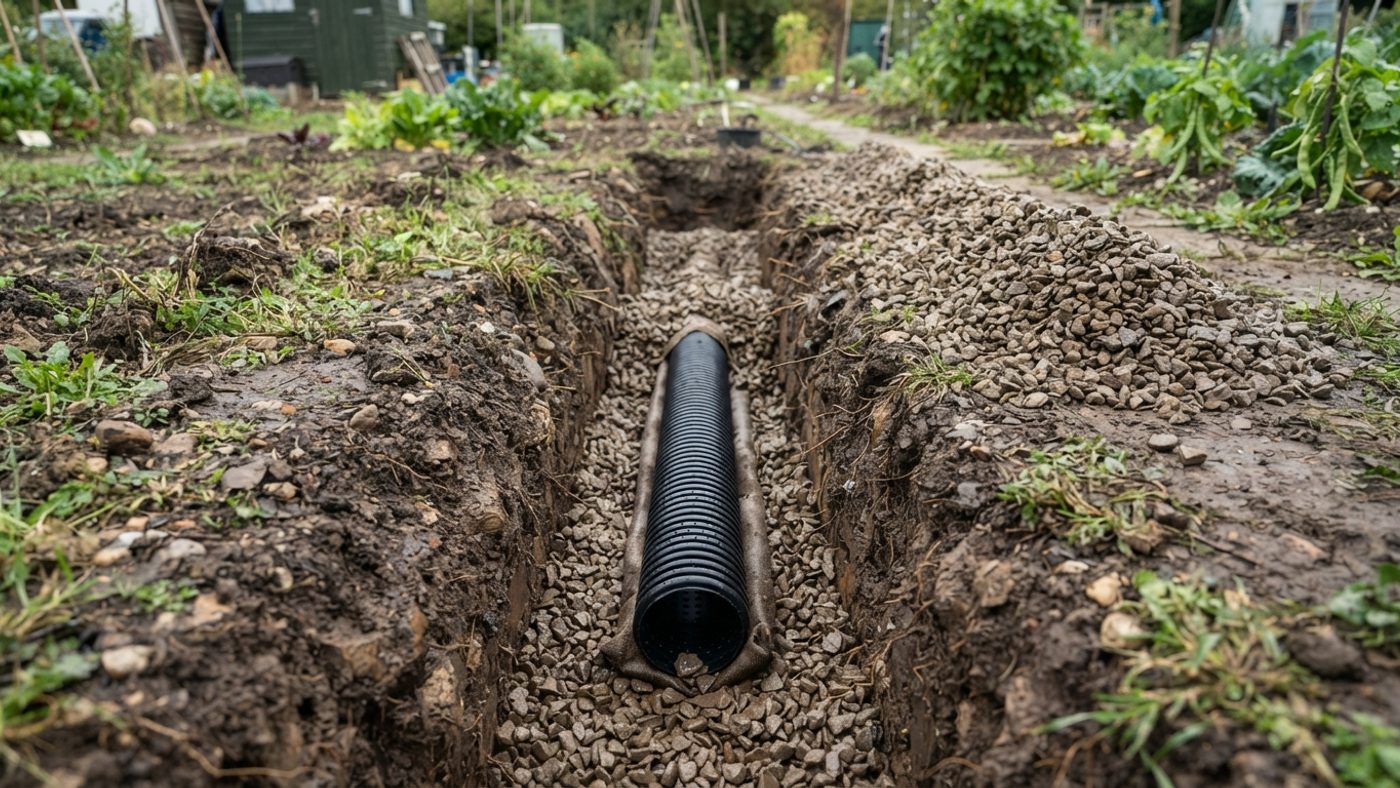
Those figures are standard guidance for piped garden drainage. The fall matters more than any other number in that table: a drain laid dead level, or with the slope running the wrong way, simply doesn't carry water away, however well everything else is built. On an allotment plot you're usually dealing with a single short run rather than a network of drains, so parallel-run spacing rarely applies. Checking a 1:40 fall by eye is unreliable over any real distance, a cheap spirit level with a slope-percentage marker, or two pegs and a length of string with a line level clipped to it, is enough to get it right without hiring a laser level.
Where does the water go, the hard part. This is the piece that's genuinely difficult on a shared site, and it's worth working out before you dig, not after. You can't run your pipe to the boundary and let it discharge onto a neighbouring plot or a shared path, that just moves your flooding problem onto someone else's ground, and it will be noticed. Realistic outfalls on an allotment are: a soakaway (a rubble- or gravel-filled pit that lets water disperse gradually into the surrounding subsoil) dug on your own plot, well away from the wet zone; a site-wide ditch or drain, if the site has one and the committee agrees you can tie into it; or, in the rare case where a plot borders a watercourse, discharge into that, which is a regulated activity, not something to do without checking first.
There's a real catch worth knowing before you commit to a soakaway specifically: the Scottish Environment Protection Agency (SEPA), the regulator for water and drainage discharges in Scotland, sets a minimum distance of 10 metres between a soakaway and any watercourse, permeable drain, loch or the sea, and requires the ground's seasonal high water table to sit at least a metre below the base of the soakaway. That second condition matters a lot here, if a high water table is what's causing your flooding in the first place, a soakaway dug into that same saturated ground won't have anywhere to disperse water into, and won't work. A French drain needs somewhere genuinely dry enough, below ground, to send the water, which is why it isn't always the fix it looks like on paper. If you're unsure whether your situation clears that bar, or whether your soakaway needs to be registered with SEPA at all, SEPA is the body to check with directly.
French drains also silt up over time, especially where floodwater is carrying fine clay particles into the pipe: a run that worked well in its first winter can slow down within a few years and need the inspection end rodded out or, in the worst case, dug up and relaid. Factor that ongoing maintenance in when weighing a French drain against the lower-maintenance options above.
If none of your plot has anywhere for water to go that doesn't cross onto someone else's ground or a shared path, a French drain on your plot alone probably won't solve the problem, and raised beds are the more honest answer.
Check before you dig: permission on a rented plot
Under the Community Empowerment (Scotland) Act 2015, local authorities are required to set allotment site regulations covering, among other things, the buildings and other structures that may be erected on allotments, what modifications may be made to them, and what materials may or may not be used, as well as cultivation and maintenance of the plot itself. Those rules vary between local authorities and even between sites within the same council, so it's your specific site's own version that governs what you're allowed to build and leave in place, not a generic national standard.
There's a practical reason to sort this out beyond just avoiding a dispute over a structure: cultivation duties sit in the same regulations, and a plot that's stayed unworkable through standing water for a season is the kind of thing that can end up in correspondence with a site committee regardless of whose fault the flooding is. Fixing the drainage problem and keeping the tenancy in good standing are, in practice, the same job.
The practical questions worth asking your site committee or landlord before you start: is a permanent structure like a raised bed or French drain permitted on this plot, are there restrictions on materials, and, often overlooked until it matters, what happens to what you've built if you give up the plot. Some sites expect structures to be removed at the end of a tenancy; others are happy for them to stay for the next tenant. Getting this answered before you build saves either an argument later or wasted material. The guide to getting an allotment in the UK covers the wider statutory picture of Scottish allotment law and site regulations.
Raising a suspected site-wide fault early is also worth it for a practical reason beyond your own plot: a blocked ditch or crushed drain tends to get worse, not better, left alone, and the plots downstream of yours are dealing with the same water in the meantime.
A garden lawn or general flooded border is a different problem with different fixes, since you own the ground outright and can regrade or drain it however you like. See fixing a waterlogged lawn on clay soil and recovering a sodden garden after heavy rain for those scenarios specifically.
Common questions
What happens to a raised bed or French drain if I give up the plot later?
That depends entirely on your site’s own rules, and it’s worth asking before you build rather than after: some sites expect a tenant to remove any structures they’ve put in when they leave, others are happy for a well-built raised bed or drain to stay for the next tenant. Since site regulations vary between local authorities and even between sites in the same council, get this answered specifically rather than assuming either way.
Can I just direct my French drain’s water onto the path or the next plot?
No. Redirecting water onto a shared path or a neighbouring plot moves your flooding problem onto someone else’s ground and is likely to cause a dispute with your site. A French drain on an allotment needs its own outfall, typically a soakaway dug well clear of the wet zone on your own plot, or a tie-in to a site-wide drain or ditch with the committee’s agreement.
Can a high water table eventually affect a raised bed too, or does building up solve the problem completely?
A well-built raised bed at 45cm or more generally keeps the growing medium above the saturated layer, but it’s worth checking after a genuinely wet winter whether the base has settled or the surrounding ground has risen relative to it, especially on a plot where the water table itself is high rather than just slow to drain. It’s not a one-off fix-and-forget in the way a bed on ordinary ground is.
What’s the minimum depth for a raised bed on genuinely waterlogged ground?
Beds intended for most vegetables need at least 45cm of depth; on wet ground it’s worth building at the higher end of that range so the growing medium stays clear of the saturated soil beneath, particularly after heavy rain. Beds for shallow-rooting crops like salad leaves can go as low as 30cm, but that leaves less margin on genuinely wet ground.
Should I fix the whole site’s drainage instead of just my plot?
That’s rarely something an individual plot holder can do, site-wide drainage is the site committee’s responsibility, not yours to take on alone. If you suspect the cause is a blocked or overwhelmed site drain rather than your own plot’s soil, raise it with the committee; no amount of work on your own plot will fix a problem with the shared infrastructure.
Sources
7 sources, recorded with what each was used for
- RHS: How to Install Garden Drainage: Trench depth, gravel bedding and covering depths, pipe gradient (1:40) and spacing for piped drainage; French ditch construction
- RHS: Waterlogging and Flooding Solutions: Causes of waterlogging, raised beds as a long-term response, where drainage installation is and isn’t appropriate
- RHS: Gardening on Wet Soils: Organic matter application rate (one barrow load per square metre) for compacted/poorly drained soil without a high water table
- RHS: How to Make a Raised Bed: Bed depth guidance, drainage holes for timber and stone/brick construction, fill depth below rim; raised beds as necessary where topsoil sits over impervious clay or rock
- SEPA: Discharging to Land via a Soakaway: Soakaway siting distance from watercourses (10m minimum) and required depth to seasonal high water table (1m minimum below soakaway base)
- legislation.gov.uk: Community Empowerment (Scotland) Act 2015, Section 115: Mandatory local authority allotment site regulations covering structures, modifications, materials, cultivation and maintenance of allotment plots
- gov.scot: Part 9 of the Community Empowerment (Scotland) Act 2015 — Allotments: Guidance for Local Authorities: Context on local authority allotment site regulations