
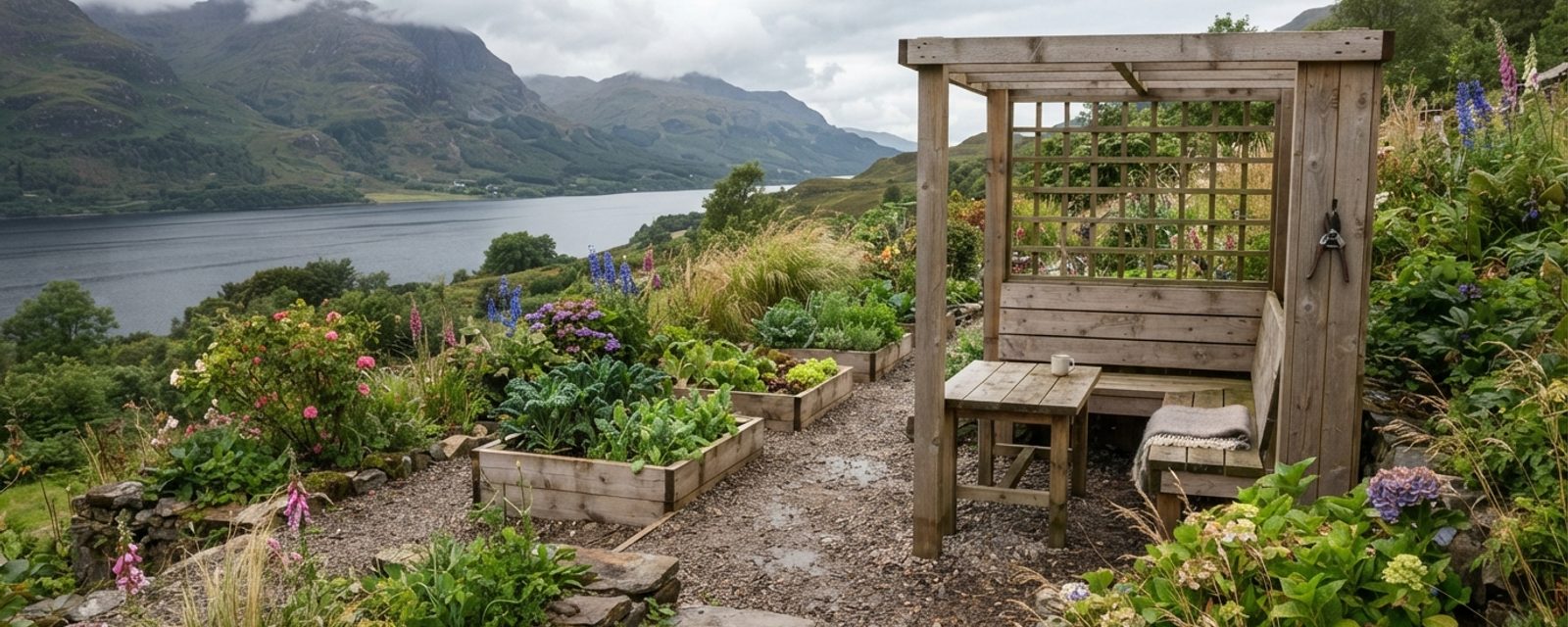
Scottish summer evenings are long. The sun barely leaves the sky in June, and after a day of work the obvious moment to water the beds, deadheadRemoving spent flowers before they set seed, which redirects a plant's energy into further flowering rather than seed production. Full definition → the roses or just sit outside with a drink is early evening, as the light softens and the air cools. That is also, almost exactly, the window when the Highland biting midge is at its most active. The gardener's favourite hour and the midge's favourite hour are the same hour, and on the west coast and through the Highlands that overlap can end a gardening session in minutes.
This is not a story about avoiding the garden all summer. It's about understanding the actual shape of the problem, hour by hour and month by month, and using the two defences that hold up under scrutiny: timing your work around the midge's real activity pattern, and using wind, which midges are genuinely bad at flying in, as a deliberate feature of how a garden is laid out. Deterrent planting gets a more mixed verdict: some of it is old and genuinely Scottish, most of it is borrowed from a different insect entirely, and the two are worth telling apart rather than repeating the usual plant list as settled fact.
Where in Scotland this actually matters
The Highland biting midge is not evenly spread, and its habitat requirements explain why. Its stronghold is the west coast, the Highlands, Argyll and the islands, notoriously Skye, Wester Ross and around Fort William, where high rainfall, acidic peaty soil and rushy, boggy ground are common and largely unbroken. Gardens in Edinburgh, Fife, much of Aberdeenshire and other drier, more easterly parts of the country generally have less of that specific habitat close by, since the same larval requirement, damp, acidic, undrained ground, is patchier in the drier east, so midge pressure there tends to track local wet ground rather than the region as a whole. Trees for Life also notes the midge thins out above roughly 500 metres, so higher, more exposed ground carries less risk than a sheltered glen at the same latitude. Anyone gardening in the west Highlands, Argyll or the islands should treat midges as a genuine, season-long constraint on when and where they garden; further east, it comes down more to whether the garden itself has a damp, undrained corner.
What the midge actually is, and why gardens matter to it
The insect responsible for the vast majority of Scottish midge misery is Culicoides impunctatus, the Highland biting midge, one of several dozen Culicoides species recorded in Scotland but by far the dominant biter. Only females bite, because they need a blood meal to develop eggs. According to Trees for Life, the Highlands conservation charity, its larvae develop in damp, acidic upper soil layers, particularly around rushes, and larval densities can reach extraordinary levels in the right conditions: NatureScot cites up to 700 larvae per square metre of suitable ground, and Trees for Life puts the figure at up to 24 million larvae per hectare in ideal habitat. Much of that biology comes from Highland conservation and government surveillance bodies rather than a dedicated midge research programme: the James Hutton Institute, Scotland's leading applied plant research institute and a real source elsewhere on raspberry and fruit pests, has not published entomological work on the biting midge itself.
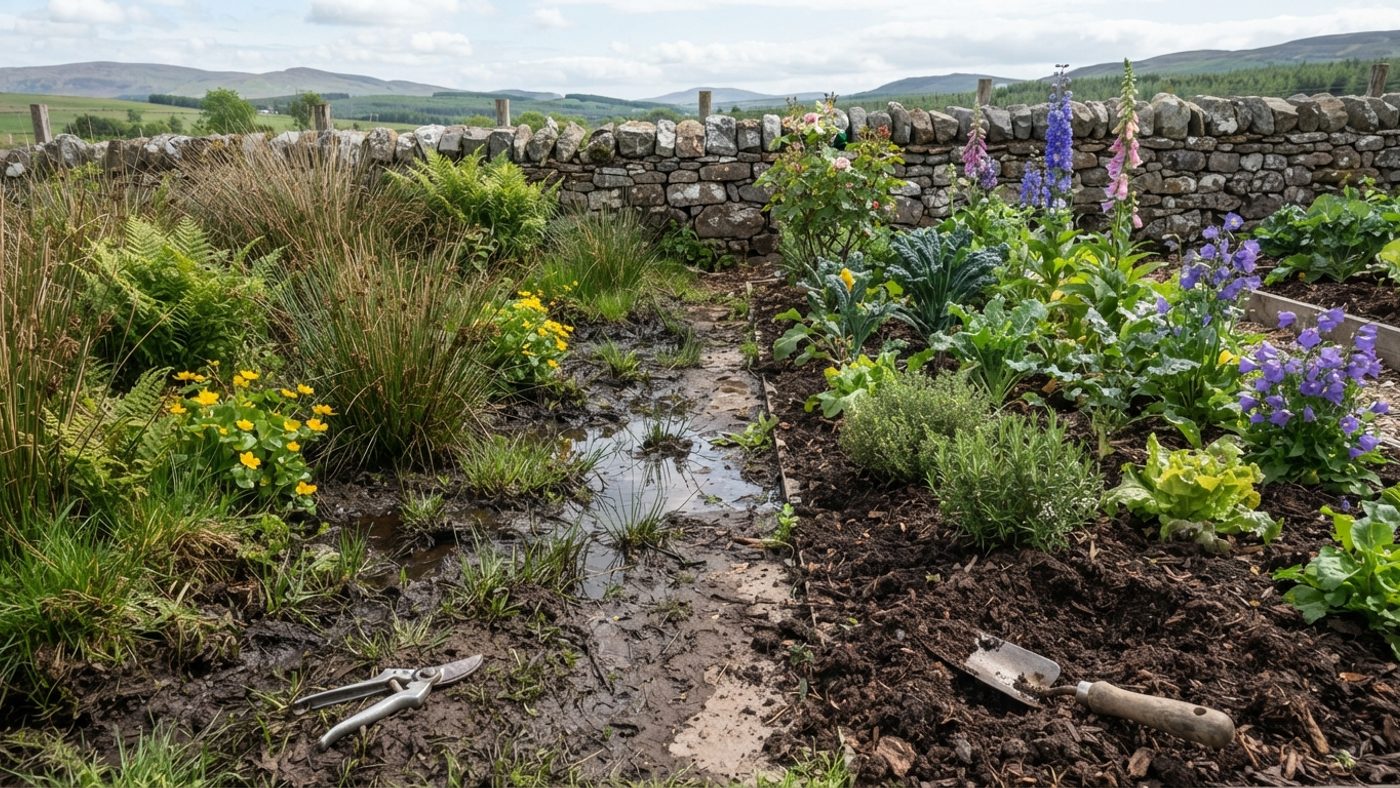
That habitat description matters for gardeners, because it's easy to conflate the Highland midge with a completely different insect. Many "garden midge" articles are actually describing chironomid gnats, small non-biting flies that swarm around garden ponds and outdoor lights but don't bite at all. The Highland midge is not a pond insect. It breeds in wet, acidic, poorly drained ground: boggy corners, badly drained lawns, rush-infested rough grass, undrained soil generally, and, per SRUC's surveillance work, damp ground near dung heaps on rural and smallholding plots. A garden that sits on or backs onto boggy, acidic, undrained ground is sitting next to a breeding site. Improving drainage in permanently wet corners and keeping rushy, undrained rough ground to a minimum is the closest thing to a structural, habitat-level defence a gardener actually has, as distinct from a repellent or a net.
The clock problem: when you want to be out, and when they're out
C. impunctatus is most active around dawn and dusk: sunrise and sunset mark the peak of their activity, not the point at which they disappear, and they're also markedly less active in bright, sunny, breezy conditions than in overcast, still, humid weather. That combination, overcast and still, is also unfortunately a very normal description of a west-coast Scottish evening in July.
| Time of day | Typical midge activity | Why |
|---|---|---|
| Early morning (dawn) | High | Cool, often still, high humidity |
| Mid-morning to early afternoon (bright, breezy) | Low | Sun and moving air both suppress activity |
| Overcast daytime | Moderate to high | Lacks the two things that suppress them: strong light and wind |
| Early evening (dusk) | High | Cooling air, stilling wind, rising humidity |
| Full dark, cold night | Low | Temperature drop suppresses flight |
The practical translation for a gardener is unglamorous but effective: do the tasks that require lingering outdoors, weeding, planting out, harvesting, pottering, in the two or three hours either side of midday, when the sun is highest and any breeze is most likely to be up. Push watering, which many gardeners instinctively save for evening to reduce evaporation, to first thing in the morning after the dawn peak has passed, or accept that dusk watering in midge season means covering up properly rather than gardening in a t-shirt.
Season-wise, Scotland's Rural College (SRUC), which runs a national midge surveillance programme with the Scottish Government's EPIC disease-surveillance group to track the "midge-free period" relevant to livestock disease control, records the season starting as early as late April in a mild year and continuing into late September, with temperature as the primary driver of how long the season runs. NatureScot and Trees for Life both describe the same broad window, active roughly May to September with peak abundance in July and August, and the first proper autumn frosts as the thing that finally ends the season, not any calendar date. A cold, late spring genuinely does buy a gardener a shorter season; a mild one does the opposite.
Wind: the one defence with real teeth
Of everything commonly claimed about midges, the wind effect is the one with the most direct and consistent support. Midges are small, weak fliers, and moving air disrupts their ability to home in on a host by scent far more effectively than most people's siting of seating areas gives it credit for. Midges cannot maintain flight above roughly 5.5 mph, landing on vegetation or tree trunks instead once wind speed passes that point. On the Met Office's Beaufort scale that sits right where a "light breeze" begins, the point at which leaves start to rustle, well short of what most people would call "a windy day."
| Beaufort force | Wind speed (mph) | Description | Effect on midges |
|---|---|---|---|
| 0–1 | Under 3 | Calm to light air | No suppression; classic still, midgy conditions |
| 2 | 5–7 | Light breeze, leaves rustle | Around the threshold where flight becomes difficult |
| 3 | 8–12 | Gentle breeze, leaves and twigs move constantly | Midges largely grounded |
| 4+ | 13 and above | Moderate breeze and up, small branches move | Effectively midge-free |
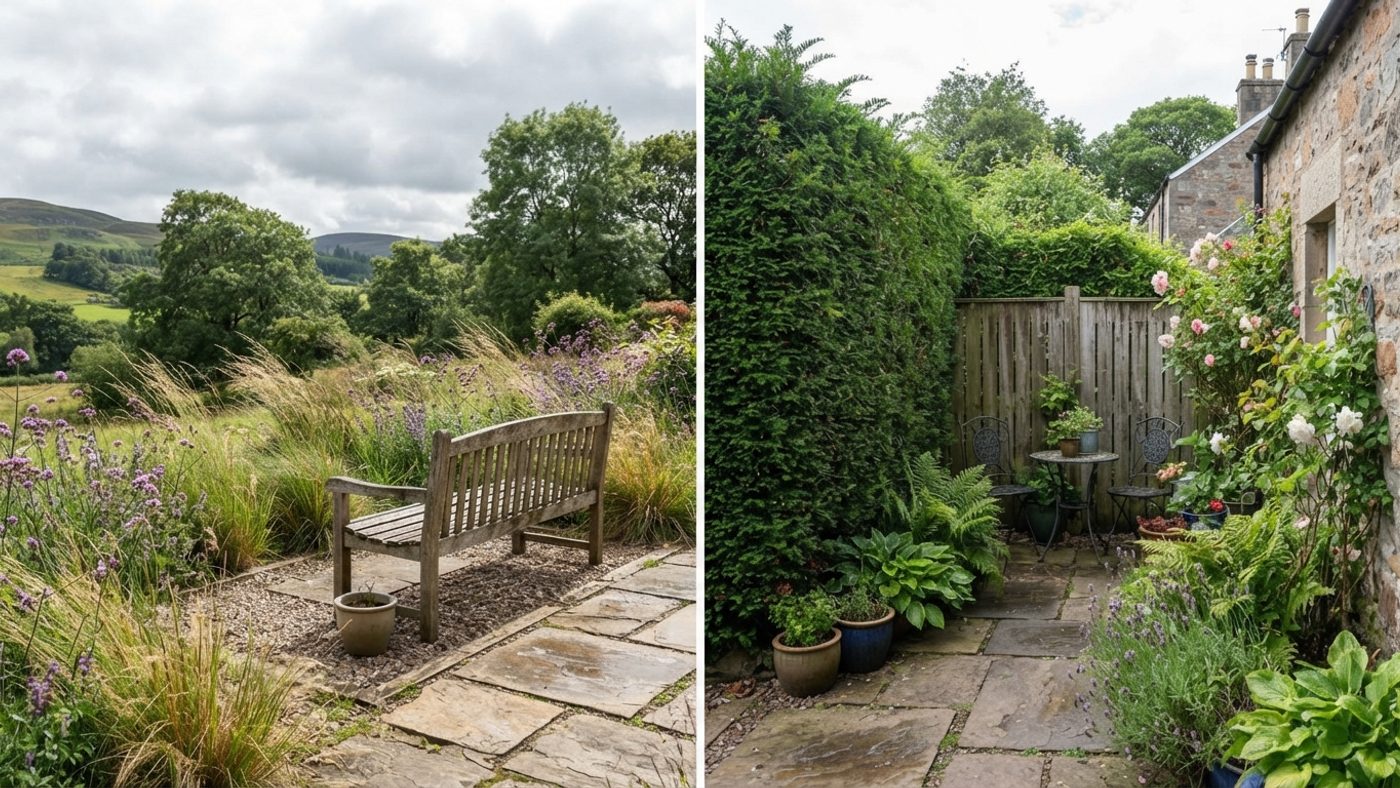
The practical upshot is that a garden doesn't need to be exposed or blustery to get real relief, it needs a seating or working area that isn't fully sheltered from every direction. This cuts directly against the instinct to build a cosy, fully enclosed suntrap seating area with hedging or fencing on all sides: that layout is excellent at blocking wind, and therefore excellent at creating still air, exactly the condition midges prefer. A seating area open on at least one side to whichever direction the local prevailing breeze tends to come from, while still sheltered from the coldest or most driving weather, gets the benefit of wind without being unusably exposed. A courtyard-style enclosed patio, sheltered on every side, keeps the air stillest for longest, and on the still, damp evenings midges favour most, that makes it one of the least comfortable layouts to sit in.
Smoke is commonly credited with a similar effect, on the reasoning that midges home in on carbon dioxide and body scent, and that smoke disrupts that scent trail much as moving air does. It's a plausible, widely repeated claim rather than a measured one, so a fire pit or chiminea near a seating area is a reasonable bet rather than a guaranteed fix.
Deterrent planting: what the evidence actually supports
This is the part of most midge articles that collapses under scrutiny. The standard list, citronella, lavender, mint, basil, rosemary, marigold, lemon balm, garlic, eucalyptus, is recycled from generic "garden midge" content that is actually about non-biting garden gnats, not the Highland biting midge. None of these plants has institutional or peer-reviewed backing for measurably reducing Culicoides impunctatus activity in a garden setting. That doesn't mean they do nothing for other insects, or that growing them is a bad idea for other reasons, but calling any of them a proven midge deterrent is not warranted.
The one plant with a genuine, longstanding Scottish evidence trail is bog myrtle (Myrica gale), the aromatic native shrub of Highland bogs: a traditional Highland repellent, historically carried or rubbed on rather than grown as a garden ornamental, and it remains the basis of a small modern industry of bog-myrtle-scented midge products, alongside older household staples such as Avon's Skin So Soft, a moisturiser with no midge-specific design that hillwalkers and gamekeepers have used for decades on the same word-of-mouth basis. Bog myrtle's tradition is real and old, and materially stronger than "plant some lavender," but it's still traditional and anecdotal rather than a controlled result: no peer-reviewed field trial establishes how much protection a living bog myrtle plant in a border, as opposed to its extracted oil applied to skin, gives a person sitting nearby. It remains a genuine plant option for a damp, acidic Highland garden on its own merits as a native shrub, and it earns its place for that and its real folk pedigree, not as a marketed, solved repellent.
Building a midge-lighter garden
The four defences carry very different weight, worth ranking rather than treating as equal options:
| Defence | Effort | How well-supported |
|---|---|---|
| Timing (avoid dawn and the hour or two either side of dusk) | None, just scheduling | Strong |
| Wind (site seating for a light breeze, not full shelter) | Low, mainly a layout choice | Strong |
| Drainage (deal with permanently wet, acidic corners) | High, structural, takes a season or two to show | Moderate; reduces local breeding rather than a single evening's exposure |
| Deterrent planting (bog myrtle included) | Low | Weak, traditional at best |
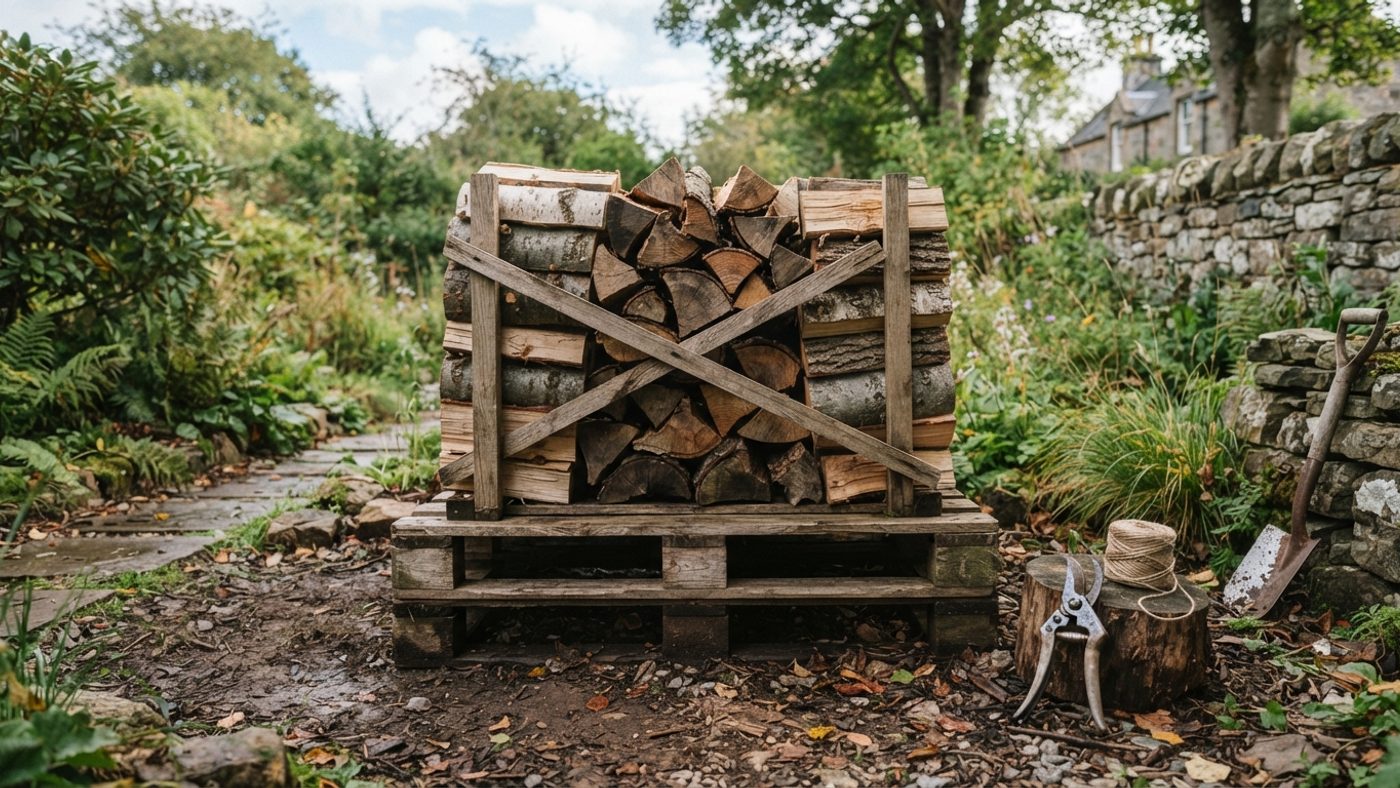
Applied together over a season, moving the seating area, sorting out the wettest corner, avoiding the two peak windows on the worst evenings, the effect compounds: none of them alone guarantees a midge-free evening, but stacking timing, wind and drainage is a materially different garden to sit in by July than doing nothing. Any small, permanently damp spot near where people sit is also worth a second look, not just a boggy corner of lawn: a shaded compost heap that never dries out, a mulchA layer of material spread over the soil around plants to suppress weeds, retain moisture, and improve soil structure as it breaks down. Full definition → pile kept wet, a stack of logs sitting on bare damp soil. None of these breed midges the way rushy, undrained ground does, but they keep the immediate area humid and sheltered, exactly the still, damp microclimateThe local growing conditions in one specific spot that differ, sometimes substantially, from the wider area's average climate. Full definition → the midge prefers to rest in during the day before its evening activity peak. Moving a seating area a few metres from the compost heap, or lifting a log pile onto a pallet so air and light reach underneath it, costs nothing and complements the drainage point above.
Common questions
Does planting lavender, mint or citronella actually keep Highland midges away?
No institutional or peer-reviewed evidence supports it. That list of plants circulates widely online but traces back to generic "garden midge" advice describing non-biting chironomid gnats, a different insect entirely, not the Highland biting midge that bites people in Scottish gardens.
Is bog myrtle worth growing in the garden as a repellent?
It's the one plant with a real, long Scottish tradition behind it, historically worn or rubbed on skin rather than grown as a border plant for protection. It's a legitimate native shrub for damp, acidic Highland gardens on its own merits, but no controlled trial confirms that a living plant in the ground measurably reduces bites for someone sitting nearby, so treat it as traditional rather than proven.
Will a garden pond make my midge problem worse?
Not for the Highland biting midge specifically. Culicoides impunctatus breeds in damp, acidic, poorly drained soil, not open standing water. A pond is far more likely to attract non-biting chironomid gnats, a separate insect often confused with midges in generic garden advice.
How much wind does it actually take to stop midges biting?
Around 5.5 mph according to Trees for Life, roughly the point on the Met Office's Beaufort scale where a light breeze starts to rustle leaves. That's a genuinely mild amount of moving air, not a windy day, which is why a garden seating area that catches even a gentle breeze can be dramatically better than a fully sheltered, still corner.
Does frost really end the midge season?
Yes. Both NatureScot and Trees for Life point to the first proper autumn frosts, rather than a fixed calendar date, as what actually ends the season each year, which is also why a cold, late spring tends to delay the season's start and a mild one extends it at both ends.
Sources
4 sources, recorded with what each was used for
- NatureScot: All you ever wanted to know about the pesky Scottish midge: Dawn/dusk activity pattern, wind/temperature/dryness suppressing activity, larval density (700 per square metre), bog myrtle as traditional repellent
- Scotland's Rural College (SRUC): How Midge Trapping is Helping Scotland to Stay Ahead of Disease Risks: Season start/end timing, the EPIC national surveillance programme, temperature as the primary driver of season length, damp ground as habitat
- Met Office: Beaufort Wind Force Scale: Wind speed table and Beaufort force descriptions, used to contextualise the midge wind threshold
- Trees for Life: Highland biting midge: Wind-speed flight threshold (5.5 mph), larval habitat and elevation limit (500m), larval density per hectare