
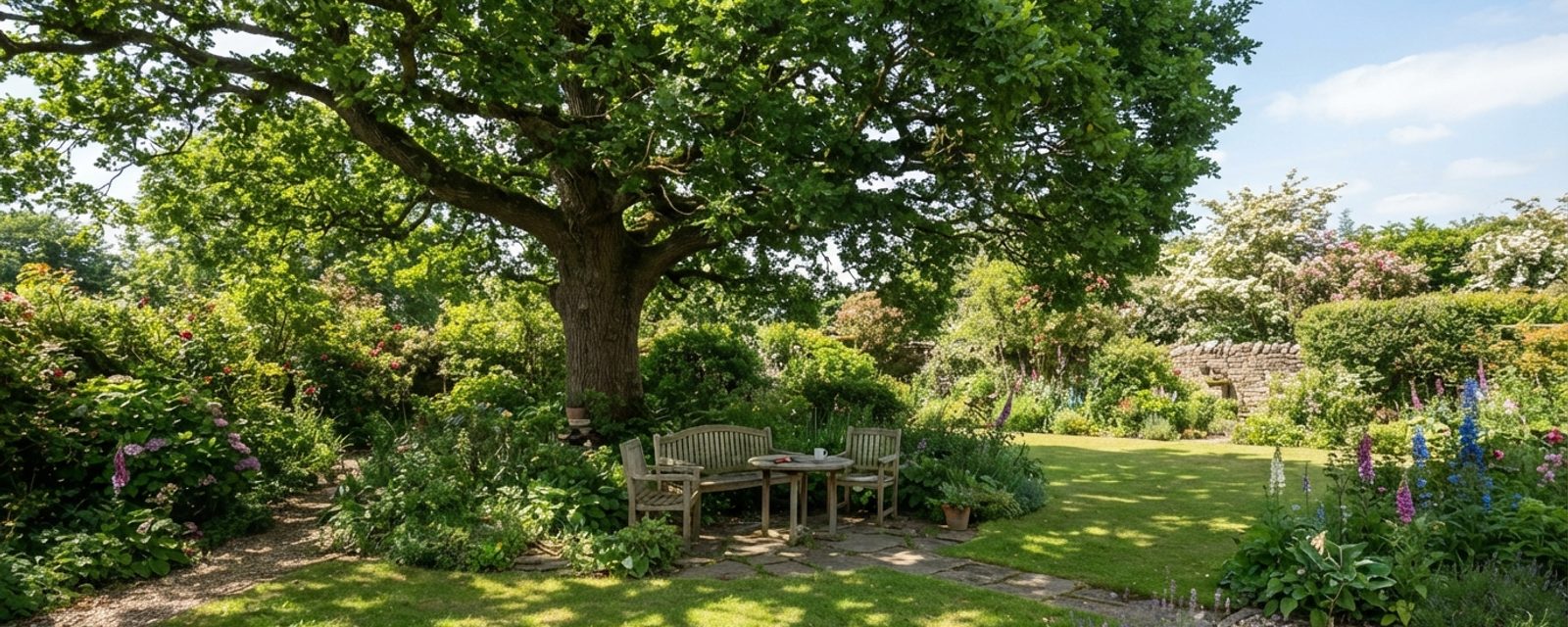
By early afternoon on a clear summer day, an unshaded south- or west-facing patch of garden is absorbing hours of direct sun with nothing to interrupt it. The soil surface dries out faster than roots below can replace the moisture, paving and stonework store heat and re-radiate it into the evening, and anyone sitting out loses the option of moving out of direct sun without leaving the garden altogether. A tree changes that arithmetic: a canopy overhead intercepts a share of that radiation before it ever reaches the ground, so the soil beneath stays cooler and damper and the sitting space underneath it stays usable for longer in the day. Which tree does that job, though, depends on how big a canopy the garden can actually carry once it's mature.
Quick answer
For most Scottish domestic gardens, rowan (Sorbus aucuparia) is the best overall pick: native, reliably hardy, and sized so it won't outgrow an average plot. If the garden is small or close to a boundary, a compact field maple cultivarA plant variety that arose or was bred under cultivation and is kept true by deliberate propagation, rather than a naturally occurring wild species. Full definition → such as Acer campestre 'Elsrijk' gives a denser, more controlled canopy in less lateral space. On an exposed or coastal site rather than a straightforwardly sunny one, hawthorn is the tougher choice of the two.
Why a sunny corner needs more than shade cloth
Choosing a garden tree's canopy is a genuine design decision: whether you want "a dense canopy of leaves to provide welcome shade in summer, or... a small or light canopy that simply filters the sun." A dense-crowned deciduous tree like field maple gives the first; a birch's narrower, more open habit gives the second, letting dappled light through rather than blocking it outright. Neither is automatically the right answer, it depends on whether the sunny spot is a patio you want fully shaded by midday, or a border that just needs the worst of the afternoon sun taken off it.
The trade-off gardeners most often get wrong is blunt: height and spread are "probably the most important factor" in choosing a tree for a smaller plot, and planting in a corner usually means "most of the canopy will shade neighbouring gardens" as well as your own. A tree bought for its flowers or its size on the label can be a very different proposition once RHS's own "ultimate height and spread" figures for that species are checked against the actual plot.
Does UK-wide "shade tree" advice fit a Scottish garden?
Most tree-selection advice available in the UK is written without a Scottish climate specifically in mind, and it's worth checking whether that changes the practical picture. On sunshine hours it does: Scotland as a whole gets meaningfully fewer annual sunshine hours than the UK average, per Met Office long-term climate data, and the gap within Scotland itself is just as real, the east coast, including Fife and the Lothians, runs sunnier than the west and the Highlands, where hill and mountain shading cuts hours further. A "sunny corner" on the Fife coast and a "sunny corner" in a west Highland glen aren't starting from the same annual total, even though both count as "Scotland."
On hardiness, though, the trees in this list are not the limiting factor. All five carry RHS hardiness ratings of H6The RHS's H1a–H7 scale for how much cold a plant can survive outdoors, H1a being tender indoor-only and H7 hardy anywhere in the UK. Full definition → or H7, hardy through the full range of UK and northern European winters, including the most severe continental cold down to and below -20°C, so none of them are marginal choices for a Scottish garden on cold-tolerance grounds. Forestry and Land Scotland goes further for two of the five: silver birch is described as "one of Scotland's hardiest trees," and rowan is "found higher in the mountains than any" of Scotland's other native trees, a genuinely Scotland-specific claim about altitude tolerance, not just cold tolerance. Growth speed is the one place UK-wide advice could mislead: none of it is broken out by region, so treat the "years to ultimate size" figures below as a UK-wide average that a shorter, cooler Scottish growing season may push toward the slower end, rather than an exact countdown.
The five picks compared
| Tree | Ultimate height | Ultimate spread | RHS hardiness | Time to ultimate size |
|---|---|---|---|---|
| Rowan (Sorbus aucuparia) | 4–8m | 2.5–4m | H6 | 10–20 years |
| Field maple 'Elsrijk' (Acer campestre 'Elsrijk') | 8–12m | 4–8m | H6 | 10–20 years |
| Hawthorn (Crataegus monogyna) | 4–8m | 4–8m | H7 | 10–20 years |
| Crab apple 'Evereste' (Malus 'Evereste') | 4–8m | 4–8m | H6 | 10–20 years |
| Silver birch (Betula pendula) | over 12m | over 8m | H7 | 20–50 years |
Figures are RHS's own banded "ultimate height/spread" ranges for the named plant, except silver birch, given as the species figure. H6 and H7 are the two hardest bands on RHS's hardiness scale, fully hardy through UK winters, including the most severe. Read the birch row with its shape in mind, not just the number: a narrow, open-canopied tree like birch gives dappled rather than dense shade, so a taller ultimate height doesn't translate one-for-one into more shade cast at ground level.
The five trees
Rowan (Sorbus aucuparia)
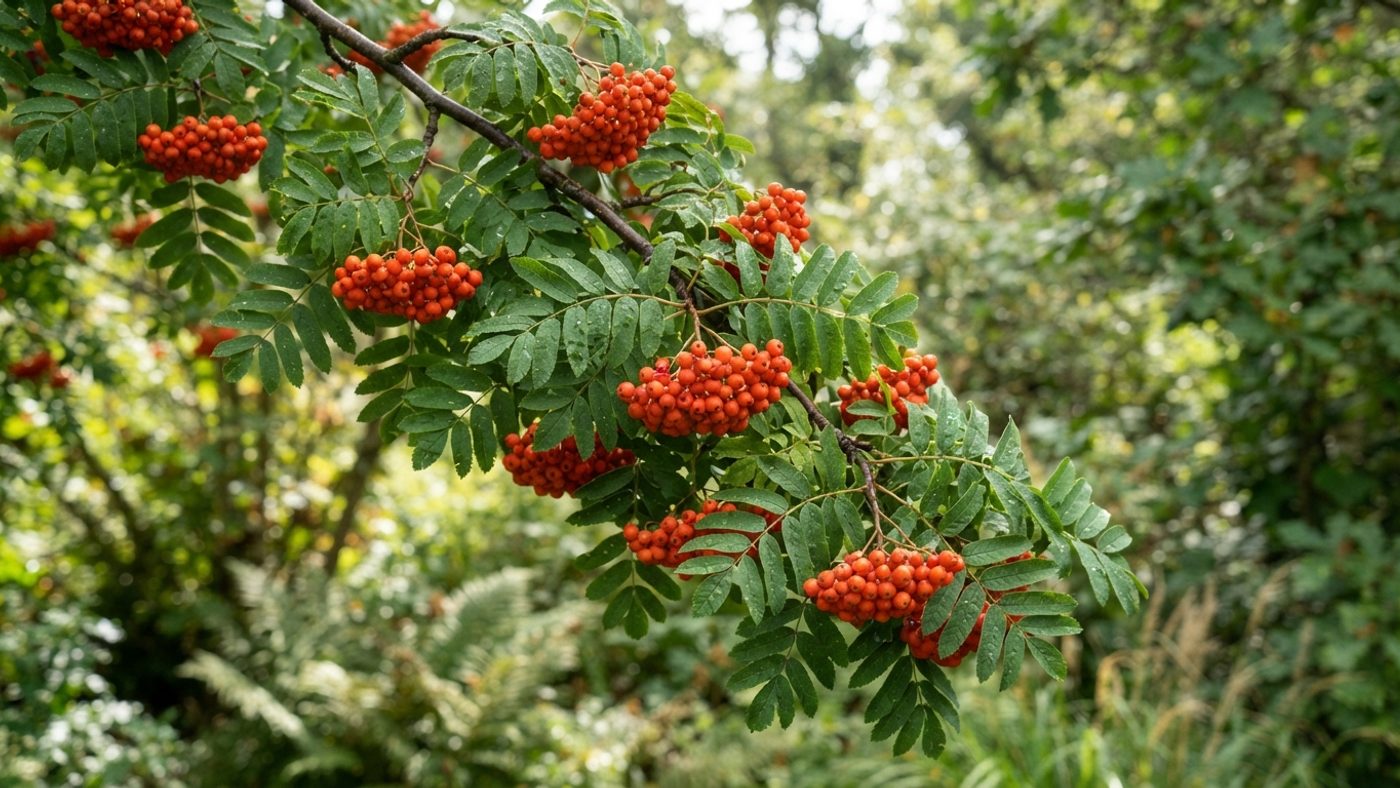
Rowan is native to Scotland and, per Forestry and Land Scotland, grows at higher altitude than any of the country's other native trees, a genuine marker of cold and exposure tolerance rather than a general "hardy tree" claim. RHS lists it at 4–8m ultimate height with a narrower 2.5–4m spread, tolerant of full sun or partial shade and of both exposed and sheltered sites, in a wide range of soil types provided drainage is reasonable. That combination of modest ultimate size and genuine hardiness is why it's the default pick here: most gardens can accommodate it without the tree ever needing to be restricted, and it isn't a marginal choice anywhere in Scotland. White flowers in late spring are followed by orange-red berries that Forestry and Land Scotland notes feed migrating Scandinavian birds in autumn. Young trees benefit from a rabbit or deer guard around the trunk in the first few years, until the bark toughens, a routine precaution in most Scottish gardens, not just rural ones. Rowan is also one of the species RHS lists as particularly susceptible to honey fungus, alongside birch; there's no chemical control for it, so a rowan showing sudden branch dieback and bootlace-like fungal growth at the base is worth checking against RHS's own honey fungus guidance.
Field maple 'Elsrijk' (Acer campestre 'Elsrijk')
The straight species of field maple, the UK's only native maple according to the Woodland Trust, has an RHS ultimate height banded at "higher than 12 metres," too large for most gardens to plant as the species and let run. 'Elsrijk', a compact cultivar with what nurseries describe as a neater, more upright crownThe base of a perennial plant where roots and shoots meet, often sold and planted as a ready-made dormant plant rather than grown from seed. Full definition →, is listed by RHS at a smaller 8–12m height and 4–8m spread, H6 hardy, tolerant of full sun to partial shade and of exposed sites, and unfussy about soil type across chalk, clay, loam and sand. Its habit gives one of the denser canopies on this list, which makes it the better choice than rowan specifically where full, heavier shade over a patio or seating area is the goal rather than a lighter, more open canopy.
Hawthorn (Crataegus monogyna)
Hawthorn is the toughest tree here on exposure. RHS rates it H7, hardy through the most severe European continental winters, and lists it as suited to town, coastal or exposed gardens specifically, at 4–8m in both height and spread. It flowers later than most spring-blossom trees, once its leaves are already out, with white flowers in May followed by dark red haws; the Woodland Trust notes it supports over 300 insect species. Its thorns and dense, twiggy growth make it a poor pick immediately beside a path or seating area used by small children, but a strong one for an exposed boundary that also happens to get full sun. Hawthorn is also one of the ornamentals fireblight can infect, RHS notes hawthorn hedges can carry the infection, though that's not usually reason enough to rule it out; watch for wilted, blackened blossom and shoots in late spring and early summer, and cut affected wood well back into healthy growth if it appears, since there's no chemical treatment.
Crab apple 'Evereste' (Malus 'Evereste')
Malus 'Evereste' carries RHS's Award of Garden Merit, a UK-wide award, not a Scotland-specific recommendation, at 4–8m height and spread and H6 hardy, in full sun to partial shade across most soil types. Spring blossom is followed by small, orange-red crab apples that persist into autumn, genuinely decorative rather than a crop, though they are edible if anyone wants to use them for jelly. Its rounded, moderate canopy sits between rowan and field maple 'Elsrijk' in the amount of shade it casts, and it's a reasonable middle choice where spring flowering is valued as highly as the shade itself. As a relative of apples and pears, it's worth knowing it can be affected by fireblight, the same bacterial disease covered above for hawthorn.
Silver birch (Betula pendula)
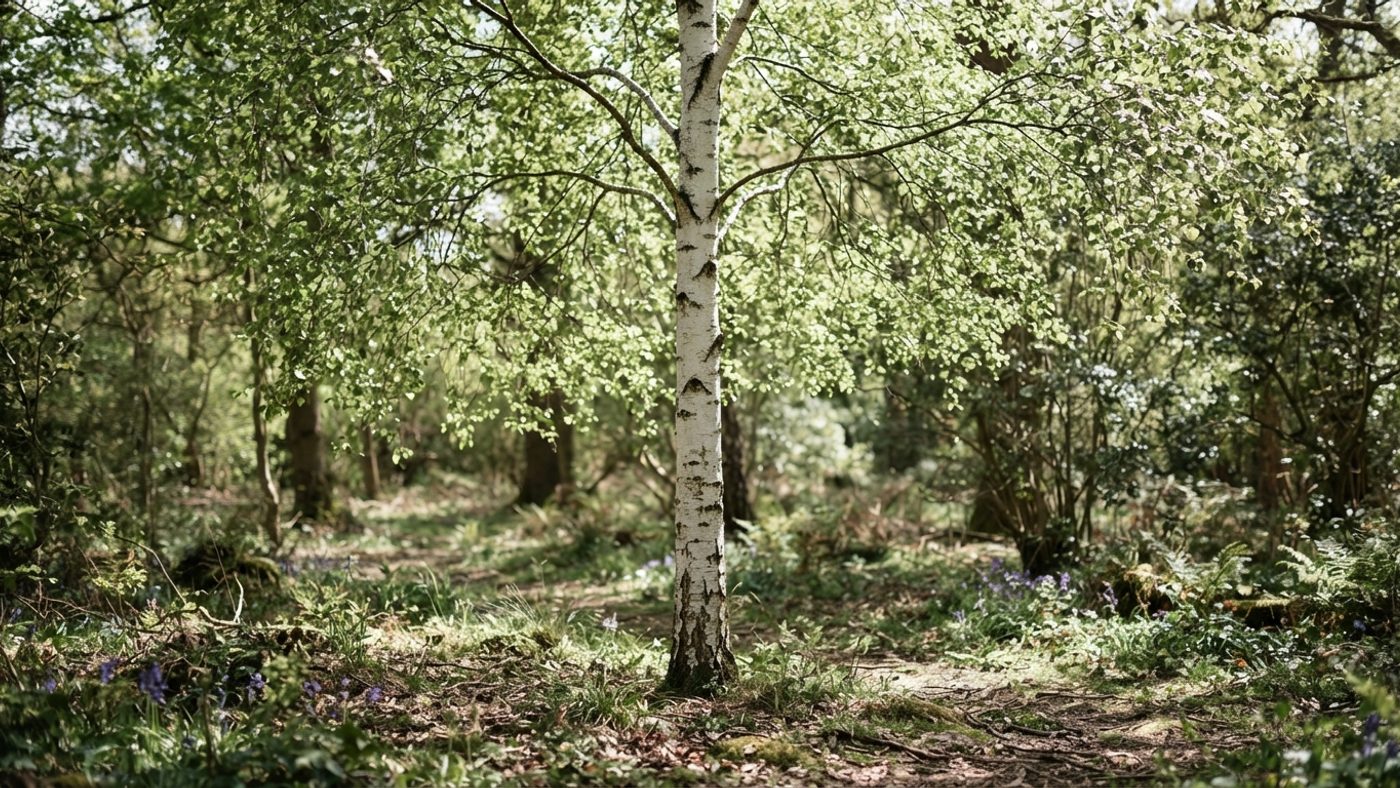
Silver birch is listed on Forestry and Land Scotland's own species page as "one of Scotland's hardiest trees," and carries RHS's most severe hardiness rating, H7. Its ultimate height is banded by RHS as "higher than 12 metres," with a spread over 8m and a 20–50 year span to reach full size, considerably slower and larger, eventually, than any other tree on this list. What makes it worth including despite that size is its shape: a narrow trunk and open, drooping canopy rather than a broad dome, which is why RHS lists it among trees suited to smaller gardens even at that ultimate height, and why it gives dappled light-filtering shade rather than the denser cover of field maple or crab apple. It suits a garden that wants height and movement overhead more than a fully shaded patio floor, and it's usually best planted as a single specimen or, where there's room, a multi-stemmed group rather than close to a boundary. Birch is also on RHS's list of species particularly susceptible to honey fungus, alongside rowan, worth knowing given how long-term a planting decision this is, even though there's no way to guard against it beyond good general tree health.
Siting and planning for shade, not just for the tree
Choosing the right species is only half the job, where it goes and how long it takes to earn its keep matters just as much.
Distance from the house. RHS's guidance on trees near buildings ties safe distance to a tree's water demand rather than a single fixed rule: high water-demand species can dry the soil out to roughly the tree's own height in distance, while lower-demand species rarely affect the ground beyond about half their height. None of the five trees here are on RHS's high-risk list (that's headed by oak, willow, poplar, eucalyptus and some conifers), so applying that "roughly half of ultimate height" rule directly to the ultimate-height figures already given above gives a rough working minimum distance for each:
| Tree | Ultimate height | Rough minimum distance from a wall |
|---|---|---|
| Rowan | 4–8m | 2–4m |
| Field maple 'Elsrijk' | 8–12m | 4–6m |
| Hawthorn | 4–8m | 2–4m |
| Crab apple 'Evereste' | 4–8m | 2–4m |
| Silver birch | over 12m | over 6m |
These are GrowScotland's own figures, worked from RHS's height/spread rule rather than a distance RHS publishes per species, a starting point for planning, not a guarantee. The underlying risk is soil-specific either way, subsidence from tree-root water uptake is, per RHS, "generally only a problem on shrinkable clay soils" (the guide to identifying your soil type covers how to check), and older buildings (pre-1950s, under four storeys) with shallow foundations carry more risk than modern ones, a real factor for many pre-1950s Scottish homes. Root spread on any of these can still extend up to three times the tree's height regardless of building age, and root barriers don't reliably stop it even close to an older, more vulnerable foundation, roots tend to grow under them rather than being blocked.
Years to useful shade. All five of these trees are banded by RHS at 10–20 years to reach their ultimate size, except silver birch at 20–50 years. That figure is for full maturity, not for the point at which a tree starts casting worthwhile shade, a well-established young tree can be providing meaningful cover well before it reaches its final height and spread, but nothing here will shade a patio the year it's planted. A nursery-grown semi-mature specimen, planted rather than a young whip, closes some of that gap at extra cost; none of the five needs regular structural pruning to hold its shape once established, beyond removing damaged or crossing branches in the dormant season.
What grows in the shade underneath. A mature shade tree changes what a border beneath it can grow, not just how the seating area feels, the guide to the five best crops for a shaded Scottish garden covers what still crops well once a tree like these is casting real shade over part of the plot.
Leaf drop near paving and gutters. Rowan and silver birch are both moderate-to-heavy leaf droppers; sited directly over a patio, path or gutter, that means an autumn clearing job most years, worth weighing against a more open canopy if low maintenance matters more than density of shade.
Shade, damp ground and midges. The same cooler, damper microclimateThe local growing conditions in one specific spot that differ, sometimes substantially, from the wider area's average climate. Full definition → a canopy creates over a seating area is also the kind of still, humid ground midges favour, particularly in the west and Highlands, the guide to gardening around the midge covers how to manage that trade-off around a shaded sitting spot.
Planting technique. All five are commonly available bare-rootA plant, usually a fruit tree or hedging, sold with its roots exposed rather than in a pot, and only available while dormant. Full definition → through the dormant winter season as well as container-grown year-round. Getting a bare-root or containerisedA plant grown and sold in a pot of compost, which can be planted out at any time of year, unlike a bare-root plant. Full definition → tree into the ground correctly, hole depth, backfillingThe soil (sometimes improved with grit or compost) used to fill the gap around a plant's roots after it's placed in its planting hole. Full definition →, staking and the first year or two of watering, is covered in full in the guide to planting bare-root trees in Scotland.
If the problem is wind, not sun. A tree chosen to cast shade over a sunny spot is a different brief from planting to shelter an exposed garden from wind, for the latter, the guide to shelter-belt planting for exposed gardens covers windbreak-focused species and layout instead.
Common questions
Will any of these trees actually fruit as well as shade the garden?
Rowan and hawthorn both produce berries that birds rely on rather than people, and crab apple 'Evereste' produces small ornamental crab apples that are edible but not a realistic eating or cooking crop on the scale a dedicated fruit tree would give. None of the five is a substitute for a proper fruiting apple, pear or plum tree if that's actually the goal.
Which of these gives the deepest, most complete shade?
Field maple 'Elsrijk' and crab apple 'Evereste' both have denser, more rounded canopies than rowan, hawthorn or silver birch, and are the better picks for blocking direct sun over a patio or seating area rather than filtering it.
Is silver birch too big for an average Scottish garden?
Its ultimate height, over 12m, is the largest of the five, but RHS lists it among trees suited to smaller gardens because of its narrow trunk and open canopy rather than a broad spreading crown, it takes up less ground-level space than the height figure alone suggests, though it does need vertical room to grow into.
Do I need to worry about these trees damaging my house's foundations?
Only really relevant on shrinkable clay soils and mainly for high water-demand species like oak or willow, none of which are on this list. Check the soil type and the age of the building rather than assuming risk from the tree species alone.
How much sun does a Scottish garden actually get compared with the rest of the UK?
Less, on average, per Met Office long-term climate data, and the difference within Scotland is just as significant, with the east coast (Fife, the Lothians) running notably sunnier over the year than the west and the Highlands, where hill and mountain shading reduces hours further.
Sources
18 sources, recorded with what each was used for
- RHS: Trees for Smaller Gardens: Canopy-density vs light-filtering choice, corner-planting shade-on-neighbours warning, height/spread as the key selection factor
- RHS: Small Garden Trees: General advice on choosing naturally compact trees over restricting vigorous ones by pruning
- RHS: Shade Gardening Tips and Plant Ideas: Dense vs dappled shade distinction, deciduous canopy behaviour, planting-distance-from-walls advice
- RHS: Trees Near Buildings: Subsidence risk by soil type and building age, high/low water-demand species, root spread and root-barrier effectiveness
- RHS: Acer campestre (field maple) plant details: Species-level ultimate size, hardiness and soil/aspect data
- RHS: Acer campestre 'Elsrijk' plant details: Ultimate height/spread, hardiness rating, time to maturity, soil/aspect/exposure tolerance
- RHS: Sorbus aucuparia (rowan) plant details: Ultimate height/spread, hardiness rating, time to maturity, sun/soil/exposure tolerance
- RHS: Betula pendula (silver birch) plant details: Ultimate height/spread, hardiness rating, time to maturity, sun/soil tolerance
- RHS: Crataegus monogyna (common hawthorn) plant details: Ultimate height/spread, hardiness rating, suitability for exposed/coastal gardens
- RHS: Malus 'Evereste' (crab apple) plant details: Ultimate height/spread, hardiness rating, AGMThe RHS's Award of Garden Merit: a UK-wide trials award for reliable performance, not a Scotland-specific recommendation. Full definition → status, sun/soil tolerance
- Woodland Trust: Field Maple: Native-species status (UK's only native maple), wildlife value, pollution tolerance
- Woodland Trust: Rowan: Native range weighted to north/west UK and Scottish highlands, wildlife value
- Woodland Trust: Silver Birch: Native/naturalised range, open-canopy growth habitA plant's characteristic shape and manner of growth, such as upright, spreading, creeping or bushy. Full definition →, insect species supported
- Forestry and Land Scotland: Rowan: Scotland-specific altitude-tolerance claim
- Forestry and Land Scotland: Silver Birch: "One of Scotland's hardiest trees" claim, growth habit, ultimate size
- Met Office: UK and regional climate series (sunshine): Scotland vs UK annual sunshine hours, and east-vs-west/Highland regional variation within Scotland
- RHS: Fireblight: Susceptible ornamentals (Crataegus, Sorbus and related Rosaceae), symptoms, and the absence of any chemical control
- RHS: Honey Fungus: Species particularly susceptible (Betula, Sorbus named directly), absence of chemical control