
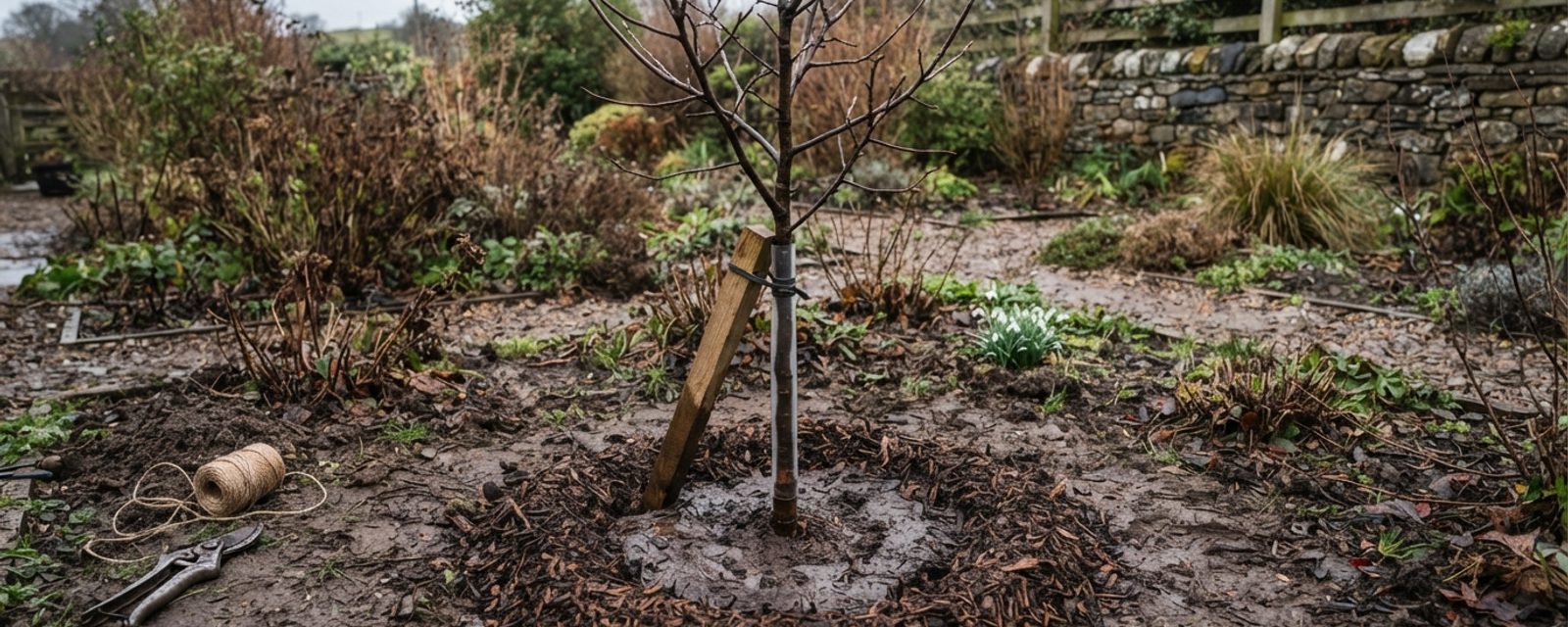
A bare-rootA plant, usually a fruit tree or hedging, sold with its roots exposed rather than in a pot, and only available while dormant. Full definition → tree is lifted straight out of the nursery field, soil shaken from its roots, while it's fully dormant, no leaves, no active growth, next to no water or sugar moving through it. That dormancy is what makes the whole method work: a tree in that state can have its roots exposed to the air for the journey from field to garden and feel almost nothing, because it isn't drawing on those roots for anything at the moment it's lifted. The catch is that the technique is entirely tied to the tree staying dormant, and in Scotland the thing that actually ends that window usually isn't the calendar at all.
A container-grown tree, by contrast, is never dormant in quite the same way and carries a pot's worth of roots that have often circled the inside of that pot for a year or more before you ever plant it. Bare-root trees are cheaper for exactly this reason, no pot, no compost, no year of nursery space taken up keeping a root system contained, and a well-handled one establishes at least as well as its container-grown equivalent, because its whole root system, not just what fits in a pot, comes with it. The trade-off is availability: bare-root stock is sold by specialist tree nurseries and some garden centres for a few winter months only, rather than sitting on the shelf year-round the way container trees do. It's worth buying UK-grown stock from a reputable nursery and checking it over on arrival, plant disease such as ash dieback has made where a tree was grown a real biosecurity question, not just a planting-technique one.
Once a tree breaks bud in spring, roots exposed to the air will dry out and it will struggle, so bare-root stock is only sold, and should only be planted, during the dormant season, in most of the UK, roughly November to March. In Scotland, dormancy itself runs a little later, but the tighter limit on that window usually isn't the calendar at all: it's whether the ground is actually fit to dig.
Scotland's planting window: why the ground decides
The standard dormant season is set at November to March, stretching a bit longer in Scotland and Northern Ireland since spring growth starts later here. Forestry and Land Scotland works to the same recognised window, October to March, for its own bare-root planting programme, and has experimented with freezing surplus stock to hold it in artificial dormancy, part of why a nursery can occasionally still offer bare-root stock later into spring than the season would otherwise suggest.
A tree can be planted through a light frost, dormant bare-root stock tolerates cold better than most people expect, but it cannot be planted into ground that's frozen solid, and it shouldn't be planted into ground that's waterlogged, because working wet, heavy soil at that point does the ground more harm than the tree any good. Soil that's worked or walked on while wet loses its structure and becomes puddled and compacted, damage that's slow and laborious to put right, and once wetted by winter rain, clay soil can stay unworkable until mid-spring. That's a soil-structure problem, not a cold one, and it can easily outlast the frost season by weeks. Frost timing itself is governed mainly by altitude and distance from the sea, and Scotland's frost dates page covers that region by region, a bare-root tree can go in perfectly well on a day that's still within the local frost window, provided the ground underfoot is actually workable.
That workability, for weeks at a stretch, comes down to soil type and rainfall more than temperature. Scotland carries a far higher share of its land in slow-draining, easily waterlogged soils than Europe as a whole:
| Soil type | Share of Scotland's land | What it means for planting |
|---|---|---|
| Podzols, acid, generally free-drainingSoil that lets water pass through quickly rather than pooling, so roots aren't sitting in wet ground after rain. Full definition → | 23.7% | Workable through most of the dormant season once temperatures allow |
| Peat, wet, slow to drain, high organic matter | 22.5% | Can stay unworkable for extended spells in a wet winter |
| Gleys, periodically or permanently waterlogged | 20.6% | The most direct match for the "cannot be worked" warning above |
Peat and peaty gleys concentrate in the Highlands and Southern Uplands, especially to the west; the Central Belt sits mostly on mineral soils that behave more like the rest of the UK. Rainfall tracks the same west-east split, and it's the practical reason why:
| Area | Typical annual rainfall |
|---|---|
| Coastal East Lothian, Fife, Moray Firth | Under 700mm |
| Upper Clyde valley, Ayrshire and Dumfries and Galloway coasts | Under 1,000mm |
| Southern Grampians | Over 1,500mm |
| Higher ground of the west Highlands | Over 3,500mm |
Prolonged rainfall causes flooding especially in winter and early spring, when soils across both eastern and western Scotland are usually near saturation, precisely the stretch that overlaps with bare-root planting season. Practically: on free-draining podzol near the east coast, most dry-enough days between November and March are plantable; on heavy, peaty or gley ground further west or at altitude, the safe end of the season can arrive later than the calendar, or even the local frost dates, suggest on their own. That same ground is also windier, western Scotland is one of the more exposed areas of the UK, with its strongest average winds falling in exactly those November-to-March planting months, worth factoring into how firmly a new tree needs staking.
Reading your own ground before you dig
None of this is postcode destiny, a coastal, sandy plot can drain freely anywhere in Scotland, and a heavy clay pocket can turn up in an otherwise easy garden. Check the ground itself, not the date: avoid digging clay when it's wet and claggy, avoid digging sandy soil when waterlogged or frozen, and avoid rotavating or working any wet soil at all, since it's extremely damaging. If a spade sticks, smears rather than crumbles, or the ground squelches underfoot, it isn't ready yet.
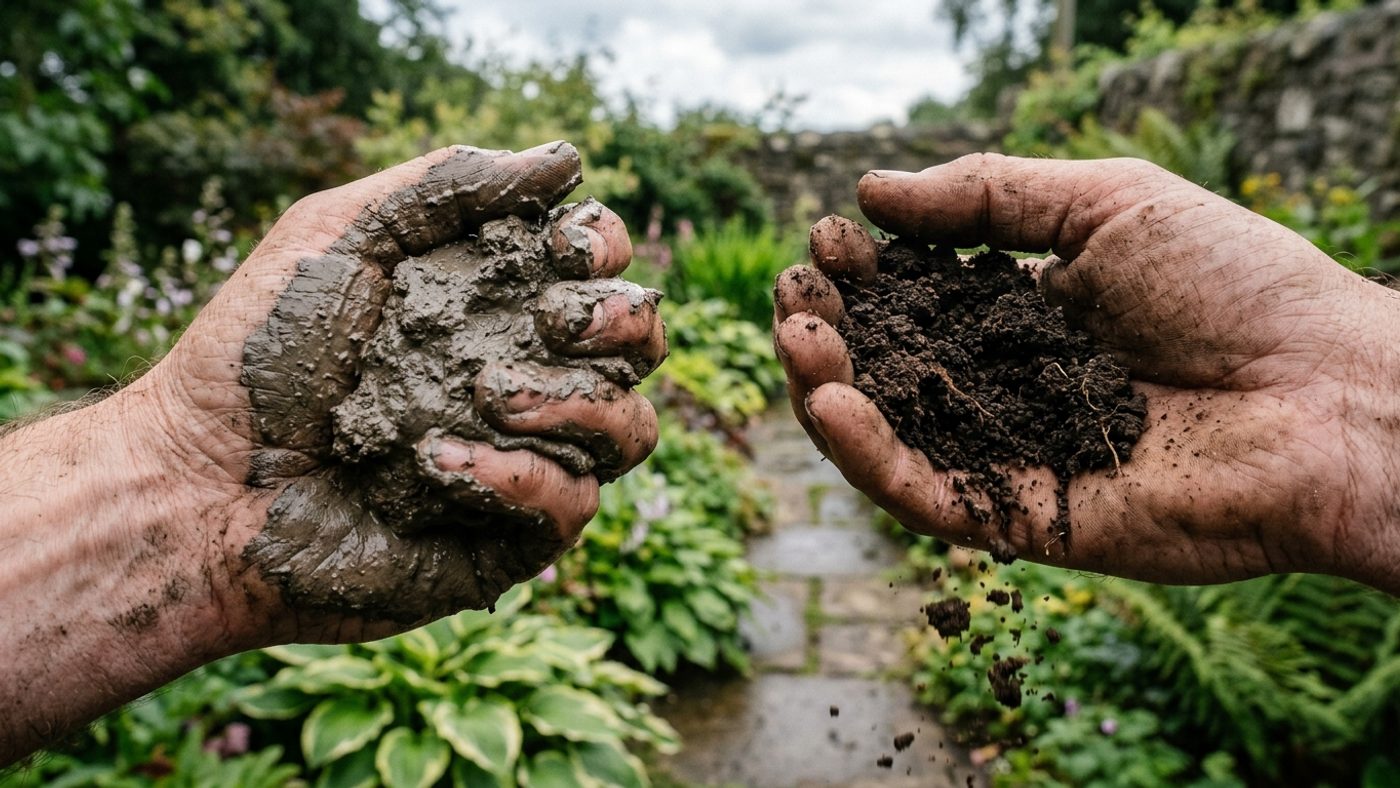
On genuinely heavy or slow-draining ground, that doesn't rule out planting once conditions do allow it. Plant on a slight raised mound, keeping the root system above the wettest layer of soil, and fork through any compacted soil at the base and sides of the hole so water can't collect in a sealed pocket around the roots. Where the whole plot stays wet for long stretches even in the growing season, it's also worth choosing a tree that actually tolerates that, willows and alders are the classic examples of species that do well on ground drier-loving trees would struggle with, rather than fighting the site with drainage work alone. Podzols' acidity is rarely the limiting factor for a tree in the way waterlogging is; most garden and orchard trees tolerate a range of soil pH and fail on wet roots long before pH becomes the problem.
How to plant a bare-root tree
Once the ground is actually workable, the technique itself matters as much as the timing.
Soak the roots, and check them over
If they look moist on arrival, thirty minutes in a bucket of water is enough; if they've dried out at all, soak for up to two hours. While they're out, trim and spread the roots so none are cramped, torn or doubled back on themselves, a clean cut is better than a ragged one on anything obviously damaged.
Dig the hole wide, not deep
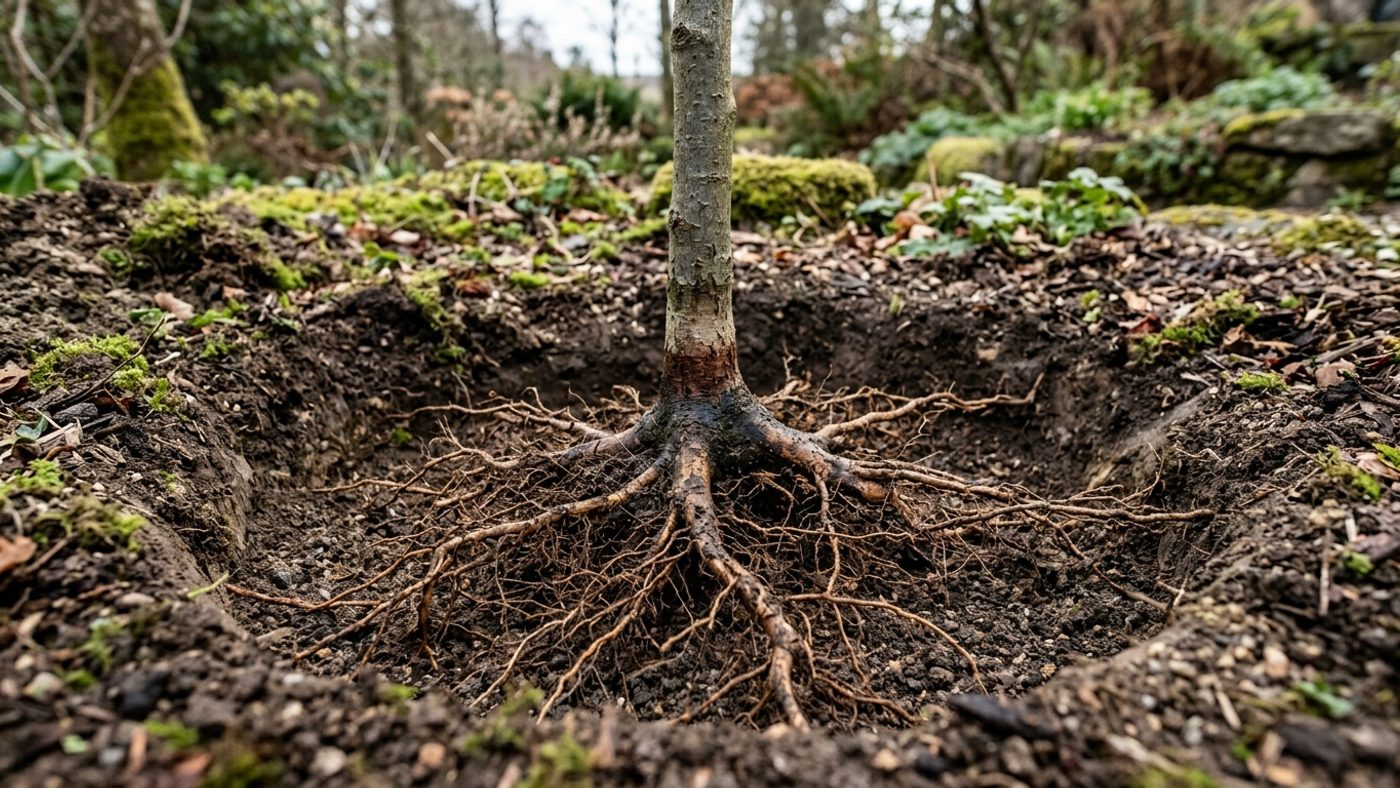
A hole at least three times the diameter of the root system, but no deeper than the roots themselves, is the standard target. Spread the roots out across the base rather than cramming them into a narrow shaft, and loosen the sides of the hole so roots meeting them can push through into the surrounding soil rather than circling back on themselves.
Get the depth right
The point where the roots flare out from the trunk, the nursery mark, often visible as a slight colour change on the bark, should sit level with the surrounding soil surface once you've finished, not buried under it (on a raised mound, that means level with the top of the mound, not the original ground beneath it). Planting too deep is one of the most common causes of a newly planted tree failing: it stops air reaching the root system and leaves the lower trunk more vulnerable to disease.
Backfill without extras, and firm it in
Place soil between and around all the roots to eliminate air pockets, then firm it gently. There's little to be gained from digging compost or fertiliser into the base of the hole, testing finds it doesn't reliably help establishment and can actually hinder it, so plain soil, well firmed, does the job.
Stake if the tree needs it, and think about exposure
Small trees generally don't need staking at all. Larger or top-heavy specimens do, angled into the prevailing wind. A young tree on an exposed, western or upland site is more likely to need a stake, and a firmer one, than the same tree on a sheltered east-coast plot, since that's the same ground described above that also carries Scotland's strongest winds over the winter planting months. Check the tie in spring and autumn so it never constricts the growing stem, and expect to remove the stake after about two growing seasons, by which point the tree's own roots should anchor it.
Water it in, and mulch, keeping the mulch off the trunk
Give it a thorough watering straight after planting. Roughly 30–50 litres per square metre, about four to six full watering cans, weekly in dry weather through its first couple of growing seasons is the standard target; on high-rainfall western or upland ground that requirement may rarely bite in practice, where a freer-draining east-coast garden is more likely to need it followed through properly. Keep a vegetation-free circle at least 1.2m across around the base for the first three years so grass and weeds aren't competing for water, and leave a 10cm collar of bare soil right around the stem itself when mulchingA layer of material spread over the soil around plants to suppress weeds, retain moisture, and improve soil structure as it breaks down. Full definition →, mulch piled against the bark holds moisture there and can cause it to rot.
Guard against animals
A newly planted trunk is vulnerable to mice, voles, rabbits and deer, all of which can ring-bark it, strip away a full ring of bark around the trunk, cutting off the flow of water and food between roots and canopy and killing the tree outright. Roe deer are widespread on the Scottish mainland, occurring right across the country, not confined to the Highlands, and excessive deer browsing is a direct cause of young trees failing to establish. A guard or spiral fitted around the base at planting time is worth doing everywhere, not just in obviously rural spots, since damage done in the first weeks is rarely something a young tree recovers from.
The same steps apply whatever species you're planting; the apples, pears and plums growing guides each carry their own spacing, rootstockThe root system and lower stem a fruit tree is grafted onto, chosen to control the tree's eventual size rather than for its own fruit. Full definition → and pollination-partner notes worth checking alongside this.
If the ground isn't ready when your tree arrives
A bare-root tree can turn up by post or from a garden centre in the middle of a hard frost or a wet spell that's made the ground unworkable, and given how much of Scotland's ground can stay genuinely unworkable for weeks at a stretch within the dormant season, it's worth being ready for that rather than treating it as unlucky.
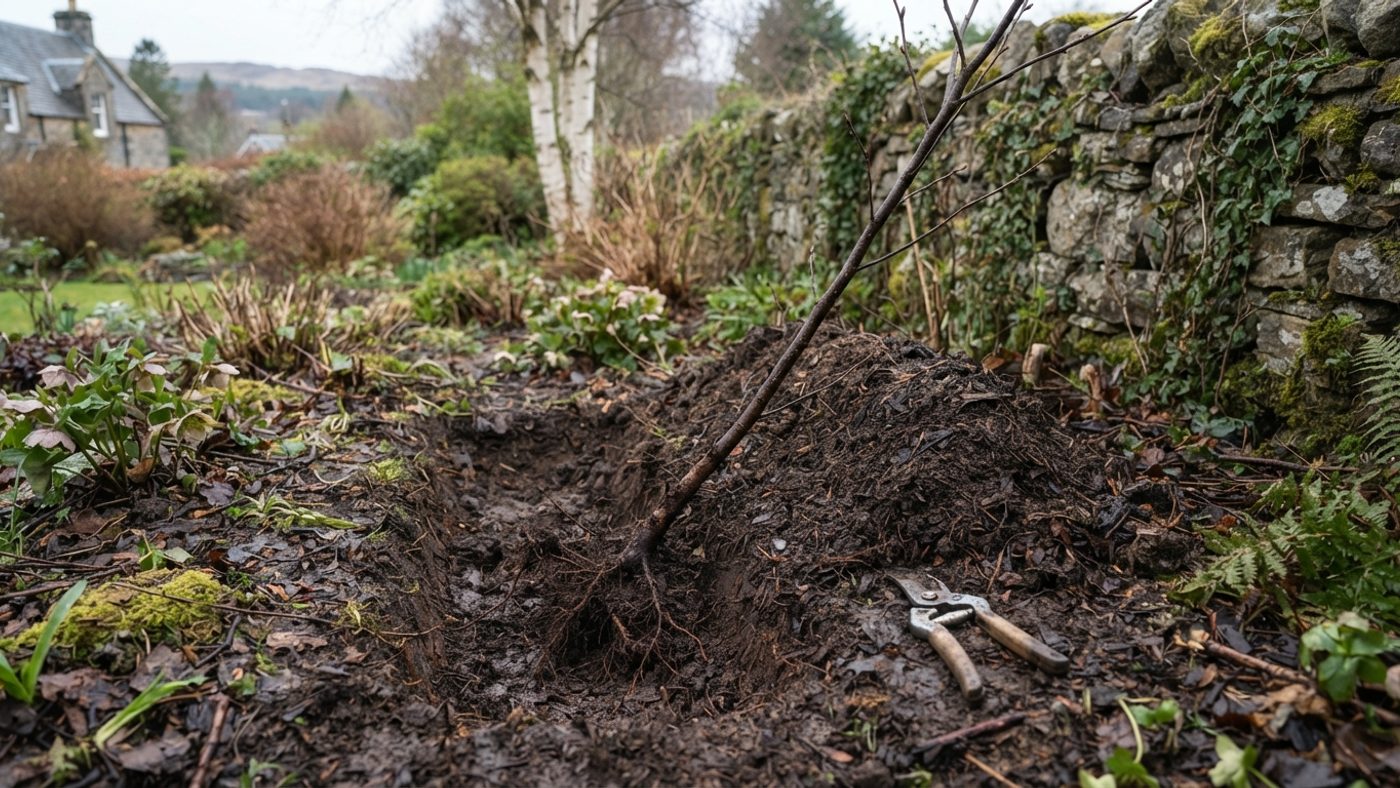
The standard answer is to heel it in, a temporary planting, not the real one. Dig a trench or hole in a sheltered spot with workable soil (a border, a raised bed, even a large tub of compost if the open ground is frozen or too wet to dig at all), lay the roots in at an angle, and back-fill firmly enough that no air pockets are left around them; standing water in an air pocket does more damage if it then freezes than exposed roots would on their own. Keep the trench shaded from strong sun and drying wind rather than in full exposure. A dormant tree handled this way will sit heeled in safely for several weeks, since it's still fully dormant and drawing on almost nothing while it waits, there's no fixed deadline by which it has to go into its final position, only the ongoing need to keep the roots moist and cool.
If the ground is frozen solid enough that even a temporary trench isn't possible, the fallback is to keep the roots wrapped and just damp, the bag or wrapping they arrived in, with a little water added if it's dried out, stored somewhere cold but frost-free such as an unheated shed or garage, until either the ground softens or a container of compost becomes the temporary home instead. Keep the roots moist, keep them cool, and don't let them dry out; a dormant tree tolerates the wait far better than it would tolerate being forcedCovering plants to exclude light and speed early, tender growth in the dark, most associated with rhubarb and sea kale in late winter. Full definition → into ground that isn't ready for it.
Common questions
Can I plant a bare-root tree in a hard frost?
No. Dormant bare-root stock tolerates cold well, but the ground needs to be workable to plant into, and frozen soil can't be dug without damaging the roots as you try. Heel the tree into a sheltered spot with unfrozen ground, or keep it wrapped and cool, and wait for a thaw.
My ground is heavy clay, when's it actually safe to plant?
Judge it by the soil, not the date. Clay that's wet and claggy shouldn't be dug at all; once winter rain has soaked it, that can mean it stays unworkable well into spring in parts of Scotland, later than the general November-to-March planting season implies further south. Planting on a slight raised mound once conditions do allow it also helps keep roots above the wettest layer of soil.
What's the real trade-off with a bare-root tree versus a container-grown one?
Mainly timing and handling, not quality. A bare-root tree has to be planted, or at least heeled in, promptly after it arrives, within a narrow winter window, and can't sit waiting on a patio the way a container tree can. In exchange it's usually cheaper and comes with its whole root system rather than whatever fitted inside a pot.
How long can a bare-root tree survive heeled in?
Several weeks at minimum, provided the roots are kept moist, the tree stays dormant and it isn't left exposed to drying wind or waterlogged ground, there's no fixed limit while those conditions hold, since a dormant tree is drawing on almost nothing while it waits.
Does frost timing tell me when it's safe to plant?
Not on its own. Frost dates and ground workability are related but different questions, a plot can be past its last frost date and still too wet or heavy to dig without damaging the soil structure, particularly on peat or gley ground further west or at altitude. Check the soil itself before digging.
Sources
14 sources, recorded with what each was used for
- RHS: Trees and Shrubs, Planting Guide: Planting hole size and depth, deep-planting risks, root trimming and spreading, backfillingThe soil (sometimes improved with grit or compost) used to fill the gap around a plant's roots after it's placed in its planting hole. Full definition →, the finding against adding compost/fertiliser to the hole, staking, watering rates, mulch and trunk-collar rule, animal-guard advice
- RHS: Trees, buying and planting specimens: Definition of bare-root, dormant-season availability, root-soaking guidance, heeling in as the standard fallback
- RHS: Clay soils: Structural damage from working wet clay, and clay staying unworkable until mid-spring once wetted by winter rain
- RHS: Soil Cultivation Tips: Timing guidance by soil type; warning against digging or rotavating waterlogged or frozen ground
- RHS: Waterlogging and Flooding Solutions: Planting on a raised mound and avoiding a sealed pocket at the base of the hole on slow-draining ground
- RHS: Wet soils, plants for: Matching species to a genuinely wet site rather than relying on drainage work alone
- RHS: Ash dieback: The biosecurity case for buying UK-grown stock from a reputable nursery
- Woodland Trust: How to Plant Trees: The standard November-to-March planting season running longer in Scotland and Northern Ireland
- Woodland Trust: How to Plant and Maintain Hedges: Dormant winter planting window and the mechanics of heeling in bare-root stock
- Forestry and Land Scotland: Frozen trees help extend planting season: Scotland's recognised October-to-March winter planting season and the dormancy mechanism behind it
- Met Office: Eastern Scotland climate: Eastern Scotland rainfall figures and soils being usually near saturation in winter and early spring
- Met Office: Western Scotland climate: Western Scotland rainfall figures, the same soil-saturation finding, and the region's wind exposure over the winter planting months
- gov.scot: The Scottish Soil Framework: Podzol/peat/gley shares of Scotland's land area, their concentration in the Highlands and Southern Uplands, and Scotland carrying a higher share of these soils than Europe as a whole
- NatureScot: Deer: Roe deer's widespread mainland distribution and browsing as a named cause of young trees failing to establish