
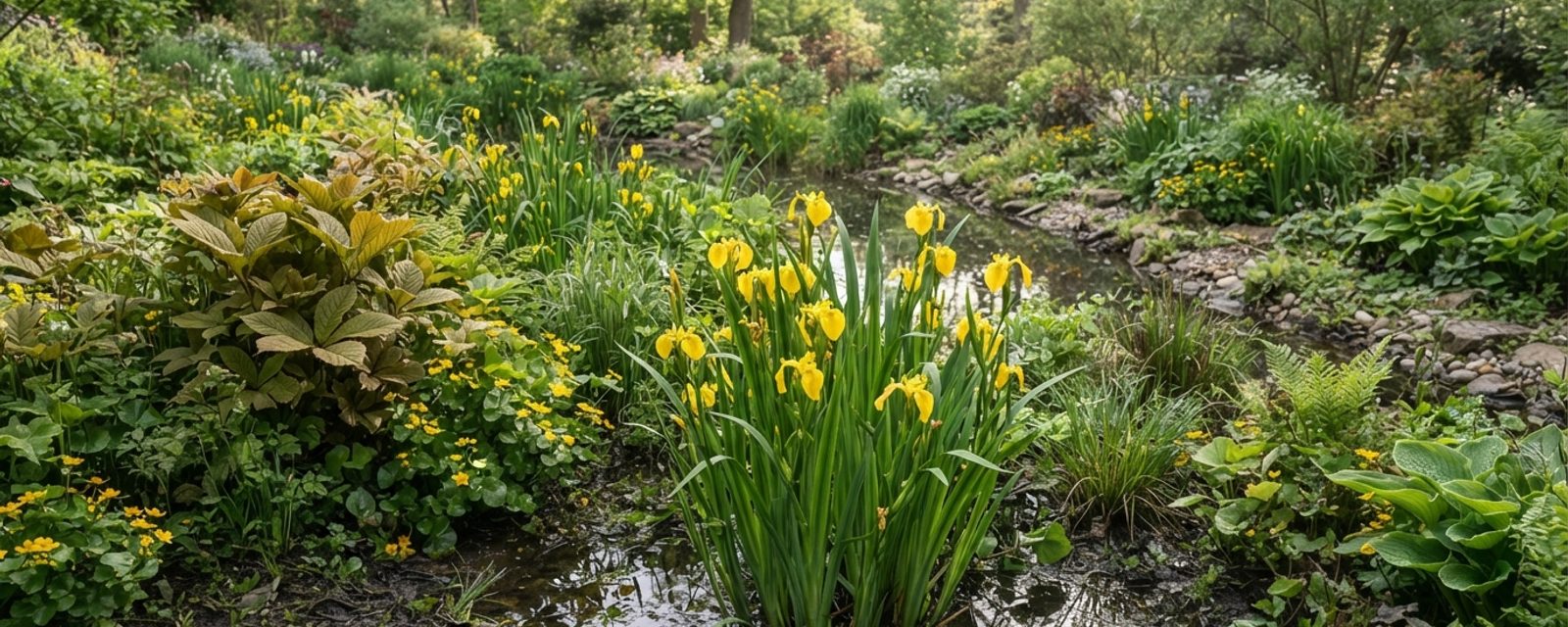
By the third week of February the puddle in the low corner of the border still hadn't gone. Not a boggy patch, not damp soil, actual standing water, a couple of centimetres of it, reflecting a grey Scottish sky over ground that had been "planted up" the previous spring with perennials chosen because a label somewhere said they liked clay. Most of them were gone by April, rotted at the crownThe base of a perennial plant where roots and shoots meet, often sold and planted as a ready-made dormant plant rather than grown from seed. Full definition →, because there's a world of difference between soil that's heavy and soil that's waterlogged, and almost nothing sold as generically "clay-tolerant" is bred to sit in the second kind.
Quick answer
For genuinely waterlogged clay, standing water, not just heavy going, Iris pseudacorus (yellow flag iris) is the best all-round pick: hardy, showy, and built for wet margins. Where space is tighter or you want groundcover rather than height, Ajuga reptans does the job instead, and where the wet patch gets full winter sun and you want structure rather than flowers, Cornus alba earns its place for the stems alone.
If the same low, wet corner is more use to you growing food than flowers, see the article on the best crops for heavy clay soil, which covers the structural problem with heavy clay, the wet-dry seasonal swing, and a simple drainage test, dig a 30cm hole and fill it with water; drained within a few hours means workable heavy clay, still full a day later means genuine waterlogging. That test matters here too: the plants below are chosen for the "still full a day later" scenario, not the merely sticky one.
"Clay tolerant" is not the same claim as "waterlogged tolerant"
Most clay-soil plant lists conflate two different problems. A plant that wants "moist but well-drained" ground needs consistent dampness with water still moving through the soil, it will suffocate and rot if the roots sit in standing water for weeks. A plant that's genuinely suited to "poorly-drained" ground is bred to cope with soil that stays saturated, with little air reaching the root zone, which is what a low corner of clay actually does through a Scottish winter. The five plants below all have real evidence behind them for that second, harder condition, not just the first. Hardiness is a separate rating worth knowing too: bands run from H1 (needs a heated greenhouse) to H7 (survives the coldest UK winters outdoors, below -20°C), so an H7 plant is never at risk from Scottish winter cold, while an H6The RHS's H1a–H7 scale for how much cold a plant can survive outdoors, H1a being tender indoor-only and H7 hardy anywhere in the UK. Full definition → plant copes with an ordinary winter but not the very worst of it.
The five picks
These are ornamentals with a genuine track record in ground that stays wet, not just heavy, ranging from true marginal/bog plants through groundcover to a structural shrub for winter interest.
1. Caltha palustris (marsh marigold)
Native to Britain and Ireland, and a genuine marginal and bog plant, it grows naturally at pond edges and in wet meadows, not just tolerated there, and it's rated for poorly-drained soil specifically. Low and spreading rather than tall, height and spread both sit in the 0.1–0.5m range, with bright yellow, buttercup-like flowers in spring that read well against still water or bare wet clay before other planting fills in. It's rated hardy to H7, the toughest UK hardiness band, so winter cold is never a limiting factor wherever it's planted. It tolerates acid, alkaline or neutral soil and takes loam as well as clay. Divide it in late summer or early spring, and cut back after flowering. Handle with gloves: the sap is an irritant and the plant is poisonous if eaten, worth knowing if there are children or grazing pets near the border.
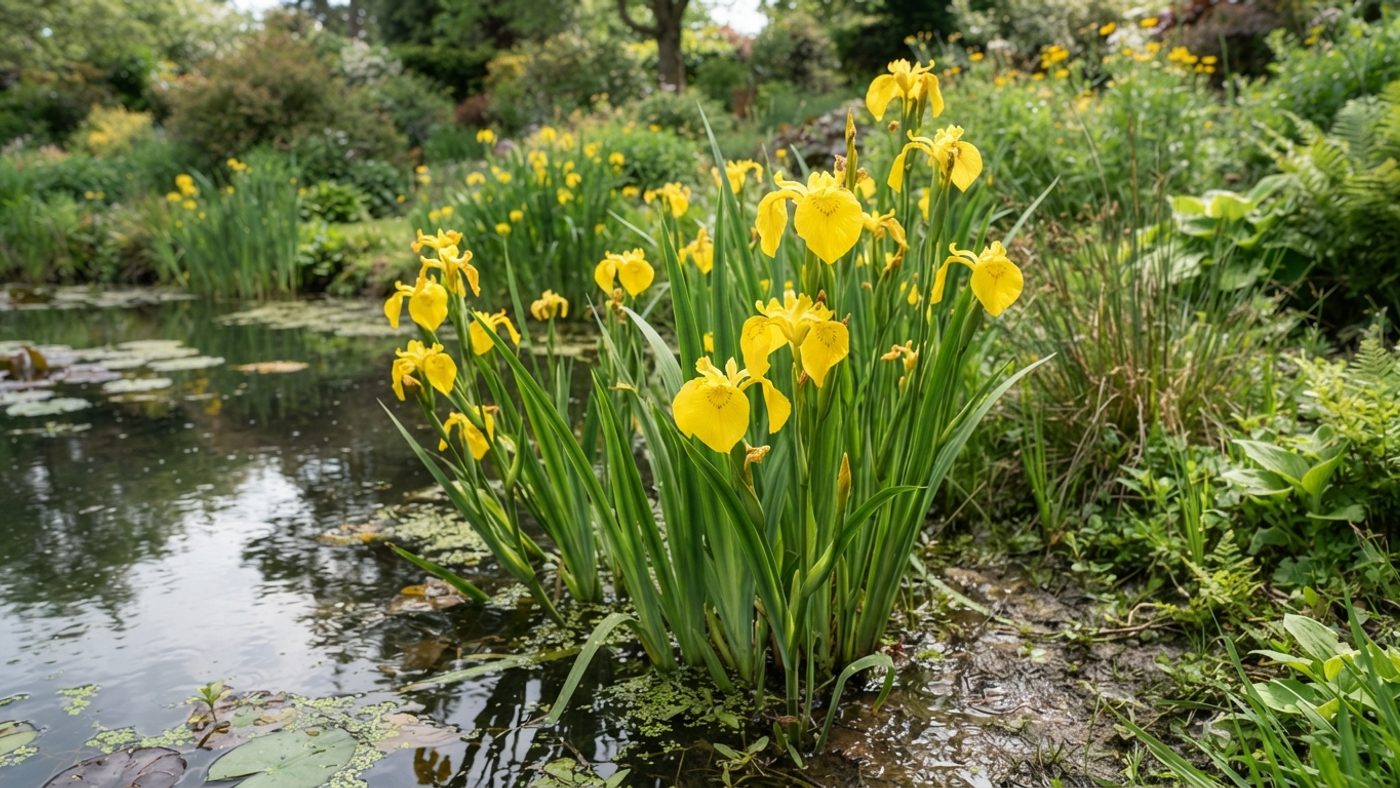
2. Iris pseudacorus (yellow flag iris)
The clearest case here, and another Britain and Ireland native, at home on real pond and stream margins as well as a wet border. It's rated for poorly-drained soil specifically, and named on both a curated wet-soils perennials list and a dedicated gardening-on-wet-soils resource. It's a substantial plant at 1–1.5m in both height and spread, rated H7, happy in clay or loam, in full sun or partial shade, and it flowers with the bold yellow blooms the common name promises. The real caveat: it's genuinely vigorous and spreads by rhizome, an underground stem that sends up new shoots as it creeps, rather than staying in one clump. In a contained wet corner that's an asset, it fills ground other plants won't touch, but near a small pond, ditch, or anything connected to a watercourse it can travel further than intended, so it needs siting with that in mind rather than planted and forgotten. It's tagged for acid soil specifically, worth checking against a soil test if the border's pH is unknown. Divide clumps from midsummer to early autumn, replanting straight into their flowering position, and cut back old flower stems once blooming ends.
3. Ligularia przewalskii
A tall, architectural perennial, rated for poorly-drained soil and listed on the curated wet-soils perennial list too. It reaches 1.5–2.5m in height with a narrower 0.5–1m spread, giving vertical structure that most wet-tolerant ornamentals don't offer, with deeply cut, dark-stemmed foliage and slim spires of yellow flowers. Rated H6, one band below the others here, so it copes with an ordinary UK winter but not the very hardest cold snap the H7 plants shrug off, worth mulchingA layer of material spread over the soil around plants to suppress weeds, retain moisture, and improve soil structure as it breaks down. Full definition → the crown in its first winter, especially on an exposed or inland site. Takes clay or loam and any soil pH. It can also draw slugs and snails, worth watching for on young growth in a permanently wet bed.
4. Ajuga reptans (bugle)
The most forgiving choice on this list, rated for both moist-but-well-drained ground and poorly-drained ground at once, useful if the wet patch has drier margins around it. It's low groundcover, 0.1–0.5m tall spreading to 0.5–1m, rated H7, and takes clay or loam. It also turns up separately among clay-soil groundcover recommendations, with multiple cultivarsA plant variety that arose or was bred under cultivation and is kept true by deliberate propagation, rather than a naturally occurring wild species. Full definition → available for foliage colour beyond the plain species, and takes any soil pH. Good for covering bare wet clay under taller plants like the iris or ligularia rather than standing alone as a feature.
5. Cornus alba (dogwood)
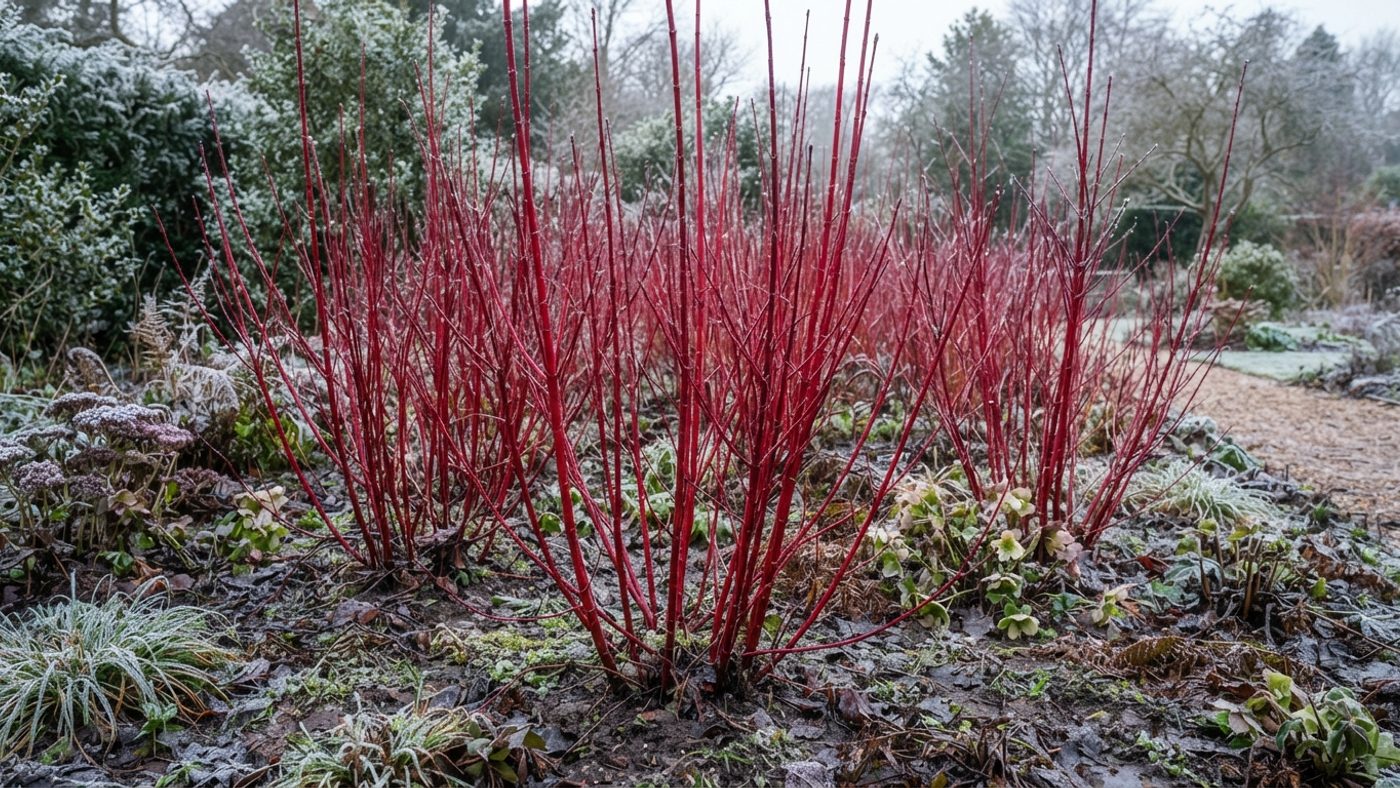
The one shrub on this list, native to East and North Asia rather than Britain. Its own record is tagged "Moist but well-drained" and "Well-drained" rather than "Poorly-drained," a genuinely weaker waterlogging claim than the four perennials above, resting instead on its named inclusion on both a wet-soils shrub list and the gardening-on-wet-soils resource. In return it offers something none of the perennials above do: structure and colour in the depths of a Scottish winter, with bare red stems that carry the garden through the darkest months, white late-spring flowers that pollinators use, and white berries after. Rated H7, tolerates any soil pH, and sizeable at 2.5–4m in both height and spread, so it needs room rather than a tight corner. Cut all shoots back to 5-7.5cm from the ground in late winter to mid spring, early-to-mid April is often the best balance between enjoying the display and getting good colour the following year, since older wood loses its colour as it matures. Left unpruned, the shrub still lives, but the strongest colour fades.
Comparison table
| Plant | Ultimate size (H x S) | Hardiness | Soil pH | Real caveat |
|---|---|---|---|---|
| Caltha palustris | 0.1–0.5m × 0.1–0.5m | H7 | Acid, alkaline or neutral | Poisonous if eaten; handle with gloves |
| Iris pseudacorus | 1–1.5m × 1–1.5m | H7 | Acid | Vigorous spreader, site away from watercourses |
| Ligularia przewalskii | 1.5–2.5m × 0.5–1m | H6 | Acid, alkaline or neutral | One hardiness band lower; watch for slugs and snails |
| Ajuga reptans | 0.1–0.5m × 0.5–1m | H7 | Acid, alkaline or neutral | Low-growing only, no height or structure |
| Cornus alba | 2.5–4m × 2.5–4m | H7 | Acid, alkaline or neutral | Weakest waterlogging evidence of the five; site slightly back from the wettest ground |
Siting the border, and what to leave out
Put the tallest, most water-tolerant plants, the iris and the ligularia, in the wettest, lowest part of the border where water genuinely stands, and use the ajuga as groundcover at the margins where the ground is damp but not submerged. The caltha works well right at the wet edge, close to where standing water is visible, and the dogwood is better sited slightly back from the worst of it, where its roots reach damp soil without sitting permanently underwater, since its wet-tolerance credentials are the weakest of the five. Check the site for wind exposure too, not just water: Ligularia's tall flower spikes and a young Cornus alba can both take a battering in an open, exposed spot, and much of Scotland is windier than the typical English garden this kind of plant list gets written for.
A grey, streaked or mottled subsoil under the topsoil is a good visual sign of the same waterlogging the digging-a-hole test confirms, that mottling is caused by iron in the soil reacting differently where air can and can't reach it, and it's worth a look while digging the planting hole regardless. When planting into ground this wet, set the crown slightly proud of the surrounding soil level rather than flush or sunk, since a crown sitting right at or below a waterlogged surface is exactly what rotted the perennials in the opening story.
None of the five straight species hold the RHS Award of Garden Merit, worth knowing if that's normally a first filter, though named cultivars can: Ajuga reptans 'Catlin's Giant' carries it, for one, so it's worth checking a specific cultivar's own listing before buying if AGMThe RHS's Award of Garden Merit: a UK-wide trials award for reliable performance, not a Scotland-specific recommendation. Full definition → status matters to you.
Rodgersia and Astilbe both turn up constantly in "plants for damp gardens" lists, but neither belongs in a genuinely waterlogged corner. Rodgersia's own growing guide states plainly that some rodgersias dislike waterlogged soil, they want consistently moist, improved ground with organic matter worked in, not standing water. Astilbe has the same problem: its own growing guide says astilbes like damp soil but don't like waterlogged conditions either. Both are excellent choices for permanently moist soil that still drains, keep them for a damp-but-not-flooded bed rather than the wettest spot in the garden.
Plant any of the five in spring or autumn, the standard window for hardy perennials and shrubs, when the ground is workable rather than frozen or baked hard, autumn is generally kinder in a genuinely wet spot, since the plant gets a full season to root in before its first summer.
A permanently wet clay corner is also genuinely good slug and snail ground, and standing water anywhere near a seating area can draw midges through a Scottish summer, worth bearing in mind when deciding how close to a path or patio to site the border, on top of the plant-by-plant caveats above.
Common questions
When should I divide these plants, and do they need much aftercare?
Caltha divides in late summer or early spring and is cut back after flowering. Iris pseudacorus divides from midsummer to early autumn, replanted straight into its flowering position, with dead foliage and old flower stems removed in autumn. Ajuga spreads on its own and rarely needs dividingPropagating a clump-forming perennial by digging it up and splitting it into several smaller pieces, each with roots and shoots attached. Full definition → for space. Ligularia and Cornus alba need little beyond an annual cut-back, Cornus alba's colour actually depends on it, since older stems lose their colour as they mature, and cutting hard back each spring keeps young, brightly coloured stems coming through.
Can I improve drainage instead of choosing waterlogging-tolerant plants?
In a genuinely low, waterlogged corner, improving drainage usually means real engineering, raised beds, French drains, or regrading the ground to a lower point it can drain to, rather than a soil amendment. Digging in compost helps ordinary heavy clay by opening up the structure so water can move through more freely, but it doesn't work here, because the ground around and beneath the problem spot is just as saturated, so water stays put regardless of what's mixed into the top layer. Choosing plants suited to the existing conditions is often the more practical route for a single problem corner.
Will yellow flag iris take over my whole garden?
It spreads by rhizome and can be vigorous in consistently wet ground, but it's manageable in a contained bed with occasional division. The real risk is next to a pond, ditch, or watercourse it can reach, where it should be sited with more caution or kept in a planted container submerged at the margin.
Are any of these plants safe for a garden with children or pets?
Caltha palustris is poisonous if eaten and its sap can irritate skin, so gloves are worth using when planting or dividing it, and it's worth siting away from areas where small children play unsupervised. The other four don't carry the same specific warning.
What about a wet spot that gets deep shade rather than sun?
None of the five picks here are shade specialists, Iris pseudacorus and Ligularia przewalskii take partial shade, but full sun brings out the best flowering in most of them. A shaded, waterlogged corner is a genuinely harder combination and worth treating as a separate question rather than assuming these picks will perform the same way.
Sources
11 sources, recorded with what each was used for
- RHS: Caltha palustris: Moisture tag, hardiness, size, native status, poisonous/handling note, AGM status
- RHS: Iris pseudacorus: Moisture tag, hardiness, size, native status, growing conditions, AGM status
- RHS: Ligularia przewalskii: Moisture tag, hardiness, size, AGM status
- RHS: Ajuga reptans: Moisture tags, hardiness, size, AGM status
- RHS: Ajuga reptans 'Catlin's Giant': AGM status of a named cultivar
- RHS: Cornus alba: Moisture tags, hardiness, size, native status, ornamental features, AGM status
- RHS: How to grow winter stem colour dogwoods: Pruning group 7 timing and method, why older wood loses its colour
- RHS: Perennials for wet soils: Confirms Caltha palustris, Iris pseudacorus, and Ligularia przewalskii as suited to wet soils
- RHS: Gardening on wet soils: Confirms Iris pseudacorus and Cornus alba as suited to wet soils
- RHS: Rodgersia: States some rodgersias dislike waterlogged soil, prefer consistently moist organic-rich soil
- RHS: How to grow astilbe: States astilbes like damp soil but don't like waterlogged conditions