
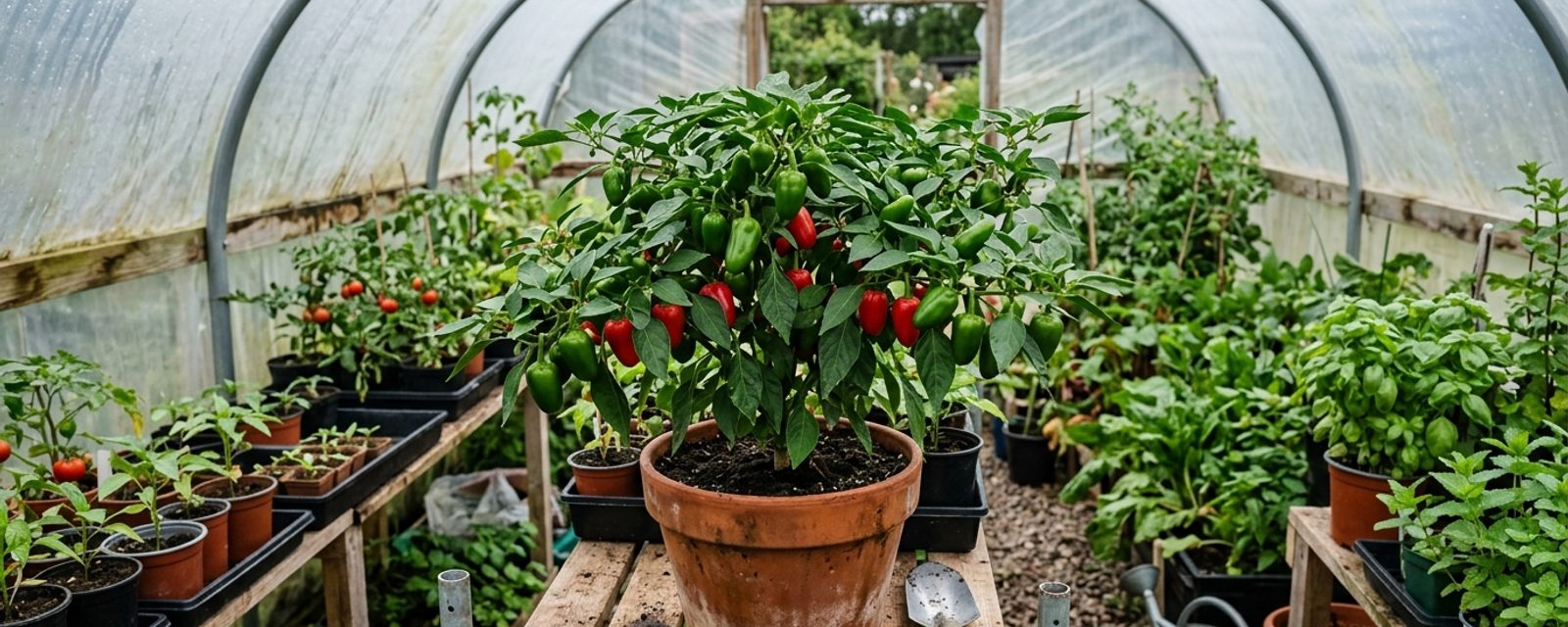
A pepper plant only sets fruit once its flowers are pollinated in warm, still air, and the minimum for reliable fruit set sits around 12°C, with growth really taking off above 15°C. Below that threshold, flowers form but drop before they've been pollinated at all. That single physiological fact is what decides almost everything else about growing peppers in Scotland: the plant itself isn't fussy about soil or exposure, but it needs sustained warmth a Scottish garden rarely provides outdoors, which is why variety choice here comes down to which plant makes the best use of a greenhouse, polytunnel or large coldframe rather than which one is toughest outside.
Quick answer
Redskin is the best all-round pick for a Scottish greenhouse or polytunnel: compact at 45cm, sized for a container, and the only one of five AGMThe RHS's Award of Garden Merit: a UK-wide trials award for reliable performance, not a Scotland-specific recommendation. Full definition →-labelled pepper varieties whose Award of Garden Merit is confirmed on its own individual plant page as well as the general one. Go for Mohawk instead if space is even tighter (a true dwarf built for a single patio pot), Corno di Toro Rosso if you have room to spare for a long, tapering fruit, or Bianca for its genuine disease resistance. Jolly Giallo is the one yellow-fruited option worth growing for that reason alone.
Why space, not season, is the real decision here
The full growing guide already covers why cover is close to essential for peppers in Scotland. Once that's accepted, the constraint that actually shapes variety choice is how much bench, growing-bag or pot space you can give up to it. Greenhouse and polytunnel floor space is usually scarcer than garden ground here, and that's the lens every variety below gets judged through. Every AGM mentioned below is a UK-wide award, not a Scottish recommendation; it confirms garden merit across the UK generally, not that a variety was ever tested against Scotland's shorter, cooler summer specifically.
The seven varieties worth comparing
Six sweet pepper varieties are named on the main growing page, five of them carrying the Award of Garden Merit there. A seventh, Gypsy, doesn't appear on that page at all but is worth a look for a trait none of the other six have. Every variety below was checked against its own individual plant page, not just the general page's summary. That turned up a real, site-wide discrepancy worth stating plainly before the comparison: the general growing page marks Mohawk, Corno di Toro Rosso, Topepo Rosso and Bianca all as AGM holders, but not one of those four varieties' own, individual plant pages carries the Award of Garden Merit anywhere on the page. Redskin is the exception: its own page states outright that "the Royal Horticultural Society has awarded Sweet Pepper 'Redskin' with an Award of Garden Merit." Jolly Giallo and Gypsy are consistent the other way: no AGM on either their general-page listing or their own pages. Which version is correct for the other four isn't settled here, since it isn't something that can be resolved from outside RHS's own records. It's worth knowing before treating every AGM claim below as equally confirmed.
| Variety | AGM status | Fruit | Height | Standout trait |
|---|---|---|---|---|
| Redskin | AGM, confirmed on its own page | Blocky, ~8cm, green ripening red | 45cm | Compact, container-sized, most reliably AGM-confirmed |
| Mohawk | AGM on general page only | Bell-shaped, ~9–10cm, dark green to yellow | 50cm, dwarf, semi-trailing | Smallest footprint, built for a single patio pot |
| Corno di Toro Rosso | AGM on general page only | Tapering, up to 25cm, thin skin | 60cm | Largest fruit, independently named by RHS and Gardener's World |
| Bianca | AGM on general page only | Large bell, cream ripening scarlet | 60cm | Tobacco mosaic virus resistance; dense foliage shields fruit from sunscald |
| Topepo Rosso | AGM on general page only | Round, pimento-type, 7–8cm, blood red | 60cm | Very thick, crisp flesh bred for stuffing; Italian heirloom |
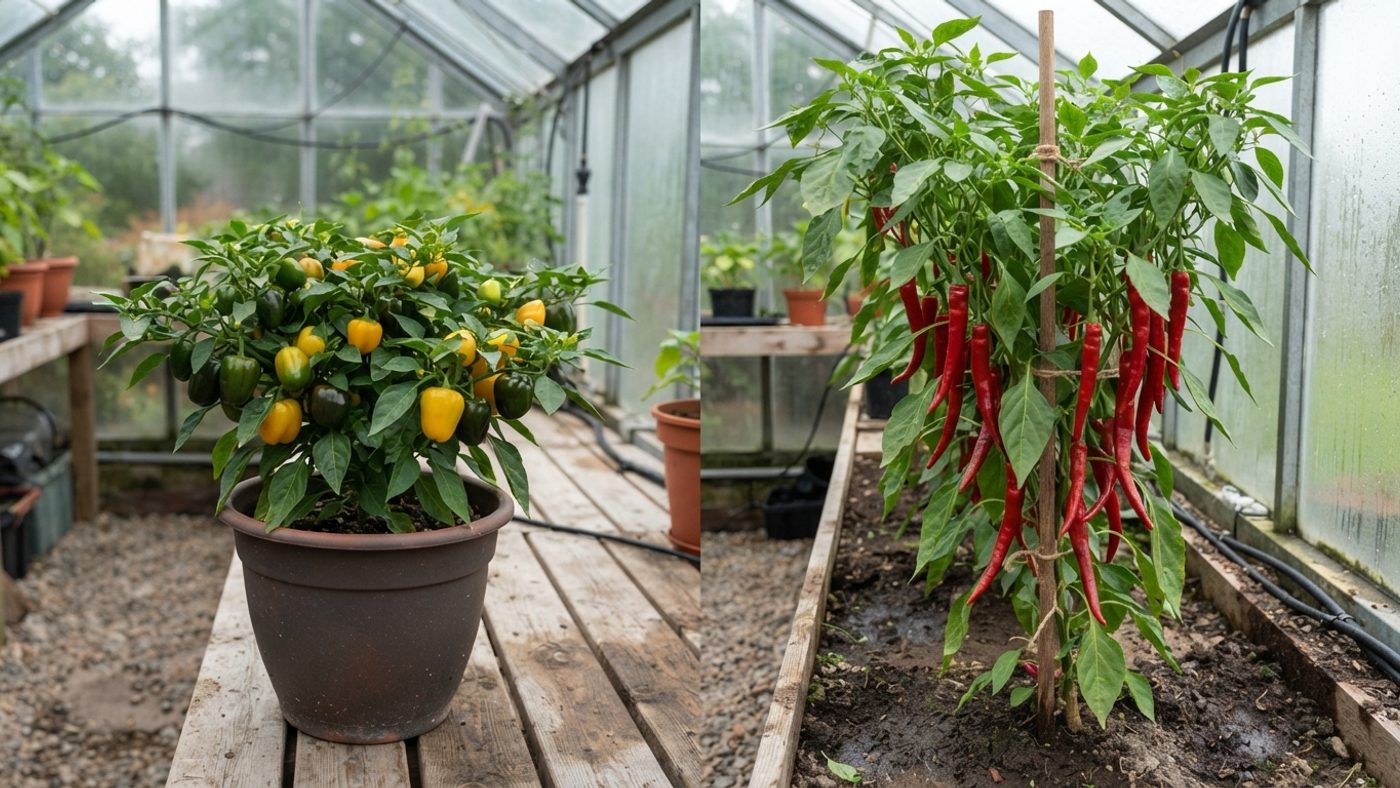
| Jolly Giallo | No AGM on either page | Square, 12cm, golden yellow | 50cm | Only yellow-fruited pick of the seven |
| Gypsy | No AGM | Conical, pale green ripening red | 50cm | Earliest to set fruit, but needs warm conditions to do it |
Fruit colour on Mohawk gets described slightly differently between sources: the RHS page says the fruit ripens from dark green to bright yellow, while Gardener's World describes green fruit ripening to orange. Both agree on everything else, including the dwarf, semi-trailing habit and its fit for containers, so this reads as a minor colour-description gap between two otherwise-agreeing sources rather than a real contradiction.
Rethinking three varieties the growing guide leaves out
The growing guide currently features only Redskin, Mohawk and Corno di Toro Rosso, on the reasoning that Topepo Rosso, Bianca and Jolly Giallo don't add a distinguishing trait beyond those three. Checking each variety's own page rather than the general summary doesn't support that:
- Topepo Rosso isn't a bigger or smaller version of the other picks. It's a different fruit shape entirely, round rather than blocky or tapering, with flesh described as "very thick and crisp," and it's the variety framed around a specific use: stuffing, the classic Italian preparation for this pepper shape. Its own page also gives a pinch-out height of 20cm, ten centimetres earlier than the 30cm figure given for pinching peppers generally, worth knowing if you're growing this variety specifically.
- Bianca carries a real, named disease resistance the general page doesn't mention at all: resistance to tobacco mosaic virus. Its own page also credits its dense foliage with shielding fruit from sunscald, a genuine problem for any pepper ripening in a sunny greenhouse. Neither trait shows up anywhere in the general growing page's six-variety summary.
- Jolly Giallo is the only yellow-fruited variety among all seven named here: every other pick ripens through shades of red, orange or cream-to-scarlet. Its square shape and named July-to-October harvest window are also both concrete, sourced details the growing guide's exclusion note didn't weigh.
None of this means the original three picks are wrong. Redskin's clean AGM confirmation and container size still make it the strongest all-round choice below. It means "adds nothing beyond the existing picks" wasn't actually true for any of the three once their own pages were read.
A seventh option worth knowing about: Gypsy
Gypsy doesn't appear on the general peppers page at all, and turned up only via Gardener's World's own growing guide. Its own plant page describes it as "early cropping but needs warm conditions to do well," genuinely double-edged for Scotland. Setting fruit earlier than the others matters in a shorter growing season, but the same page's hardiness ratingThe RHS's H1a–H7 scale for how much cold a plant can survive outdoors, H1a being tender indoor-only and H7 hardy anywhere in the UK. Full definition → (H2, tolerating down to 1°C, against H1C for every other variety here, rated only down to 5–10°C) suggests slightly better cold tolerance too, while the "needs warm conditions" caveat is a direct warning not to expect that early cropping outdoors or in an unheated space. It doesn't appear anywhere in the growing guide's own sourced variety data, so treat it as a genuine find worth trialling rather than an established recommendation.
Which one for your situation
Best all-round: Redskin. Compact at 45cm, sized for a single container or growing bag, and the one variety here whose AGM is confirmed on its own individual page rather than only the general summary.
Tightest space: Mohawk. A true dwarf with a semi-trailing habit recommended for a single patio pot, the pick if you're working with one windowsill or one greenhouse corner rather than a bench.
Most room to spare: Corno di Toro Rosso. Its 25cm tapering fruit and 60cm plant height need real bench space, but it's the one variety named independently by both RHS and Gardener's World, and needs cane support as it grows, so budget for that if you choose it.
Disease pressure or a very sunny greenhouse: Bianca. Tobacco mosaic virus resistance and sunscald-shielding foliage are traits none of the other picks here carry.
Want colour variety: Jolly Giallo. The only yellow pepper on this list, with a named July-to-October harvest window.
Greenhouse and polytunnel floor space, not garden ground, is the real constraint for most Scottish growers with peppers, so it's worth weighing spacing directly: Mohawk and Redskin can go in at 30cm centres, against 38–45cm for Corno di Toro Rosso, Bianca and Topepo Rosso. That's not a sourced ratio, just the spacing figures read straight, but it's a meaningfully tighter footprint in both directions across a bench or a run of growing bags, worth having in mind before committing limited cover space to the larger-fruited picks.
Soil pH
No UK source publishes a soil pH figure for peppers specifically, so this is left honestly unresolved rather than guessed. The closest published figure found is from Ohio State University's extension service, which states peppers prefer "a little acidic" soil with a pH of 6 to 6.8. That's a US extension source, not a UK or Scotland-specific one, so treat it as a rough, corroborating steer rather than an established figure. If your soil already grows tomatoes or potatoes well, it's very likely already in range for peppers too.
Is there any Scottish trial data behind these picks?
No. None of the AGM awards or named traits above come from a Scottish trial: they're UK-wide RHS assessments, not Scottish-specific ones. RHS is currently running an ongoing multi-site sweet pepper trial (Bridgewater in Greater Manchester, Rosemoor in Devon, and Wisley in Surrey, assessing around 48 cultivarsA plant variety that arose or was bred under cultivation and is kept true by deliberate propagation, rather than a naturally occurring wild species. Full definition →), but the results aren't published yet and the trial sites are all in England. No Scottish institution, whether the James Hutton Institute, SASA or SRUC, publishes variety trial data for sweet peppers; their trial work in this space is concentrated on arable crops like cereals and potatoes. Which variety of pepper is genuinely best-suited to Scotland's shorter, cooler growing season, as opposed to which one holds a UK-wide award, remains an open question no published source answers yet.
Pests and problems these varieties still face
Variety choice doesn't change which pests a pepper plant is exposed to under glass. Aphids and glasshouse whitefly target shoot tips and leaf undersides on any of the seven varieties above; grey mould and red spider mite both thrive in the same humid or dry greenhouse conditions regardless of which pepper is growing in it. Blossom end rot, caused by irregular watering rather than a pest, is worth watching for on any variety, though Bianca's own page additionally lists cutworms, flea beetles and bacterial spot among its susceptibilities, none of them sourced as risks for the other six varieties here, so that's specific to Bianca rather than a pepper-wide concern.
Common questions
Do Topepo Rosso and Bianca actually carry the Award of Garden Merit?
The general peppers growing page says yes for both. Their own, individual plant pages carry no AGM mention anywhere, which is also true for Mohawk and Corno di Toro Rosso. Only Redskin's AGM is confirmed on both its general listing and its own page. Which page is right for the other four isn't something readers outside RHS can settle, so it's stated here as found rather than resolved either way.
What's the best pepper variety for a small Scottish greenhouse?
Mohawk, if you're down to a single pot or windowsill: it's a true dwarf named specifically for patio containers. Redskin is the best choice once you have a little more room, since it combines a compact 45cm habit with the most cleanly confirmed AGM of any variety here.
Is there a yellow pepper variety worth growing in Scotland?
Jolly Giallo is the only yellow-fruited pick among the seven varieties compared here: square-shaped, mild and sweet, cropping from July to October. It doesn't carry an AGM on either page, but that's consistent rather than a discrepancy.
Which variety copes best with a cool Scottish summer?
None of the seven are bred specifically for cold tolerance, since none carry Scottish trial data. Gypsy's own plant page rates it H2 (hardier than the H1C rating every other variety here carries) and describes it as early-cropping, which suits a shorter season, but the same page warns it "needs warm conditions to do well," so treat it as a genuine option to trial, not an established cold-tolerant pick.
Sources
11 sources, recorded with what each was used for
- Peppers: Grow Your Own: General variety list (six named varieties, AGM status as shown on that page), sowing/planting/care baseline
- Capsicum annuum 'Redskin': Own-page AGM confirmation, height, hardiness rating
- Capsicum annuum 'Mohawk': Dwarf/semi-trailing habit, fruit colour, absence of AGM mention
- Capsicum annuum 'Corno di Toro Rosso': Fruit size, cane-support note, absence of AGM mention
- Capsicum annuum 'Bianca': Tobacco mosaic virus resistance, sunscald-shielding foliage, susceptibility list, absence of AGM mention
- Capsicum annuum 'Topepo Rosso': Round pimento fruit shape, stuffing use, 20cm pinch-out height, absence of AGM mention
- Capsicum annuum 'Jolly Giallo': Square yellow fruit, July-October harvest window, absence of AGM mention
- Capsicum annuum 'Gypsy': Early-cropping/warmth-needing trait, H2 hardiness rating, absence of AGM mention
- Sweet Pepper Trial: Confirms the ongoing 2025 multi-site trial, ~48 cultivars, results not yet published, no Scottish trial sites
- How to Grow Peppers: Names Gypsy as a variety the general page omits; independently describes Mohawk, Redskin and Corno di Toro Rosso; Mohawk fruit-colour detail that differs slightly from RHS's own page
- Vegetable Garden: Peppers (HYG-1618): Pepper pH preference (6-6.8), used as a non-UK corroborating figure only, since no UK source publishes one