
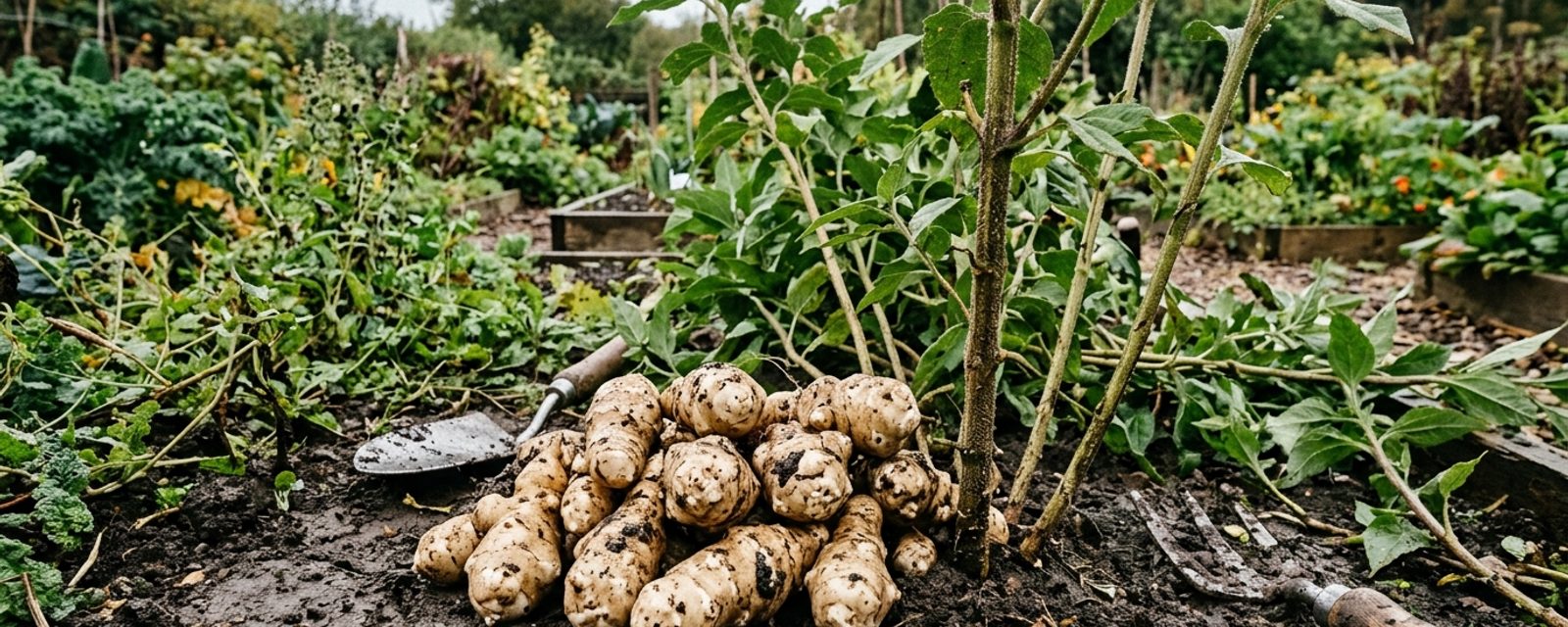
If you've had Jerusalem artichokes in the ground for more than a season, you've probably faced one of two problems already. Either the patch has quietly spread past its original edges and you're now digging tubersA swollen underground stem or root a plant uses to store energy, which can also grow into a new plant, the classic example being a potato. Full definition → up through a path or a neighbouring bed, or you've lifted a fork-load of knobbly, twisted tubers and wondered whether the smoother-skinned kind everyone raves about actually exists, and whether it would have saved you twenty minutes at the peeling board.
Quick answer
Dwarf Sunray for an exposed plot or a container, less staking and easier to contain. Fuseau if you want a windbreak or the biggest tubers and don't mind the extra height.
Both problems trace back to the same decision: which variety went in the ground, and whether that choice matched what you actually needed from a permanent planting. Jerusalem artichoke isn't a crop you rotate round the plot each year the way you would beans or brassicasThe cabbage family: cabbage, kale, broccoli, cauliflower, Brussels sprouts, kohlrabi, swede, turnip and more, sharing the same pests, diseases and rotation rules. Full definition →: it regrows from any tuber piece left in the soil, so most growers end up choosing a spot once and living with it for years, which is what this article is actually about. For planting depth, mounding, staking technique and pruning for wind, see the full growing guide.
What Scottish trial data actually exists
Before comparing varieties, it's worth being straight about the evidence base. No Scottish institution, not the James Hutton Institute, not SASA, not SRUC or Farm Advisory Service Scotland, publishes trial data comparing Jerusalem artichoke varieties, or indeed much on this crop at all.
What that means practically is that a Scotland-specific recommendation has to be built from general UK agronomy that is genuinely well established (this crop is very hardy, and tubers survive in the ground through winter) combined with reasoning about which trait matters more on an exposed, windy plot.
Dwarf Sunray vs Fuseau
Only two named varieties, Dwarf Sunray and Fuseau, turn up consistently across UK growing guides. A knobblier, higher-yielding cultivarA plant variety that arose or was bred under cultivation and is kept true by deliberate propagation, rather than a naturally occurring wild species. Full definition → called Gerard is mentioned in passing elsewhere, but with too little detail published anywhere to compare it properly, so it's left out below rather than guessed at.
| Dwarf Sunray | Fuseau | |
|---|---|---|
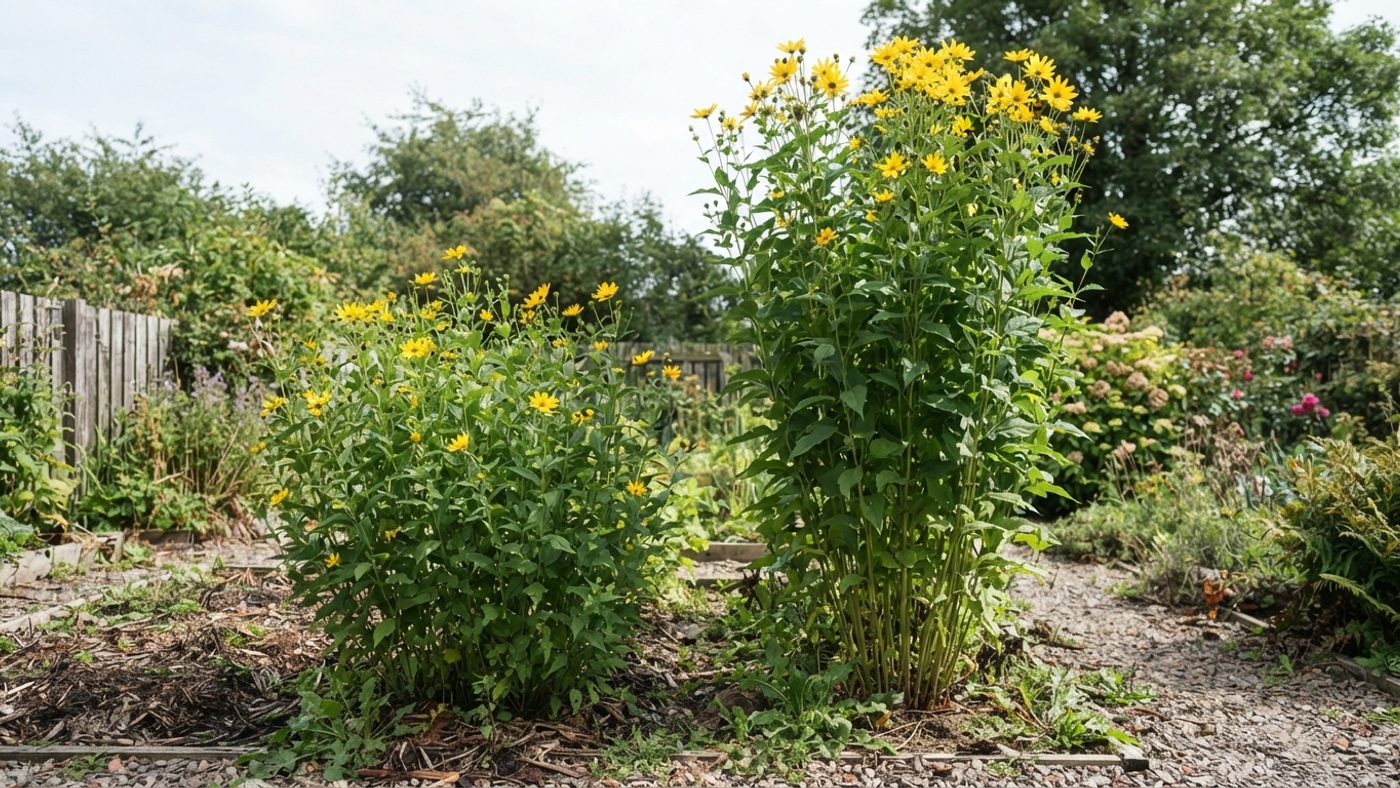
| Height | 120-150cm | 2m or more |
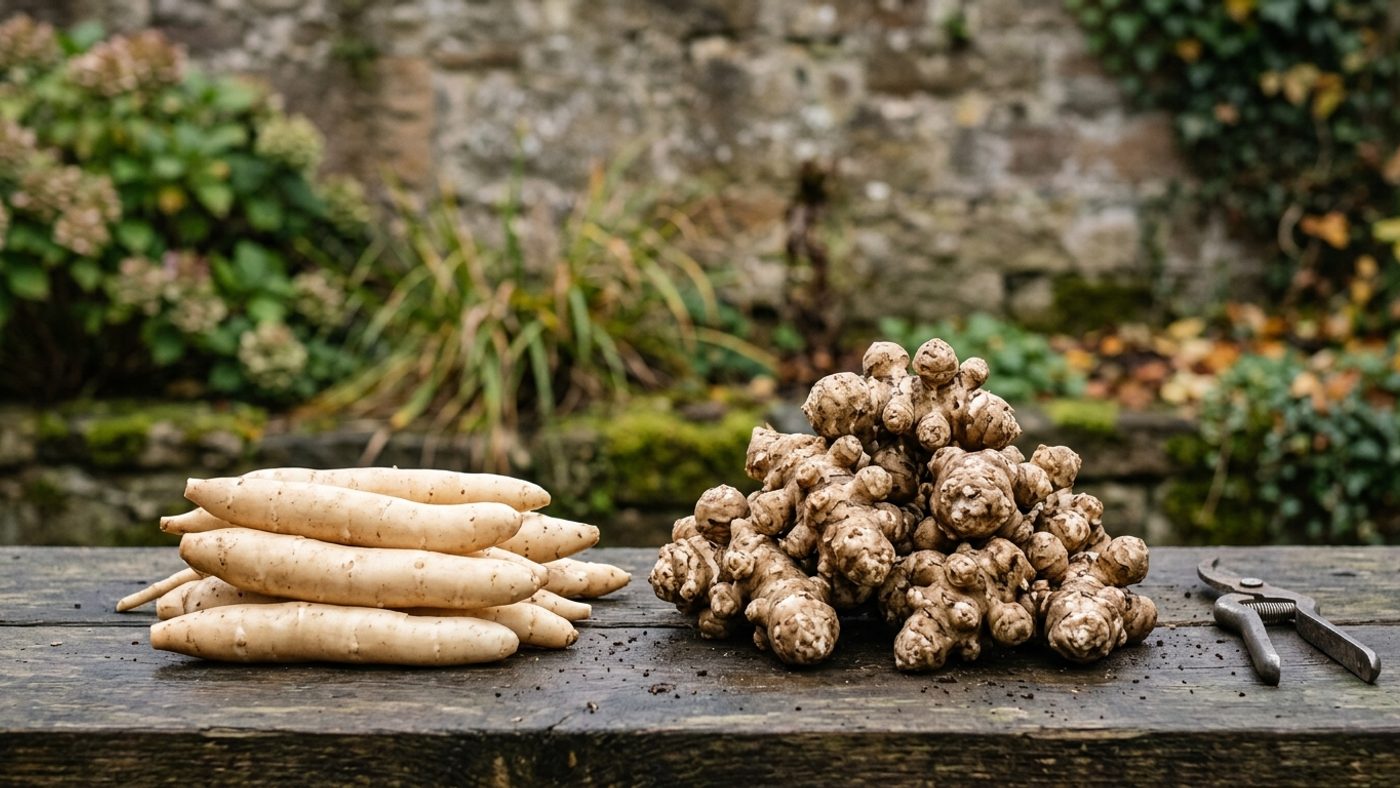
| Tuber shape | Long, slender, smooth pale skin | Larger, rounder, smooth skin; more flesh per tuber for less peeling |
| Peel ease | Easy (smooth skin) | Easy (smooth skin) |
| Staking/wind resistance need | Lower: shorter growth needs less support | Higher: tall growth is more exposed; pruning stems to 1.5m on exposed sites prevents wind damage |
| Windbreak value | Limited, given the shorter height | Better: the taller of the two makes a more effective windbreak |
| AGMThe RHS's Award of Garden Merit: a UK-wide trials award for reliable performance, not a Scotland-specific recommendation. Full definition → award | None | None |
Neither variety holds an RHS Award of Garden Merit (AGM), the badge given to plants judged to perform reliably in UK conditions. That's likely because Jerusalem artichoke has never had an AGM trial run against it at all, a crop the award scheme hasn't reached rather than one that was assessed and passed over, though no source states that outright, so treat it as a reasonable reading rather than a confirmed fact.
Both varieties share the smooth-tuber peeling advantage over the knobbly shape more typical of the species generally, so peel-ease doesn't distinguish between them: it distinguishes them jointly from other, less-refined stock.
Reading the table against a permanent site
The table above is really a multi-year commitment, not a one-season choice, given how hard this crop is to move once planted. On an exposed plot, Dwarf Sunray's lower stature means less staking and mounding to maintain every year for as long as the bed stays in that spot, a real advantage where Fuseau's extra height, and the wind-pruning it needs on exposed ground, would otherwise be a recurring task. Conversely, if the aim is to eat a substantial amount of tuber from a bed you won't be able to clear easily, Fuseau's larger tubers and smooth skin reduce the peeling workload across a bed that isn't going anywhere.
If windbreak function is the actual goal, screening a more tender crop or an exposed corner of the plot, Fuseau's height does that job in a way Dwarf Sunray, topping out at around three-quarters of Fuseau's minimum height, cannot.
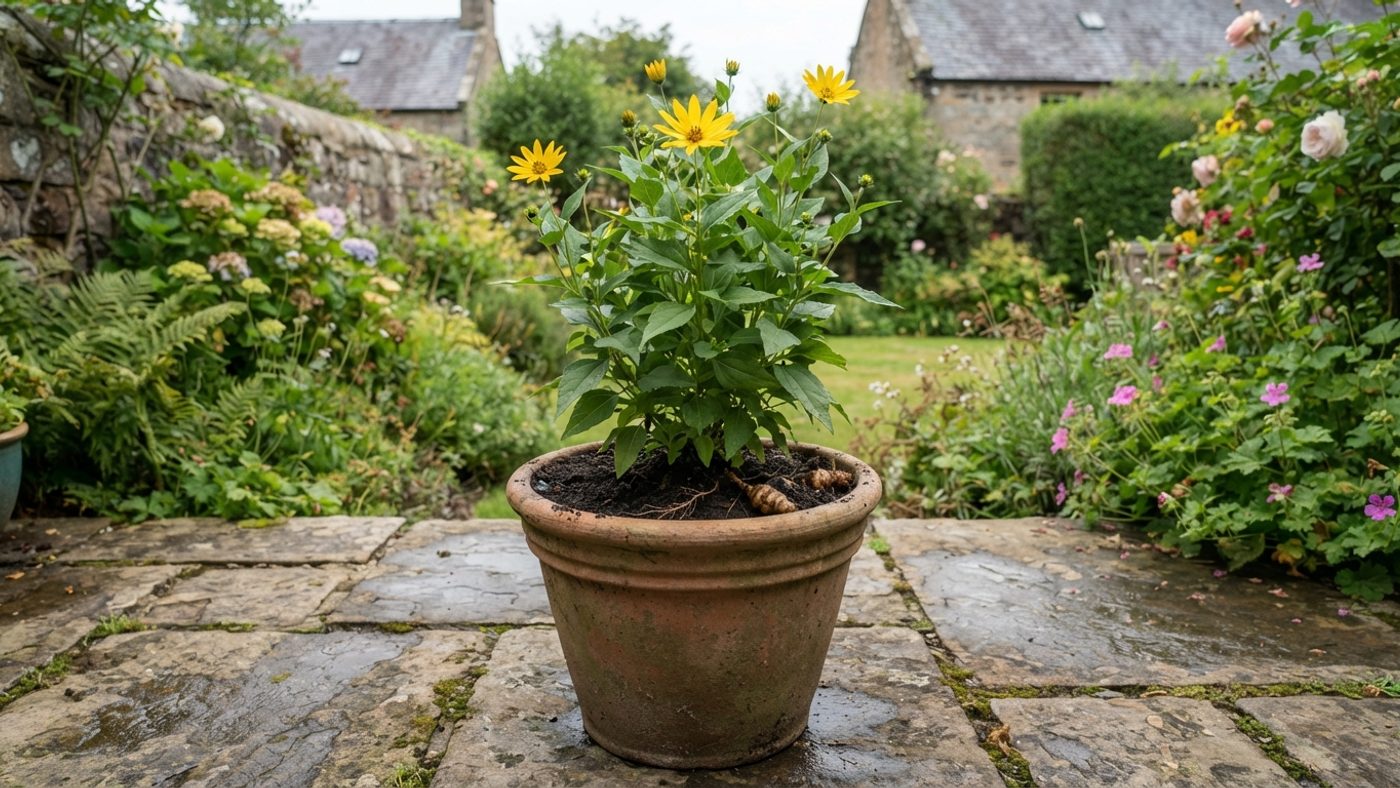
Neither variety solves the spread problem on its own. Growing Jerusalem artichoke in a container is one way to contain it on a smaller plot. A container's limited root room slows growth more for a variety that would otherwise reach 2m or more than for one that tops out around 150cm, so Dwarf Sunray copes better with the restriction and is the more practical choice of the two where containment, not windbreak, is the goal.
Soil pH: the honest gap
None of RHS, Garden Organic or Gardener's World publish a soil pH figure for Jerusalem artichoke. What is published instead is a general preference for moderately fertile, moisture-retentive soil that isn't prone to waterlogging, since tubers can rot in wet ground: worth checking drainage on a heavier clay plot before committing a bed you won't easily move.
Row spacing: two real, unresolved figures
Row spacing is another point where sources genuinely disagree rather than one being wrong:
| Source | Within the row | Between rows |
|---|---|---|
| RHS | 30cm | 1m if you need access, or as little as 30cm for a dense block you won't walk through |
| Gardener's World | 30cm | 1.5m, given as a standard figure |
Both are real published figures from different sources, so use whichever fits your plot: the tighter figures if you won't need to walk between rows, the wider ones if you will. For full spacing guidance alongside planting depth and timing, see the growing guide.
Pests and disease relevant to variety siting
Jerusalem artichoke is a comparatively robust crop with few serious problems, but two are worth weighing into where, and for how long, a variety sits in the ground. Slugs and snails can nibble new shoots in spring and can eat into tubers left underground over winter, see slugs and snails. Since the whole point of leaving tubers in the ground through a Scottish winter is to use the soil as storage, that slug risk runs for as many months as the tubers stay there, not just the growing season. Sclerotinia, a fungal disease that survives in soil for long periods, is a confirmed problem on this crop, see sclerotinia. It's not a reason to avoid the crop, most beds never see it, but because it lingers in soil for years once present, it's worth weighing before committing a permanent bed rather than discovering it after the fact.
Storage: the ground is the store
Whichever variety is grown, storage works the same way. Tubers don't store well once lifted (about a fortnight, refrigerated in a sealed bag), so the practical method is leaving tubers in the ground and lifting only what's needed through late autumn and winter. Frost is reported to improve flavour, which makes a Scottish winter's own cold ground an advantage rather than something to work around. Worth planning around, though: a hard freeze or waterlogged spell can make the ground briefly unreachable, so it's worth lifting a batch to keep in the fridge before a prolonged cold snap rather than relying on being able to dig at short notice. No source compares yield or flavour between Dwarf Sunray and Fuseau specifically. Inulin, the carbohydrate that makes these tubers filling without spiking blood sugar the way potatoes do, is also what causes digestive wind, especially in large portions; starting with small amounts, cooking with lemon juice, and harvesting later in the season are all noted as things that can help with this.
Common questions
Which Jerusalem artichoke variety is easiest to peel?
Both Dwarf Sunray and Fuseau have smooth-skinned tubers that are easier to peel than the knobblier shape typical of the species generally. Neither has a documented edge over the other on this specifically.
Do I need to stake Jerusalem artichokes in Scotland?
Pruning stems down to 1.5m on exposed sites prevents wind damage, and that applies more to the taller Fuseau (2m+) than to the shorter Dwarf Sunray (120-150cm). No Scotland-specific staking guidance exists, but on an exposed or coastal plot, that general advice is worth following rather than waiting to see if wind damage happens.
Will Jerusalem artichoke take over my plot?
It regrows from any tuber piece left in the soil. The usual advice is a three-year rotationMoving each crop family to different ground each year, on a multi-year cycle, so pests and diseases that build up in soil don't get a repeat host. Full definition →, though many growers instead site it permanently, for example as a windbreak, rather than fight the regrowth.
Is there a Scottish-specific variety recommendation?
No Scottish institution publishes trial or variety-performance data for this crop, so no. The comparison above is built from RHS's and Gardener's World's general UK growing information, reasoned through against Scotland's known conditions of exposure and wind.
What soil pH does Jerusalem artichoke need?
No figure is published anywhere for Jerusalem artichoke specifically.
Not sourced from any authority above, but disclosed for clarity: the staking-burden-vs-windbreak-value comparison, the container-growing recommendation for Dwarf Sunray over Fuseau, and the framing of variety choice against permanent siting are GrowScotland's own synthesis of the sources below, not drawn from any external authority.
Sources
3 sources, recorded with what each was used for
- RHS: Jerusalem artichokes, grow your own: Variety names and traits (Dwarf Sunray, Fuseau), row spacing, soil siting advice, sclerotinia and slug/snail pest confirmation, storage, hardiness and wind-pruning advice, container growing, frost improving flavour, and the digestive-wind mitigations (small quantities, cooking in lemon juice, harvesting late in the season)
- Gardener's World: Fact file, Jerusalem artichoke: The 1.5m row-spacing figure and the specific fortnight refrigerated storage duration
- Garden Organic: Jerusalem artichoke FAQ: The regrowth-from-tuber-fragments behaviour and the three-year rotation recommendation