
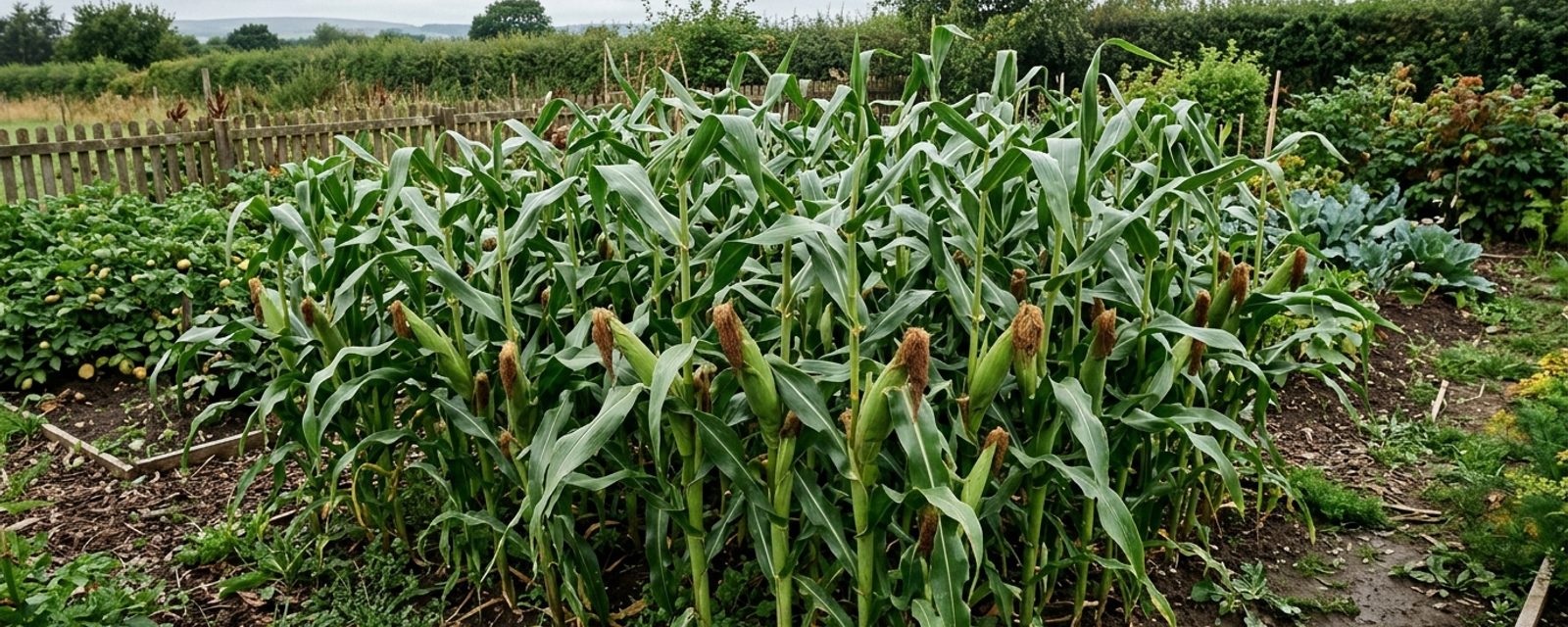
Sweetcorn is one of the trickiest crops on a Scottish plot. General advice for the crop opens with "long, hot summers are ideal for sweetcorn," a description a typical Scottish summer rarely matches. That gap between what the crop wants and what a Scottish garden can offer is exactly why variety choice matters more here than it does for something forgiving like courgettes: pick the right one and you'll get ripe cobs by September; pick the wrong one and you're left with plants that never quite finish.
Quick answer
Earlibird is the best overall pick for Scotland, it's the earliest-maturing Supersweet variety and copes well with cold soil at germinationA seed sprouting: breaking dormancy and putting out its first root and shoot, given the right warmth and moisture. Full definition →, which is usually the first thing that goes wrong here. Choose Lark instead if germination itself is the problem (it's the most reliable of the group in cold soil), and choose Rising Sun or Northern Xtra Sweet if your issue is a consistently cool, poor summer rather than a cold spring.
Cold soil and a poor summer are two different problems
It's tender (frost-sensitive, sown indoors mid-to-late spring and not planted out until frost risk has passed, check regional frost dates for your area), it needs full sun to ripen its cobs at all, and it's wind-pollinated, which is why it's grown in blocks rather than rows, a decision that matters more than variety and is covered in full in the growing guide. None of that changes no matter which variety you plant. What does change between varieties is how they handle the two failure modes a Scottish season throws at them: cold soil at sowing time, and a summer that never really warms up. Those aren't quite the same problem, cold soil mostly affects germination and early establishment, while a poor summer affects whether cobs fill out and ripen at all, and the varieties below aren't all bred to solve the same one.
Variety comparison
| Variety | AGMThe RHS's Award of Garden Merit: a UK-wide trials award for reliable performance, not a Scotland-specific recommendation. Full definition → | Sweetness type | Cob size / count | Cold/cool-season trait |
|---|---|---|---|---|
| Earlibird | General page only, see below | Supersweet | 1–2 cobs, ~20cm | Good tolerance of cold soil, aiding germination |
| Lark | Yes | Extra tendersweet | Not stated | More reliable cold-soil germination than most Supersweet varieties |
| Swift | Yes | Extra tendersweet | 1–2 cobs, ~20cm | Copes with cold soil; well adapted to British conditions generally |
| Ovation | Yes | Supersweet | 20–23cm cobs, vigorous and consistent | None stated beyond general UK suitability |
| Mirai Picnic | Yes | Supersweet | At least 2 cobs, ~15cm | Robust growth suited to poorer soil conditions |
| Rising Sun | No RHS record | Supersweet | Not stated | Reliable even in poor summers |
| Northern Xtra Sweet | No RHS record | Not stated | Not stated | Recommended by name for colder growing areas, alongside Earlibird |
A few things in that table are worth unpacking rather than taking at face value.
The Earlibird AGM discrepancy. The general sweetcorn grow-your-own page lists Earlibird among its six Award of Garden Merit (AGM) varieties, but Earlibird's own individual plant page doesn't display the AGM badge anywhere, the other three AGM varieties checked in depth here all show it correctly on their own pages. The two RHS pages disagree. Earlibird's growing traits (earliest of the group, tolerant of cold soil) are the same on both pages regardless of which one has the AGM status right.
Cold soil versus a poor summer are different problems. Earlibird, Lark and Swift are all described in terms of cold-soil tolerance and germination, that's about getting the plant established when a Scottish spring is slow to warm up. Rising Sun's "reliable even in poor summers" claim is a different claim: it's about the whole season staying cool, not just the start. Northern Xtra Sweet gets grouped with Earlibird by Teagasc specifically for "colder areas," which reads closer to the poor-summer problem than the cold-soil-germination one, though Teagasc doesn't spell out which mechanism is at work. If a cold, late spring is the recurring issue on your plot, Earlibird or Lark address that directly. If the whole summer tends to be short and cool rather than just the start, Rising Sun or Northern Xtra Sweet are aimed at that instead.
Mirai Picnic's soil trait is genuinely different, not just more of the same. Mirai Picnic's "suitable for poorer soil conditions" isn't a cold-tolerance claim at all, it's about general soil fertility, a common allotment problem independent of the weather. That makes it a real differentiator from the cold-soil trio rather than a restatement of what they already offer. It doesn't overtake Earlibird as the default recommendation, since cold-soil germination is the failure mode named most often across these sources, but on a plot with known poor soil it's worth factoring in specifically for that reason.
Ovation's edge is size, not climate. Ovation earns its AGM on cob size and consistency, 20–23cm cobs from a vigorous, consistent plant, rather than on any cold-soil or short-season trait. It's a reasonable choice if a Scottish summer is reliably warm enough on your plot (a sheltered, south-facing spot, say) and cob size matters more to you than earliness.
Rising Sun and Northern Xtra Sweet have no RHS record. Neither variety has an RHS plant page or AGM listing. That doesn't mean they're inferior, Rising Sun's "poor summers" claim from Gardener's World and Northern Xtra Sweet's cold-area recommendation from Teagasc (Ireland's national agriculture and food development authority) are both specific, real claims from credible growing sources, it just means there's no RHS trial data or award backing them the way there is for the other five.
Which one for your situation
- Most Scottish gardens, most years: Earlibird, as the default. No source gives an exact days-to-maturity figure for any variety here, but "earliest of the Supersweet varieties" combined with cold-soil tolerance stacks the two biggest odds in its favour at once, rather than solving only one of them.
- If germination itself keeps failing, even with Earlibird: Lark, described as more reliable in cold soil than most Supersweet varieties, a stronger germination claim than Earlibird's.
- If your summers are consistently short and cool rather than just slow to start: Rising Sun or Northern Xtra Sweet, since their claims are about surviving a whole poor season rather than just a cold spring.
- If your soil is poor rather than cold: Mirai Picnic, for its stated tolerance of poorer soil conditions, a different problem to the one the cold-soil varieties solve.
- If you have a genuinely sheltered, warm spot and want bigger cobs: Ovation, for cob size, given a warm enough site to let its lack of any stated cold-tolerance trait not matter.
Soil and site notes specific to variety choice
No upper pH bound has been published for sweetcorn as a crop; Teagasc states growth is restricted below pH 5.5, without giving a ceiling. That lower threshold is worth checking on acidic, peaty ground, which much of west-coast and upland Scotland has, a bed testing below 5.5 will hold sweetcorn back regardless of which variety goes in it. All of the varieties above need full sun, cobs won't ripen without it, so site selection matters before variety selection does: the sunniest, most sheltered spot on the plot is what makes the "long, hot summer" the crop wants achievable at all here, whichever variety goes in it. For early sowings specifically, clear or black plastic mulch over the soil raises soil temperature by 2–4°C, directly relevant to why the cold-soil-tolerant varieties (Earlibird, Lark, Swift) exist: mulchingA layer of material spread over the soil around plants to suppress weeds, retain moisture, and improve soil structure as it breaks down. Full definition → narrows the gap those varieties are already bred to cope with, rather than replacing the need for a cold-tolerant variety outright. A greenhouse or polytunnel isn't the usual fallback here the way it is for some other marginal crops, since sweetcorn's wind pollination needs open air; that's covered in full in the growing guide. Spacing and pollination technique are also unaffected by variety choice and covered there in full.
None of the sources behind this article give an exact days-to-maturity figure for any variety, and none address the autumn end of the season specifically, how likely a given variety's cobs are to ripen before the first autumn frost, as opposed to how well it copes with a cold spring. Harvest for all seven varieties above falls within the same general August-to-October window; an early variety buys margin at both ends of the season, not just at sowing time, but no source quantifies that margin, so it isn't claimed here beyond that general pattern.
Ripeness itself doesn't vary by variety either, the browning-silks and thumbnail tests in the growing guide apply equally to all seven varieties above. Birds targeting ripening cobs and sweetcorn smut are both real risks for the crop, but no variety above is named for resistance to either, so none is claimed. Slugs and snails, aphids and mice and voles are also worth watching for at the seedling stage, again regardless of variety.
Storing your harvest
Sweetcorn's sugars start converting to starch as soon as a cob is picked, so it's worth freezing any surplus quickly rather than waiting. Blanch whole cobs in boiling water for four minutes, drain, wrap, and freeze, kept whole rather than stripped, which is simpler and keeps texture better than freezing loose kernels.
Common questions
Do I need more than one sweetcorn plant to get cobs?
Yes, sweetcorn is wind-pollinated and needs to be grown in a block of at least several plants, not a single plant or a row, for reliable pollination. This applies to every variety equally, it's a pollination requirement, not a variety trait.
Is Earlibird's AGM status real, given the discrepancy?
The two RHS pages for Earlibird disagree with each other on this. The growing traits are identical on both pages either way, so it's worth planting on its merits regardless of which page has the AGM status right.
Can I direct-sow sweetcorn outdoors in Scotland?
It's unreliable here, outdoor soil rarely warms enough early enough for consistent germination. Starting seed indoors at 18–21°C and transplanting out after frost risk has passed is the more dependable route.
What's the difference between "Supersweet" and "extra tendersweet" varieties?
These refer to different sweetness genes bred into the corn, affecting how sugary and tender the kernels are and how long that sweetness holds after picking. All the varieties compared here fall into one of those two categories rather than older standard-sweetness types.
Sources
7 sources, recorded with what each was used for
- Sweetcorn: Grow Your Own: General variety list, climate/site requirements, germination temperature
- Zea mays 'Earlibird' (F1) AGM: Hardiness, cob size/count, cold-soil trait, AGM badge discrepancy
- Zea mays 'Lark' (F1) AGM: Hardiness, cold-soil/germination trait
- Zea mays 'Swift' (F1) AGM: Hardiness, cob size/count, cold-soil trait
- Zea mays 'Mirai Picnic' ('Mirai 003Y'): Hardiness, cob size/count, poor-soil tolerance trait
- Sweetcorn – Vegetable Growing Guide: Northern Xtra Sweet cold-area recommendation, plastic mulch soil-temperature effect, germination temperature
- How to Grow Sweetcorn: Rising Sun poor-summer reliability, storage/freezing method, corroboration of cold-soil traits