
A dark, sunken, leathery patch at the base of a tomato, aubergine, pepper or chilli is probably the most misdiagnosed problem in the vegetable bed. It looks like a disease and it gets treated like a calcium shortage, and it's usually neither. The fix is free; the popular fix usually is not.
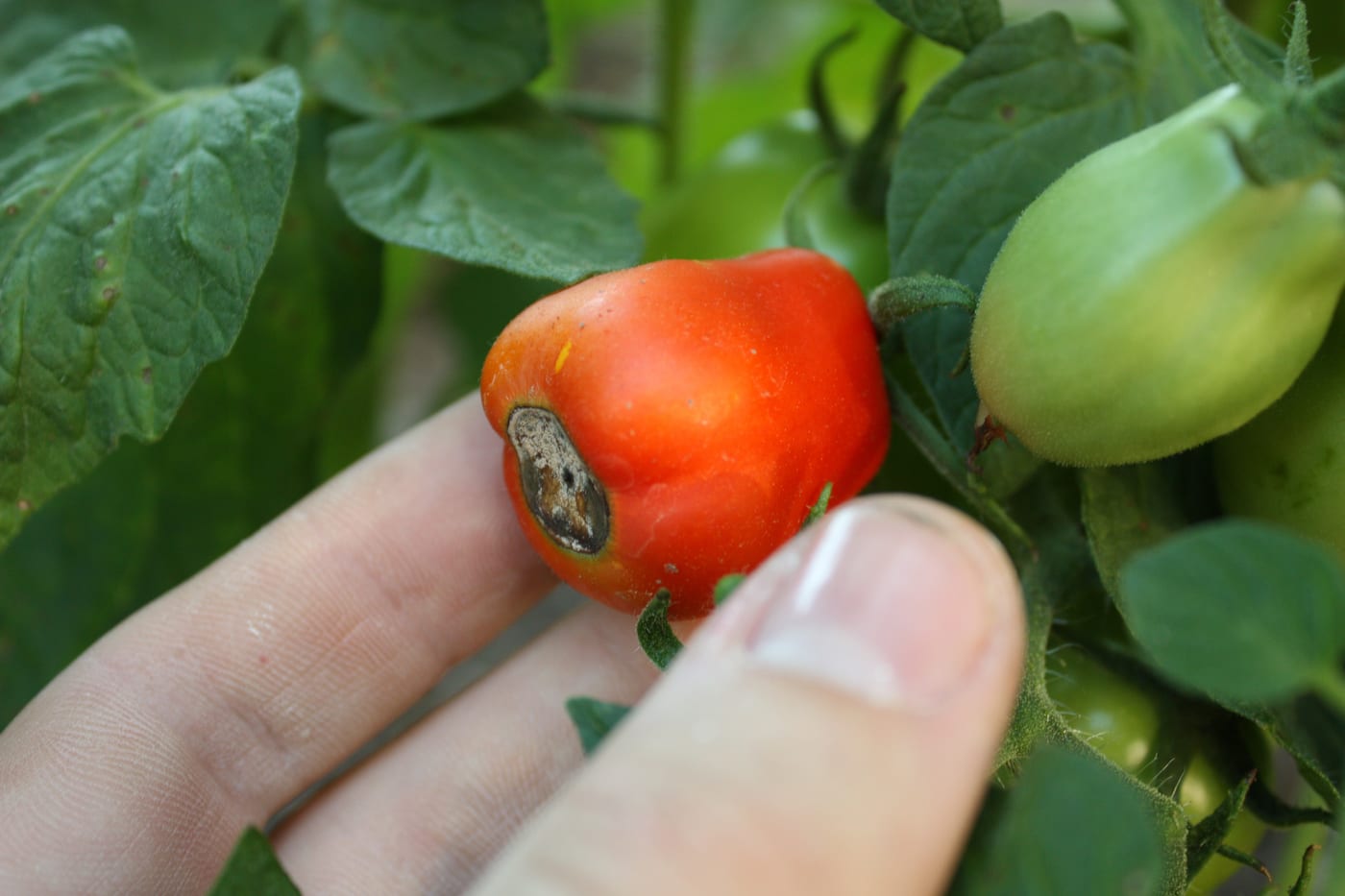
What it looks like
Small light-brown spots appear at the blossom end of immature fruit and expand into a sunken, leathery lesion, greenish-brown to black, as the fruit ripens, typically 1-2.5cm across or larger. Internal hard, brown areas can develop too, sometimes with no visible damage on the outside. Only the affected fruit is lost. The rest of the plant, and later trussesThe flowering, then fruiting, stem cluster on a tomato plant; each truss ripens its fruit together. Full definition →, are often unaffected once the underlying watering issue is corrected.
The cause: a water-flow problem wearing a calcium costume
The shortage is of calcium inside the fruit, not necessarily in the soil, and that distinction does most of the work. In most gardens the soil already holds enough calcium; the real problem is getting it to the fruit. Calcium only moves through the plant with a steady flow of water, so anything that interrupts that flow, a dry spell followed by a soak, a hot spell, salty or sandy soil, heavy nitrogen feeding, or a container drying out between waterings, starves the fruit of calcium even though the roots have plenty. Containers carry extra risk simply because irregular watering is easier to fall into than with an open bed.
This is why the same soil can produce a perfect truss one week and a rotten one the next: nothing about the ground changed, only the consistency of the watering.
Our sources genuinely disagree here
RHS frames this as a watering problem. Teagasc's growing guide describes it simply as "calcium deficiency." UC IPM's plant-science position, and the one the evidence actually supports, is that it's calcium in the fruit combined with water balance in the plant, aggravated by salinity, low soil moisture and sandy soil, and explicitly not a soil calcium shortage.
The "calcium deficiency" framing is the one that sends readers out to buy eggshells, lime and calcium sprays for soil that already has enough. We've gone with the evidence rather than the most common phrasing.
Why this matters in Scotland
The badge above reflects general severity rather than a distinct Scottish risk level: this isn't a weather-driven disorder the way boltingA plant switching early into flowering and seed production, usually triggered by stress, after which leaves, roots or bulbs turn bitter or unusable. Full page → or botrytis are, and no source makes a Scotland-specific severity claim for it. The real Scottish angle is narrower but genuine.
Tomatoes, aubergines, peppers and chillies are grown under glass or polytunnel in most Scottish gardens out of necessity, for warmth rather than shelter from rain. Growing under cover doesn't relax watering discipline, it raises the stakes on it: a container or growbag under glass dries out faster on a sunny day and gets no accidental top-up from rain the way an open bed further south might. The fix doesn't change, steady watering, but the margin for letting it slip is smaller under cover than in an open border.
There's a second, more tentative Scottish angle worth naming: mains water across much of Scotland, especially the west and the Highlands, runs soft and low in dissolved minerals (though this varies regionally, Edinburgh's supply, for instance, runs harder). Soft water carries less calcium to begin with, which is worth knowing as a plausible extra drag on the water-delivery mechanism above. No source we've found tests this specifically for blossom end rot, so treat it as a reasoned inference rather than a confirmed finding, not a reason to change what you'd do differently: steady watering is still the fix either way.
What actually works
Not every method here works equally well: some are backed by real evidence, some are simply traditional, and one has been tested and shown not to help despite how often it's repeated.
Keep the soil or compost consistently moist, never letting it dry out fully
The single most useful thing to get right. Consistent moisture keeps the water flow calcium needs to reach the fruit uninterrupted. During hot spells, watering little and often, for example twice a day, works better than one large dose, since it avoids the dry-then-soaked swing that triggers the problem.
MulchA layer of material spread over the soil around plants to suppress weeds, retain moisture, and improve soil structure as it breaks down. Full definition → to conserve moisture, and use the largest practical container or border soil rather than a small pot
A mulch slows how fast the soil surface dries out between waterings. Container size matters for the same reason: a small pot dries out and swings between dry and wet far faster than border soil or a larger container, which is why containers carry the higher risk of the two.
Only apply liquid feed to soil that is already moist, and avoid heavy nitrogen feeding
Feeding dry soil or compost adds another swing in conditions on top of the watering problem. Heavy nitrogen feeding is separately named as a factor that makes blossom end rot more likely, on top of its effect on watering consistency.
Some varieties are less prone than others
Variety susceptibility genuinely differs, though neither source names specific Scotland-relevant cultivarsA plant variety that arose or was bred under cultivation and is kept true by deliberate propagation, rather than a naturally occurring wild species. Full definition →.
Calcium sprays or foliar feeds applied directly to the plant or fruit
RHS states plainly that calcium nitrate sprays are ineffective for treating the fruit. The mechanism explains why: the shortage is a water-flow problem, not a lack of calcium in the soil for the roots to take up, so adding more calcium doesn't fix what's actually broken.
What actually works: Fix the watering. It's free, and it addresses the actual cause rather than a symptom of it.
Adding crushed eggshells or garden lime to the soil
Widely repeated advice, but it treats a soil calcium shortage that usually isn't the actual problem. Doing it won't cause any harm, so there's no reason to stop if it's already habit, but it isn't the fix, and spending money on it before fixing the watering is spending it in the wrong place.
Frequently asked questions
Do eggshells or calcium sprays stop blossom end rot?
We don't think so, though they won't do any harm. Blossom end rot is a shortage of calcium inside the fruit, which is rarely the same as a shortage of calcium in your soil. In most gardens the calcium is already there; the plant just can't move it into the fruit fast enough because watering keeps swinging between dry and drenched. RHS states directly that calcium sprays are ineffective for treating the fruit. Steady watering is free, so it's worth trying that first.
Is it a disease that will spread to other plants?
No. It's a physiological response to inconsistent watering, not a pathogen, so there's nothing to spread. Only the affected fruit is lost; later trusses are often fine once the watering steadies.
Why does it show up on some fruit and not others on the same plant?
Because the trigger is a temporary interruption in water flow, not a fixed soil condition. A dry spell followed by a soak, or a hot day the plant couldn't keep up with, can hit whichever fruit was developing fastest at that moment and leave the rest untouched.
Does growing under cover in Scotland make this worse?
It raises the stakes rather than the risk. Tomatoes, aubergines, peppers and chillies are grown under glass or polytunnel in most Scottish gardens for warmth. A container or growbag under glass dries out faster on a sunny day and gets no accidental top-up from rain, so the watering discipline that prevents this matters more under cover, not less.
Sources
3 sources, recorded with what each was used for
- RHS: definition, appearance and size, susceptible crops (tomatoes, aubergines, peppers), the calcium/water-flow mechanism, container risk, watering frequency and mulching advice, feeding practice, calcium spray inefficacy
- UC Integrated Pest Management Program: the calcium-in-fruit-plus-water-balance mechanism (plant physiology only, not Scotland-applicable), salinity and soil-type aggravating factors, confirmation this is not pathogenic, variety susceptibility, fertiliser-rate advice
- Teagasc: the contrasting 'calcium deficiency' framing already flagged on this site's own tomato guide as the framing that misleads readers into buying calcium they don't need