
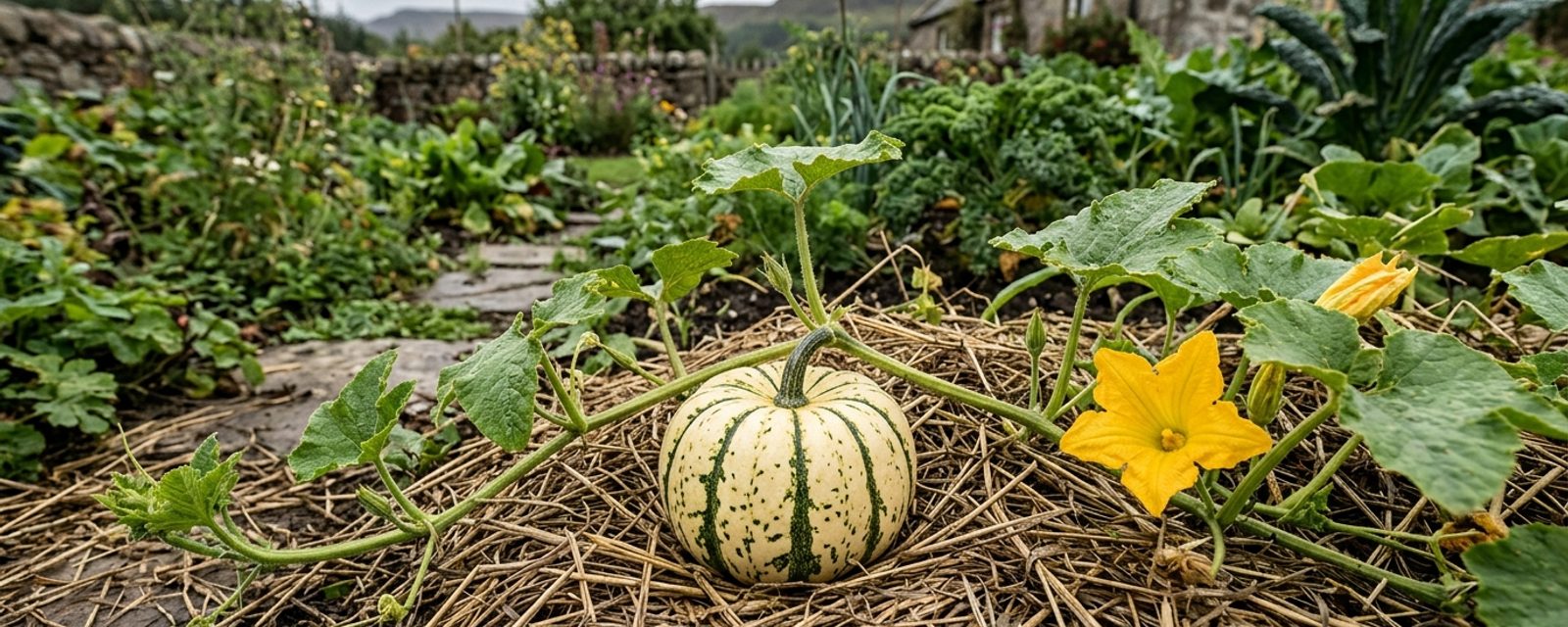
Summer squash and winter squash share a genus and a common name, but they are grown, harvested, and used in completely different ways, and the reason comes down to one mechanism. A summer squash (courgette-type patty pans included) is picked while immature, its skin still soft and its seeds barely formed, so the plant never needs to complete fruit development before it reaches your kitchen. A winter squash is the opposite bet entirely: the fruit has to stay on the vine until it reaches full size, full colour, and a fully hardened skin, because that hardened skin is what lets it store for months rather than days. Skin hardening and full ripening happen right at the end of the fruit's development, which means winter squash needs a long, uninterrupted run of warm weeks with nothing cutting it short. That single physiological requirement, maximum ripening time, uninterrupted, is what makes winter squash a genuinely harder bet in a Scottish growing season, where a shorter, cooler run of summer weeks and an autumn that can turn cold and wet early both cut into the time a fruit has to finish hardening. A winter squash caught mid-ripening by an early cold snap won't store well even if it's cut before frost hits. Summer squash sidesteps the entire problem, because "immature" is the harvest target, not a failure state.
Quick answer
For most Scottish gardens with reasonable space and some shelter, Crown Prince is the best all-round choice, a proven, high-yielding trailing winter squash with dense, sweet orange flesh that stores for months. If space is tight, Harlequin gives you a genuine winter squash on a compact, non-trailing plant. If your season tends to run short or unpredictable, Harrier (bred specifically for short growing seasons) or a fast, low-risk summer squash like Sunburst is the safer bet.
Why variety choice matters more for winter squash than summer squash
A variety's stated days-to-maturity and fruit size are the practical proxy for that ripening requirement: smaller fruit and a shorter stated maturity window mean less time exposed to an early cold snap. Six squash varieties carry the Award of Garden Merit (AGMThe RHS's Award of Garden Merit: a UK-wide trials award for reliable performance, not a Scotland-specific recommendation. Full definition →), a UK-wide mark of reliable garden performance, not a Scotland-specific one, so it's a starting point for comparison rather than a guarantee any of the six will finish ripening in a shorter Scottish season. For sowing dates, spacing, watering, and how to cure and store the crop once it's harvested, the growing guide covers the cultivation technique in full.
All squash, regardless of variety, follow the same broad calendar: sown under cover in mid-to-late spring and planted out only once the last frost has passed. The growing guide has the exact dates; what changes by variety is how much of the season is left to ripen after planting out.
Two other risks worth flagging before the variety-by-variety detail, neither one solved by variety choice alone: squash flowers are insect-pollinated, and a cool, wet, low-pollinator spell can leave fruit failing to set regardless of variety, worth hand-pollinating as standard practice through a marginal summer rather than only once flowers have already failed to set; the guide to hand-pollinating squash covers how. And a cold snap at either end of the season, not just at harvest, can set a plant back or kill it outright; fleeceA lightweight, breathable fabric laid or draped over plants to trap a little warmth and keep off frost, wind and some flying pests. Full definition → or a clocheA small, portable clear cover placed over an individual plant or short row to trap warmth and keep off wind, rain and pests. Full definition → over newly planted-out squash buys real protection during an uncertain spring, and the same cover extends the ripening window at the other end of the season if an early cold snap threatens before a winter squash has finished colouring. Check regional frost dates for how much margin your own area typically has, since the west coast, east coast, Highlands and Central Belt don't share one single "last frost" date.
The six varieties compared
Three of these are winter squash (the ones where ripening time is the real risk factor), two are summer squash, and one, Sunbeam, sits in an odd spot that's worth explaining properly below the table.
| Variety | Type | Habit / footprint | Days to maturity | AGM on own page |
|---|---|---|---|---|
| Crown Prince | Winter (C. maxima) | Trailing, 2.5–4m | Not stated | Yes |
| Harlequin | Winter (C. pepo) | Compact/bushy, 0.5–1m x 1.5–2.5m | Not stated | Yes |
| Harrier | Winter (C. moschata, butternut) | Trailing (footprint not stated) | ~100 days | Not shown, see below |
| Sunburst | Summer (C. pepo, patty-pan) | Bushy, 0.1–0.5m x 1–1.5m | Not stated | Yes |
| Sunbeam | Summer (C. pepo, patty-pan) | Non-trailing, spreading | Not stated | Not shown, see below |
| Sweet Dumpling | Winter (C. pepo) | 1.5–2.5m x 1–1.5m | Harvestable Oct–Nov | Yes |
Crown Prince: the safe, proven storage squash
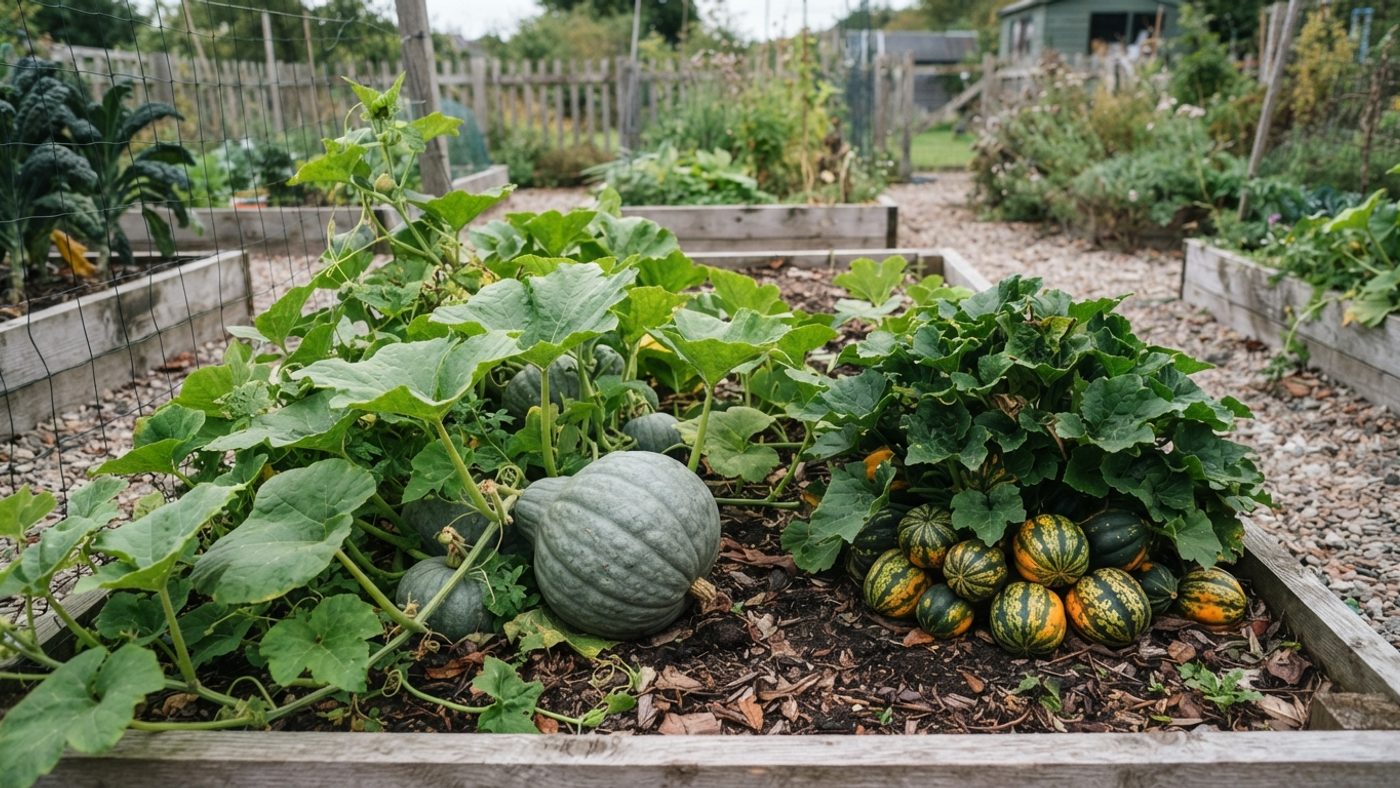
Crown Prince is a big plant for a big payoff: a trailing vine spreading 2.5–4m that needs the space the growing guide's spacing figures already account for. The fruit itself runs 2–4kg, with blue-grey skin hiding dense, bright orange flesh with a sweet, nutty flavour, often compared to sweet potato, and dense enough to make good soup. It's a long-standing UK garden favourite specifically for storage, keeping for months in the right conditions rather than weeks. No days-to-maturity figure is published for it, which matters here: without that figure, Crown Prince's ripening timeline can't be compared on the same terms as Harrier's stated ~100 days below, so choosing it is a bet on its size and reputation rather than a known number of days against the season. It needs the space and the season to bulk up properly, so it suits gardens with reasonable growing space and at least some shelter from an early autumn chill.
Harlequin: winter squash for a small garden
Harlequin's compact habit is a genuine distinguishing trait, not a minor variant on Crown Prince. It doesn't trail extensively like other squash varieties, with a footprint of just 0.5–1m by 1.5–2.5m, a fraction of Crown Prince's spread, which makes it a real option for a small plot or a raised bed where a 4m trailing vine simply isn't practical. The fruit is smaller too, around 700g, acorn-shaped with green-yellow-orange striped skin, and very sweet, moist flesh with high sugar levels that caramelise well when pan-fried. If your garden can't accommodate Crown Prince's spread, Harlequin is a genuine winter squash alternative, not a consolation prize.
Harrier: bred for a short season
Harrier is a butternut-type winter squash, and it's the variety with the clearest short-season pedigree of the six. It's British-bred and described as ideally suited to the short growing season, ready to harvest just over three months from sowing, around 100 days, a concrete maturity window that Crown Prince's own listing simply doesn't give. Planted out once frost risk has passed (check regional frost dates for a rough date), a 100-day window buys real margin against an early autumn cold snap on a plot where frost typically arrives late enough to allow it. Gardener's World gives a similar general figure for butternut varieties, around 15 weeks or roughly 105 days, broadly consistent with Harrier's stated window. The fruit is medium-sized and pear-shaped, with good storage ability and a reputation for reliability. One discrepancy worth stating plainly: the general "how to grow squashes" page lists Harrier as AGM, but Harrier's own individual plant page shows no AGM badge and no "Award of Garden Merit" text anywhere on it.
Sunburst and Sunbeam: fast, low-risk summer squash
Because summer squash is picked young, none of the ripening-window risk above applies to either variety here. Sunburst is a bushy patty-pan type, bright yellow and glossy, with a tender, nutty flavour and a buttery, melt-in-the-mouth texture when steamed, a compact plant (0.1–0.5m by 1–1.5m) that suits smaller spaces and containers well.
Sunbeam looks like Sunburst's twin at a glance, same patty-pan shape, same yellow colour, but two things about it are worth stating plainly. No AGM badge appears on Sunbeam's individual page, despite the general squash page listing "Sunbeam AGM." And Sunbeam's own page files its common name as "courgette 'Sunbeam,'" not squash, a classification quirk between two RHS pages rather than a meaningful growing distinction. What does change how it's grown is its hardiness ratingThe RHS's H1a–H7 scale for how much cold a plant can survive outdoors, H1a being tender indoor-only and H7 hardy anywhere in the UK. Full definition →: H1c, tenderer than the H2 rating most of the other varieties here carry. In practice, H1c means it needs to stay under cover or indoors until night-time temperatures are reliably above about 10°C, later than H2 varieties can safely go outside, worth watching against late spring frost dates rather than sowing on the same schedule as the hardier types.
Sweet Dumpling: small fruit, reliable yield
Sweet Dumpling splits the difference between Crown Prince's size and Harlequin's compactness, with a footprint of 1.5–2.5m by 1–1.5m. It produces numerous small, cream-white fruit striped with green, each suited to baking whole, with sweet, buttery orange flesh inside. It's high-yielding and harvestable through October and November, and stores well into winter, a solid middle option if Crown Prince feels like too much plant and Harlequin's fruit feel too small for your needs.
Disease and pest considerations that affect variety choice
Powdery mildew is the main disease risk that intersects with variety choice here, and it's worth being precise about the cause: insufficient watering encourages it, not overwatering, a dry-stressed plant is more vulnerable to the fungus than a well-watered one, regardless of how much rain has fallen elsewhere in the garden. So a variety's water needs during a dry spell matter more than Scotland's typically wetter summers do. None of the six varieties above are noted for particular mildew resistance on their own listings. Slugs threaten all young squash plants regardless of variety, and grey mould can affect stored winter squash wherever the skin is damaged, another reason a fully hardened skin at harvest matters.
Soil pH: the honest gap
No published pH figure exists specific to squash from the sources this site draws on. The closest available guidance comes from Utah State University Extension, which gives a pH of 6.5 to 7.5 as ideal for cucurbits generally (the plant family squash belongs to, along with courgettes, cucumbers and pumpkins), a general family-wide range rather than a precise squash-specific target, but the best currently available.
Decision guide
Space and shelter decide more of this choice than any other single factor. A garden with room for a 4m trailing vine and at least some shelter from an early cold snap gets the most from Crown Prince, still the best all-round pick for long storage and dense flesh. A small plot does better with Harlequin's compact habit. A short, exposed, or unpredictable season points to Harrier's stated ~100-day window, or to a summer squash like Sunburst, which removes the ripening-window risk altogether by never needing to reach full maturity. As a rough planting guide, worked out from the spacing figures above rather than a published planting-density figure: one Crown Prince or Harrier plant, given its spread, is usually enough for a household wanting a genuine storage crop; a small plot growing Harlequin or a summer type has room for two or three plants in the same footprint.
Common questions
Is Crown Prince really the best winter squash for Scotland?
For most gardens with reasonable space, yes, it's a proven, high-yielding variety known for long storage and dense, sweet flesh. It needs a large trailing footprint (2.5–4m) and benefits from some shelter, so a small or very exposed plot may do better with Harlequin or Harrier instead.
Can I grow squash in a container in Scotland?
Compact varieties like Sunburst (0.1–0.5m) or Harlequin (0.5–1m, non-trailing) are the most realistic container candidates among the six covered here. Large trailing types like Crown Prince aren't suited to container growing.
Why does my seed packet say Harrier is an AGM winner if the RHS website doesn't show it?
The general "how to grow squashes" page does list Harrier as AGM, but Harrier's own individual plant page currently shows no AGM badge. Both pages are named as they stand, rather than assuming which one is out of date.
Is Sunbeam a squash or a courgette?
The general squash page treats it as a summer squash, but its own individual plant page files it as "courgette 'Sunbeam.'" Functionally it's a patty-pan type squash; the naming difference is a quirk between two RHS pages, not a meaningful growing distinction.
Sources
10 sources, recorded with what each was used for
- How to Grow Squashes: General variety list and AGM tagging for all six varieties
- Crown Prince: Habit, fruit size, flesh colour and flavour, AGM confirmation
- Harlequin: Compact habit, fruit size and appearance, AGM confirmation
- Harrier: Short-season breeding, maturity window, storage, no AGM badge on its own page
- Sunburst: Habit, flavour/texture, AGM confirmation
- Sunbeam: Hardiness rating, habit, no AGM badge and courgette classification on its own page
- Sweet Dumpling: Habit, fruit description, yield, harvest window, AGM confirmation
- Types of Squash: Storage and flavour detail for Crown Prince, Sweet Dumpling, and Harlequin
- How to Grow Butternut Squash: General butternut maturity window and disease notes
- Cucurbits Soil Guidance: General cucurbit soil pH range