
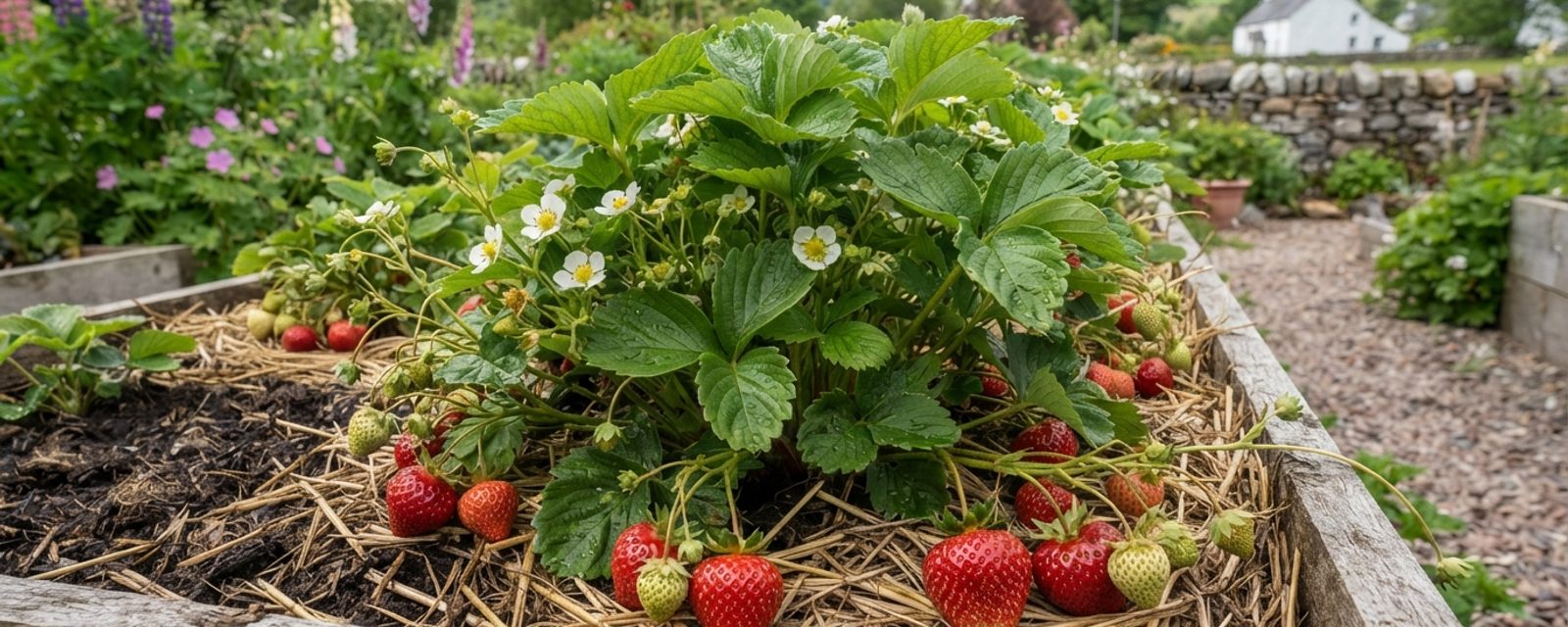
By late July, a lot of Scottish strawberry beds go quiet. The first punnets came off two or three weeks earlier, heavy, sweet, more than you could eat before the birds got interested, and then the plants just stop. What's left is a scatter of small, soft fruit, some of it already turning grey and fuzzy overnight, and a long wait until the shops' imported punnets are the only option again. The gap is a variety problem: a bed planted with a single mid-season type is built to crop hard for a fortnight and then fall silent. The rot is a different problem, and not one a drier summer would fix on its own, grey mould's spores are airborne and always present, and they find the softest, most crowded fruit fastest, wet year or not.
Quick answer
For a reliable single planting, Cambridge Favourite remains the safest choice, proven, widely grown, and a strong runner producer for renewing the bed. If the priority is spreading the harvest across the whole summer from one variety, Finesse's everbearingA strawberry type that produces smaller flushes of fruit continuously through the season, rather than one large crop over a few weeks. Full definition → habit does that on its own. Want fruit as early as possible, plant Honeoye or Vibrant; on light, dry soil, Hapil holds up better than most; on a genuinely damp west-coast plot, Symphony is worth trying first.
Why variety choice is the real lever here
The growing guide covers spacing, soil preparation and general aftercare in detail, and none of that changes much between varieties. What does change, a lot, is when a variety fruits, how long it keeps fruiting, and which diseases it's more or less exposed to. Nine strawberry cultivarsA plant variety that arose or was bred under cultivation and is kept true by deliberate propagation, rather than a naturally occurring wild species. Full definition → carry the Award of Garden Merit: Cambridge Favourite, Honeoye, Vibrant, Hapil, Pegasus, Symphony, Rhapsody, Florence and Finesse. The AGMThe RHS's Award of Garden Merit: a UK-wide trials award for reliable performance, not a Scotland-specific recommendation. Full definition → is a UK-wide horticultural award, not a Scotland-specific one, so it confirms a variety performs reliably somewhere in the UK rather than confirming it's suited to a short, cool Scottish summer specifically, but it's still the most useful shortlist available.
Three cropping types sit inside that list. Summer-fruiting varieties, most of the nine, give a short, heavy flush over two or three weeks. Finesse is the exception: an everbearer producing smaller flushes from early summer into early autumn. None of the nine AGM varieties are alpine strawberries, a fourth type that produces small, intermittent, aromatic berries all summer and tolerates part-shade better than the others, a genuine extra option for extending the season further, just not one carrying an AGM. The table below sets out where each of the nine sits in the early-to-late spread, so a mixed planting can be put together deliberately rather than by chance.
Comparison table
Every one of the nine shares two things: an H6 hardiness ratingThe RHS's H1a–H7 scale for how much cold a plant can survive outdoors, H1a being tender indoor-only and H7 hardy anywhere in the UK. Full definition → (hardy through a UK winter to about -20°C, that protects the dormant crownThe base of a perennial plant where roots and shoots meet, often sold and planted as a ready-made dormant plant rather than grown from seed. Full definition →, but says nothing about the flowers, which are what a late Scottish frost actually damages, see strawberry black eye), and the standard caveat that the fruit "may be susceptible to strawberry viruses" and grey mould. None of the nine is described as resistant to grey mould on its own page. What the table below shows instead is where each variety actually differs: its cropping season, and any disease resistance or susceptibility named specifically, beyond that shared baseline. "Verticillium wilt" and "red core" are both soil-borne fungal diseases that can kill a plant outright rather than just spoiling fruit, which is why resistance to either is worth having if a bed has had problems before.
| Variety | Season / type | Named disease resistance or risk (own page) |
|---|---|---|
| Cambridge Favourite | Mid-season | None named beyond the shared baseline |
| Honeoye | Early season, heavy cropping | May be susceptible to Verticillium wilt |
| Vibrant | Early season; possible September second crop in a cool July | None named beyond the shared baseline |
| Hapil | Early to mid-season, heavy cropping | May be susceptible to Verticillium wilt |
| Pegasus | Not stated on own page | None named beyond the shared baseline |
| Symphony | Mid to late season | Good resistance to red core; may be susceptible to mildew |
| Rhapsody | Late season | Resistant to red core; some resistance to Verticillium wilt and mildew |
| Florence | Late season, heavy cropping | None named beyond the shared baseline |
| Finesse | Everbearer, early summer to early autumn | None named beyond the shared baseline; produces few runnersLong, trailing stems a plant sends out that root where they touch soil, producing a genetically identical new plant for free. Full definition → |
Slugs are a separate, variety-blind risk worth the same straw-mulchA layer of material spread over the soil around plants to suppress weeds, retain moisture, and improve soil structure as it breaks down. Full definition → defence as grey mould, especially in a wet year.
Cambridge Favourite: the baseline the others are measured against
Cambridge Favourite is the safe, proven mid-season pick, and against eight more specialised options that's exactly its value: it's the variety least likely to disappoint if only one thing gets planted. It produces "medium-sized soft berries with a good flavour in mid-season," with excellent general disease resistance, and is "a good producer of runners," useful given the growing guide's propagation advice relies on runners to renew a bed every three to four years. It still carries the same grey mould and virus caveats as the rest of the list, but nothing about it is a weak point relative to the alternatives. For one strawberry bed and no strong reason to specialise, this is where to start.
Honeoye and Vibrant: the earliest fruit
Both are early-season, heavy-cropping varieties, which makes them the pair to plant if the goal is fruit as soon as possible in the summer. Honeoye is "an early season heavily-cropping cultivar" with "a good flavour"; Vibrant is described the same way, with the added note that "a second crop may be produced in September if July temperatures remain relatively low," a trait that could suit a cool Scottish summer better than it suits a hot one further south, though it isn't framed in those terms. Both share the same disease profile as the rest of the list: fruit prone to grey mould, possible susceptibility to strawberry viruses and root rot, and Honeoye additionally flagged for possible Verticillium wilt.
Flowering earliest is a trade-off as well as an advantage: an early crop also flowers into whichever cold, wet, low-pollinator spell Scotland's spring happens to deliver that year, and poor pollination at that stage can thin the crop regardless of the variety's own vigour. Hand-pollinating with a soft brush on a still morning is a low-cost backup if bees are scarce while an early variety is in flower.
Hapil: for light, dry soil
Hapil is "an early to mid-season heavy cropping cultivar" with "large, glossy berries of a good flavour," carrying the same Verticillium, virus, root rot and grey mould caveats as Honeoye. Gardener's World adds a distinct, practical claim its own page doesn't make: Hapil "performs well on poor, drier soils." For a plot that struggles to hold moisture, that's a genuine reason to choose it over the others.
Symphony and Rhapsody: Scottish-bred, and where their resistance differs
Symphony and Rhapsody were both bred at the Scottish Crop Research Institute, now part of the James Hutton Institute in Dundee, with Rhapsody as one of Symphony's own parents. Neither variety's own Hutton breeding page states a Scottish-climate aim, so being bred in Scotland doesn't by itself mean either one performs better in a Scottish garden.
Where they genuinely differ is disease resistance. Symphony's own page states it "may be susceptible" to mildew and doesn't mention Verticillium wilt at all. Rhapsody's own page states the opposite pattern: "some resistance to Verticillium wilt and mildew." Hutton's own pages back this up, Rhapsody "was resistant to red core and shows moderate resistance to Verticillium wilt" in trials, while Symphony's page describes "field resistance to Red Core" (resistance shown in real growing conditions, not just a lab test) and general vigour, without a Verticillium or mildew resistance claim. Two siblings from the same breeding programme, published with different resistance profiles: on a plot with a known powdery mildew problem, that difference is the reason to pick Rhapsody over Symphony, not the Scottish breeding history.
Season-wise, Symphony crops mid to late season and Rhapsody later still, "a late season fruiting cultivar." Gardener's World adds one more distinct, Scotland-relevant claim about Symphony specifically: it "performs well in damper conditions, particularly suited to UK north/west regions." Scotland's west coast is about as wet as that description gets, which makes Symphony worth considering there even without a formal Scottish-trials claim behind it.
Florence: late season, and a gap between two sources
Florence is "a late season cultivar with good disease resistance producing heavy crops of firm, long-lasting fruit," but its own page keeps that resistance general, it doesn't name a specific pathogen beyond the standard virus, root rot and grey mould caveats shared across the list. Gardener's World is more specific: Florence is "resistant to powdery mildew and vine weevil." Its own page doesn't name either pathogen. Useful if vine weevil has been a problem in pots or containers before.
Finesse: the only perpetual, and a runners trade-off
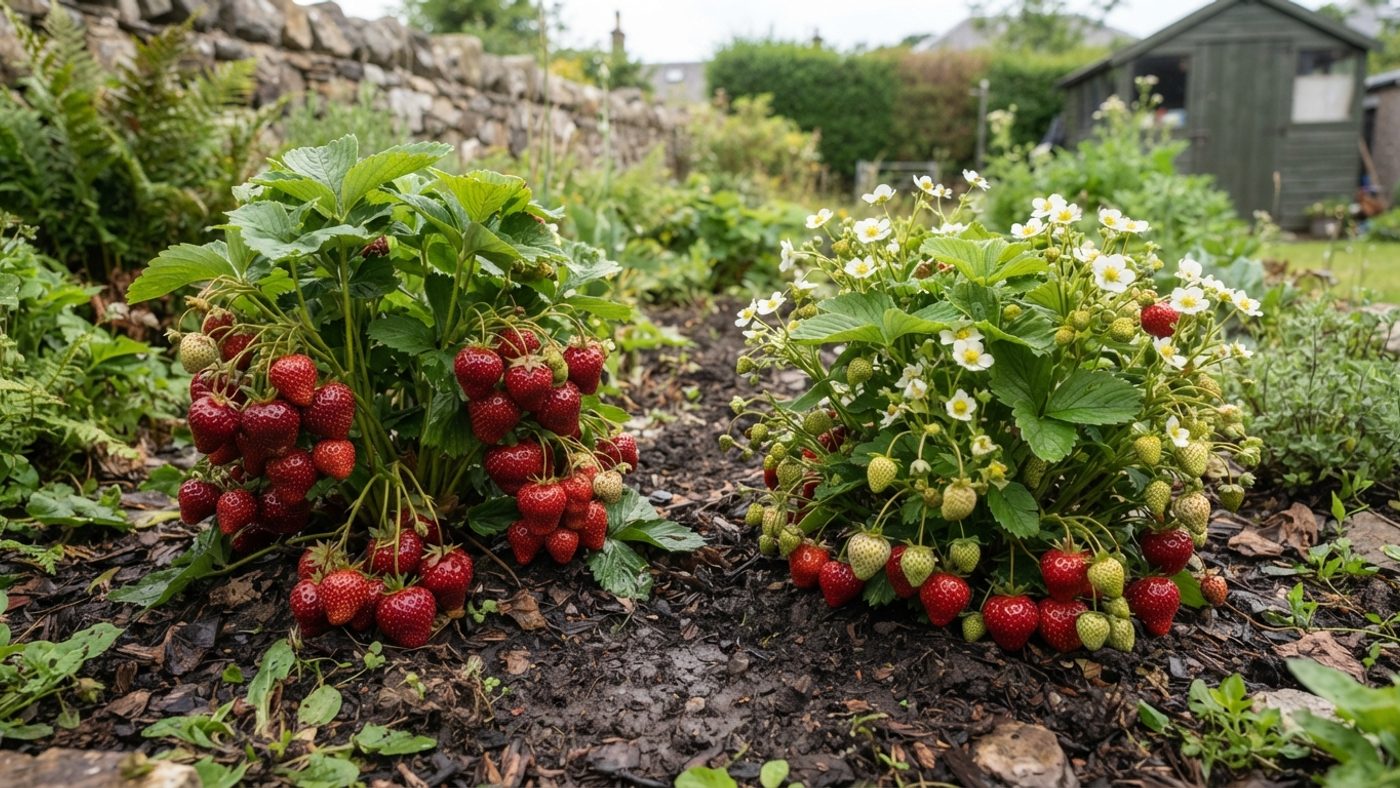
Finesse stands apart from the other eight: it's the only everbearer on the AGM list, producing "a good yield of high quality, well-flavoured, red berries in long trussesThe flowering, then fruiting, stem cluster on a tomato plant; each truss ripens its fruit together. Full definition → from early summer to early autumn" per its own page, rather than one short heavy flush. That's the direct answer to the late-July gap, a bed with Finesse in it doesn't go quiet the way an all-mid-season bed does.
It comes with a genuine trade-off the growing guide's propagation advice doesn't anticipate: its own page notes Finesse "produces few runners," which matters because renewing a bed by rooting runners is the standard, free way to replace plants after three to four years. A Finesse bed is more likely to need buying in new plants than a Cambridge Favourite bed does.
The two sources also diverge on Verticillium wilt specifically. Its own page states "very good disease resistance" in general terms and doesn't mention Verticillium at all. Gardener's World states Finesse is "resistant to verticillium wilt," a real gap between what the two sources say, not something to resolve either way here.
Pegasus: the least-documented of the nine
Pegasus carries the AGM and the standard virus, root rot and grey mould caveats, but its own plant page is the least specific of the nine on season and resistance: it doesn't state a cropping season, and doesn't mention Verticillium wilt, powdery mildew or red core in either direction. Retailer listings for Pegasus make broader claims than that, including wilt tolerance, but those aren't repeated here since its own page doesn't back them: on the evidence available, Pegasus is a reliable AGM cropper of unstated season, nothing more specific.
Soil, frost and buying in clean stock
Soil pH and preparation are covered in the growing guide, general direction points to "slightly acidic," and Teagasc, the Irish agricultural extension body, gives a numeric target of pH 5.7–5.9, useful as a maritime-climate reference point, though it's an Irish source rather than a Scottish one. Late frost at flowering is a separate risk covered there too, including strawberry black eye, the frost-damage symptom that can look like a disease but isn't one; fleeceA lightweight, breathable fabric laid or draped over plants to trap a little warmth and keep off frost, wind and some flying pests. Full definition → thrown over the flowers on a forecast frost night is the standard defence, whichever variety is planted.
Every variety in the table above carries the same "may be susceptible to strawberry viruses" caveat on its own page. None of the nine is described as virus-resistant, so the real defence is buying certified, virus-tested runners from a reputable supplier rather than relying on variety choice, and not propagating new plants from a bed that's already showing stunted growth or discoloured leaves.
Common questions
Can I grow more than one variety in the same bed to spread the harvest?
Yes, pairing an early variety like Honeoye or Vibrant with a late one like Florence or Rhapsody, or adding a row of the everbearing Finesse, spreads cropping across more of the summer than any single mid-season variety will on its own.
Which strawberry variety is most resistant to grey mould?
None of the nine AGM varieties are described as resistant to grey mould on their own plant pages, all are flagged as susceptible or possibly susceptible on the fruit. Airflow, mulching and prompt picking matter more than variety choice for this particular problem.
Is Symphony actually better for Scotland because it was bred in Dundee?
Not on its own. Symphony and Rhapsody were bred at the Scottish Crop Research Institute (now the James Hutton Institute), but neither variety's own breeding record states a Scottish-climate aim. Symphony's genuinely useful trait is a separate claim from Gardener's World that it performs well in damper conditions, relevant to Scotland's west coast specifically, not a Scottish-breeding argument.
Does Finesse need less maintenance since it's disease-resistant?
Its general disease resistance is described as "very good," but its fruit is still flagged as possibly susceptible to grey mould, and it produces few runners, meaning a Finesse bed is harder to renew from its own plants than most of the other eight varieties.
Sources
14 sources, recorded with what each was used for
- Strawberries: Grow Your Own: Cropping types, spacing, general problem list, AGM variety list
- Fragaria × ananassa 'Cambridge Favourite': Season, hardiness, disease notes, AGM
- Fragaria × ananassa 'Honeoye': Season, hardiness, disease notes, AGM
- Vibrant (AGM): Season, hardiness, disease notes, AGM
- Fragaria × ananassa 'Hapil': Season, hardiness, disease notes, AGM
- Fragaria × ananassa 'Pegasus': Hardiness, disease notes, AGM
- Fragaria × ananassa 'Symphony': Season, hardiness, disease notes, AGM
- Fragaria × ananassa 'Rhapsody': Season, hardiness, disease notes, AGM
- Fragaria × ananassa 'Florence' (PBR): Season, hardiness, disease notes, AGM
- Fragaria × ananassa 'Finesse': Everbearing habit, hardiness, disease notes, runner production, AGM
- James Hutton Institute Fruit Breeding — Symphony: Parentage, red core resistance, breeding origin
- James Hutton Institute Fruit Breeding — Rhapsody: Parentage, red core and Verticillium wilt trial resistance, growth habitA plant's characteristic shape and manner of growth, such as upright, spreading, creeping or bushy. Full definition →
- The Best Strawberries to Grow: Hapil on dry soil, Symphony in damp/north-west conditions, Finesse and Florence disease-resistance claims
- Strawberries (Greenhouse and Salad Crops): Numeric pH target of 5.7–5.9