
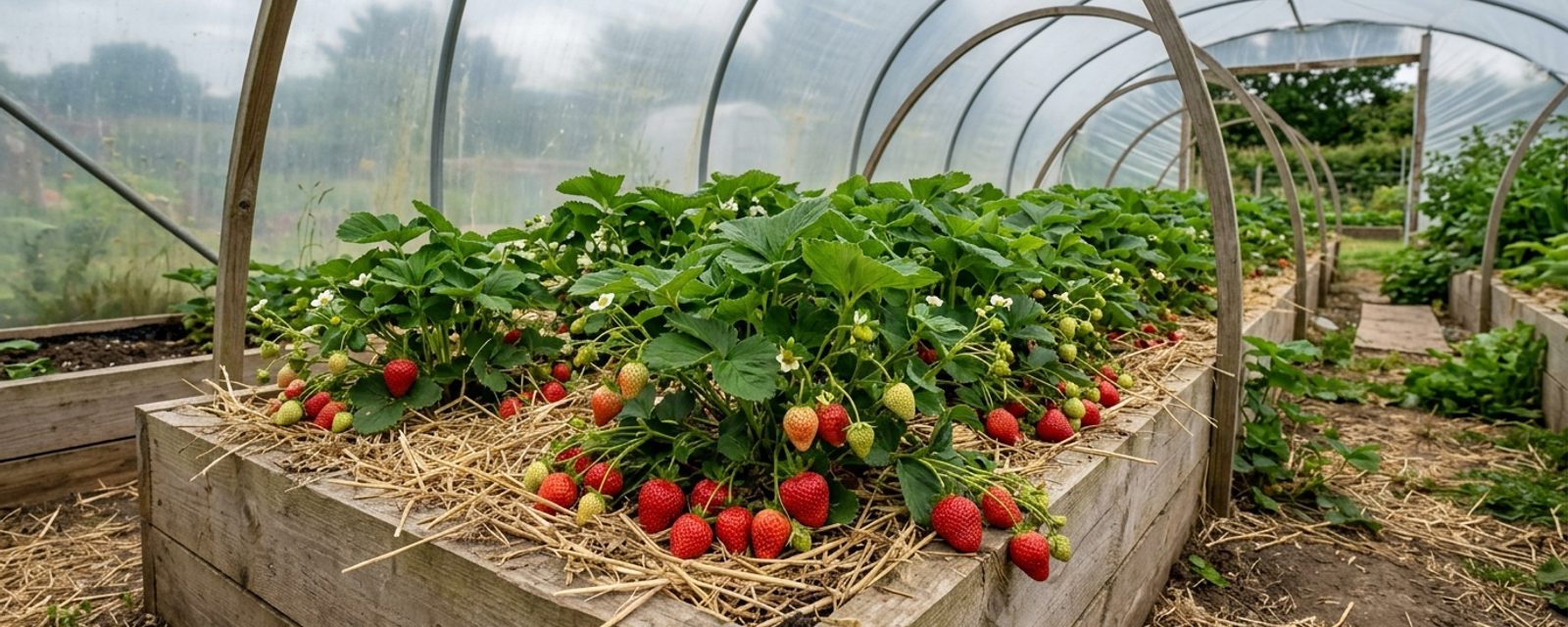
Fragaria x ananassa
Strawberries run from an August planting to the first warm berry picked on a June morning, and a few plants tucked into almost any sunny corner of a Scottish garden will reward you for it.
A Scottish strawberry grown in full sun and picked warm from the plant tastes sweeter than anything you will buy. The crop is forgiving. A few plants at the front of a border, a hanging basket by the back door, a dedicated bed with a netting frame: strawberries will produce in all of these. Summer-fruiting types give the largest fruit. PerpetualA strawberry type that produces smaller flushes of fruit continuously through the season, rather than one large crop over a few weeks. Full definition → varieties produce smaller flushes over months. Alpine types will self-seed and spread. Plant a mix and you can have fresh strawberries from early June through to the first autumn frosts. A bed lasts three to four years before it needs replacing, and the plants produce their own replacements through runnersLong, trailing stems a plant sends out that root where they touch soil, producing a genetically identical new plant for free. Full definition →.
Why strawberries suit Scotland
Strawberries want full sun, shelter and slightly acidic soil. Scotland provides the acidity naturally on much of its ground, and a south-facing wall or sheltered border provides the sun trap they need. The crop's main enemy in Scotland is not heat or drought. It is late frost. A strawberry flower caught by frost develops a black centre and will not set fruit. This is known as strawberry black eye, and it is the risk that makes site selection matter here. Avoid frost pocketsA low-lying spot where cold air drains and pools on still nights, making it noticeably more frost-prone than the surrounding area. Full definition →. If frost is forecast while the plants are in flower, cover them overnight with fleeceA lightweight, breathable fabric laid or draped over plants to trap a little warmth and keep off frost, wind and some flying pests. Full definition → or an old bedsheet. A clocheA small, portable clear cover placed over an individual plant or short row to trap warmth and keep off wind, rain and pests. Full definition → row cover or an unheated greenhouse gives you fruit at least a week earlier, which in a Scottish June is the difference between waiting and eating.
Varieties
The three picks here span early, mid and late season, so you can harvest from June into August. These carry the RHS Award of Garden Merit, a UK-wide award, not a Scottish one.
★ Our pick for Scotland
Cambridge FavouriteAGM
Summer-fruiting · mid-season
Very popular and reliable, with sweet berries and good disease resistance. A classic mid-season pick.
Why this one: Reliability is the trait that earns a strawberry its place in a Scottish garden. Cambridge Favourite has been the standard mid-season variety for decades, holding its AGMThe RHS's Award of Garden Merit: a UK-wide trials award for reliable performance, not a Scotland-specific recommendation. Full definition → through multiple trials. It produces sweet berries with good disease resistance, and it is included among the varieties suitable for forcingCovering plants to exclude light and speed early, tender growth in the dark, most associated with rhubarb and sea kale in late winter. Full definition → under glass — which matters where an open-field Scottish June may not deliver the warmth that triggers ripening.
Also worth considering
HoneoyeAGM
Summer-fruiting · early season
Early to crop, which is the trait worth having where the season is short.
FlorenceAGM
Summer-fruiting · late season
Heavy crops of firm, well-flavoured fruit. Good disease resistance.
Show other recommended varieties (2)
FinesseAGM
Perpetual/everbearer
Several harvests of sweet berries from early summer to early autumn.
Mara des BoisAGM
Perpetual
Small aromatic berries with a wild strawberry flavour.
Best Strawberry Varieties for Scotland → compares all named strawberry varieties head-to-head, with the practical detail that doesn't fit in a summary card.
Soil and site
If you test the soil, aim for a pH of about 5.7 to 5.9: most Scottish gardens sit in that band already, which is one of the few times our naturally acid soils hand us an advantage rather than a problem. Fertile, well-drained ground works best. Strawberries will tolerate partial shade but the fruit will be smaller and less sweet. A low-lying garden that pools cold air is the site most likely to lose its crop in May.
Weed the ground thoroughly before planting. Dig in two bucketfuls of well-rotted organic matter per square metre, ideally a few weeks in advance so the soil can settle. Many growers plant through weed-suppressing membraneA permeable fabric laid over soil to block weeds while still letting water and air through, often planted through with holes cut for each plant. Full definition →. It stops weeds, holds moisture, and keeps soil from splashing onto the fruit. Lay it over the planting area, pin it with U-shaped wire pegs, and cut holes to plant into the soil underneath.
Planting
Plant strawberries in spring, late summer or early autumn. August or September is the best time. The plants establish through autumn and fruit the following year. Space plants 35 to 40cm apart in rows 75cm apart. If using containers, space them 20cm apart.
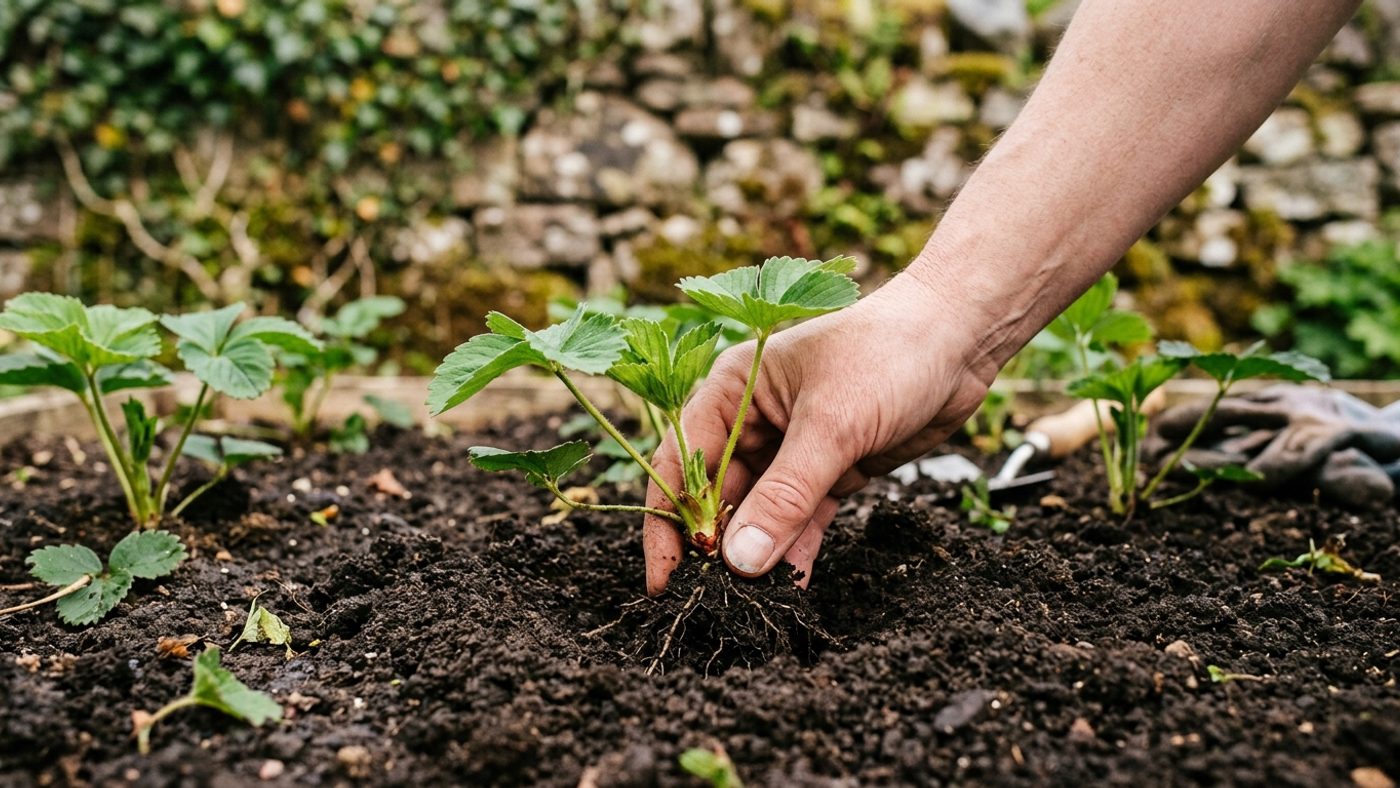
The planting depth is crucial. The crownThe base of a perennial plant where roots and shoots meet, often sold and planted as a ready-made dormant plant rather than grown from seed. Full definition → of the plant, the thickened base where the leaves emerge, must sit at the soil surface or a shade above it. Never below. Too deep and it rots, which in a wet Scottish autumn happens faster than most people expect. Too shallow and the roots dry out. Trim bare-rootA plant, usually a fruit tree or hedging, sold with its roots exposed rather than in a pot, and only available while dormant. Full definition → runners to 10cm if the roots are tangled. Spread the roots out in the hole. Replace the soil, firm gently, and water well.
Cold-stored runners, available from late spring to early summer, give you fruit about 60 days after planting. They are more expensive but give you a crop in the same season.
Watering and care
Water new plants regularly while they establish. Once established, water during prolonged dry periods, especially while the fruit is swelling. Try to water in the morning and avoid wetting the crown or the fruit. Splashed fruit rots faster.
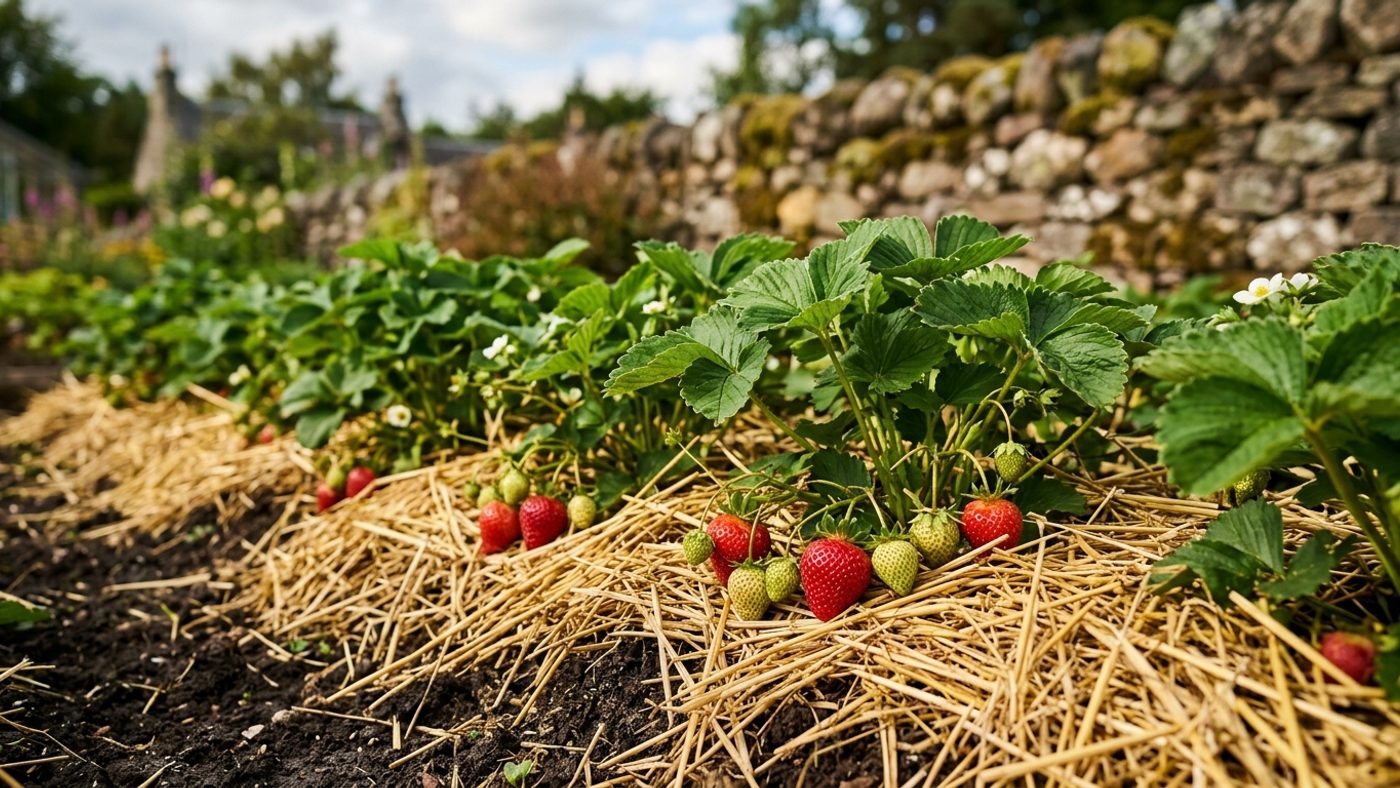
MulchA layer of material spread over the soil around plants to suppress weeds, retain moisture, and improve soil structure as it breaks down. Full definition → in late winter or early spring with a layer of well-rotted organic matter, leaving a gap around the crown. When the fruits start to develop, put a layer of straw or mulch mats under the plants to lift the berries off damp ground. Straw keeps the fruit clean, dry and less likely to rot. Remove the straw in autumn.
If growth is poor, apply a high-potassium granular fertiliser in spring. Container plants need fortnightly liquid feeding through the growing season — a general-purpose feed at first, switching to high-potassium once flower buds appear.
After harvesting summer-fruiting strawberries: cut off the old leaves about 10cm above the crown. This lets fresh leaves develop and keeps the plants healthy. With perpetual types, just remove dead or damaged leaves during the autumn clear-up.
Propagation: late summer is the time to peg down runners into small pots of compost. Aim each runner into a 9cm pot, peg it with a U-shaped wire, keep the compost moist, and sever the new plant from the parent once it has rooted. Free replacements.
Harvesting
Summer-fruiting types ripen from early June to early August, depending on the variety. Perpetual types produce flushes from early summer into autumn. Alpine types produce small aromatic berries intermittently over the summer. Pick strawberries when they are bright red all over, ideally during the warmest part of the day when the flavour is fullest. Eat them as soon as possible. A strawberry picked and eaten still warm from the sun is the reason to grow your own.
Forcing Chicory, Sea Kale & Strawberries → covers cold-stored runners and cloche forcing for an earlier crop, plus the same blanchingExcluding light from part of a growing plant, usually by earthing up, wrapping or covering, so it grows pale, tender and less bitter. Full definition → principle applied to two other crops.
Common problems
- Grey mould rots the fruit, especially in wet weather. Keep fruit off the ground with straw or mulch mats. Water in the morning. Harvest often and remove any mouldy berries.
- Birds will take the fruit. Netting on a framework, raised above the plants and secured taut, keeps them off. Put it up before the berries start to colour.
- Slugs damage the fruit, particularly in wet summers. Straw mulch helps by keeping the fruit dry and off the ground.
See more problems
- Strawberry black eye is frost damage to the flowers. The centre turns black and no fruit sets. Avoid frost pockets when choosing your site. Cover plants with fleece if frost is forecast while they are in flower.
- Vine weevil larvae eat the roots, especially in containers. Plants wilt and die. Biological nematode controls are effective when applied at the right time.
- Spotted wing drosophila lays eggs directly in ripening fruit rather than waiting for it to spoil first; pick promptly and clear fallen fruit to reduce the risk.
- Red spider mite is mainly a risk if you grow under a tunnel or cloche for an earlier crop, since it needs the same warm, dry conditions that gives you.
Common questions
What type of strawberry should I grow in Scotland?
Summer-fruiting strawberries give you the largest fruit in the shortest window, about two to three weeks of heavy cropping. If you want berries across the whole season, add a perpetual variety that produces small flushes from early summer into autumn. In Scotland, an early variety gives you berries before the mid-season types ripen, and a late variety extends the crop into August. If you can only pick one, a mid-season like Cambridge Favourite is the most reliable.
How do I stop birds eating my strawberries?
Netting supported on a framework of canes or wood, raised above the plants and fastened securely. Do this before the berries start to colour. The birds notice pink fruit before you do. A fruit cage is the permanent solution if you grow a lot of soft fruit. Remove the netting after harvesting to let birds feed on any pests.
When is the best time to plant strawberries?
August or September is ideal. The plants establish through autumn and crop the following summer. Spring planting works too but gives you a smaller crop that first year because the plants have had less time to build up. Cold-stored runners planted in late spring will fruit about 60 days later: a fast but pricier option.
Why are my strawberries rotting before they ripen?
Usually grey mould, and the usual cause is damp fruit sitting on wet soil. Put a layer of straw or mulch mats under the plants when the fruits start to form. This lifts the berries off the ground, keeps them dry, and reduces rot. Water in the mornings rather than the evenings, and try not to splash the fruit. Space plants adequately so air can circulate.
How long does a strawberry bed last?
About three to four years of good cropping. After that, disease builds up in the soil and the plants lose vigour. Make a new bed in a different spot and replace the old one. Propagate new plants from runners on your existing plants. Summer-fruiting varieties produce plenty of runners. Peg them into small pots of compost in late summer, sever them from the parent once rooted, and you have free replacements for the new bed.
Sources
2 sources, and what each was used for
- RHS: planting windows, 35-40cm spacing, 75cm rows, four-year bed life and 3-4 year replanting, runner propagation, summer-fruiting/perpetual/alpine types and their cropping windows, slightly acidic soil preference, AGM varieties
- Teagasc: a numeric pH target of 5.7-5.9 where RHS gives direction only, 5kg per square metre of bulky organic compost, setting crowns at or slightly above soil level, high-potash feeding twice weekly once flowers appear, taking primary and secondary runners as the best plants, opening vents so bees can pollinate under cover, and picking once the shoulders colour