
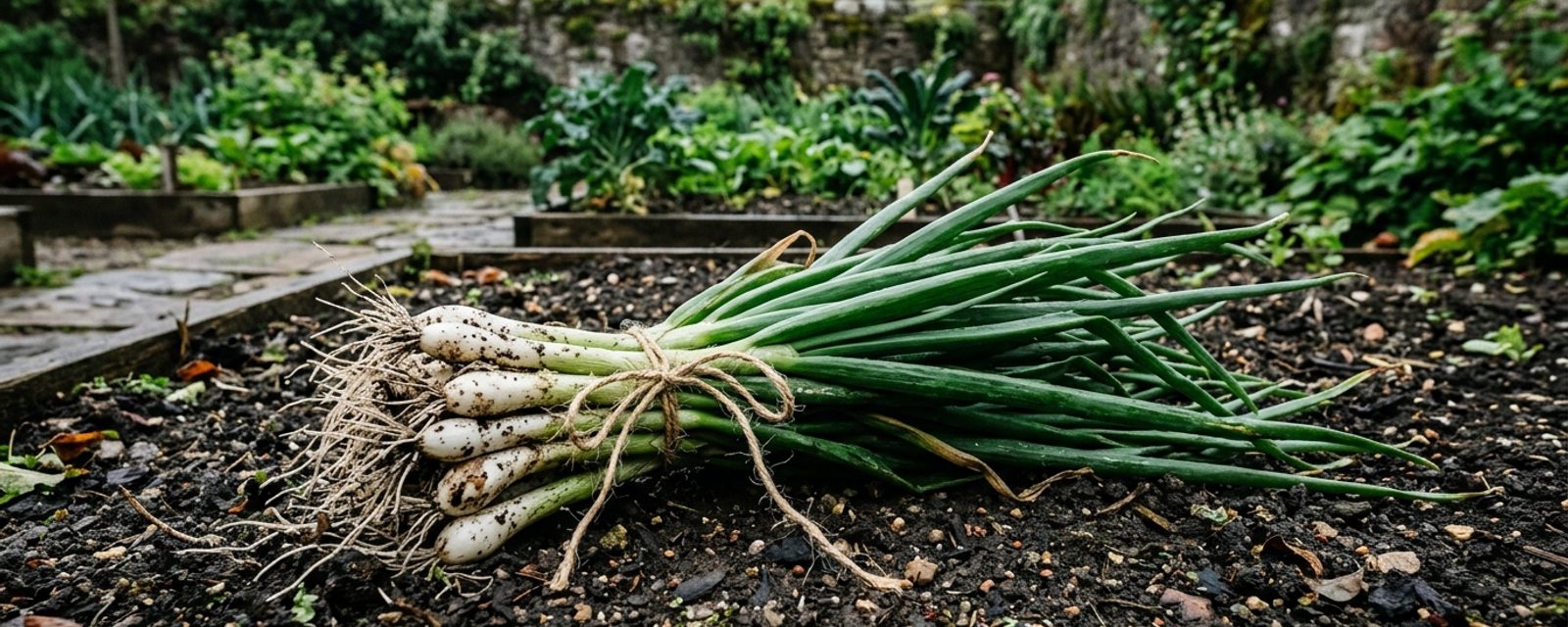
A spring onion isn't a different plant from a bulb onion, it's the same Allium cepa (or, for a handful of varieties, the related Allium fistulosum) pulled young, before the base has had time to swell. That single fact explains most of what actually separates one variety from another: flavour barely varies between them, but they differ a great deal in how long each stays in that immature, ungrown-up state before it either boltsA plant switching early into flowering and seed production, usually triggered by stress, after which leaves, roots or bulbs turn bitter or unusable. Full page →, swells into a bulb, or gets tough, and, separately, how hard a winter it can sit through if you're sowing it in autumn rather than spring. The RHS Award of Garden Merit (AGMThe RHS's Award of Garden Merit: a UK-wide trials award for reliable performance, not a Scotland-specific recommendation. Full definition →), a UK-wide mark of reliable garden performance, not a Scotland-specific one, is one signal of that, but as this comparison shows, not always a consistent one even across RHS's own pages.
Quick answer
White Lisbon is the best all-rounder: it's the only RHS-named variety for both summer succession sowing and a hardy autumn sowing that overwinters for an early spring crop. Ishikura is the better choice if you want a longer window to harvest a single sowing without it swelling into a bulb. Guardsman buys the same insurance through sheer vigour rather than resisting bulbing, and Photon trades hardiness for the longest single-sowing harvest period of the four, at the cost of being the least winter-tolerant.
Five varieties are named for this crop: White Lisbon, Ishikura, Guardsman, Photon and Apache. This comparison covers the first four in depth. Guardsman carries a genuine contradiction between two RHS-published pages, worth knowing about before you buy seed on the strength of an award badge alone.
The four varieties compared
| Variety | Species | Hardiness | AGM on own page? | Real distinguishing trait |
|---|---|---|---|---|
| White Lisbon | Allium cepa | H4The RHS's H1a–H7 scale for how much cold a plant can survive outdoors, H1a being tender indoor-only and H7 hardy anywhere in the UK. Full definition → | No, see note below | Fast-growing; named for succession sowing and overwinteringKeeping a plant alive and intact through the cold months, whether left outdoors, moved under cover, or stored dormant. Full definition → |
| Ishikura | Allium fistulosum | H5 | Yes | Long white stalks that resist swelling into a bulb over an extended harvest |
| Guardsman | Allium fistulosum-type | H3 | No, see note below | Vigorous, tall growth; slow to bulb rather than bolt-resistant |
| Photon | Allium fistulosum | H5 | No | Longest single-sowing harvest window (June-October) of the four, but no overwintering claim |
Hardiness runs on the standard scale from H1 (needs heat) to H7 (hardy anywhere in the UK); H3 means hardy only in mild, coastal parts of the UK (roughly -5°C to 1°C), the sheltered southwest, broadly, not most of Scotland's inland or east-coast growing conditions, while H5 means hardy through a severe UK winter (down to -15°C). On that scale, Guardsman is the real outlier: an AGM variety that's also the least winter-hardy of the four. For an autumn sowing left unprotected over a Scottish winter, that gap matters more than which variety carries an award, H3 is a candidate for clocheA small, portable clear cover placed over an individual plant or short row to trap warmth and keep off wind, rain and pests. Full definition → or fleeceA lightweight, breathable fabric laid or draped over plants to trap a little warmth and keep off frost, wind and some flying pests. Full definition → protection through hard weather, not one to leave bare on an exposed plot.
The AGM badge itself doesn't match cleanly across RHS's own pages. The general salad-onion grow-your-own summary lists both White Lisbon and Guardsman as AGM varieties. Neither variety's own individual plant page shows an AGM badge or mentions the award at all. Ishikura, by contrast, is consistent: AGM on both the general list and its own individual page. Take the AGM claim on White Lisbon and Guardsman as real, RHS states it plainly on its general page, but don't expect to see the badge repeated if you look each variety up individually.
White Lisbon: the succession-and-overwinter workhorse
White Lisbon is "suitable for successional sowingSowing a small batch of seed every couple of weeks, rather than all at once, so crops mature in a staggered sequence instead of a single glut. Full definition → throughout the year" and "suitable for overwintering," with a sowing window of March to September, 1cm deep in drills 15cm apart, slightly closer row spacing than the 20cm the general salad-onion page gives, though close enough not to matter in practice. It's the one variety of these four named for both jobs: a fast summer succession supply, and a hardy late-sowing that survives winter for an early spring harvest, well ahead of anything sown fresh the following year.
Bolting is a named susceptibility on its own page too, alongside onion white rot, leek rust and downy mildew, a real risk on this specific variety, not just a generic allium caveat, so a sudden cold spell after sowing is worth watching for even on the variety chosen for its overwintering reputation.
Ishikura: swelling resistance for a long harvest window
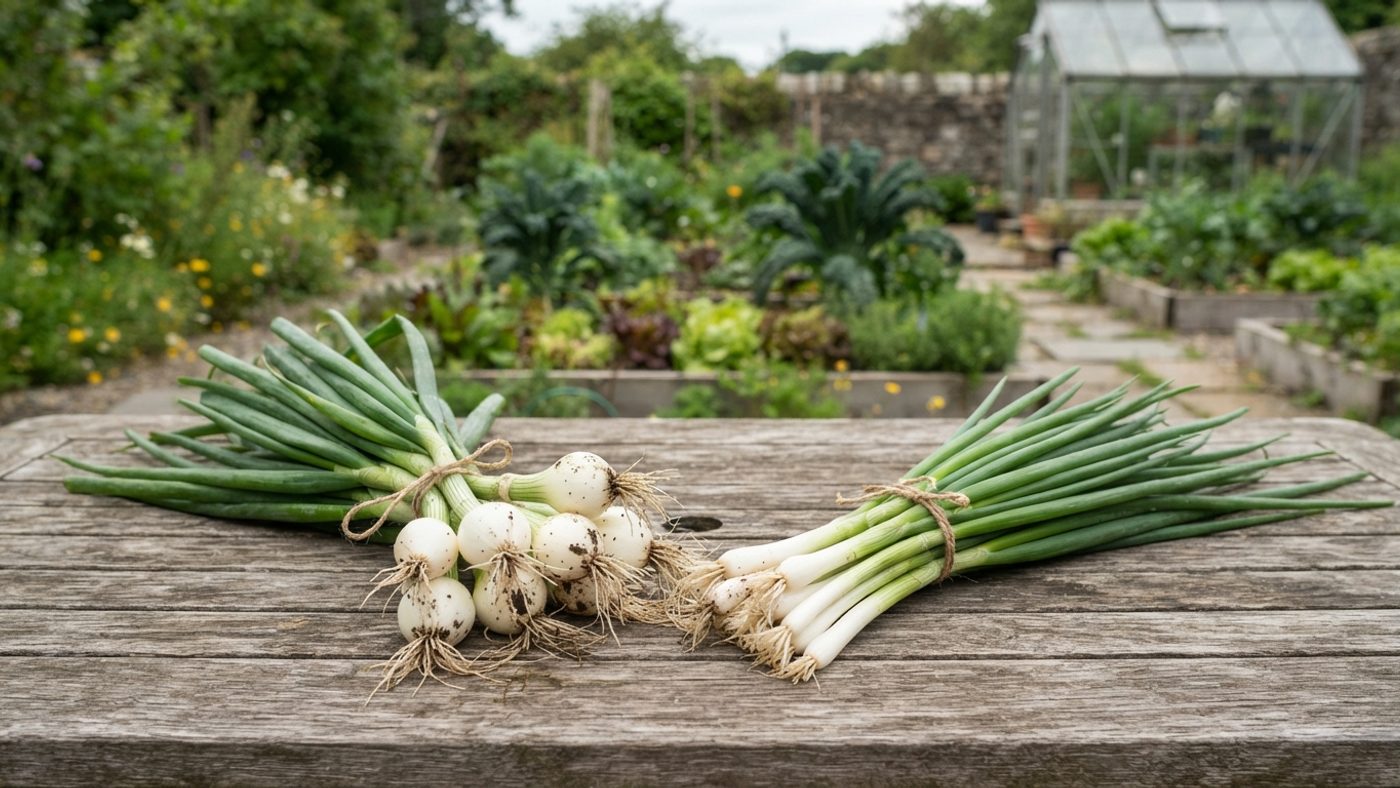
Ishikura is an Allium fistulosum type, a genuinely different plant from White Lisbon's Allium cepa, which is part of why it behaves differently. It's described as "clumps of elongated, straight white stems and hollow green leaves" with an "exceptionally long harvest period from summer to autumn without the need for successive sowings." In practice that means a single sowing of Ishikura stays usable for longer than a bulb-onion type would, because the stems don't swell into a bulb the way White Lisbon's eventually will if left too long, useful insurance if a succession-sowing schedule slips, rather than a trait you're relying on for a fast turnaround.
Allium leaf miner and onion fly are named pest risks, and onion white rot and onion downy mildew disease risks, worth checking against slug damage on young seedlings too, since that's often the more common early threat while a sowing is still small and vulnerable.
Guardsman: vigour that buys time, not bolt resistance
Guardsman is worth being precise about, because "slow to produce bulbs" and "bolt-resistant" sound similar but aren't the same trait. The general variety list describes it plainly: "Vigorous growth produces tall, upright leaves. Slow to produce bulbs." That's a growth-habit trait, the plant simply takes longer to swell into a bulb once it's past the immature spring-onion stage, not a claim that it resists bolting (running to flower) under stress from a cold snap or dry spell. Its own individual page names bolting as a susceptibility risk, the same as White Lisbon, and adds bull neck (a soft, thick neck that stops the plant storing well), downy mildew, neckrot, rust and white rot to the disease list, plus leek moth, onion fly and eelworm as pests.
The practical upshot: Guardsman gives you a wider forgiving window before an unharvested plant turns into an oversized bulb onion rather than a spring onion, genuinely useful if you can't always get out to the plot on schedule, but it isn't insurance against a cold-snap bolt, and at H3 it's the least winter-hardy of the four, so it isn't the one to reach for on an autumn-sown, overwintering crop.
Photon: the longest single-sowing window, without the hardiness
Photon is the other Allium fistulosum type here, described almost identically to Ishikura in form, "elongated, straight white stems and hollow green leaves", but with the longest harvest period of the four: June to October from a single sowing, again without needing repeat sowings. It carries no AGM on either the general list or its own page, and is rated H5, the same as Ishikura. Slugs, snails and allium leaf miner are named pests, with onion white rot and onion downy mildew as disease risks.
The general variety page doesn't give Photon a sowing-window recommendation the way it does for White Lisbon's autumn/overwintering option, and Photon's own page makes no overwintering claim either. That's a real gap in what's published, not a resolved answer either way: Photon matches Ishikura's H5 rating on paper, so it's plausibly just as capable of overwintering, but nothing in either source actually says so. Until it does, sow Photon for its stated strength, a long summer-to-autumn window, and choose White Lisbon or Ishikura for an autumn sowing instead.
Which one for your situation
- Sowing an autumn crop to overwinter on an exposed plot, with no cloche or fleece to hand? White Lisbon (H4) is the safer bet over Guardsman (H3); pair either with cover through the hardest weeks if you can.
- Want the longest harvest from one spring/summer sowing, with winter hardiness in reserve for a future autumn attempt? Ishikura's H5 rating matches Photon's, but only Ishikura carries an overwintering pedigree Photon doesn't claim.
- Can't always get out to pull plants on schedule and want a wider margin before they swell into an oversized bulb? Guardsman's slow-to-bulb habit buys that time on a summer sowing, just protect it well, or skip it, for an autumn one, given its H3 rating.
- Growing only a summer-to-autumn crop with no interest in overwintering? Photon's June-October window is the longest of the four from a single sowing.
A gap worth naming honestly
No Scottish trial data, Hutton Institute, SASA, or otherwise, compares these varieties' performance specifically in Scottish conditions. Every hardiness and AGM figure above is a UK-wide RHS rating; none of it has been separately tested for Scotland. Apache (purple-skinned bulbs, mild flavour, fast growing), the fifth AGM variety on the general list, is named here rather than given its own section because nothing marks out a hardiness, bolt-risk, or overwintering trait distinct from the four above.
Bolting itself is triggered by a cold spell or by changes in day length through the growing season, worth bearing in mind on any of these four, not only the varieties named above as bolting-susceptible, since no bolting risk rating exists that differs by variety for this crop.
Soil pH is a similar gap: no figure is published for spring onions specifically.
Common questions
Is Guardsman actually bolt-resistant, since it's described as slow-growing?
No. "Slow to produce bulbs" and bolt resistance are different traits. Guardsman is slower to swell into a full bulb once past the spring-onion stage, useful if you can't harvest exactly on schedule, but its own page names bolting as a susceptibility risk, the same as White Lisbon, so a cold snap can still send it to flower.
Why does White Lisbon show an AGM on some RHS pages but not its own?
RHS's general salad-onion variety list names White Lisbon as AGM, but its own individual plant page carries no AGM badge or mention, the two RHS pages genuinely disagree. Guardsman shows the same pattern. Ishikura, by contrast, is consistent: AGM on both.
Which of these can I sow to overwinter for an early spring crop?
Only White Lisbon has an explicit overwintering recommendation among these four, its own page states it's "suitable for overwintering." Neither Ishikura's, Guardsman's, nor Photon's own page makes that claim, so treat White Lisbon as the safer choice for an autumn sowing.
Do I need to treat these varieties differently for pests and diseases?
Not fundamentally. All four share largely the same risk list: onion fly, onion white rot, onion downy mildew, and slugs on young seedlings. Guardsman's own page names a slightly longer list (also bull neck, neckrot, rust, leek moth, eelworm), but that's a broader susceptibility list, not a variety that needs different treatment.
Sources
7 sources, recorded with what each was used for
- How to grow Salad Onions: General varieties list (White Lisbon, Apache, Guardsman, Ishikura, Photon with AGM status as shown on this page), sowing timeline, and confirming Guardsman/White Lisbon's AGM status on this specific page
- Allium 'Guardsman': Hardiness (H3), absence of AGM on its own page, growth habitA plant's characteristic shape and manner of growth, such as upright, spreading, creeping or bushy. Full definition → ("vigorous... slow to produce bulbs"), and pest/disease list
- Allium fistulosum 'Photon': Hardiness (H5), absence of AGM, stem/leaf description, June-October harvest claim, and pest/disease list
- Allium cepa 'White Lisbon': Hardiness (H4), absence of AGM on its own page, successional-sowing and overwintering statements, sowing window, and bolting/disease susceptibility
- Allium fistulosum 'Ishikura': Hardiness (H5), AGM confirmation on its own page, stem description, harvest-period claim, and pest/disease list
- Bolting in Vegetables: General cause of bolting ("triggered either by cold spells or by the changes in day length through the seasons"), applied here since no bolting-risk rating exists specific to this crop or its varieties
- Spring onions grow guide: Checked as a secondary source for additional named varieties and bolt-resistance claims; confirms White Lisbon's overwintering reputation but doesn't cover Guardsman, Photon, or Ishikura