
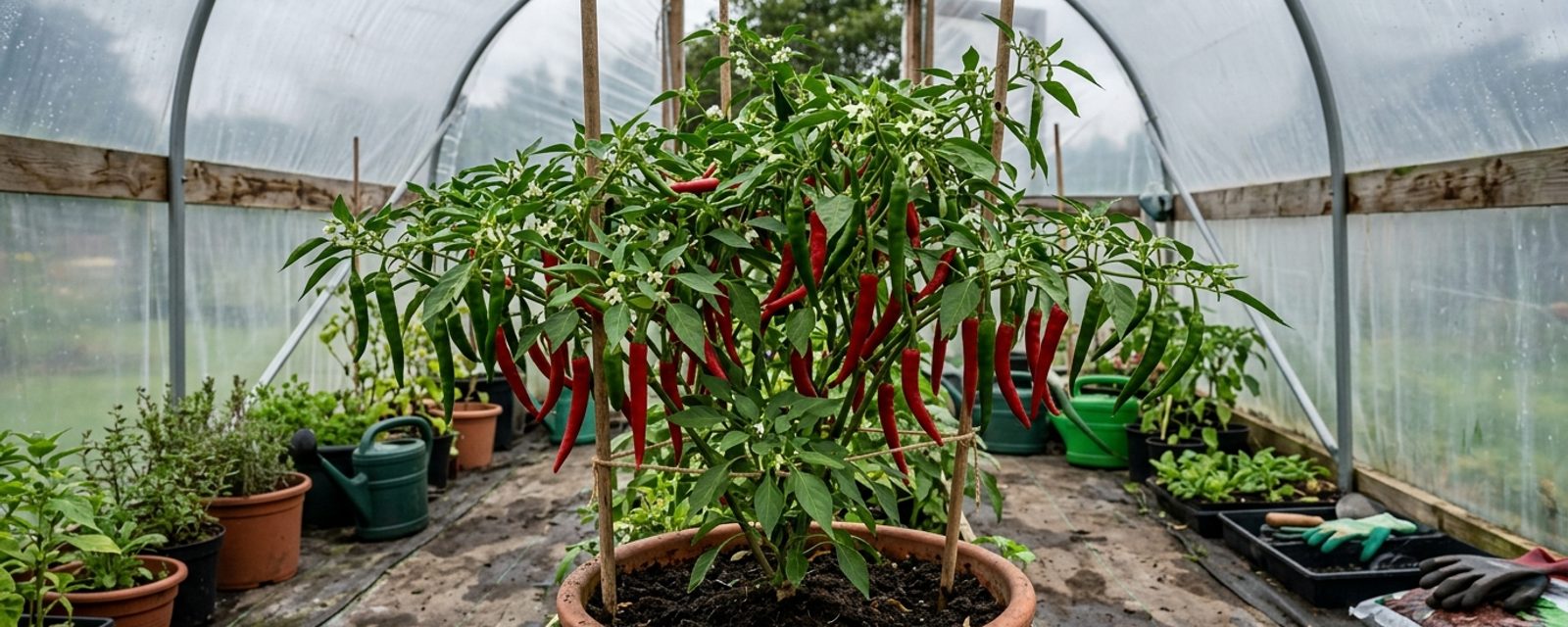
Chilli plants live their whole life under glass here, and that changes what "best variety" even means. Ask a grower in Kent which chilli to plant and heat rating is most of the answer. Ask the same question in Fife or Aberdeenshire and the greenhouse becomes part of the decision too, how much space it has to spare, how much light and warmth it can actually deliver through a Scottish summer, and whether a heavy-cropping plant packed in beside the tomatoes is going to cause its own problems.
Quick answer
Fuego is the strongest all-round pick: the growing guide names it specifically as more cold tolerant than most chilli varieties, a rare trait for this crop. Loco or Prairie Fire suit a greenhouse or windowsill with little room to spare, Hungarian Hot Wax suits anyone who wants a mild, approachable pepper rather than genuine heat, and Hot Thai suits a grower who wants volume, one plant can carry up to 200 fruits, useful for drying or preserving a real crop from a single space.
Why chillies need a different kind of "best" here
Chillies ask for heat, humidity and a lot of direct sun to fruit well, and outdoor fruiting is often reduced without them, the same steer given to sweet peppers, and for the same reason. A greenhouse or polytunnel is the realistic route to a genuine crop in Scotland. That also means a stated Scoville rating (SHU, Scoville Heat Units, the standard scale for chilli heat) is a ceiling, not a guarantee: capsaicin builds with heat and sunlight, so a variety rated extremely hot in trial conditions may not reach that figure in a cooler, less sunny summer.
Growing under glass all season affects more than heat, too. Gardener's World notes that chilli flowers grown inside rarely get visited by pollinating insects or wind, and may need pollinating by hand, a light shake or a soft brush between flowers, to set fruit, regardless of which of the six varieties below is grown. Gardener's World is also direct that chillies won't survive a Scottish winter and are best sown fresh each year rather than kept as a returning plant, so overwinteringKeeping a plant alive and intact through the cold months, whether left outdoors, moved under cover, or stored dormant. Full definition → isn't a shortcut worth planning around for any variety here. An early indoor start under heat gives the longest possible harvest window before the season closes; the full chillies growing guide covers sowing, spacing and care in detail.
No soil pH figure is published for chillies.
The six worth comparing
Six chilli varieties carry the Award of Garden Merit, a UK-wide award for garden performance, not a Scottish recommendation. All six carry the same hardiness ratingThe RHS's H1a–H7 scale for how much cold a plant can survive outdoors, H1a being tender indoor-only and H7 hardy anywhere in the UK. Full definition → (H1c) on their individual plant pages: none tolerates frost, and all need a greenhouse, polytunnel or windowsill rather than open ground for most or all of the year. That rating is identical across all six, including Fuego. The general growing guide singles out Fuego as "more cold tolerant than most" in its prose, but that claim isn't reflected in a distinct formal hardiness class on Fuego's own plant page, where it carries the same H1c rating as the other five. The cold-tolerance trait is real and sourced, just not backed by a different official hardiness figure than its stablemates.
| Variety | Type | Heat (SHU) | Height | Real edge |
|---|---|---|---|---|
| Fuego | Cayenne, long tapering fruit | 30,000–50,000 | Up to 50cm | Named cold-tolerant; best all-round pick here |
| Loco | Compact, small multi-colour fruit | 20,000–30,000 | Up to 50cm | Gentle, everyday heat in a compact plant |
| Hungarian Hot Wax | Large citrus-toned fruit | 5,000–15,000 | Up to 1m | Mildest pick; pick green or ripe |
| Hot Thai | Small bullet-shaped fruit | 50,000–70,000 | Up to 1m | Up to 200 fruits per plant |
| Prairie Fire | Tiny multi-colour fruit | Up to 1,000,000 | Up to 30cm | Smallest of all six; windowsill-viable |
| Apache | Small fruit, held upright | 80,000 | Up to 50cm | Fills the heat gap between Loco and Prairie Fire |
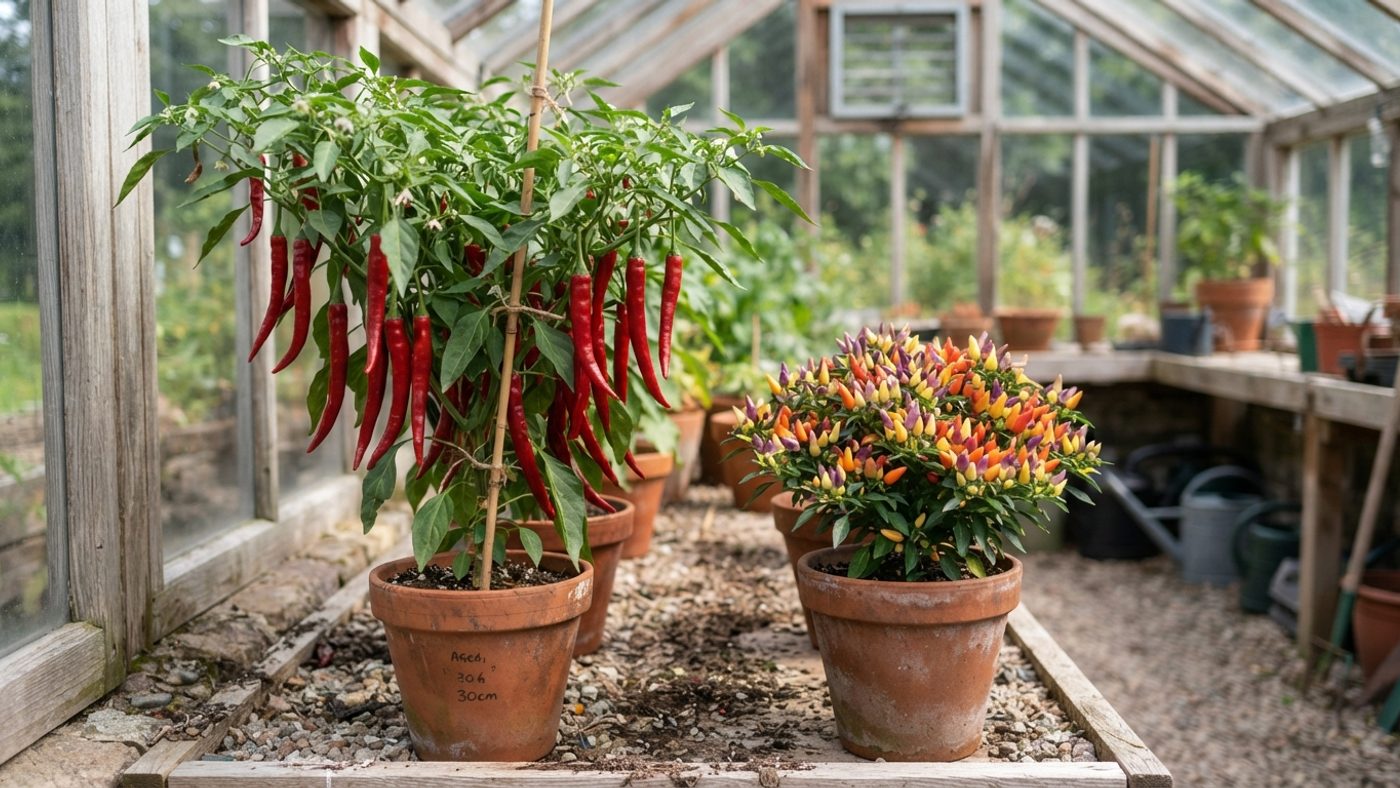
Hot Thai: a real yield figure
Hot Thai's own plant page states up to 200 peppers from a single plant. None of Fuego, Loco or Hungarian Hot Wax carries a stated yield figure at all. Where greenhouse space is the real limit on how many chilli plants fit in, one high-yielding plant produces more usable crop, dried, frozen or pickled, than several lower-yielding ones sharing the same warmth and light. Gardener's World separately describes Hot Thai as compact and windowsill-friendly, which sits at odds with its own plant page's stated height class of 50cm–1m, taller than Hungarian Hot Wax's upper bound and no shorter than Fuego's. Both can be true at different growth stages, but it's a real variation worth knowing before assuming Hot Thai stays small.
A plant carrying 200 fruits is also a dense plant, and dense, humid greenhouse growth is exactly the condition grey mould needs, worth pairing a heavy-cropping variety like Hot Thai with the ventilation and dead-material removal that keeps grey mould down, more than a sparser variety like Hungarian Hot Wax needs.
Prairie Fire: smaller than Loco, and far hotter
Prairie Fire's own plant page states a maximum height of 30cm, smaller than the general 0.1–0.5m range given for Loco, Fuego and Apache, and it's explicitly recommended for a sunny windowsill or patio container as well as a greenhouse border. That makes it the smallest-footprint option of the six, for anyone whose limiting factor is a single windowsill or a spare corner of greenhouse staging rather than a full border. It's also the hottest by a wide margin: rated up to 1,000,000 SHU, against Loco's 20,000–30,000. Serious heat from minimal space points to Prairie Fire; a gentler, more usable everyday chilli in a similarly small space still points to Loco.
Apache: real heat, one open contradiction
Apache's own plant page rates it at 80,000 SHU, hotter than Hot Thai, and far hotter than Loco, sitting in the gap between Loco's approachable heat and Prairie Fire's extreme end. Its footprint (0.1–0.5m) matches Loco and Fuego, so it doesn't add a space-saving case the way Prairie Fire does. Gardener's World, though, describes Apache as a "medium heat" variety, against the 80,000 SHU trial figure on its own page. Both are genuine sources naming the same variety differently; the RHS figure is the one used in the table above.
Which one for your situation
- Want the best all-round chance in an unheated or barely-heated greenhouse: Fuego, for the named cold-tolerance trait, even with the caveat above about its formal hardiness rating.
- Short on space, one windowsill or a single growing bag: Prairie Fire for maximum heat in the smallest stated footprint, or Loco for a gentler, more usable everyday heat in a similarly small space.
- Want a genuinely mild pepper, not real heat: Hungarian Hot Wax, pick it green for a mild pepper or let it ripen for more warmth, hedging against however much sun the season delivers.
- Want volume, for drying, freezing or pickling a real batch from one plant: Hot Thai, on the strength of its stated 200-fruit yield, just give it the airflow a heavy crop needs.
- Want serious heat and aren't short on room: Apache, with the honest caveat that Gardener's World rates its heat lower than the RHS trial figure does.
Common problems this affects
Variety choice doesn't change which pests and diseases chillies get, but it changes how much risk a grower is taking on. A dense, heavily-fruiting plant such as Hot Thai in a humid greenhouse is worth watching for grey mould more closely than a sparser variety. Aphids and glasshouse whitefly target any chilli regardless of variety, feeding on shoot tips and leaf undersides. Red spider mite is worse in the dry conditions a greenhouse often creates, and regular misting, useful anyway for raising humidity, helps deter it. Blossom end rot follows inconsistent watering rather than variety choice, showing as dark blotches at the base of the fruit; it's a watering-routine problem, not one a variety choice solves.
Common questions
Is Fuego really more cold tolerant than the other varieties?
The general growing guide names it as more cold tolerant than most, the strongest single Scotland-relevant trait among the six AGMThe RHS's Award of Garden Merit: a UK-wide trials award for reliable performance, not a Scotland-specific recommendation. Full definition → varieties. Its individual plant page carries the same H1c hardiness rating as the other five, so the trait comes from the growing guide's prose rather than from a distinct formal hardiness class.
Which chilli variety gives the most fruit from one plant?
Hot Thai, with a stated yield of up to 200 peppers per plant on its own plant page, a specific figure none of the other five AGM varieties carries.
Is Prairie Fire really hotter than Apache?
On the RHS figures, yes, by a wide margin: 1,000,000 SHU against 80,000 SHU. Gardener's World rates Apache lower, as "medium heat", a genuine disagreement between the two sources that isn't resolved here.
Do I need a greenhouse whichever variety I choose?
For a reliable crop, yes. Chillies crop best in a greenhouse and outdoor fruiting is often reduced without one. A cold-tolerant variety such as Fuego helps hedge against a cool summer, but cover is still the more reliable route for any of the six varieties here.
Sources
9 sources, recorded with what each was used for
- How to Grow Chilli Peppers: Greenhouse-vs-outdoor recommendation, Fuego's named cold tolerance, and the six AGM varieties with their Scoville ratings
- Capsicum annuum 'Apache': Height, spread, hardiness rating and 80,000 SHU heat figure
- Capsicum annuum var. annuum (Longum Group) 'Hot Thai': Height, hardiness rating and the 200-fruits-per-plant yield figure
- Capsicum annuum var. annuum 'Prairie Fire': 30cm maximum height, hardiness rating and windowsill/container recommendation
- Capsicum annuum 'Fuego': Height, spread and hardiness rating, checked against the general guide's cold-tolerance claim
- Capsicum annuum var. annuum (Longum Group) 'Loco': Height, spread and hardiness rating
- Capsicum annuum 'Hungarian Hot Wax': Height, spread and hardiness rating
- How to Grow Chillies: Apache's 'medium heat' description (a genuine contradiction of the 80,000 SHU figure, stated honestly rather than resolved) and Hot Thai's windowsill-compact description
- Chilli Peppers - Greenhouse Salad Crops: Confirming no soil pH figure is published for chillies