
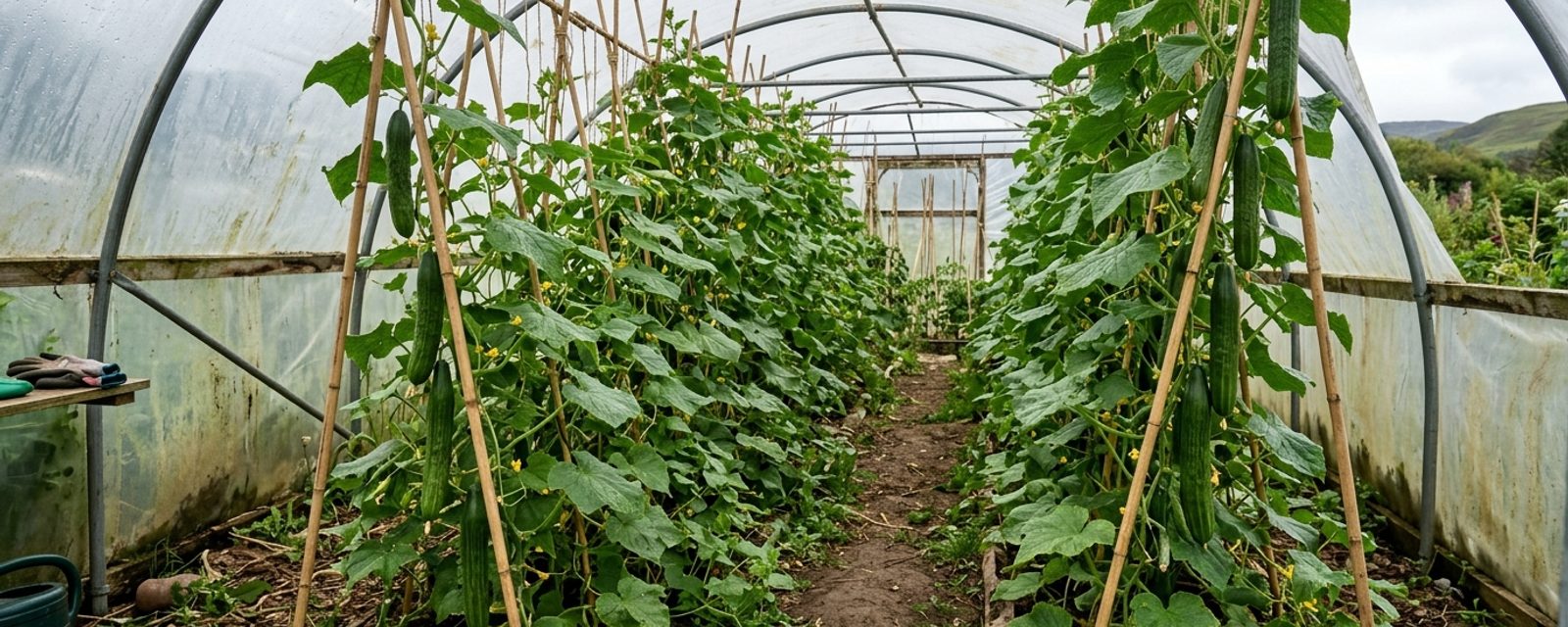
If your greenhouse cucumbers keep coming out bitter and seedy by August, or your outdoor plants have sat there sulking all summer without setting a single fruit, the variety on the seed packet is often more to blame than anything you did wrong. Cucumbers split into two genuinely different jobs, greenhouse types bred to crop smooth and sweet under glass, and hardier ridge types bred to take Scottish open ground, and growing the wrong one for your setup is the single most common reason for a disappointing crop.
Quick answer
Carmen is the best all-round choice for most Scottish growers with any kind of greenhouse or polytunnel: it carries the AGMThe RHS's Award of Garden Merit: a UK-wide trials award for reliable performance, not a Scotland-specific recommendation. Full definition →, crops heavily, and its disease resistance matters more here, where humid, unheated glass through a cool wet summer favours powdery mildew. Growing entirely outdoors in open ground, Marketmore is the stronger pick instead, and if your greenhouse is unheated and you want a variety specifically noted for tolerating that, Bella is worth considering despite lacking an AGM.
Bitterness and seediness in a greenhouse cucumber almost always means an all-female variety got pollinated, either a stray male flower left on the plant, or one that drifted in from elsewhere. Outdoor ridge varieties work the opposite way: they need insects pollinating both male and female flowers to set fruit at all, so a poor pollinator year is the likely cause if an outdoor plant flowers but never fruits. The cucumber growing guide has the full sowing dates, spacing and the 12°C threshold that makes outdoor planting a harder bar to clear reliably here than milder parts of the UK.
Two hardiness ratings come up below: H1CThe RHS's H1a–H7 scale for how much cold a plant can survive outdoors, H1a being tender indoor-only and H7 hardy anywhere in the UK. Full definition → means the plant needs a heated or well-protected structure and won't take anything below about 5°C, while H2 tolerates a few degrees lower without dying, though still not a frost. Neither changes the 12°C planting-out threshold above, Scotland's later, less reliable arrival at that threshold is the bigger factor for every variety here, not the small gap between the two ratings.
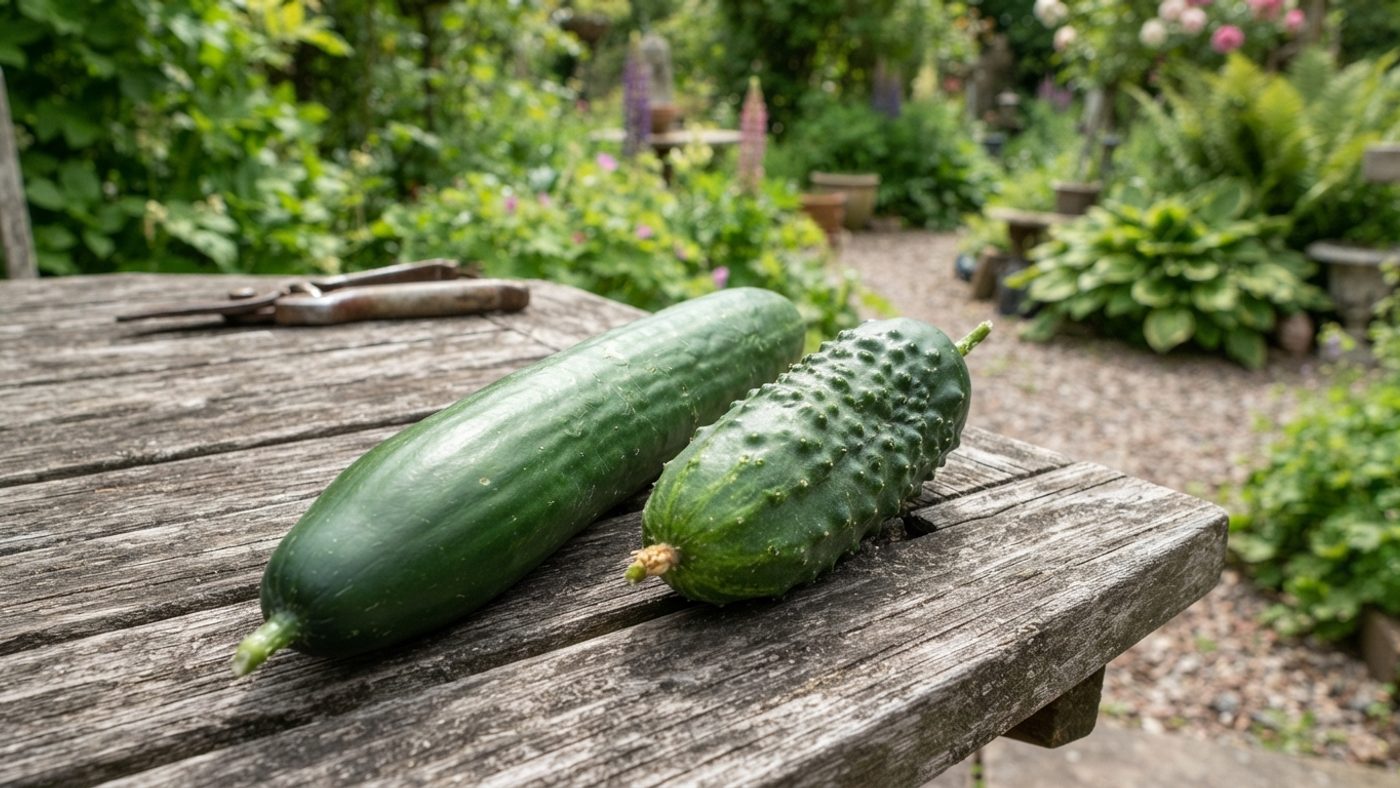
The seven varieties worth knowing
Six varieties carry the AGM on the general grow-your-own page, though only three hold up once checked against each variety's own individual plant page, details below. A seventh, Bella, has no RHS listing at all but carries a real, Scotland-relevant trait of its own.
Carmen
Carmen produces long, straight, mild-flavoured fruit up to 40cm under glass and crops heavily. It carries the AGM, confirmed on its own plant page, and shows general disease resistance, most usefully against powdery mildew. Under Scottish conditions, where greenhouses and polytunnels run humid for longer through a cool, wet summer, that resistance earns its keep more than it would further south. Hardiness rating H1C.
Marketmore
Marketmore is a ridge (outdoor) cucumber producing dark green, cylindrical fruit up to 20cm, and it's the best-corroborated outdoor pick available: named independently by Gardener's World and Teagasc as well as carrying a confirmed AGM. It's suitable outdoors or under glass and crops heavily. As a ridge variety it needs pollinating insects to set fruit, see the note above if an outdoor plant is flowering without fruiting. Hardiness rating H1C, the same rating given to most cucumber types regardless of growing method; it still needs to go in after frost risk has passed, same as every variety here.
Lili
Lili is a dual-purpose variety for greenhouse or outdoor growing, producing predominantly female flowers and a reliable crop of large fruit. It carries good disease resistance specifically to downy mildew, a fungal disease that spreads in the same damp, humid conditions as the powdery mildew Carmen resists above. It also has good storage ability, a trait no other variety here carries, since the general storage guidance for cucumbers is otherwise just a few days in the fridge, and an H2 hardiness rating, a step more cold-tolerant than Carmen's H1C. It does come with a caveat on outdoor growing: suited to an unheated greenhouse or outdoors "in warmer areas," a real hedge against treating Lili as a strong open-ground choice in most of Scotland. Because it's predominantly female-flowering, it needs the same male-flower-removal check as Bella; the growing guide covers how.
Lili is tagged AGM on the general grow-your-own page, but no AGM badge appears anywhere on its own individual plant page, see the discrepancy section below for what that means if you're comparing seed packets.
Mini Munch
Mini Munch is an all-female, heavy-cropping variety producing small, snack-sized fruit around 7cm, cropping June to October under glass. Its AGM is confirmed on its own plant page, unlike Emilie and Delistar below, which carry the same tag on the general page but not on their own.
Emilie
Emilie produces almost entirely female flowers and a large crop of mid-sized, smooth-skinned fruit, harvested July to October, with disease resistance described only in general terms, unlike Lili's, it isn't tied to a named pathogen. Hardiness rating H1C. Despite being tagged AGM on the general page, its own individual plant page carries no AGM badge or mention at all.
Delistar
Delistar produces small, aromatic fruit around 16-18cm with thin, sweet skins that need no peeling, a genuine culinary trait rather than a climate one. Hardiness rating H2. Like Emilie, it's tagged AGM on the general page, but its own individual plant page shows no AGM badge anywhere.
Bella
Bella is an all-female variety producing long fruit up to 35cm, tolerant of unheated-greenhouse conditions and of powdery mildew, a combination that matters directly for an unheated Scottish greenhouse or polytunnel, exactly the humid, unheated setup that favours the disease. Bella carries no RHS listing and no AGM, so treat it as a genuinely useful option rather than as verified to the same standard as the AGM varieties above.
Bush Champion, a compact variety suited to smaller gardens or containers, is also worth knowing if space is the main constraint, named only in passing by Gardener's World, with no hardiness rating or disease detail published beyond its compact habit.
Variety comparison
| Variety | Environment | AGM (own page) | Hardiness | Standout trait |
|---|---|---|---|---|
| Carmen | Greenhouse | Yes | H1C | Long straight fruit, disease resistance |
| Marketmore | Outdoor/ridge, or under glass | Yes | H1C | Best-corroborated outdoor pick |
| Lili | Greenhouse, or outdoor in warmer areas | No, see below | H2 | Downy mildew resistance, storage ability |
| Mini Munch | Greenhouse | Yes | H1C | Small snack-sized fruit, heavy cropper |
| Emilie | Greenhouse | No, see below | H1C | Female-flowering, smooth skin |
| Delistar | Greenhouse | No, see below | H2 | Thin, sweet, no-peel skin |
| Bella | Unheated greenhouse | Not RHS-listed | — | Unheated-greenhouse and powdery mildew tolerance |
The AGM discrepancy, explained
Six varieties carry an AGM tag on the general cucumber grow-your-own page. Checking each one's own individual plant page shows the badge genuinely present for only three of them: Carmen, Marketmore and Mini Munch. Lili, Emilie and Delistar are all tagged AGM on the general page but carry no AGM badge on their own individual pages.
Lili's downy mildew resistance, storage ability and H2 hardiness are real and useful regardless of the AGM question, but its AGM claim doesn't hold up under its own individual listing. If you're comparing seed packets that all print "AGM" on the front, it's worth checking the variety's own RHS page rather than taking the packet at its word.
Which one for your situation
Best overall: Carmen. Of the three varieties whose AGM genuinely holds up on their own page, it's the one built specifically for the disease pressure a humid Scottish greenhouse creates.
Three situations where a different variety wins:
- Growing entirely in open ground, no glass at all: choose Marketmore. It's the only variety here purpose-bred for ridge growing outdoors, corroborated by Gardener's World and Teagasc as well as RHS. Outdoors, watch for slugs on young plants, a bigger risk in open ground than under cover.
- Unheated greenhouse with no supplementary heat: choose Bella, for the unheated-tolerance and powdery-mildew combination, but weigh that against the fact that it carries no RHS listing at all.
- Wanting a hardier, better-storing pick despite the AGM question: choose Lili. H2 hardiness and genuine storage ability are real advantages, even with the AGM claim unresolved.
Soil pH
No specific pH figure is published for cucumbers by the sources this site draws on.
Common questions
Is Lili really an AGM variety?
RHS's general grow-your-own page lists it as AGM, but Lili's own individual plant page carries no AGM badge or mention anywhere on it. The same pattern holds for Emilie and Delistar.
What's the best cucumber for an unheated greenhouse in Scotland?
Bella is the variety specifically named for unheated-greenhouse tolerance combined with powdery mildew resistance, though it carries no RHS listing at all. Lili's own page also allows for unheated greenhouse growing and adds downy mildew resistance and storage ability.
Can I grow cucumbers outdoors in Scotland without an AGM variety?
Yes, but Marketmore, which does carry a confirmed AGM on its own page, is the best-corroborated outdoor choice available, named independently by Gardener's World and Teagasc as well as RHS.
Do I need to remove male flowers on these varieties?
Only on the predominantly or entirely female-flowering types, Lili and Bella. Ridge types like Marketmore don't need it.
Sources
9 sources, recorded with what each was used for
- Cucumbers: Grow Your Own: General variety list and AGM naming, cross-checked against individual plant pages below
- Cucumis sativus 'Carmen': Fruit size, disease resistance, AGM confirmation, hardiness
- Cucumis sativus 'Marketmore': Fruit size, AGM confirmation, hardiness, outdoor suitability
- Cucumis sativus 'Lili': Disease resistance detail, storage ability, hardiness, AGM discrepancy, outdoor hedge
- Cucumis sativus 'Mini Munch': Fruit size, cropping season, AGM confirmation, hardiness
- Cucumis sativus 'Emilie': Variety description, AGM discrepancy, hardiness
- Cucumis sativus 'Delistar': Fruit description, AGM discrepancy, hardiness
- How to Grow Cucumbers: Bella variety description, Bush Champion mention, independent corroboration of Marketmore
- Cucumbers (Greenhouse and Salad Crops): Independent corroboration of Marketmore as an outdoor variety