
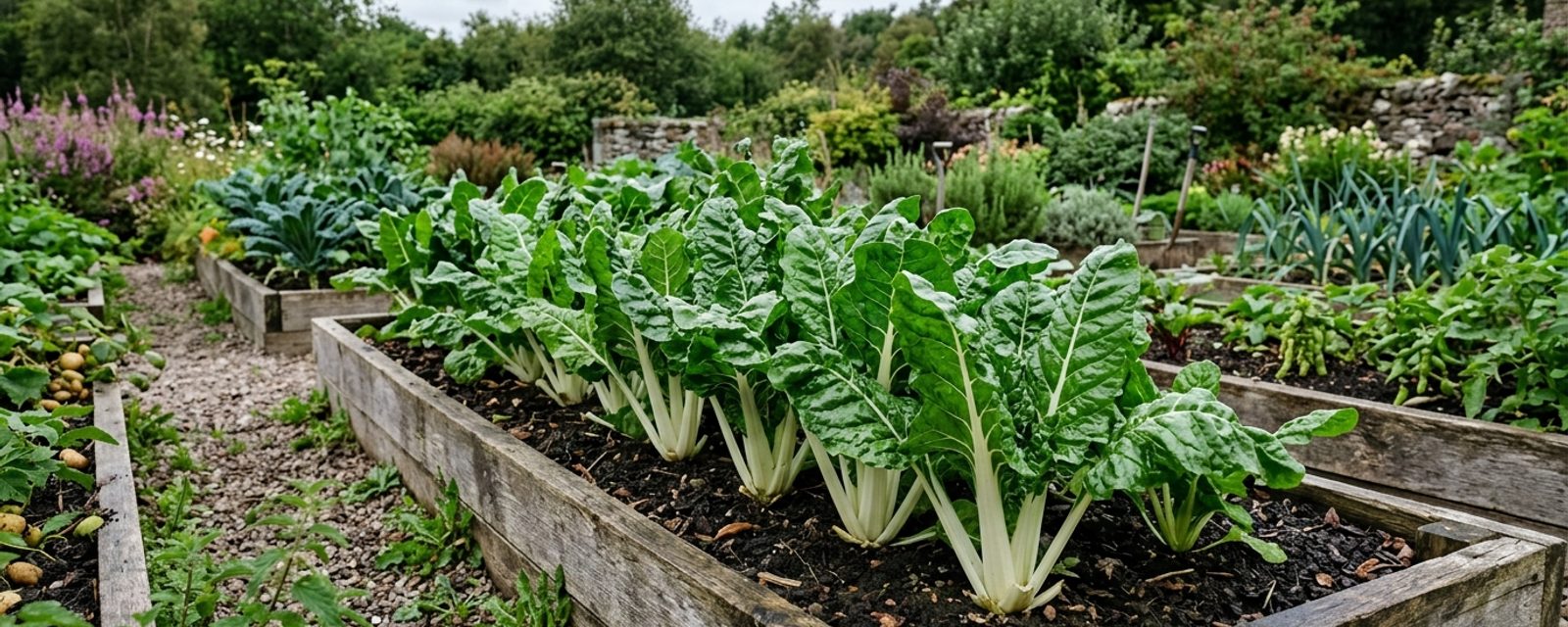
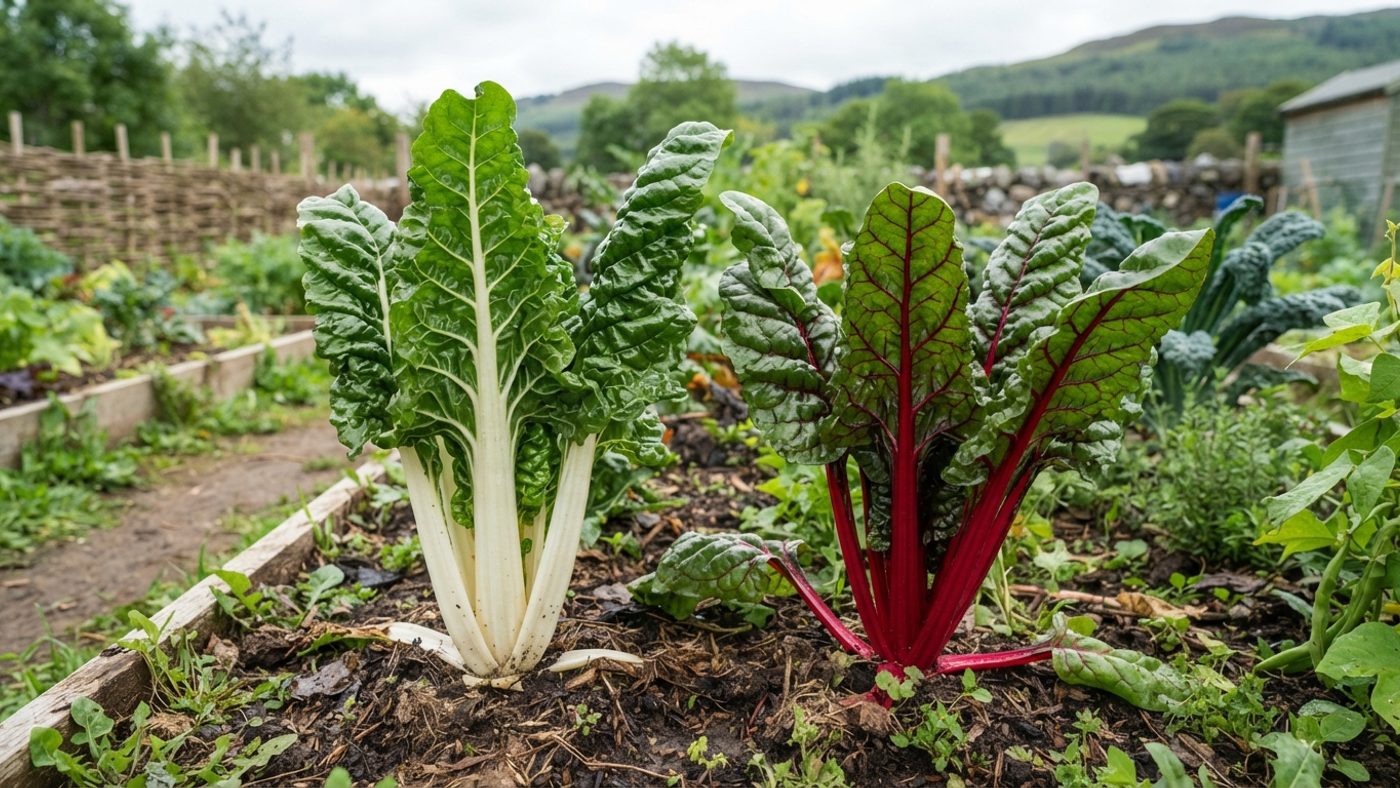
Stem colour in chard isn't just decorative, it's a marker for a real physiological trade-off. Anthocyanin, the pigment that turns a chard stalk red, purple or deep gold, is produced by the same stress-response pathway that pushes a plant toward boltingA plant switching early into flowering and seed production, usually triggered by stress, after which leaves, roots or bulbs turn bitter or unusable. Full page →: heat, long daylight, or a cold shock all trigger the hormonal cascade that says "flower now." Breeding for strong stem colour has historically ridden along with that same stress-sensitive physiology, which is why white-stemmed chard has a long reputation as the hardier, slower-to-bolt type and coloured-stemmed chard as the more temperamental one. A changeable, stop-start season like Scotland's, cold snaps, short daylight windows, wet spells, is the kind of growing conditions where that difference is most likely to matter. But the named varieties don't sort into two neat camps, and picking well means knowing which ones break the pattern.
Quick answer
Fordhook Giant remains the best all-round pick for Scotland: it holds the AGMThe RHS's Award of Garden Merit: a UK-wide trials award for reliable performance, not a Scotland-specific recommendation. Full definition →, has white stems, and is bred specifically for productivity and cold tolerance. If stem colour matters, for a flower border or a container display, Bright Yellow is the one exception worth knowing: unlike most coloured-stemmed chard it's specifically noted as slow to bolt and winter-hardy. Charlotte, a red-stemmed variety, is the next-best colour option, with "very good resistance to bolting" stated on its own plant page. Straight rainbow mixes like Bright Lights trade some of that resilience for looks.
The mechanism: why stem colour and bolting are linked
White-stemmed chard is named as the hardiest and most productive choice for colder locations, never bred under the same colour-and-stress-linked pressure as the coloured types, and Gardener's World separately notes that red-stemmed varieties are more prone to bolting.
Two of the named coloured-stemmed cultivarsA plant variety that arose or was bred under cultivation and is kept true by deliberate propagation, rather than a naturally occurring wild species. Full definition → below carry their own, individually recorded bolt-resistance traits, though, real exceptions to that rule, not just decorative colour.
Where the varieties actually sit
The full figures are in the table below. A few things worth knowing before you buy.
Charlotte and Rhubarb Chard get mixed up constantly. The general grow-your-own page calls Charlotte "often known as rhubarb chard", but they're catalogued as two separate cultivars, and only Charlotte's individual plant record states bolt resistance; Rhubarb Chard's doesn't mention bolting at all. If red stems are wanted specifically for bolt tolerance, that's a reason to seek out Charlotte by name rather than assume any red-stemmed seed packet behaves the same way.
Bright Yellow is missing from the general recommended-varieties list, despite holding the AGM (H3The RHS's H1a–H7 scale for how much cold a plant can survive outdoors, H1a being tender indoor-only and H7 hardy anywhere in the UK. Full definition → hardiness, hardy in coastal and relatively mild parts of the UK, down to about -5°C) and its own plant record calling it "slow to bolt" with "good Winter hardiness." The general grow-your-own page names Rhubarb Chard, Bright Lights, Charlotte, Fordhook Giant and White Silver but skips it, for reasons that aren't stated. Gardener's World fills the gap, recommending it directly and naming it, alongside Bright Lights, as one of only two varieties it explicitly recommends for overwinteringKeeping a plant alive and intact through the cold months, whether left outdoors, moved under cover, or stored dormant. Full definition →.
Bright Lights' overwintering claim is conditional on soil, not a flat "yes": its own record states it's hardy only "in areas where the soil is not too wet." That matters most in Scotland's wetter, higher-rainfall areas, a free-drainingSoil that lets water pass through quickly rather than pooling, so roots aren't sitting in wet ground after rain. Full definition → raised bed or container gives it a better chance of surviving winter than open, waterlogged ground.
H3 hardiness doesn't mean safe everywhere in Scotland. All five AGM varieties share that same rating, hardy down to roughly -5°C, in "coastal and relatively mild parts of the UK", not a description that fits every Scottish site: an inland or upland garden can see colder than that in a hard winter, check the regional frost dates for your own area. A clocheA small, portable clear cover placed over an individual plant or short row to trap warmth and keep off wind, rain and pests. Full definition → or fleeceA lightweight, breathable fabric laid or draped over plants to trap a little warmth and keep off frost, wind and some flying pests. Full definition → over any of these varieties through the coldest snaps, as covered in the full growing guide, is worth it further from the coast.
Comparison table
| Variety | Stem colour | AGM | Hardiness | Bolt tendency | Best for |
|---|---|---|---|---|---|
| Fordhook Giant | White | Yes | H3 | Low, bred for productivity, hardy | Best overall: reliable cropping, winter harvest |
| Bright Yellow | Golden yellow | Yes | H3 | Low, explicitly "slow to bolt" | Colour without giving up hardiness |
| Charlotte | Dark red | Yes | H3 | Low, "very good resistance to bolting" | Containers, borders, red colour with resilience |
| Rhubarb Chard | Bright red | Yes | H3 | Not stated | Ornamental red stems, ornamental/edible dual use |
| Bright Lights | Rainbow (red/yellow/orange) | Yes | H3 | Moderate, softer, soil-conditional overwintering claim | Maximum colour range, accept less certain hardiness |
| White Silver | White | No | Not stated | Low, hardy, good early-winter cropping | Budget-friendly hardy white pick |
Hardiness rating alone doesn't separate the five AGM varieties, since they're all rated the same, bolt tendency and the overwintering caveats above are the more useful distinctions for a Scottish garden.
The best overall pick
Fordhook Giant is the best default choice for most Scottish gardens. It's white-stemmed, AGM-holding, and the only variety in this list with a stated winter harvest window: sown in July, its leaves can be picked right through winter until March.
Two situations change the answer. For a flower border, container display, or anywhere stem colour is the point, Bright Yellow is the pick that doesn't force a trade-off, it's the one coloured-stemmed variety independently flagged as slow to bolt and winter-hardy. For a red stem specifically, Charlotte is the better-supported choice over a generic "rhubarb chard" seed packet, since its own plant page records bolt resistance directly, a claim not made for the plainer Rhubarb Chard cultivar.
Soil
No specific soil pH figure is published for chard. The available growing notes give only broad categories, acid, neutral or alkaline soils are all tolerated, not a numeric range.
Common problems
The named chard varieties above share the same pest and disease exposure as chard generally: slugs, grey mould (botrytis), downy mildew, and beet leaf miner. Bright Yellow's own record additionally flags susceptibility to birds and snails alongside the standard list, and Bright Lights' own record separately notes flea beetle susceptibility, neither called out on the general chard page. For sowing depth, spacing, watering, and harvest technique, see the full chard growing guide.
Common questions
Is white-stemmed chard always the hardiest choice?
As a general rule, yes, white-stemmed chard is the hardiest and most productive type for cold locations. But it isn't a strict rule: Bright Yellow (gold-stemmed) and Charlotte (red-stemmed) are both individually recorded as bolt-resistant, so colour alone shouldn't rule a variety out if hardiness is the priority.
Why isn't Bright Yellow on the main chard-growing page if it's AGM-holding?
It's a genuine gap rather than a quality issue, Bright Yellow has its own individual plant record with the AGM and a "slow to bolt... good Winter hardiness" note, and Gardener's World names and recommends it directly, but the general grow-your-own summary page simply doesn't include it in its variety list.
Are Rhubarb Chard and Charlotte the same variety?
Closely related and often marketed under overlapping names, but catalogued separately, each with its own AGM. Only Charlotte carries a stated bolt-resistance trait; Rhubarb Chard doesn't.
Does White Silver really hold an Award of Garden Merit?
No. It's listed on the general chard-growing page without an AGM marker, unlike the five other named cultivars here. It's still a robust, hardy white-stemmed variety, good for early-winter cropping, just not an award-holding one.
Sources
7 sources, recorded with what each was used for
- How to Grow Chard: General variety list and the white-stemmed/hardiness finding
- Beta vulgaris 'Rhubarb Chard': AGM status, stem/leaf traits, hardiness rating
- Beta vulgaris 'Charlotte': AGM status, bolt-resistance note
- Beta vulgaris 'Bright Yellow': AGM status, bolt/hardiness traits, pest susceptibility
- Beta vulgaris 'Fordhook Giant': AGM status, productivity and winter-harvest window
- Beta vulgaris 'Bright Lights': AGM status, overwintering note, pest susceptibility
- How to Grow Swiss Chard: Bright Yellow and White Silver recommendations, red-stem bolting note, overwintering picks