
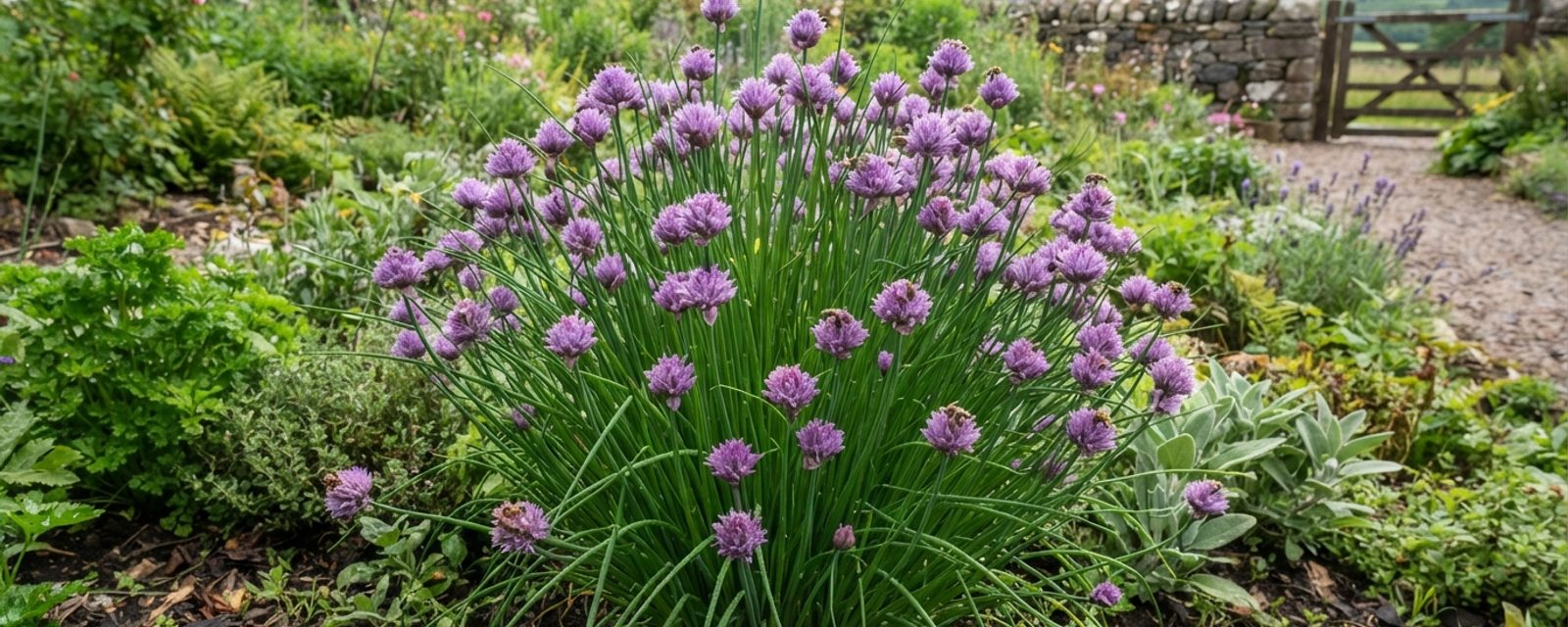
If you've ever bought a pot labelled "chives" that turned out to taste of garlic instead of onion, or had flat leaves instead of the usual fine, hollow tubes, you didn't get sold the wrong plant. Ordinary chives (Allium schoenoprasum) and garlic chives (Allium tuberosum) are genuinely different species, not two versions of the same herb, and mixing them up at the garden centre is an easy, understandable mistake.
Quick answer
For an onion-flavoured chive for everyday kitchen use, grow ordinary chives (Allium schoenoprasum), the standard choice, and the one almost everyone means by "chives." Grow garlic chives (Allium tuberosum) alongside it if you want a mild garlic flavour and flat leaves instead. If your ground is heavier or wetter than most alliums tolerate, Siberian garlic chives (Allium nutans) is the one form here that genuinely tolerates wet soil. The other named forms, 'Forescate', the white-flowered f. albiflorum, and 'Silver Chimes', are ordinary chives in different flower colours and sizes, not a different plant to choose between; pick by looks, not by any practical growing difference.
No chive of any kind, ordinary, garlic, or Siberian, holds an RHS Award of Garden Merit, so there's no award-based ranking to lean on the way there is with apples or roses. The real decision is which species and named form actually suits what you want from the plant: everyday cooking, a different flavour, an unusual site, or a longer flowering display. For full growing detail once you've picked, see the chives growing guide, which covers ordinary and garlic chives together.
The five named chive forms compared
("f." in f. albiflorum is short for forma, the botanical rank for a colour or minor variation within a species, not a typo or a different kind of plant.)
| Form | Species | Flower | Height/spread | Hardiness | Flavour/leaf |
|---|---|---|---|---|---|
| Common chives | A. schoenoprasum | Purple, early summer | ~30cm / 25cm | Not stated on the general RHS grow-guide page | Mild onion; fine, hollow, round leaves |
| 'Forescate' | A. schoenoprasum | Pink, larger form | Not individually stated | Not individually stated | Mild onion; larger plant overall |
| f. albiflorum | A. schoenoprasum | Pure white, early summer | 10-30cm / 10-30cm | H6The RHS's H1a–H7 scale for how much cold a plant can survive outdoors, H1a being tender indoor-only and H7 hardy anywhere in the UK. Full definition → (hardy to -20°C) | Mild onion; identical to common chives apart from flower colour |
| 'Silver Chimes' | A. schoenoprasum | Silvery-white, late summer | ~25cm / under 10cm | H6 | Mild onion; compact, later-flowering |
| Garlic chives | A. tuberosum | White, star-shaped, late summer/autumn | Up to 50cm / to 50cm | H5 (hardy to -15°C) | Mild garlic; flat, wider leaves |
| Siberian garlic chives | A. nutans | Rose-pink to mauve-blue or white, early-mid summer | Up to 60cm / 30cm | H6 | Mild garlic-like; broad grey-green leaves; tolerates wet soil |
H5 means hardy to -15°C, H6 to -20°C. All five named forms sit at H5 or H6, comfortably within what a typical Scottish winter asks of a plant, with no protection needed at those ratings; a hard, exposed upland site is the exception, where any rating still carries real risk in a severe winter. A hardiness figure at all is only available per named form, not chives generally, the general RHS chives page states no hardiness rating anywhere on it, confirmed directly rather than assumed, so this table is the only place that comparison exists.
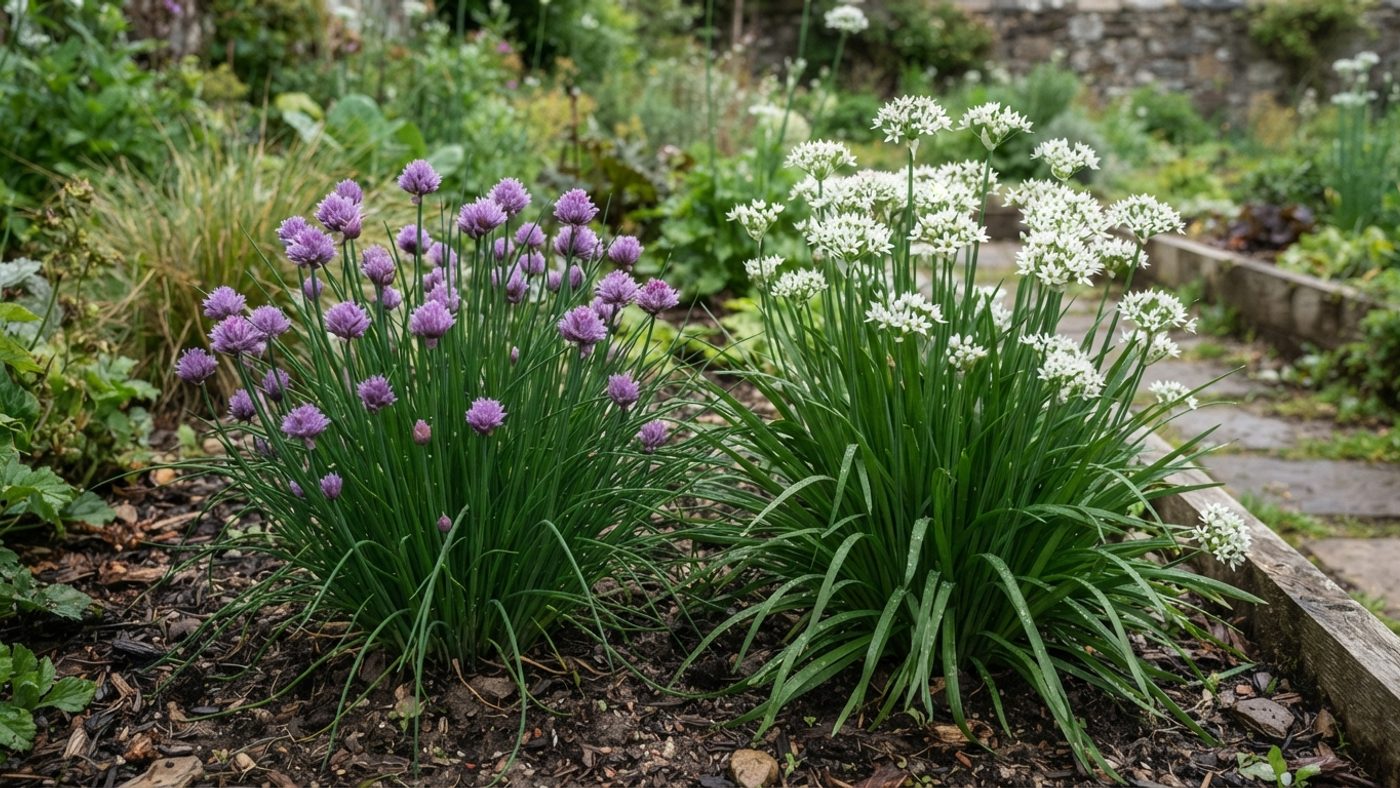
Onion or garlic: the choice that actually matters
Ordinary chives give the familiar mild onion flavour from round, hollow, tubular leaves, with purple flowers, edible in salads or scattered as a garnish, in early summer. Garlic chives give a genuinely different, milder garlic flavour from flat, solid leaves that are noticeably wider, with white, star-shaped, fragrant flowers arriving later, in July and August rather than early summer, also edible.
That flavour gap has a real kitchen consequence: garlic chives aren't a substitute for ordinary chives in a recipe that calls for an onion note, and the reverse is also true. Grow both if your cooking uses both flavours regularly; there's no reason to pick only one once you know they're not interchangeable.
Garlic chives also want a warmer spot than ordinary chives specifically ask for: a south- or west-facing aspect in full sun, sheltered, with moist soil. Ordinary chives are less particular about aspect and tolerate partial shade. If you're short on the sunniest ground in the garden, that's a reason to give garlic chives the better spot and let ordinary chives take the shadier one.
One flavour caution worth passing on: garlic chives' garlic flavour is much milder than an actual garlic clove, closer to a background note than a substitute for cooking with real garlic, useful in salads, dips, or as a garnish where a light hit is what you want, not the main flavour of a dish.
Garlic chives are toxic to dogs, cats and horses, the same caution attached to onions, garlic and other alliums generally. Worth knowing if pets or grazing animals have access to where they're grown, even though it isn't a concern for the humans doing the cooking.
The three ordinary-chive forms: flower colour, not a different plant
'Forescate', f. albiflorum, and 'Silver Chimes' are all Allium schoenoprasum, the same species as common chives, grown for a different look rather than a different use. None carries an AGMThe RHS's Award of Garden Merit: a UK-wide trials award for reliable performance, not a Scotland-specific recommendation. Full definition →, and none behaves differently in the garden beyond size and bloom.
- 'Forescate' is a larger form of ordinary chives with pink flowers. No individual size or hardiness figure is published for it beyond that description.
- f. albiflorum is ordinary chives with pure white flowers instead of purple, a colour form, not a distinct cultivarA plant variety that arose or was bred under cultivation and is kept true by deliberate propagation, rather than a naturally occurring wild species. Full definition → bred for any other trait. It carries the same H6 hardiness, similar height and spread, and the same growing needs as common chives; the flower colour is the only meaningful difference. Grown near ordinary purple-flowered chives, its seedlings may not come true to white, so divisionPropagating a clump-forming perennial by digging it up and splitting it into several smaller pieces, each with roots and shoots attached. Full definition → is the more reliable way to keep the colour, and deadheadingRemoving spent flowers before they set seed, which redirects a plant's energy into further flowering rather than seed production. Full definition → spent flowers before they set seed is worth doing on any of these three forms if you want to keep a border's mix of colours distinct rather than let them cross and self-seed into a muddle over a few years.
- 'Silver Chimes' is a compact cultivar, around 25cm tall, with silvery-white flowers that arrive later, in late summer rather than early summer. That later bloom is its one genuinely practical difference from the other forms here: planting it alongside common chives extends the flowering, pollinator-attracting window rather than having every chive in the bed finish at once.
None of this changes how you grow or harvest the plant. If flower colour or a staggered bloom time matters to you, or you want a chive for a border rather than purely for the kitchen, pick by looks. If it doesn't, common chives do the job with no trade-off either way.
Siberian garlic chives: the one for wet ground
Allium nutans is a genuinely different plant from the other four, not a colour or size variant. It grows taller than the others, to around 60cm, with broad, grey-green leaves rather than the fine round leaves of common chives or the flatter leaves of garlic chives. Its flowers are rose-pink to mauve-blue or white, in early to mid-summer, on leafless stems held above the foliage.
The real reason to grow it specifically: it genuinely tolerates wet soil, unlike most Allium species, which generally want free-drainingSoil that lets water pass through quickly rather than pooling, so roots aren't sitting in wet ground after rain. Full definition → ground. Most of this comparison's forms share the usual allium preference for moist-but-well-drained conditions; a naturally damp corner of a Scottish garden, or ground that doesn't drain quickly after rain, is a genuine reason to reach for Siberian garlic chives over any of the others rather than fight the site to grow a plant that wants better drainage than it's got. Its leaves are edible with a mild, chive-like flavour, though it's grown as much for its height and flower display as for cutting.
Soil pH: what's actually known
No numeric pH range is published for chives generally. For three named forms, f. albiflorum, garlic chives, and Siberian garlic chives, a broader answer exists on their own individual pages: all three tolerate acid, alkaline, or neutral soil equally. That's a genuinely wide tolerance, worth knowing if your own ground already runs acidic and you weren't sure chives would cope with it. It doesn't mean pH doesn't matter at all; it means chives are unusually unfussy about it compared with plants that do have a stated preference. In practice that means no pH testing or soil amending is needed before planting any chive form covered here, unlike a crop with a narrow stated target range.
Buying and starting: seed or a young plant
Ordinary and garlic chives can both be grown from seed.
| Ordinary chives | Garlic chives | |
|---|---|---|
| Sow indoors | Early spring, room temperature | From February |
| Sow direct outdoors | Spring, once soil has warmed | April to August |
| GerminationA seed sprouting: breaking dormancy and putting out its first root and shoot, given the right warmth and moisture. Full definition → | 20-25°C, around 3 weeks | Not separately stated |
| Spacing | 15-20cm | Around 10cm |
A Scottish spring typically stays cool for longer than further south, so starting either indoors rather than waiting for outdoor soil to warm is worth doing as standard, not just as a fallback for a bad year.
A ready-grown plant from a garden centre sidesteps the germination step and gets a clump established a season earlier, which matters more for the less common forms here, 'Silver Chimes', f. albiflorum, and Siberian garlic chives aren't always stocked, so seed or a specialist herb nursery may be the more realistic route for those three specifically, rather than a general garden centre.
Whichever form you're growing, cutting technique is the same: snip leaves with scissors near the base rather than pulling them, which encourages fresh regrowth, full step-by-step detail is in the chives growing guide. Freshly cut leaves are best used straight away; if you need to keep some, a few days in the fridge in a bag works, or chop and freeze in ice cube trays with a little water for longer storage.
Once established, division is the standard way to multiply any of these forms and keep older clumps productive. Ground-grown clumps are generally divided every three to four years as the centre grows woody and unproductive; chives kept in a container tend to need dividing and repotting sooner, roughly every couple of years, since a pot restricts root space in a way open ground doesn't. For garlic chives specifically, division also propagates true to type, which matters if you've bought a named form and want more of exactly that plant rather than seed-grown variation.
The pest and disease picture
Chives share the pest and disease list of the wider onion and leek family. Leek rust shows as orange pustules on the leaves and gets worse in wet summers, a real risk rather than an exception given how often a Scottish growing season delivers exactly that. It affects any of the chive forms here. Onion white rot and onion downy mildew both affect the wider allium family, including garlic chives specifically, downy mildew in particular favours the same cool, humid conditions a Scottish summer tends to deliver, so good spacing and airflow between clumps is worth doing as routine, not just after an outbreak.
Allium leaf miner tunnels through leaves, but it's rated low risk for Scotland specifically: RHS records it as established in England and parts of Wales, not Scotland. Garlic chives and Siberian garlic chives are also susceptible to slugs and snails, particularly while young, a risk shared with most seedlings and newly divided sections rather than anything specific to these two species. Aphids (greenfly) can also appear on new growth on any chive form; they're straightforward to remove by hand and very rarely kill an established plant.
None of the named forms in this comparison carries a pest or disease risk that the others don't; growing several forms together doesn't spread risk any wider than growing one.
Which one for your situation
Everyday kitchen chives, no particular fuss. Common chives, no contest. Mild onion flavour, tolerant of shade, no aspect requirement, and it's the form every garden centre stocks.
- You cook with a garlic note as often as an onion one: grow garlic chives alongside common chives rather than instead of them; they're different flavours doing different jobs, not one replacing the other. Give garlic chives the sunnier, more sheltered spot if you're choosing between sites.
- Boggy or slow-draining ground that struggles with most alliums: Siberian garlic chives is the genuine outlier here on drainage tolerance. Don't force garlic chives or common chives onto ground that doesn't drain; use the one form that genuinely tolerates it instead.
- A border or edging spot where flower colour and timing matter as much as the crop: 'Silver Chimes' for a later, silvery-white display; f. albiflorum for pure white in the usual early-summer window; 'Forescate' for a larger pink-flowered plant. All three are still edible, cutting-quality chives underneath the flower colour, so there's no trade-off against growing them for the kitchen too.
Common questions
Are garlic chives the same plant as ordinary chives, just a different variety?
No, they're a different species (Allium tuberosum versus Allium schoenoprasum), not two forms of the same plant. The leaves are a different shape (flat rather than round and hollow), the flavour is garlic rather than onion, and the flowers are a different colour and shape, appearing later in the season.
Is there an Award of Garden Merit chive worth seeking out?
No. No chive form covered here, ordinary, garlic, or Siberian garlic chives, nor any named cultivar of them, holds an RHS AGM. Choosing between them comes down to flavour, flower colour, and site, not an award.
What's the difference between 'Forescate', f. albiflorum, and 'Silver Chimes'?
All three are the same species as common chives, distinguished mainly by flower colour and size rather than any difference in flavour or growing needs: 'Forescate' is a larger plant with pink flowers, f. albiflorum has pure white flowers on an otherwise ordinary-sized plant, and 'Silver Chimes' is a compact form with silvery-white flowers that bloom later than the other two.
Is Siberian garlic chives (Allium nutans) worth growing over ordinary garlic chives?
Only if your site specifically calls for it, mainly wetter ground than most alliums tolerate. It's a taller plant with broader leaves and a milder, more background flavour than the flavour focus of garlic chives, grown as much for height and flower display as for cutting.
Sources
7 sources, recorded with what each was used for
- Chives: Grow Your Own: General spacing, sowing depth/method, harvesting, aphids as a named pest, and the list of named forms; confirms no hardiness rating is stated on this general page — independently confirmed by the hub via direct WebFetch
- Allium schoenoprasum f. albiflorum: Hardiness (H6), height/spread, flower colour and timing, soil pH tolerance
- Allium tuberosum: Hardiness (H5), height, flower colour/timing, aspect and sun requirement, soil pH tolerance, pest/disease susceptibility
- Allium nutans: Hardiness (H6), height/spread, flower colour/timing, wet-soil tolerance — independently confirmed by the hub via direct WebFetch
- Allium schoenoprasum 'Silver Chimes': Hardiness (H6), height/spread, flower colour and later bloom timing
- What are Garlic Chives?: Flavour and leaf comparison to ordinary chives, aspect/sun/moisture requirement, sowing windows and spacing, harvest and storage method, toxicity to dogs, cats and horses
- How to Grow Chives: Germination temperature and timing, container-vs-ground division frequency, pest management (greenfly by hand), leek rust disposal advice