
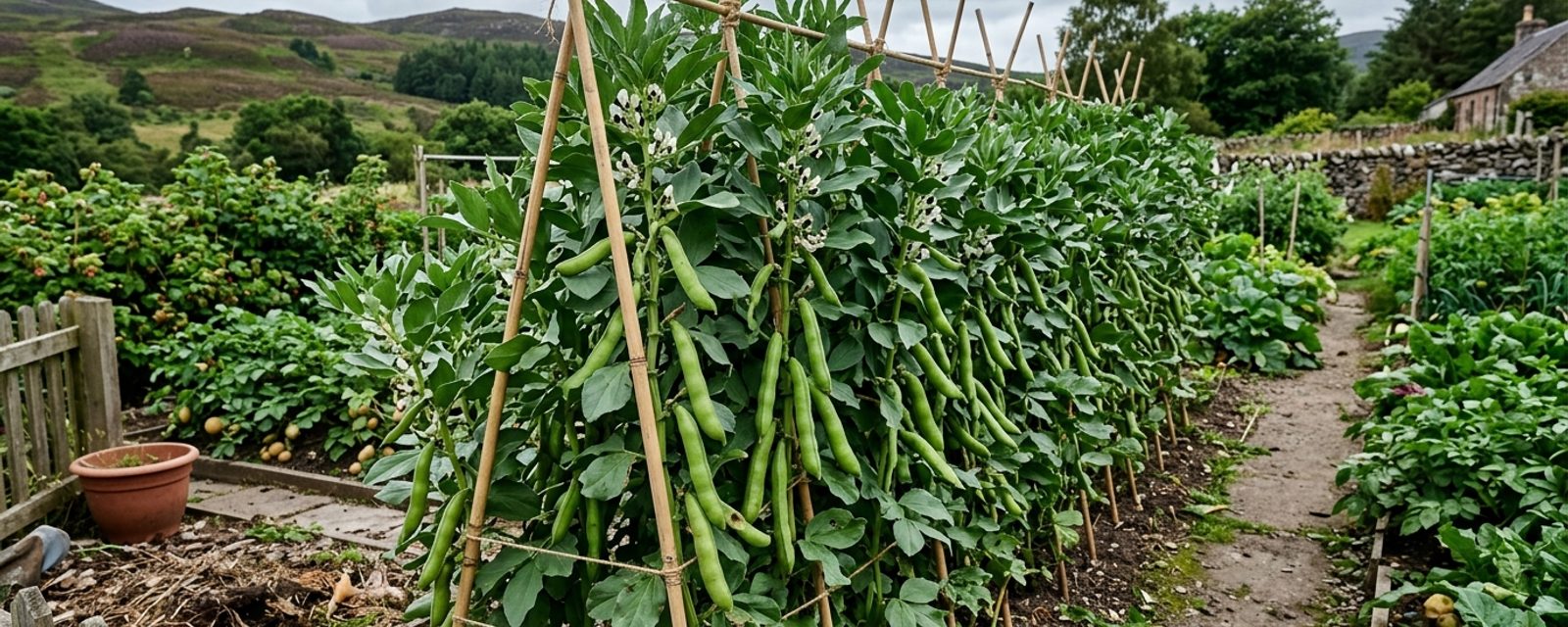
Vicia faba
Broad beans are a hardy, early cropper, and sown in autumn they beat almost every other vegetable to harvest. Their main pest is also less of a problem here than further south, thanks to a cool Scottish spring.
Two sowing windows do different jobs here. An autumn sowing of a hardy variety gets you a crop by May, well before a spring sowing has even flowered. A spring sowing, or several staggered a few weeks apart, keeps the harvest going through summer. Growing both isn't excessive: it's how this crop earns its space for the longest stretch of the year.
Sowing
Sow outdoors in March, April or early May for a summer crop, or a hardy variety in October or November (or February in mild areas) to overwinterKeeping a plant alive and intact through the cold months, whether left outdoors, moved under cover, or stored dormant. Full definition → for harvest from late spring. An indoor sowing in modulesA tray divided into small individual cells, each sown with its own seed or seedling, so each plant grows undisturbed roots until it's ready to plant out. Full definition → from February is also an option, hardened offGradually getting young plants raised indoors used to outdoor conditions over 7–14 days before planting out, so cold, wind and direct sun don't shock or damage them. Full definition → before planting out. Sow 5cm deep, and stagger a few batches weeks apart if you want cropping spread over a longer period rather than one glut.
Spacing and support
Space plants 15-23cm apart within the row. Row spacing depends on the method: 45cm between single rows, or 23cm between double rows with 60cm between each double-row pair. A simpler 60cm between rows throughout works too, a genuine alternative rather than a contradiction of the single/double-row breakdown.
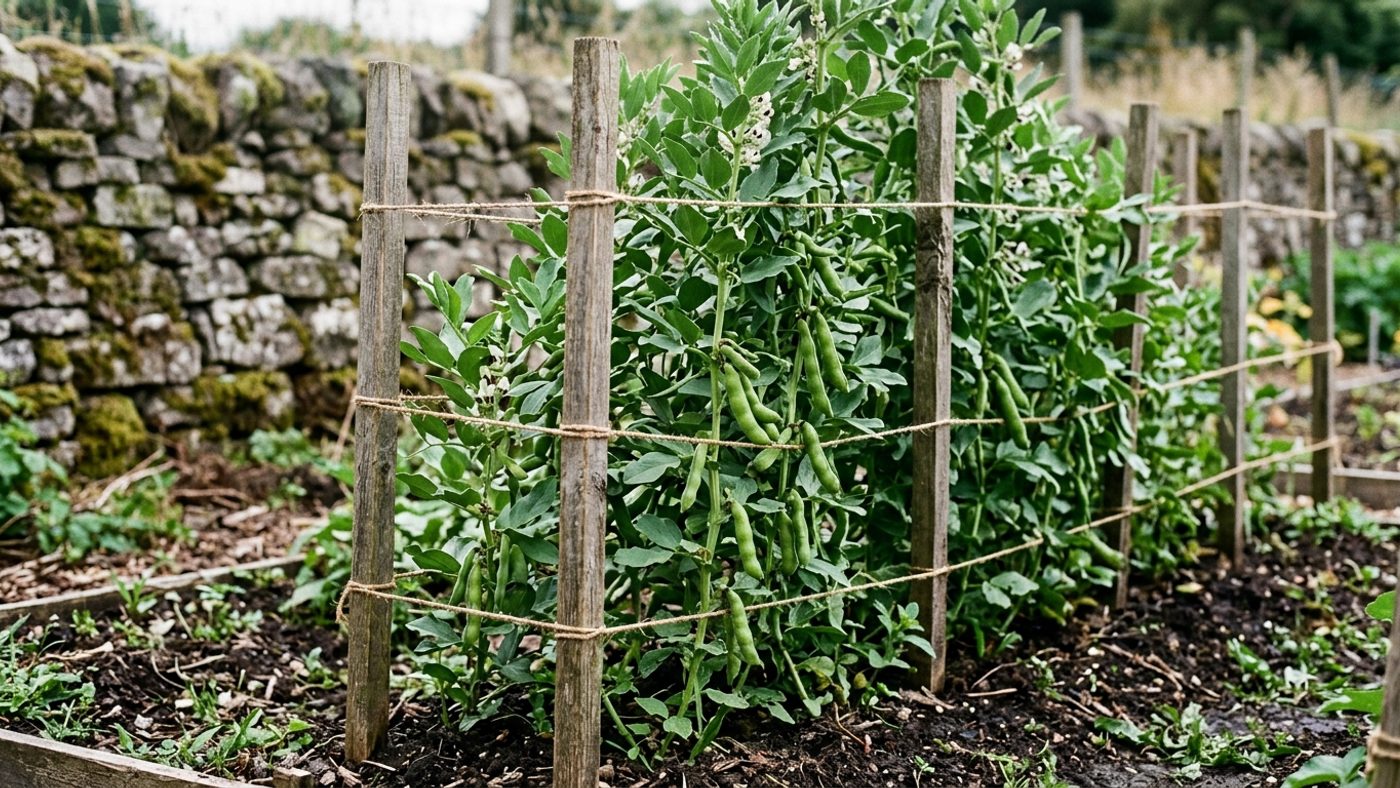
Taller varieties need staking: insert sturdy stakes at the corners and every 1.2m along the row, and run string around them at 30cm intervals as the plants grow. Dwarf varieties grown in double rows often support each other and need little or no staking at all.
Varieties
RHS also lists 'Witkiem Manita' (spring sowing, 1m tall, early long pods) with AGMThe RHS's Award of Garden Merit: a UK-wide trials award for reliable performance, not a Scotland-specific recommendation. Full definition →, and 'Dreadnought' (heritage, slender pods with 7-8 beans each), which RHS's general list tags AGM but whose own individual plant page shows no badge. The award is UK-wide, not a Scottish one.
★ Our pick for Scotland
Aquadulce ClaudiaAGM
Very hardy, autumn-sowing, long early pods
Sown in autumn, crops from May.
Why this one: Autumn sowing is this crop's strongest Scottish angle: Aquadulce Claudia is the variety bred and named for exactly that route, giving a harvest well ahead of anything sown fresh in spring, the same hungry-gap-beating pattern autumn sowing gives broccoli and spring onions.
Also worth considering
The SuttonAGM
Dwarf (45cm), suits containers and windy sites
Named by RHS specifically for windy sites, a real match for an exposed plot, and needs little to no staking.
Best Broad Bean Varieties for Scotland → compares all named broad bean varieties head-to-head, with the practical detail that doesn't fit in a summary card.
Watering and feeding
Broad beans in the ground generally don't need regular watering unless the soil is light and free-drainingSoil that lets water pass through quickly rather than pooling, so roots aren't sitting in wet ground after rain. Full definition →. A good soak as flowering starts, and again two weeks later, improves the harvest. Container plants need watering throughout the season, plus a high-potassium feed once a fortnight from first flowering.
Pinching out: pest control, not tidying
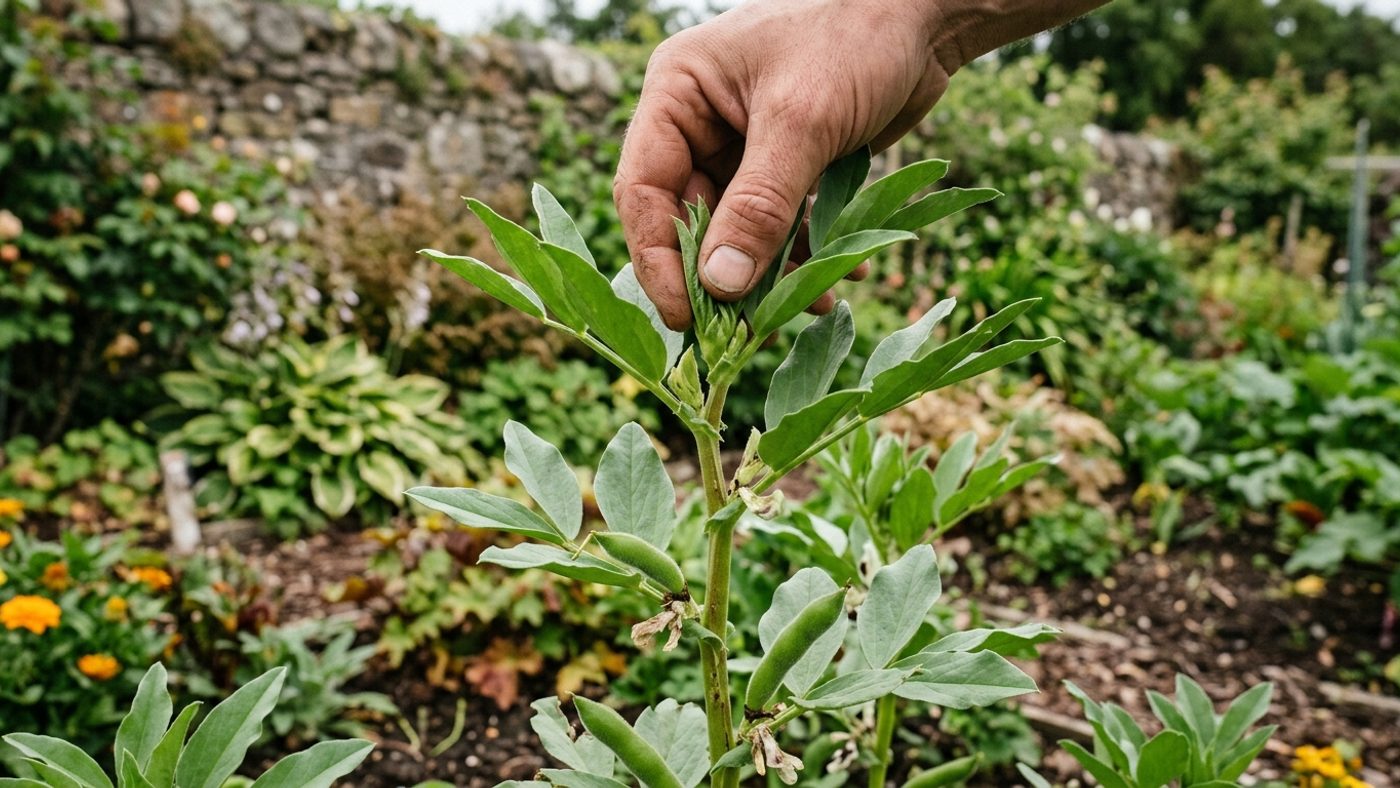
Once the lowest flowers have set small pods, pinch outRemoving the soft growing tip of a stem to stop upward growth and make the plant branch out sideways instead. Full definition → the growing tips. This isn't cosmetic: it redirects the plant's energy into pod production and specifically reduces blackfly, this crop's main pest, still worth doing even where a cool spring has already kept numbers down.
Harvesting
Pick pods while still full but relatively small, checking that the bean scar is white or green rather than black. This is an easy crop to leave too long, since the pods keep looking fine well past their best. Pick regularly to keep the plant producing. Once cropping finishes, cut plants down at the base and leave the nitrogen-fixing roots in the ground rather than pulling the whole plant up: they release nitrogen back into the soil for whatever's planted next.
Common problems
- Black bean aphid (blackfly) forms dense colonies on shoot tips, and other aphids can affect the plant more generally too. Pinch out tips once the first flowers set pods, especially after a warm spring.
- Chocolate spot is a fungal disease causing dark spots on all parts of the plant. Space plants properly for airflow, remove weeds, and bin or burn any infected material.
- Pea and bean weevils leave notch-like damage on leaf edges, and their larvae feed on the root nodules that fix nitrogen. Established plants tolerate it; seedlings are the stage to watch.
See more problems
- Broad bean rust causes small, dusty, dark brown spots on leaves.
- Mice and voles will eat sown seed before it germinatesA seed sprouting: breaking dormancy and putting out its first root and shoot, given the right warmth and moisture. Full definition →. Netting over newly sown ground also helps against birds and squirrels.
- Broad bean seed beetle can affect stored seed.
Common questions
Can broad beans be sown in autumn, or is spring the only option?
Autumn is a genuine option, not just spring: a hardy variety such as Aquadulce Claudia sown in October or November overwinters and crops from May, well ahead of a spring-sown batch. Full sourced breakdown: <a href='/tools/garden-myths/broad-beans/'>Broad Bean Myths →</a>
Should I pull up the whole plant after harvest, roots included?
No: cut the plant down at the base and leave the nitrogen-fixing roots in the ground, where they release nitrogen back into the soil for whatever's planted next. Full sourced breakdown: <a href='/tools/garden-myths/broad-beans/'>Broad Bean Myths →</a>
Is pinching out the growing tips just about keeping the plant tidy?
No: pinching out the tips once the first flowers set pods is specific blackfly control, not general tidying. Full sourced breakdown: <a href='/tools/garden-myths/broad-beans/'>Broad Bean Myths →</a>
Do all broad bean varieties need staking?
No: dwarf varieties such as The Sutton, around 45cm, are bred for windy sites and containers and often support each other in double rows without staking. Full sourced breakdown: <a href='/tools/garden-myths/broad-beans/'>Broad Bean Myths →</a>
Sources
3 sources, and what each was used for
- RHS: sowing windows for autumn, spring and indoor sowing, depth, spacing for single and double rows, soil prep, watering, feeding, staking, pinching out shoot tips against blackfly, harvest timing and method, post-harvest nitrogen-fixing advice, four named varieties with exact AGM status, pest and disease list
- Garden Organic: corroborates sowing windows and depth independently; adds that black bean aphid is specifically worse in warm springs, a detail RHS doesn't state this explicitly
- gardenersworld.com: corroborates depth and the blackfly pinch-out technique independently; gives a simpler single row-spacing figure (60cm) as an alternative to RHS's single/double-row breakdown; adds bird and squirrel netting for newly sown seed, and freezing as a storage method, neither mentioned by RHS