
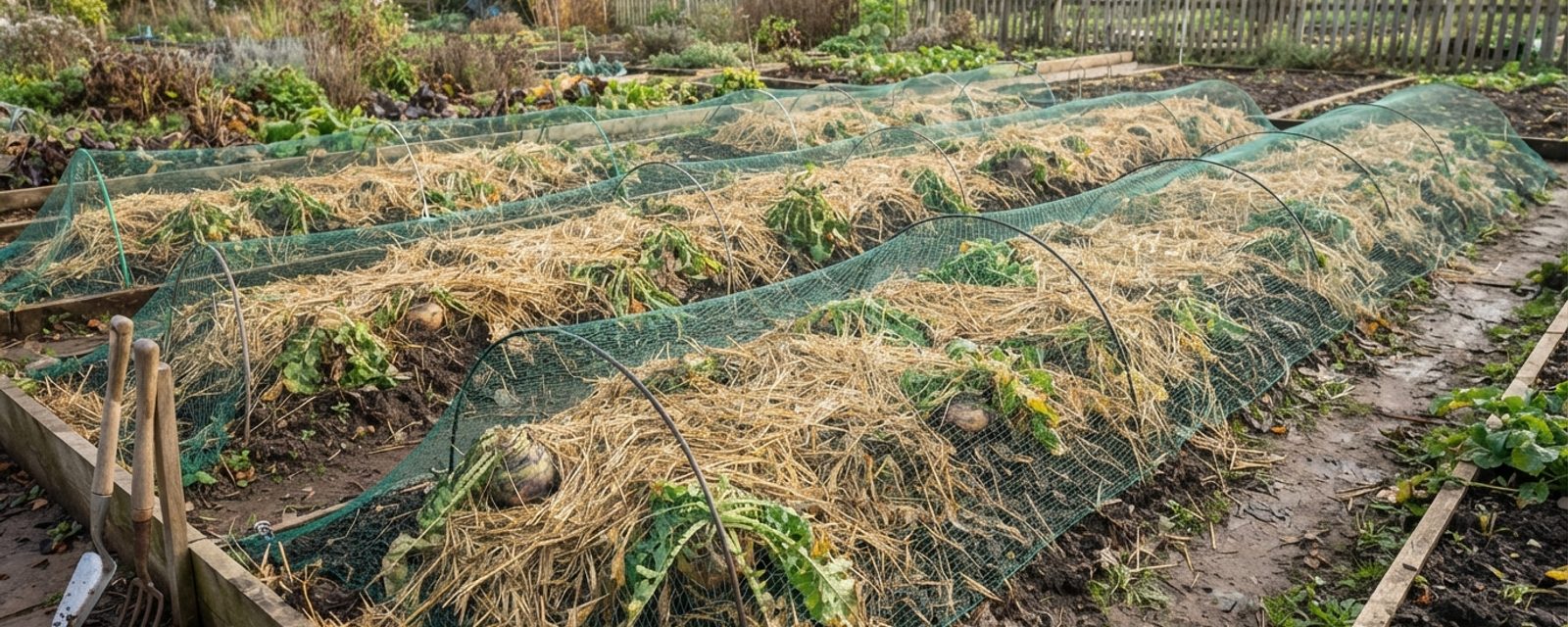
You're looking at a frost warning for tonight, and there's a row of swede and turnip still sitting in the ground. Do you leave them where they are, or get a fork out this afternoon and box them up before the weather turns? The honest answer depends on which crop you're looking at, how wet your soil sits over winter, and how soon you actually plan to eat them.
Both crops can be left in the ground under a thick mulchA layer of material spread over the soil around plants to suppress weeds, retain moisture, and improve soil structure as it breaks down. Full definition → and lifted as needed, or lifted now and packed in trays of moist sand or coir in a frost-free shed. Swede is the tougher of the two and can be left standing, or kept boxed, for months longer than turnip. Turnip doesn't have the same long-haul reputation, treat it as a "use it up over the next few weeks" crop rather than a store-till-spring one.
When to lift for storage
Timing depends on which crop and which method. Swede left in the ground can stay there right through into winter, and with protection it can be lifted as needed until March of the following year. Turnip left in the ground is more frost-sensitive, hard frost can damage the roots, and even under cover it's best used up before late winter rather than left standing as long as swede. If you're boxing rather than leaving roots in the ground, lift in late autumn, before the ground has properly frozen and before repeated hard frosts have had a chance to damage the roots.
Before lifting, check each root over: any showing slug or pest damage, splitting, a soft patch, or the swollen, distorted look of clubrootA soil-borne fungal disease of the brassica family that swells and distorts roots, and survives in soil for years. Full definition → should go in the kitchen now rather than into storage, a damaged root is the one that rots first and takes its neighbours with it. Lift on a dry day where you can; roots pulled from sodden ground carry extra moisture into the box with them, which works against the dry-and-airy step below. Full detail on growing, sizing, and named varieties for both crops is in the swede growing guide and the turnip growing guide, and how your area's first hard frost compares to the rest of Scotland is on the frost dates page.
How to box roots in sand or coir
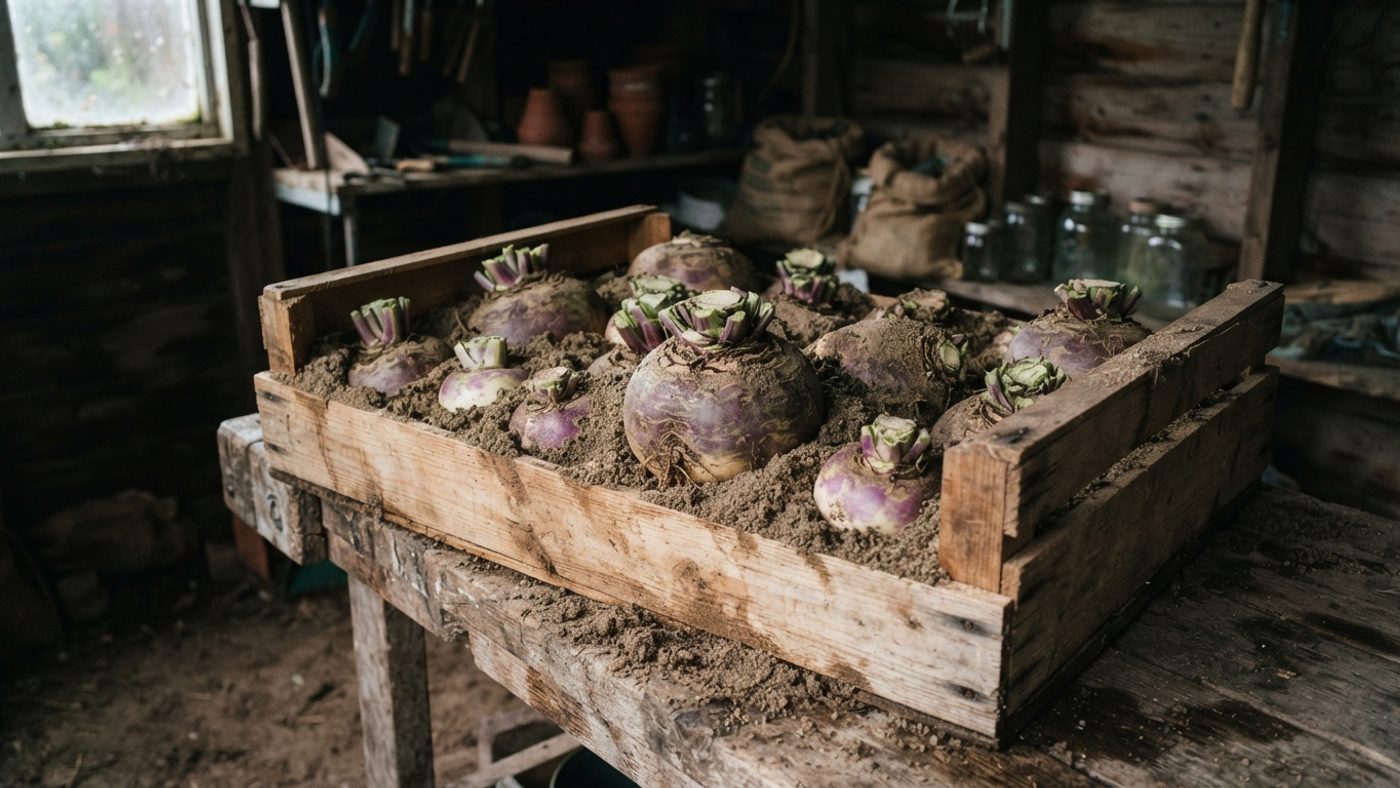
This is the standard method for both crops when you need them out of the ground:
- Lift the roots carefully with a fork, trying not to nick or bruise the skin.
- Twist or cut off the leafy tops, leaving a short stub, and brush off loose soil without washing.
- Leave the roots somewhere dry and airy for a few hours to let cut surfaces dry off before boxing.
- Line a wooden box, crate, or similar container with a few centimetres of moist sand, peat-freeCompost made without peat, which is harvested from a slow-forming, carbon-storing wetland habitat that peat extraction damages. Full definition → compost, or coir.
- Set the roots in a single layer so they aren't touching, then cover with more packing material.
- Repeat in layers if you have more roots than one layer will hold, finishing with a top layer of packing material.
- Store somewhere frost-free and dark, a shed, garage, or cellar. Keep the boxes away from apples and other stored fruit if you can, since the ethylene fruit gives off as it ripens can make stored roots sprout or turn bitter early.
Keep the packing material damp, not wet, the point is to stop the roots drying out and shrivelling, not to soak them. A genuinely cold spot, close to 0-4°C rather than merely above freezing, keeps roots firmer for longer than a shed that's only just frost-free.
In-ground overwintering vs lifting and boxing
Neither method is universally the answer, it comes down to how your ground drains and which crop you're storing. Whether the ground drains freely is the deciding factor for leaving roots in place, and it's a real question on plenty of Scottish plots: heavy clay and low-lying, high-rainfall ground both hold more water over winter than a free-drainingSoil that lets water pass through quickly rather than pooling, so roots aren't sitting in wet ground after rain. Full definition → bed does, whatever part of the country they're in.
| Factor | Leave in ground (mulched) | Lift and box |
|---|---|---|
| Best suited to | Free-draining soil, sheltered lowland sites | Heavy, wet, or waterlogged ground; exposed sites |
| Swede duration | Until March, under 15cm straw/bracken + netting or fleeceA lightweight, breathable fabric laid or draped over plants to trap a little warmth and keep off frost, wind and some flying pests. Full definition → | Several weeks in moist sand/compost, frost-free shed |
| Turnip duration | Best used before late winter, same covering | Several weeks in moist sand or coir, cool frost-free place |
| Main risk | Rot/splitting in waterlogged soil; frost damage to turnip | Drying out and shrivelling if packing isn’t kept damp |
Turnip's realistic keeping window is measured in weeks, swede's in months, whichever storage method you're using, plan your kitchen use accordingly rather than storing both at the same pace.
A large harvest of either crop can also be stored in a clamp, a mound of roots built on a bed of straw outdoors, covered with more straw and a layer of soil, with a straw wick left poking through the top for ventilation. It needs a well-drained site itself, so it doesn't solve the drainage problem, it just moves it outdoors; for most home harvests, boxed sand or coir does the same job with far less effort and risk.
Checking on stored roots through winter
Boxed roots need periodic attention, not just a one-off pack-and-forget. Check every few weeks for any roots that have gone soft, slimy, or mouldy, and remove them promptly, one rotting root can spread to its neighbours in a damp box. Top up moisture if the sand or coir has dried out; shrivelled, rubbery roots mean the packing material has gone too dry. Watch for sprouting, warmth or light reaching the boxes can trigger new growth from the crownThe base of a perennial plant where roots and shoots meet, often sold and planted as a ready-made dormant plant rather than grown from seed. Full definition →, a sign the storage spot isn't cool or dark enough. Watch turnip in particular for pithiness, it's more prone than swede to turning woody in the centre the longer it sits in store, on top of its shorter overall keeping window. For in-ground roots, check the mulch hasn't blown away or been flattened after storms, and re-firm netting or fleece as needed.
Common questions
Can I mix swede and turnip in the same storage box?
There’s no reason not to, provided you keep track of which is which. Keeping the two separated by layer or by box makes it easier to reach for the right one without digging through the whole thing to find it.
What size box do I need for a typical home harvest?
There’s no fixed rule, any wooden crate, seed tray, or similar container deep enough for a layer of packing material plus a layer of roots works. Several shallow boxes stacked with airflow between them store better than one deep box where roots at the bottom get crushed or hidden from view during checks.
Is it worth growing more turnip for tops rather than storage, given it doesn’t keep as long as swede?
Treating some of the crop as a leafy "tops" harvest rather than storing every root is a reasonable way to use turnip before it’s past its best. Full detail on the cut-and-come-again leaf harvest is in the turnip growing guide.
I don’t have a shed or garage, can I still store these somewhere?
A cool, dark cupboard, an unheated porch, or an outbuilding that stays frost-free will do the same job as a shed on a smaller scale, the requirement is the temperature and darkness, not the specific building. For a small household batch, a box on the floor of an unheated spare room works just as well.
Why does my swede feel spongy after a few months in storage even though it hasn’t rotted?
A spongy texture without visible rot usually points to the packing material having dried out at some point during storage, causing the root to lose moisture. Check and top up the dampness of the sand or coir at your next inspection.
Sources
4 sources, recorded with what each was used for
- RHS: Root vegetables — storing: In-ground storage durations for swede ("until March") and turnip ("best used before late winter"), the straw/bracken/netting covering method, the boxed sand/peat-substitute method, and clamp construction for larger harvests
- RHS: Swede — grow your own: Harvesting-and-storage notes: leaving in ground with straw/clochesA small, portable clear cover placed over an individual plant or short row to trap warmth and keep off wind, rain and pests. Full definition →/fleece cover, or lifting to store in moist sand or peat-free compost in a frost-free shed
- RHS: Turnips — grow your own: Harvest sizing, "trays of moist coir or sand, in a cool, frost-free place" storage method, in-ground overwinteringKeeping a plant alive and intact through the cold months, whether left outdoors, moved under cover, or stored dormant. Full definition → under cloches/fleece, turnip-tops leaf harvest
- Garden Organic: Harvesting and storing vegetables: General root-crop boxing method (layers of damp sand, leaf mould, sawdust, or coir, kept at 0–4°C), naming both swede and turnip among the crops it applies to