
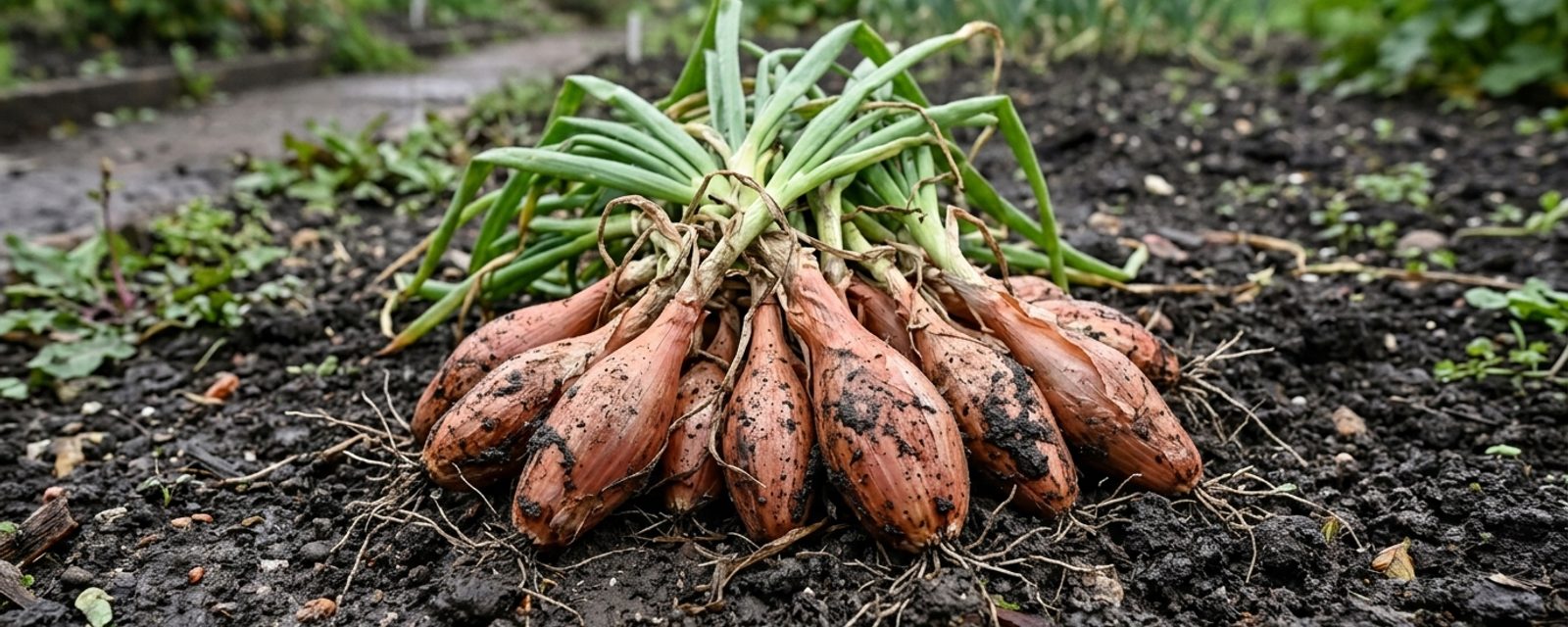
Allium cepa (Aggregatum Group)
Shallots are a low-effort allium that rewards a dry summer and a well-drained bed with clusters of bulbs that store for months.
They're forgiving once they're in the ground, but two decisions early on matter more here than the standard advice suggests: growing from sets rather than seed, since sets are quicker and better suited to cold regions, and choosing spring planting over autumn unless your soil is genuinely free-drainingSoil that lets water pass through quickly rather than pooling, so roots aren't sitting in wet ground after rain. Full definition →. Get those two right and the rest is straightforward: water sparingly, weed carefully, and lift a cluster of bulbs in mid to late summer.
Choosing sets or seed
Grow from sets rather than seed for almost any Scottish garden. Sets are quicker to grow and better suited to cold regions, which is a direct fit for a short growing season. Seed is cheaper and less prone to bolting, but noticeably slower, which works against you here. Where bolting has been a repeat problem, heat-treated sets or a bolt-resistantA plant switching early into flowering and seed production, usually triggered by stress, after which leaves, roots or bulbs turn bitter or unusable. Full page → variety such as Zebrune are the better fix than switching to seed.
Preparing the ground and planting
Choose a sunny site with fertile, well-drained soil, and work in a bucketful of well-rotted manure or garden compost per square metre. Avoid damp ground that's prone to waterlogging: shallots do poorly there, and it's a bigger risk on this crop than it looks, since a wet bed also rules out the autumn-planting option below.
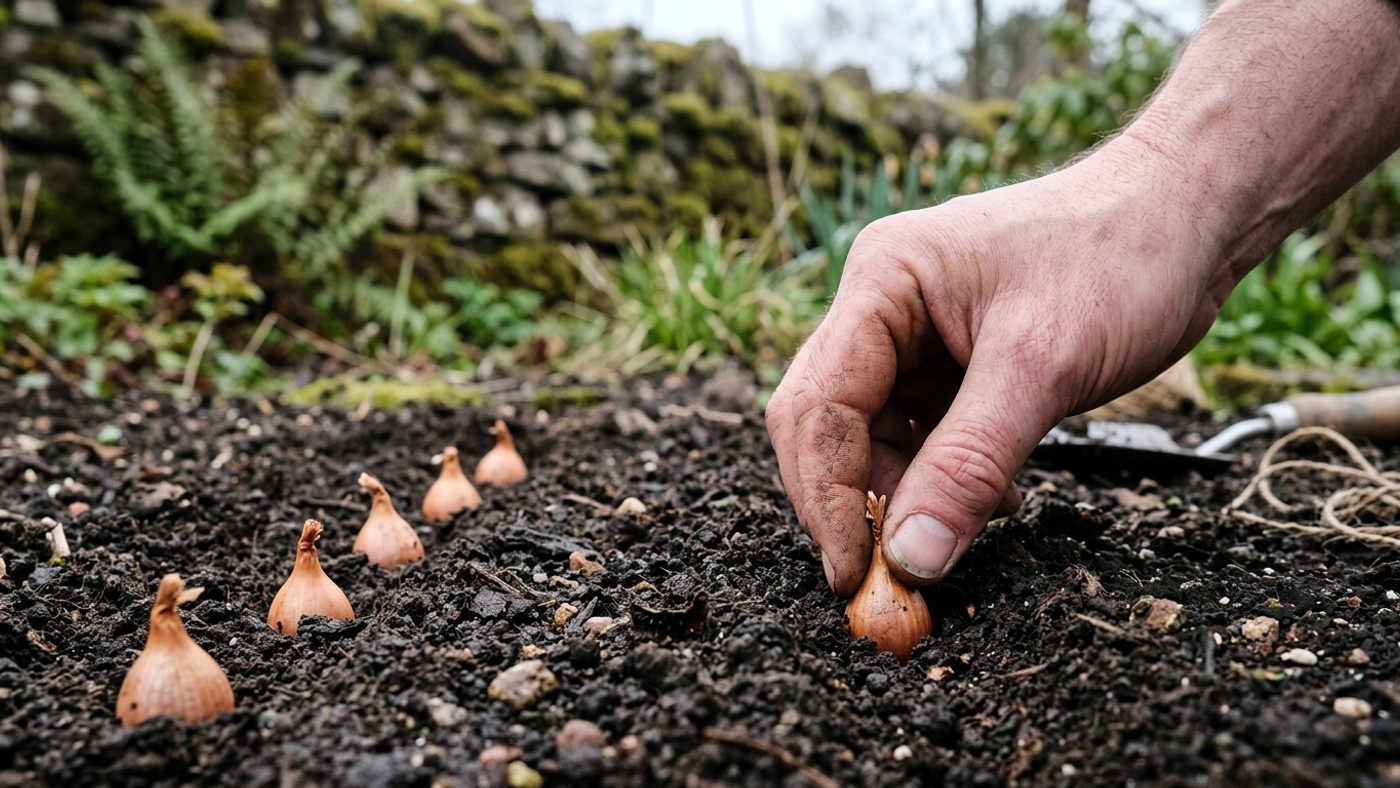
Plant sets in early to mid-spring, the reliable default, with the tip just showing at the surface, spacing them 15-20cm apart in rows 25-30cm apart. Some varieties tolerate autumn or winter planting instead, and it can give an earlier, heavier crop, but only on genuinely free-draining soil. On anything heavier, which describes a lot of Scottish ground, spring planting is the safer choice. Firm the soil and water in after planting, and check newly planted sets for a few days: birds will peck them straight out of the ground before they've rooted, so cover with fleeceA lightweight, breathable fabric laid or draped over plants to trap a little warmth and keep off frost, wind and some flying pests. Full definition → or netting if that's been a problem before.
Rotation: shallots share a family with onions and garlic
Track shallots together with onions, garlic and any other allium in your rotation plan, not as separate crops. Leave a gap of 4-5 years before returning any of them to the same ground, to stop white rot building up in the soil: a disease that, once established, has no chemical treatment and can persist for years.
Varieties
RHS also lists 'Matador' (rounded, high yield, stores well) and 'Meloine' (mild flavour, up to eight bulbs per clump, downy mildew resistance) with AGMThe RHS's Award of Garden Merit: a UK-wide trials award for reliable performance, not a Scotland-specific recommendation. Full definition →, plus 'Camelot' (teardrop-shaped, stores well) without AGM. The award is UK-wide, not a Scottish one.
★ Our pick for Scotland
LongorAGM
Elongated (banana-type), stores well
Produces up to eight shallots per set.
Why this one: A high yield per set matters more where bed space and a short season both push toward getting more from fewer plantings. Longor's eight-bulbs-per-set habit does exactly that.
Also worth considering
ZebruneAGM
Heritage, bolt-resistant
Named by RHS specifically for bolting resistance, which matters more here since a cold spring is exactly what triggers bolting.
Best Shallot Varieties for Scotland → compares all named shallot varieties head-to-head, with the practical detail that doesn't fit in a summary card.
Watering, feeding and weeding
Water only during prolonged dry spells, and stop altogether once the bulbs start to swell in high summer: watering this late doesn't help the crop and reduces how well it stores. Container-grown shallots need more frequent watering than anything in the ground. If your soil is poor, feed autumn-planted sets with a nitrogen-rich organic fertiliser in late winter to give them a spring boost.
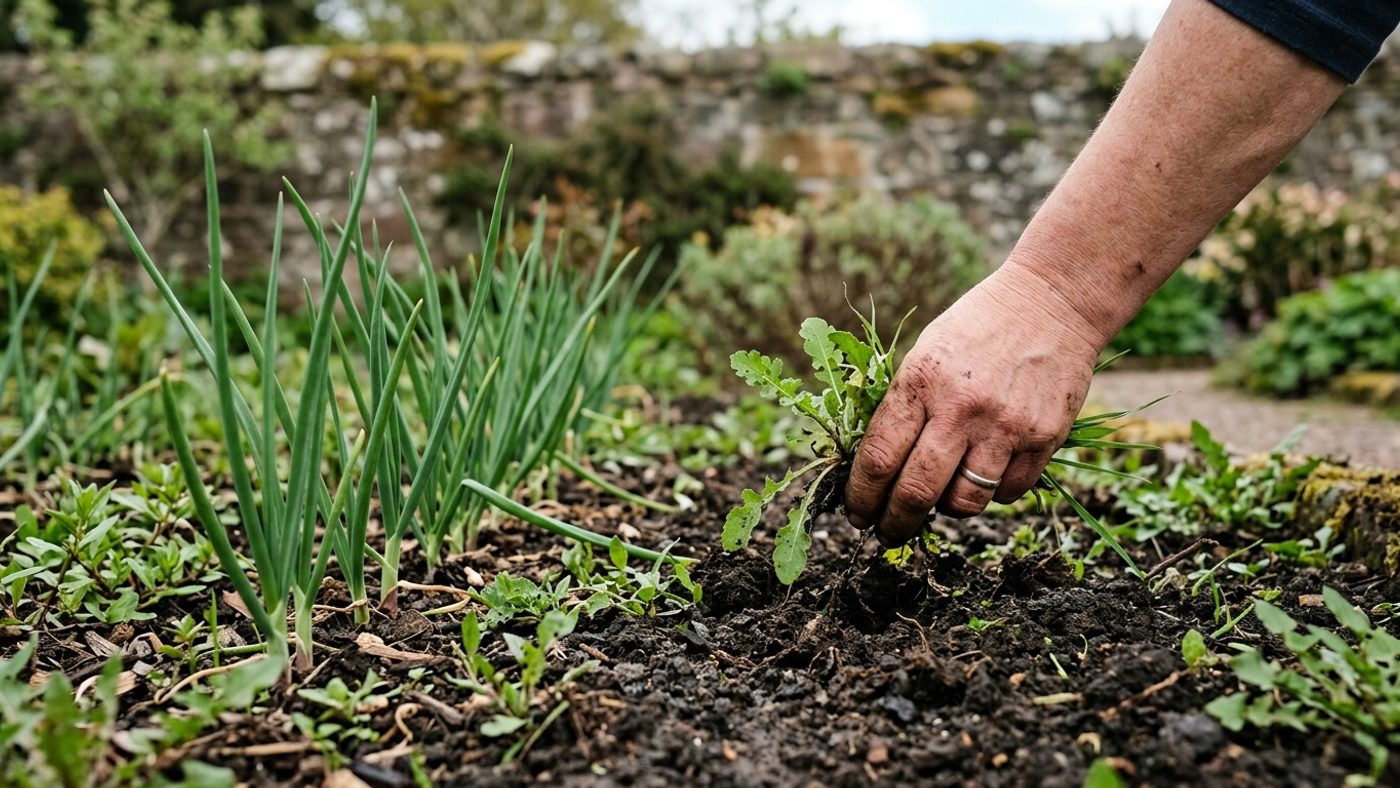
Weed regularly, since shallot foliage casts little shade and does nothing to smother competition on its own. Hand-weed close to the bulbs rather than hoeing: the roots sit shallow and a hoe close to the plant risks damaging them.
Bolting
Low spring temperatures trigger bolting, and a bolted plant won't store well even if you still get a crop from it. Remove flower stems the moment you see them, and use any bulb that's already flowered straightaway rather than trying to store it.
Harvesting
Lift shallots in mid to late summer, once the foliage yellows and flops over: roughly 20 weeks from a spring planting, longer from an autumn one. Use a hand fork to lever bulb clusters gently out of the ground rather than pulling them, since bruising a bulb is what causes it to rot in storage. Separate each cluster into individual bulbs once lifted.
Storing
Dry the bulbs fully before storing: lay them out in a single layer on wire racks or slatted trays outdoors in full sun for about two weeks, or under cover somewhere well-ventilated if the weather is damp. Where to store them afterwards is genuinely disputed rather than settled: one source says somewhere light, cool, dry and ventilated, and specifically warns that darkness encourages sprouting; another says somewhere cool, dark and dry. Both agree on cool, dry and well-ventilated, so treat those three as the non-negotiables and don't worry too much about the light. Stored well, shallots keep for several months.
Storing Onions, Garlic and Shallots → sets out curing times and storage life for all three crops together, including RHS's own case for light storage over a dark cellar.
Common problems
- Slugs and snails are a risk, particularly to seedlings from a seed-raised crop.
- Bolting is triggered by a cold spring. Remove flower stems immediately, and use heat-treated sets or a bolt-resistant variety such as Zebrune if it keeps happening.
- Birds peck newly planted sets straight out of the ground before they've rooted. Cover with fleece or netting until established.
See more problems
- Allium leaf miner and leek rust both affect shallots along with the rest of the onion family.
- Onion white rot is the reason a proper rotation matters: once it's established in the soil, there's no chemical treatment, and it can persist for years.
- Leek moth attacks shallots as well as leeks and onions.
- Onion downy mildew and onion neck rot are both named by RHS as risks to this crop, generally worse in damp growing or storage conditions.
- Onion fly maggots can kill seedlings outright and destroy mature bulbs from below ground. Growing from sets rather than seed, and covering the row with insect-proof mesh, are the two real defences.
Common questions
Should I grow shallots from sets or from seed?
Sets, for almost every Scottish garden: they're quicker and better suited to cold regions, while seed is cheaper and less prone to bolting but slower to reach a usable size, which works against an already-short season. Full sourced breakdown: <a href='/tools/garden-myths/shallots/'>Shallot Myths →</a>
Is autumn planting better than spring for shallots?
It depends on your soil, and the sources genuinely disagree on how much it matters: autumn planting can give an earlier, heavier crop, but it's a poor fit for heavy or waterlogging-prone ground, which describes a lot of Scottish plots, so spring is the safer default unless your soil drains freely. Full sourced breakdown: <a href='/tools/garden-myths/shallots/'>Shallot Myths →</a>
Should shallots be stored somewhere light or dark?
The sources genuinely disagree: cool, dry and well-ventilated are agreed on by both, but one recommends light because darkness encourages sprouting, while the other recommends dark. Prioritise the three things they agree on. Full sourced breakdown: <a href='/tools/garden-myths/shallots/'>Shallot Myths →</a>
Can I grow shallots where I grew onions last year?
No. Onions, shallots, garlic and scallions are all the same rotation family as far as soil-borne disease is concerned, so leave 4-5 years before returning any of them to ground where another has grown, to keep white rot from building up. Full sourced breakdown: <a href='/tools/garden-myths/shallots/'>Shallot Myths →</a>
Sources
3 sources, and what each was used for
- RHS: sets vs seed choice and cold-region reasoning, soil prep, planting timing and the heavy-soil caution on autumn planting, spacing, watering (including stopping watering as bulbs swell), feeding, weeding, bolting cause and fix, harvest timing and method, storage method and duration, five named varieties with exact AGM status, pest and disease list
- gardenersworld.com: corroborates spacing and planting depth independently of RHS; adds autumn planting as an earlier, heavier crop (presented alongside RHS's heavy-soil caution on the same practice, not in place of it); gives week-count harvest timing (20 weeks spring-planted, 36 weeks autumn-planted); its own storage instructions conflict with RHS on light vs dark, both sides shown
- Teagasc: explicitly names shallots (with onions, scallions and garlic) in its 4-5 year onion-family rotation guidance — the only source read that gives shallots a specific rotation interval rather than generic allium advice