
Onion Downy Mildew is a serious disease that affects onions, shallots and spring onions in Scotland. Here is what it looks like, the conditions it needs, and the controls that actually work.
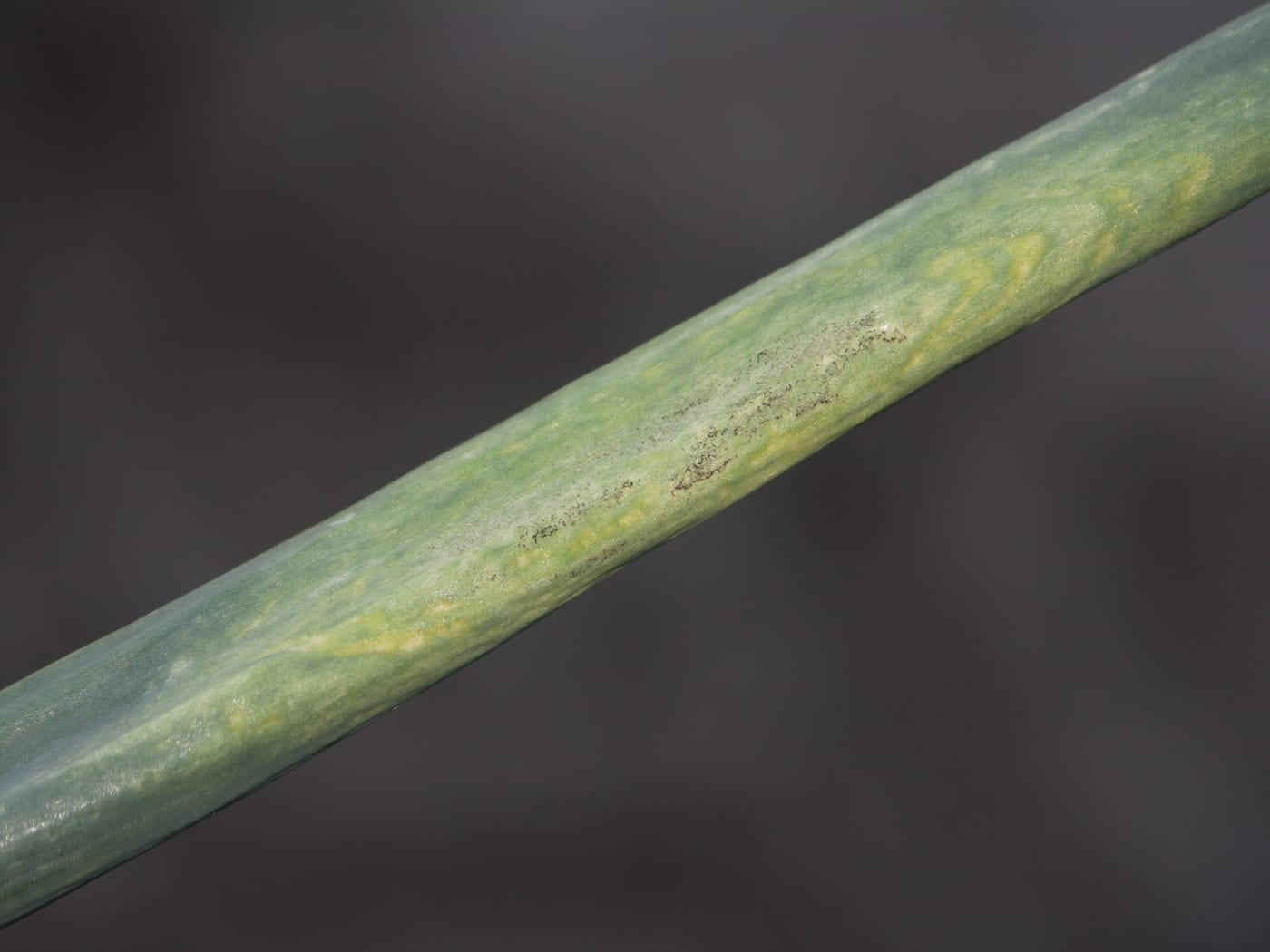
What does it look like?
Leaves yellow and die back, with white and then purple fungal growth developing on the affected foliage. Bulbs can sprout prematurely or shrivel in storage, and secondary fungal infections often move in once the plant is already weakened.
What causes it
Mild, humid weather is what this disease needs, with extended periods of leaf wetness essential for the spores to establish. Closely spaced crops like spring onions are more exposed, since crowding keeps foliage damp for longer than it would be with proper airflow.
Is this disease active now?
Watch through late spring and summer, whenever a mild, humid spell settles in. Symptoms on stored bulbs, premature sprouting or shrivelling, can show up well after harvest too.
Onion white rot forces a much longer rotationMoving each crop family to different ground each year, on a multi-year cycle, so pests and diseases that build up in soil don't get a repeat host. Full definition → off the same ground, 15 years or more, so anyone already planning that longer gap to dodge white rot has this disease covered too. See Onion White Rot →
Life cycle
Spores spread through summer on rain splash and wind. The fungus also survives as tough resting spores in the soil long-term, and as dormant infection carried inside bulbs, ready to produce fresh spores the following spring once conditions turn favourable again.
Why this matters in Scotland
Cool, wet summers make this disease worse, and a slow, drizzly stretch is a far more typical Scottish summer than a hot, dry one.
That's not a reason to give up on growing alliums here, just a reason to prioritise the airflow, drainage and spacing measures below more than a gardener somewhere drier might need to.
Controls: what actually works
All the methods below are backed by real evidence, not just repeated folklore.
Airflow: space plants widely and keep beds weeded
Wide spacing and a weed-free bed both keep air moving through the crop, working against the extended leaf wetness this fungus needs to establish.
Sanitation: clear and destroy infected debris, never compost it
Infected material left in place or added to the compost heap carries the fungus into the next season, since it survives as resting spores in soil and debris long-term.
Site selection: avoid damp, poorly-drained, sheltered spots
A naturally damp or sheltered corner of the plot gives this fungus the humidity it needs before weather or overcrowding add to it.
Healthy sets: use firm sets, discard any that sprout early
Dormant infection can be carried inside a bulb without any visible sign until it sprouts prematurely, so starting with firm, healthy sets and discarding any that sprout early keeps that hidden source out of the ground.
Crop rotation: avoid replanting alliums on the same ground for five years
The fungus survives in soil long-term as resting spores, which is why the recommended gap before replanting is measured in years rather than one season: less than five, and there's still a population in the ground waiting for the next crop.
Resistant varieties: choose Hylander or Santero for some protection
Neither variety is immune, but both show measurably better resistance than a typical cultivarA plant variety that arose or was bred under cultivation and is kept true by deliberate propagation, rather than a naturally occurring wild species. Full definition →, worth factoring in alongside the cultural measures rather than instead of them.
Frequently asked questions
What should I do first if I find onion downy mildew in my garden?
Start with airflow. After that, sanitation. Work through the rest in order of how well-evidenced they are if the first two aren’t enough on their own.
Is there a spray that works?
No. There are no amateur chemical treatments available for onion downy mildew. The controls that work are cultural: the measures listed above.
When are onion downy mildew most active in Scotland?
Check the seasonal activity section above. Scottish timings can run a few weeks behind the UK-generic figures.
Sources
2 sources, recorded with what each was used for
- RHS1: identification, symptoms, conditions that favour spread, life cycle and overwinteringKeeping a plant alive and intact through the cold months, whether left outdoors, moved under cover, or stored dormant. Full definition →, the five-year replanting guidance, airflow spacing, sanitation, site selection, healthy sets, resistant varieties, absence of a chemical control
- Garden Organic8: corroborating cool wet summers as a favourable condition, chives as an additional host, and the airflow, sanitation, site selection and healthy-set controls