
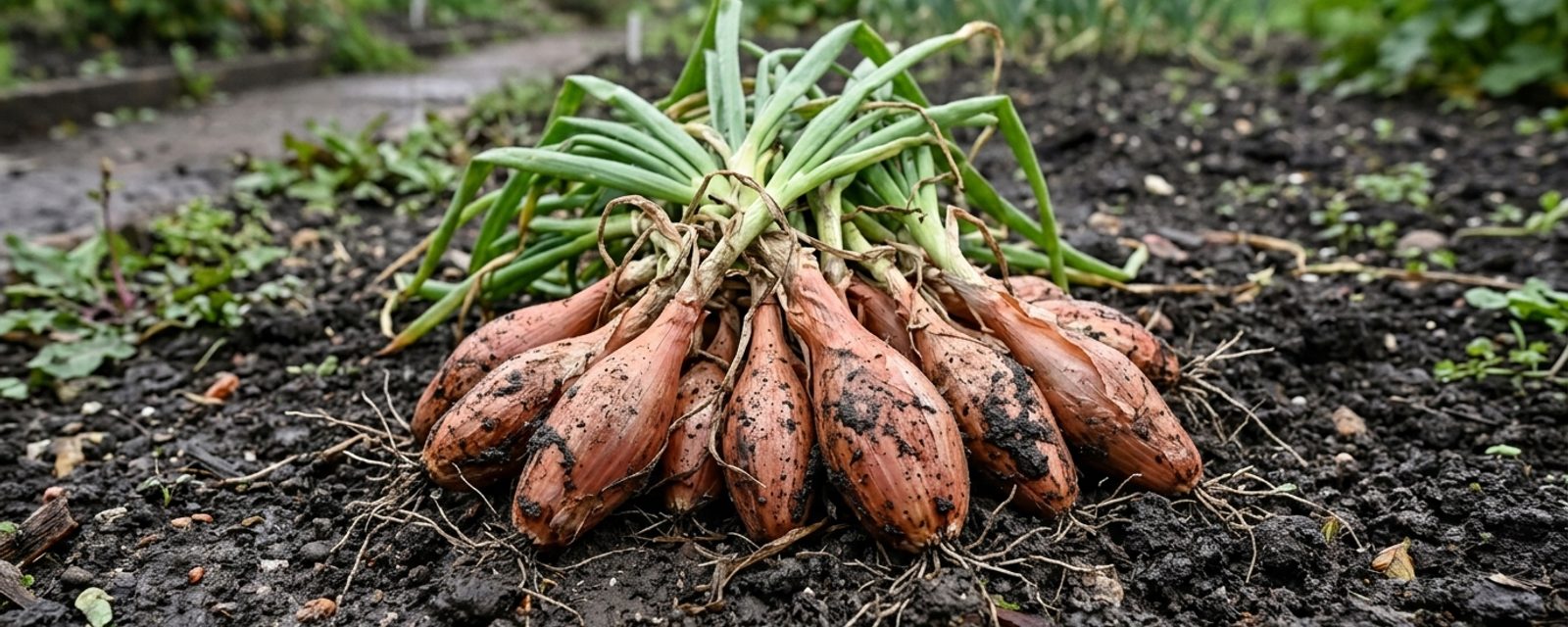
A shallot bulb takes roughly 20 weeks to bulk up from a spring-planted set. The variety in the ground matters more here than the seed packet usually lets on: which one shrugs off a cold spring without boltingA plant switching early into flowering and seed production, usually triggered by stress, after which leaves, roots or bulbs turn bitter or unusable. Full page →, and which one shrugs off a damp summer without downy mildew taking the crop, are two different questions with two different answers.
Quick answer
Longor is the best all-rounder for most Scottish gardens: it holds the RHS Award of Garden Merit (AGMThe RHS's Award of Garden Merit: a UK-wide trials award for reliable performance, not a Scotland-specific recommendation. Full definition →), produces up to eight bulbs per set, and stores well. Where a cold spring keeps triggering bolted plants, Zebrune is bred specifically for bolt resistance instead. Where a damp summer is the bigger risk, Meloine is the one named variety with a stated resistance to onion downy mildew. Matador and Camelot both store well but bring nothing a reader can't already get from Longor or Meloine.
The real choice: bolting or downy mildew
A cold snap in spring is what triggers bolting: a plant that throws a flower stem instead of bulking up a bulb, and once it has, that bulb won't store. That's a risk at planting time. Later in the season, once the crop is bulking up, the risk shifts to onion downy mildew, a disease that thrives in wet, humid conditions, a real risk in a cool, damp summer. These two risks don't overlap in the calendar, which is why the "best" variety genuinely depends on which failure has actually hit your plot before, not a single universal pick.
The five named varieties, compared
Five named shallot cultivarsA plant variety that arose or was bred under cultivation and is kept true by deliberate propagation, rather than a naturally occurring wild species. Full definition → belong to Allium cepa Aggregatum Group, the shallot group, as distinct from the Cepa Group, which covers onions. Two of the five carry a discrepancy between the general summary page and their own individual plant pages, covered below. Hardiness ratings run on the standard H-scale: H3The RHS's H1a–H7 scale for how much cold a plant can survive outdoors, H1a being tender indoor-only and H7 hardy anywhere in the UK. Full definition → means hardy only in coastal and relatively mild UK areas (roughly -5°C to 1°C), H6 means hardy anywhere in the UK (down to about -20°C), though for a bulb crop that's lifted in summer, this matters far less than it would for something left in the ground over winter.
| Variety | AGM (own page) | Hardiness | Type | Disease / bolting note |
|---|---|---|---|---|
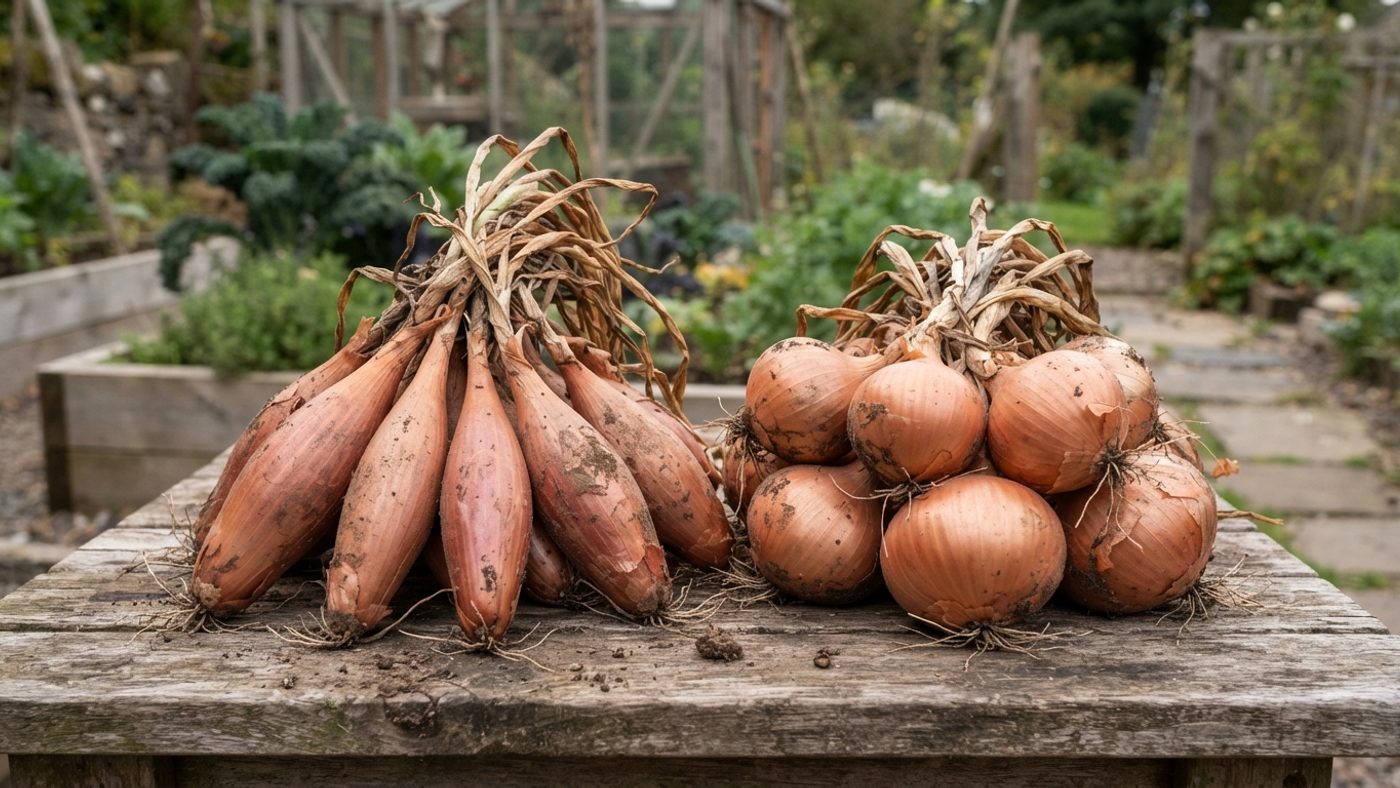
| Longor | Yes | H3 | Elongated (banana-type) | Up to 8 bulbs per set; stores well |
| Zebrune | No, see below | H3 | Torpedo-shaped, heritage | "Good resistance to bolting" |
| Matador | No, see below | H3 | Round, seed-raised, one bulb per seed | High-yielding; stores well |
| Meloine | Yes | H3 | Rounded, mild flavour | "Some resistance to onion downy mildew"; up to 8 bulbs per clump |
| Camelot | No | H6 | Teardrop-shaped, deep red skin | Stores well; no disease resistance stated |
Two things in that table matter for anyone buying seed or sets by name, beyond what's already in the columns above.
Matador and Zebrune's AGM status depends on which RHS page you check. Both carry the AGM on the general shallots page, but neither shows the badge on its own individual plant page. For Matador, that's the only discrepancy, everything else about it matches across both pages. Zebrune's runs deeper: its own page classifies it under the onion group, not the shallot group every other variety here belongs to, and its bolt-resistance claim (real, and stated plainly as "good resistance to bolting") comes with that same classification question attached.
Camelot's H6 rating doesn't actually make it the better choice. It's the only one of the five hardy enough to survive a Scottish winter in the ground, but shallots aren't left in the ground over winter regardless of variety, so that rating doesn't offset Camelot having no AGM and no stated disease resistance.
Best overall, and where the others actually win
Longor stays the strongest default: it's the only one of the five with an AGM that holds up on its own plant page and no disease-resistance question mark against it. Start there unless bolting or downy mildew has already cost you a crop.
If one of those two has actually happened, past experience should outweigh the default pick. Between Zebrune and Meloine, Meloine is the safer swap on paper, its AGM carries no cross-page discrepancy, where Zebrune's does, but a variety that's actually stopped bolting is worth more to a grower who's lost a crop to it than a clean award history is.
Matador and Camelot both round out the list on storage and yield, but neither brings a trait Longor or Meloine doesn't already cover, and Matador's AGM status is genuinely unclear (see above). Treat both as reasonable, not essential, picks, worth choosing over Longor only for flavour or bulb-shape preference, not for any trait unique to them.
Beyond the AGM list
The AGM shallots are a curated shortlist, not the full commercial range. Gardener's World names three further varieties worth knowing about even though none of them carry an AGM or have an individual RHS plant page to check claims against: Golden Gourmet (described as a heavy cropper that keeps well), Red Gourmet (early-maturing, red-fleshed), and Red Sun (large red-tinged bulbs, described as storing well). None of these three come with the kind of individually-sourced disease or hardiness data the five RHS cultivars above do, so they're named here without a recommendation attached, only as varieties worth recognising if a seed catalogue lists one.
Neither the James Hutton Institute nor SASA has published Scottish shallot variety trial data. The comparisons above rest on each cultivar's own stated traits, bolt resistance, disease resistance, hardiness rating, set against bolting and downy mildew as the two failure modes, rather than on a Scottish field trial.
Soil pH
Shallots tolerate a fairly wide range, roughly pH 5.5 (moderately acidic) to 7.5 (moderately alkaline), a wide enough band that a garden running on the acidic side needs no correction. Unless a bed is well outside that band, at either end, pH isn't what should decide variety choice or bed suitability. Drainage is the bigger factor: a wet, poorly-drained bed is a bigger risk to any shallot variety than soil acidity is.
Sets vs seed, and the rest of the growing detail
Which variety to grow is only half the decision; how to grow it is covered in full on the shallots growing guide, sets vs seed, spring planting timing, spacing, watering, storage, plus slug damage and onion white rot, and the crop rotation planner for keeping shallots on a proper allium rotationMoving each crop family to different ground each year, on a multi-year cycle, so pests and diseases that build up in soil don't get a repeat host. Full definition →. For the pest and disease side of the two failure modes above, see onion downy mildew and bolting.
Common questions
Is any shallot variety actually resistant to bolting, or just less prone to it?
Zebrune's own RHS listing states "good resistance to bolting" rather than claiming immunity, treat it as meaningfully better than the others, not bolt-proof. Bolting is triggered by cold spring temperatures, so even a resistant variety benefits from going in during the early-to-mid-spring window rather than earlier.
Does Matador actually have the AGM or not?
RHS's general shallots page lists it with the AGM, but Matador's own individual plant page shows no AGM badge or mention of the award. Both pages agree on everything else about the variety, and the two pages simply disagree on this one point.
Is Zebrune really a shallot?
By RHS's own database, no, its individual plant page classifies it under the onion group (Cepa Group), not the shallot group (Aggregatum Group) that Longor, Matador, Meloine and Camelot all belong to. It's still sold and grown as a shallot commercially, and its bolt-resistance trait is real and worth using, but its formal RHS classification disagrees with how it's marketed.
Which shallot variety stores the longest?
Longor, Matador and Camelot are all described as storing well, without a specific duration attached to any one of them individually. General shallot storage guidance (drying, then a cool, dry, well-ventilated space) applies the same way regardless of variety.
Sources
8 sources, recorded with what each was used for
- Shallots: Grow Your Own: The five named varieties as a set, their AGM status as stated on the general page, and links to each variety's own plant page
- Allium cepa (Aggregatum Group) 'Longor': AGM confirmation, hardiness (H3), bulb type and yield, disease susceptibility list
- Allium cepa (Cepa Group) 'Zebrune': Classification (onion/Cepa Group, not shallot/Aggregatum Group), no AGM shown, bolt-resistance claim, hardiness (H3)
- Allium cepa (Aggregatum Group) 'Matador': No AGM shown (contradicts general page), hardiness (H3), bulb type, yield and storage claim
- Allium cepa (Aggregatum Group) 'Meloine': AGM confirmation, hardiness (H3), stated resistance to onion downy mildew, clump size
- Allium cepa (Aggregatum Group) 'Camelot': No AGM shown, hardiness (H6), bulb description and storage claim
- How to Grow Shallots: Golden Gourmet, Red Gourmet and Red Sun as further named varieties outside the RHS AGM list
- Shallots in the Garden: Soil pH range (5.5-7.5)