
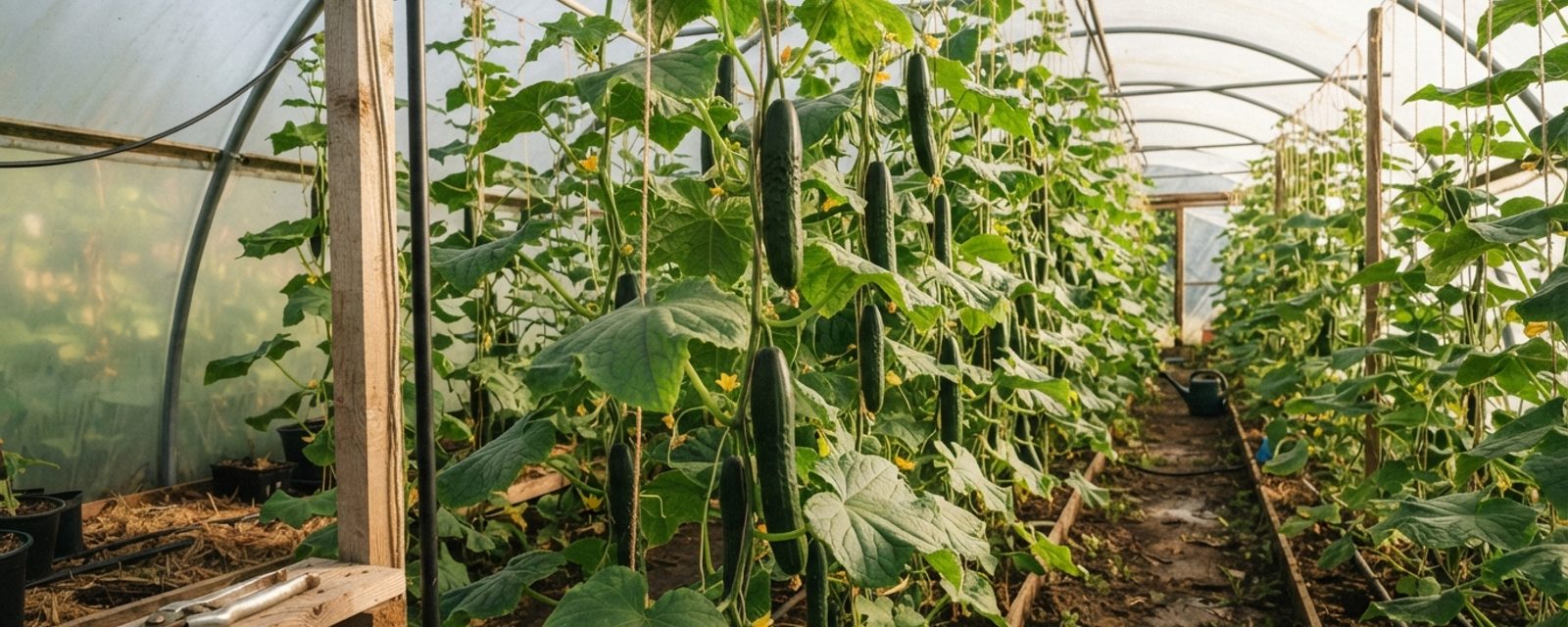
Once a greenhouse cucumber plant hits its stride in midsummer, it doesn't slow down to match your kitchen's appetite. Left unchecked, it will happily bury you in fruit within a couple of weeks, the same vigour that makes cucumbers satisfying to grow is exactly what causes the glut in the first place.
Does picking more actually keep the plant producing?
With courgettes, most gardeners have absorbed the idea that a plant left to carry one huge marrow will slow down, because the plant reads a fully swollen fruit as job done and stops pushing energy into new ones. Cucumbers are a different plant, so the same rule doesn't automatically carry over.
It does, though: the RHS states plainly that "regular harvesting encourages further fruiting." The mechanism is the same resource-allocation logic that governs courgettes and the rest of that plant family, cucumbers included: a plant carrying maturing fruit diverts energy into ripening the seed inside it rather than starting new flowers and fruit. Take the mature fruit away before it starts converting energy into seed development, and the plant keeps its resources aimed at producing more.
Practically, this means a glut isn't just something that happens to you, how you harvest through the first heavy flush directly shapes whether the plant keeps cropping hard into September and October, or tails off early. Letting fruit sit to save for later is the single easiest way to shorten your own season.
How long has a ripe cucumber got before it's too far gone?
Cucumbers move from ready to overripe faster than most people expect, so knowing what to look for matters more here than with slower-changing crops.
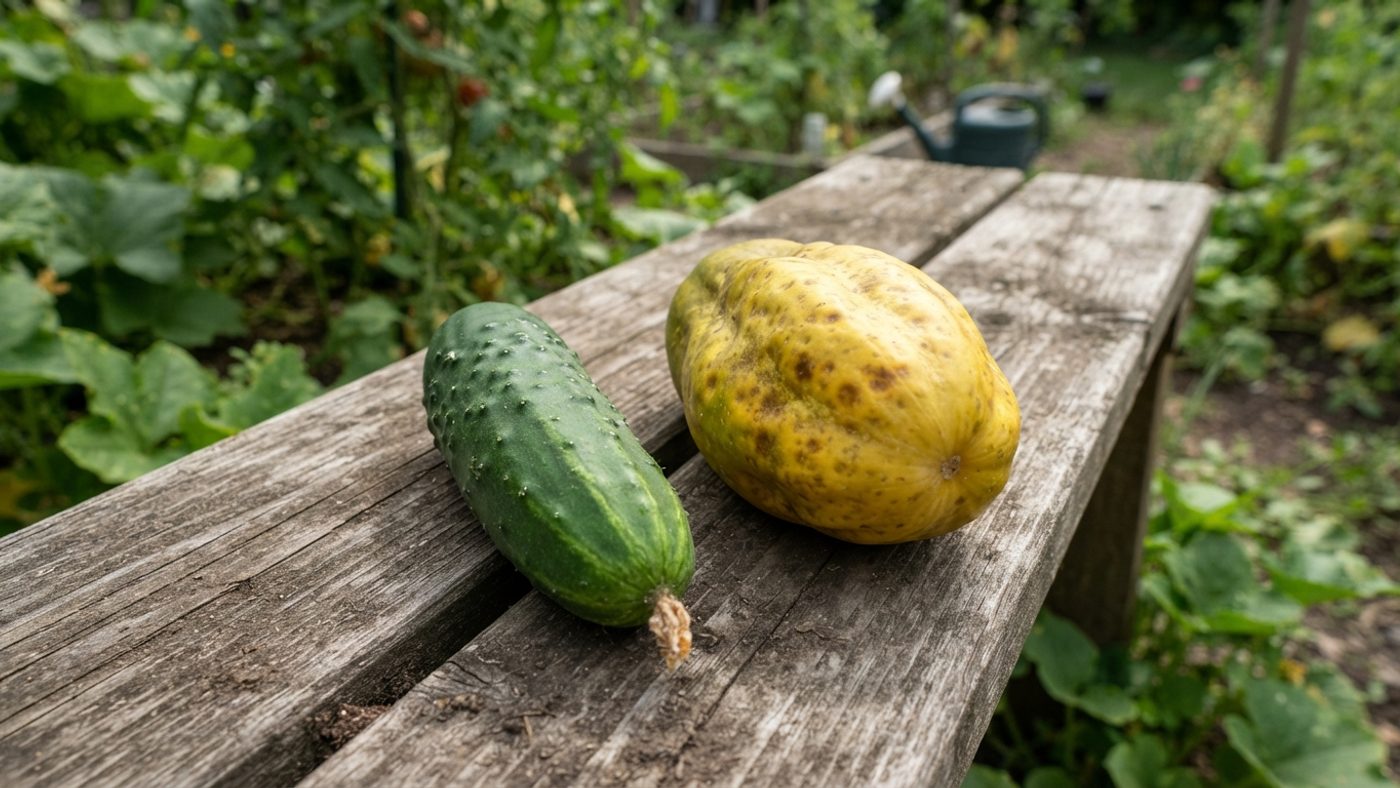
Ripe fruit should be uniformly green, firm, and slightly rounded at the tip. Once a cucumber turns yellowish, goes bulbous, or the flesh softens, RHS is clear it's "likely to be over ripe," the skin toughens and the taste turns bitter as it goes.
Because a greenhouse or polytunnel crop grows quickly in warm, humid conditions, the conditions most Scottish growers are working with, given how marginal outdoor planting is here, that ripe window can close fast. None of the sources above give an exact number of days, but checking every two to three days through the main cropping period is a sensible working rhythm, leave it much longer and you risk finding fruit has jumped straight past ripe into oversized and bitter.
Target size is a useful second check alongside colour and firmness, since ripe varies by variety:
| Type | Pick at roughly |
|---|---|
| Mini cucumbers | 8cm (3in) |
| Small-fruited varieties | 15cm (6in) |
| Full-sized varieties | 20–25cm (8–10in) |
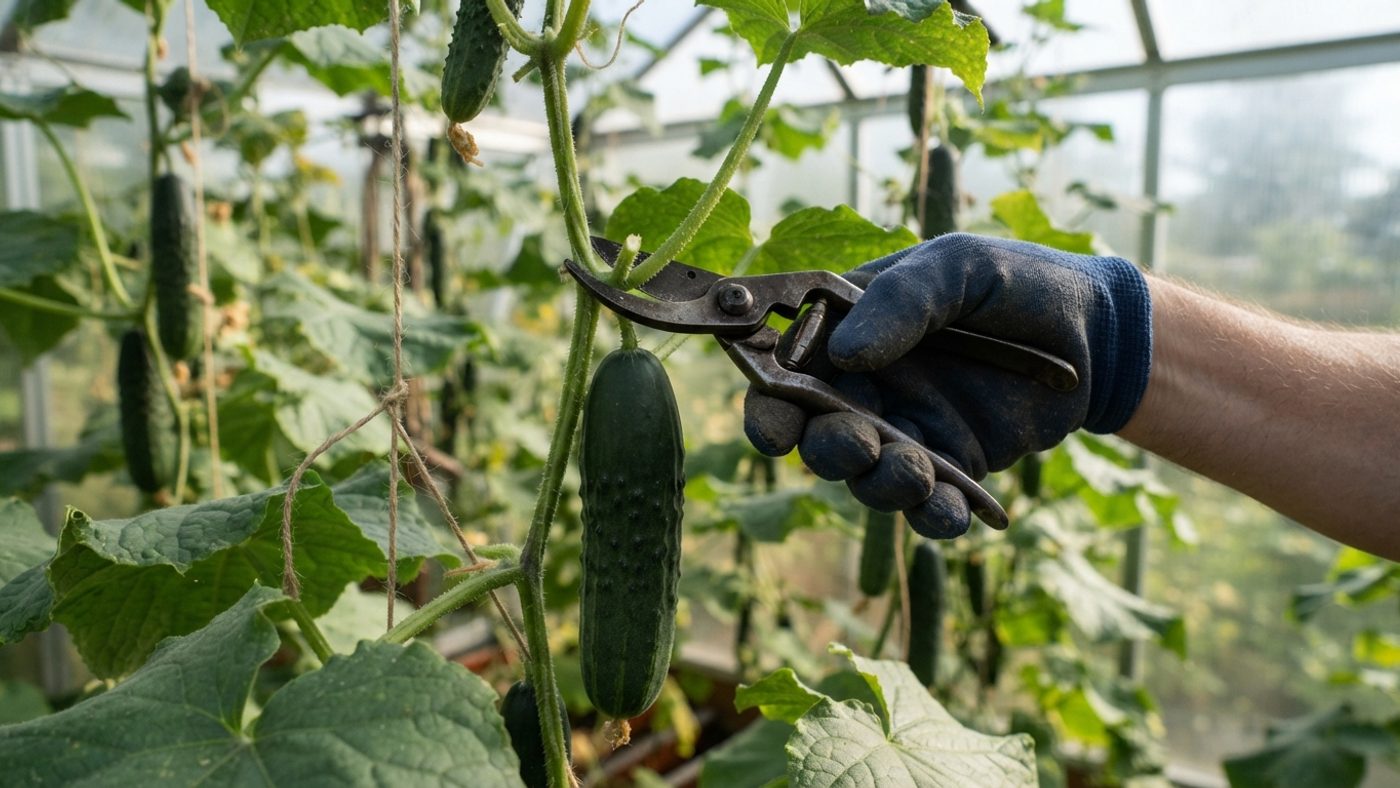
Always cut the stem cleanly with a knife or secateurs rather than pulling or twisting it off, pulling risks damaging the stem and the rest of the developing fruit cluster.
It's also worth distinguishing bitterness caused by over-maturity from bitterness caused by pollination going wrong on greenhouse varieties, which is a different problem entirely with a different fix, covered in full in the cucumber growing guide.
Why a Scottish greenhouse crop gluts harder than an outdoor one
Cucumbers are a genuinely awkward outdoor crop this far north. RHS growing advice sets the outdoor planting-out threshold at around 12°C, sustained reliably, a bar Scotland's climate clears less often and less predictably than the milder parts of the UK the same figure is written for. That's a large part of why a greenhouse or polytunnel, rather than open ground, is the more realistic route for most Scottish growers.
That choice of environment is what drives the glut, not just the plant's own vigour. Warmth and humidity are what cucumbers want, and a greenhouse or polytunnel holds both far more consistently than open Scottish weather ever would:
| Outdoor threshold | Typical cropping season | |
|---|---|---|
| Greenhouse/polytunnel | Not applicable, grown under cover | Midsummer to mid-autumn (into October) |
| Outdoor (ridge) | Around 12°C, sustained | Shorter, weather-dependent (usually finishing by September) |
A Scottish grower under glass, in other words, is running the environment and the longer season most likely to produce a heavy, concentrated crop, an outdoor grower elsewhere in the UK, cropping in the open for a shorter, cooler stretch, isn't working under the same pressure.
Can you stagger the harvest?
Sowing a second batch of seed a few weeks after the first, succession sowing, is a standard way of spreading out a harvest with plenty of other crops. For cucumbers specifically, RHS lists two realistic sowing windows: mid-February to mid-March for a heated greenhouse, or April for an unheated greenhouse, polytunnel or coldframe. Sowing a batch at the start of each window, rather than picking just one date, spreads the same total harvest over a longer stretch instead of compressing it into a single flush a few weeks later.
It's a modest lever rather than a real fix. A grower relying on one greenhouse or polytunnel also has far less room to stagger than someone further south with a mild outdoor plot, who can direct-sow outdoors in stages right through late spring. With one growing space and one realistic climate window, staggered sowing thins a Scottish glut rather than prevents it, picking promptly and often through the main flush, covered above, does more of the real work. Full detail on sowing timings, spacing, feeding and supports is in the cucumber growing guide, and variety choice is covered in Best Cucumber Varieties for Scotland.
Short-term keeping once you've picked more than you can use
Cucumbers don't have much shelf life once cut from the plant, they're a crop meant to be used quickly, not stored. Refrigerate what you can't use immediately, expect reasonable quality for a few days at most, and treat "eat soon" as the working assumption rather than "store for later." Nothing points to freezing or any longer-term storage method.
Common questions
Why has my cucumber gone yellow and fat?
It’s overripe, left on the plant past its peak. RHS describes this exact progression: fruit that turns yellowish, bulbous or soft has gone past ripe, and it will also have turned bitter and tough-skinned.
Will picking cucumbers more often really make the plant produce more?
Yes. RHS states directly that regular harvesting encourages the plant to keep setting new fruit, while fruit left to mature on the plant signals it to slow down.
How often should I check my cucumber plants?
Every two to three days once cropping starts, since fruit can go from ripe to overripe within that window in warm greenhouse conditions.
Can I leave cucumbers on the plant a bit longer to save picking time?
Not without a cost, every fruit left maturing slows the plant’s overall production, on top of the fruit itself turning bitter and unpalatable.
How long will a picked cucumber keep?
A few days in the fridge. There’s no precise day count published, so treat "use within a few days" as the realistic expectation rather than a hard number.
Sources
3 sources, recorded with what each was used for
- RHS: Cucumbers, grow your own: Ripening season and timing, ripe/overripe visual signs, fruit size guide by type, regular-harvesting-encourages-fruiting claim, harvesting technique, sowing calendar and outdoor planting threshold
- Gardener's World: How to grow cucumbers: Harvesting-start timing, corroboration that picking more produces more, bitterness/hard-skin warning on overripe fruit, outdoor vs greenhouse cropping-season length, short-term fridge storage
- Teagasc: Cucumbers (greenhouse/salad crops): Ripeness test (green, shiny, cylindrical vs still pointed), storage guidance