
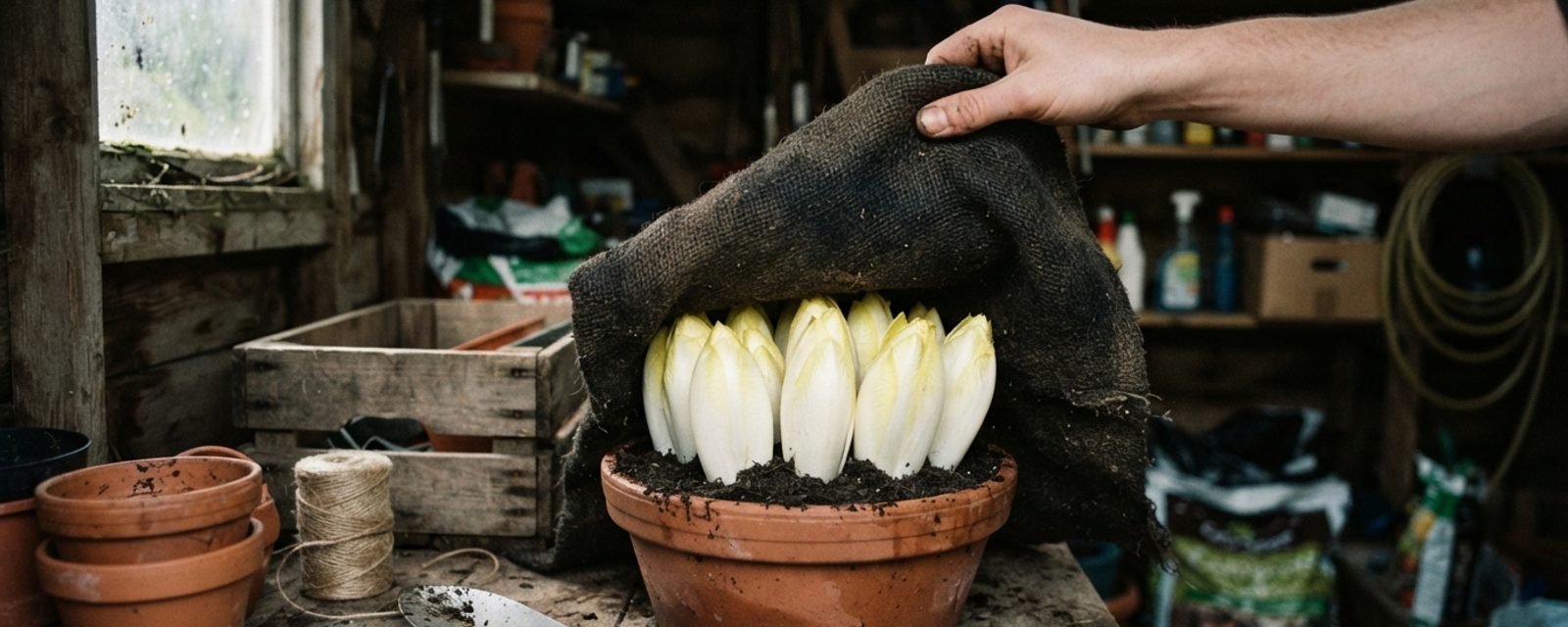
By December, the chicory has boltedA plant switching early into flowering and seed production, usually triggered by stress, after which leaves, roots or bulbs turn bitter or unusable. Full page → or been cleared, the seakale bed looks like bare soil, and the strawberry patch is a row of dead-looking crownsThe base of a perennial plant where roots and shoots meet, often sold and planted as a ready-made dormant plant rather than grown from seed. Full definition → under frost. On paper the growing year for all three crops finished months ago. And yet this is exactly the point at which each of them can be persuaded to produce something worth eating: pale, crisp chicons, the tight, torpedo-shaped heads sold as Belgian or French endive, in January, tender blanchedExcluding light from part of a growing plant, usually by earthing up, wrapping or covering, so it grows pale, tender and less bitter. Full definition → seakale shoots in the depths of winter, and, with the right cover, a bowl of ripe strawberries weeks before anyone else's plants have flowered. None of this is out of season. It's forcingCovering plants to exclude light and speed early, tender growth in the dark, most associated with rhubarb and sea kale in late winter. Full definition →: taking a dormant or resting root, crown or plant and coaxing new growth from it, in darkness or gentle warmth, at a time of year when the plant would otherwise be doing nothing at all.
Rhubarb is forced the same way and, being the most familiar of the four, has its own dedicated guide. The other three each take a different route to the same trick, chicory and seakale by shutting out light, strawberries by timing a spell of warmth after the cold.
| Crop | What's forced | Light or warmth? | Typical time to harvest |
|---|---|---|---|
| Chicory (witloof) | Lifted roots, potted and forced indoors | Darkness, with mild warmth | About 4 weeks |
| Seakale | Crowns forced in situ under cover | Darkness | 4–6 weeks from midwinter |
| Strawberries | Potted crowns brought under glass | Warmth, after a cold spell | About 6 weeks under glass |
Forcing chicory for chicons
Forcing (or Belgian) chicory, usually the variety 'Witloof', is grown all summer purely to build a root, then forced in winter to produce chicons.
Growing the roots
Sow forcing chicory outdoors in May or June and let it grow on through summer and autumn without attempting to harvest anything. All the plant's energy during this stage goes into the root, which is what gets forced later, the top growth is discarded.
Lifting
Dig up the roots in November, before hard frost locks the ground, heavy or waterlogged soil turns unworkable fast once the cold sets in, so don't leave this too late in a wet or early-frozen year. Discard any that are less than about 2.5cm across at the crown, since thin roots won't produce a worthwhile chicon. Cut the leaves back to about 2.5cm above the crown. If not forcing immediately, the roots can be stored horizontally in sand in a cool shed until needed.
Potting and forcing
Plant the roots vertically in moist, peat-freeCompost made without peat, which is harvested from a slow-forming, carbon-storing wetland habitat that peat extraction damages. Full definition → multipurpose compost with the crown left just proud of the soil surface, around five roots fit in a standard 25cm pot. Cover the pot completely: an old compost sack, black polythene, or an upturned bucket or large pot with the drainage holes blocked will all do the job, as long as no light gets in at all. Keep the pot somewhere at roughly 10-15°C, and keep the compost just damp rather than wet, with no leaves photosynthesising, a dormant root growing in the dark isn't drawing on much moisture.
Whole crowns work just as well as bare roots if that's what you've lifted: pot three or four together in a 25cm pot, or use a wider 20cm pot for a smaller batch, and stand them in a cool, dark shed until forcing begins, then move them somewhere warmer and keep them covered to exclude light.
A dark shed or garage is also a place mice and other rodents shelter over winter, and they'll happily eat a chicon before you get to it, check pots regularly and consider a covered box or mesh guard if mice are a known problem in your outbuilding.
Harvest, and what to do with a chicon
Chicons are ready to cut at the base once they reach about 15cm tall, which takes roughly four weeks. If the stump is left in the pot and covered again, a second, smaller chicon can sometimes be produced from the same root; after that, the exhausted root can go on the compost heap. Chicons have a bitter-sweet flavour: eaten raw, that bitterness is more pronounced, closer to a sharp salad leaf than a lettuce; roasted or grilled, the flavour mellows considerably, which is worth knowing before serving a first crop raw and finding it more assertive than expected.
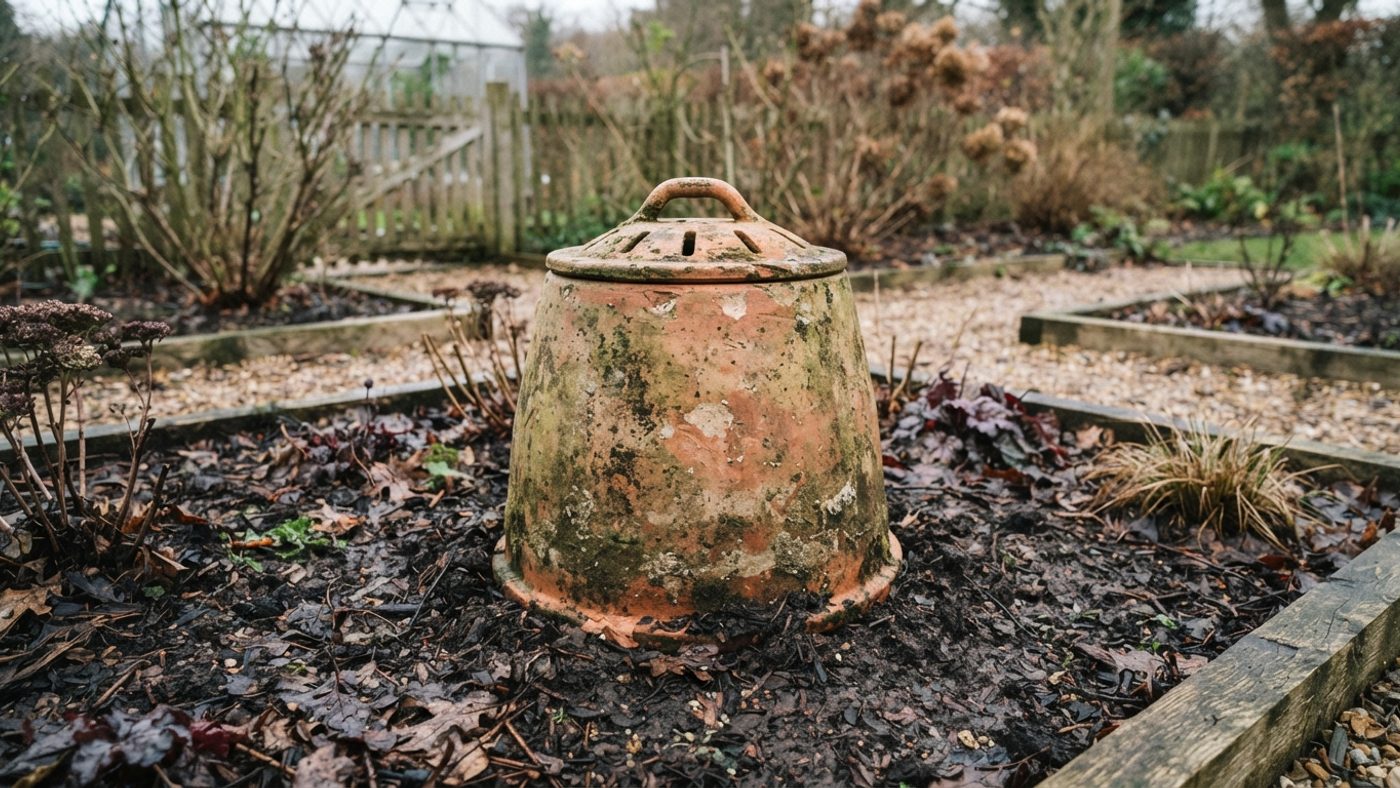
Forcing seakale: going beyond the pot-over-the-crown method
Seakale is normally planted as a young pot-grown plant or as a root cutting known as a "thong", and it needs a full first growing season to build up a root system before any shoot is cut. That's the reason behind the standard rule: cover an established crown with an upturned pot or bucket from midwinter, cut the blanched shoots at around 20cm once they emerge, wait until the plant's second year before the first forcing, and never force the same crown two years running. That in-situ method is the traditional garden approach, and it's the one RHS and Gardeners' World both describe for garden-grown seakale. Once a cover is lifted to check on or harvest the shoots, treat the exposed pale growth as a slug target: it's soft, sheltered and irresistible to slugs in a damp Scottish garden, more so than the tougher green leaves the plant produces uncovered.
Seakale is a genuinely hardy plant to be forcing in the first place: it grows wild on UK coastlines, including Scotland's, and RHS rates it hardy to H7The RHS's H1a–H7 scale for how much cold a plant can survive outdoors, H1a being tender indoor-only and H7 hardy anywhere in the UK. Full definition →, the toughest category on the scale, roughly hardy below -20°C, so a Scottish winter isn't a threat to the crown itself. The limiting factor is the technique and the plant's age, not whether it can survive the cold.
Chicory and rhubarb both have an indoor equivalent to the pot-over-the-crown method: lifting the root or crown entirely and forcing it in a box or pot in a dark shed for an earlier, more controllable crop. The same mechanism would likely work on seakale too, but it isn't an established technique with its own tested timings the way the in-situ method is, treat lifting and boxing up a seakale crown indoors as an experiment, not a reliable recipe.
What is reliably documented, from the in-situ method: don't force a crown in its first year, don't force the same crown two years running, and keep the covered shoots in total darkness for the whole 4-6 week period, any light leak will green and toughen them, the same failure mode chicory suffers if its cover isn't fully light-tight.
A note on Scotland
Two practical adjustments matter in a Scottish garden, though neither changes the method itself. First, an unheated outbuilding in a colder part of Scotland may sit well under the 10-15°C chicory wants for stretches of deep winter, which should slow the chicons down rather than stop them working, allow more than the quoted four weeks before assuming something's wrong. Second, a shorter Scottish growing season leaves less room for error building the root or crown that gets forced later: a chicory root lifted too small in November, or a seakale crown forced before it's properly established, has less summer left to recover into next year than the same mistake would further south, a reason to plant and lift on time.
Forced early strawberries under cover
This is the one technique here that relies on warmth rather than darkness, and it produces an early crop rather than a blanched one.
Why the cold matters first
Potted strawberry plants need a proper spell of winter cold before forcing will work, so plants destined for forcing need to spend December and January outdoors or in a cold frame, not brought into warmth prematurely. A Scottish winter meets that cold requirement earlier and more reliably than a milder southern one, so the cold stage isn't the part to worry about here; skipping straight to warmth too early, before the plant has had its full cold spell, is what produces weak flowering.
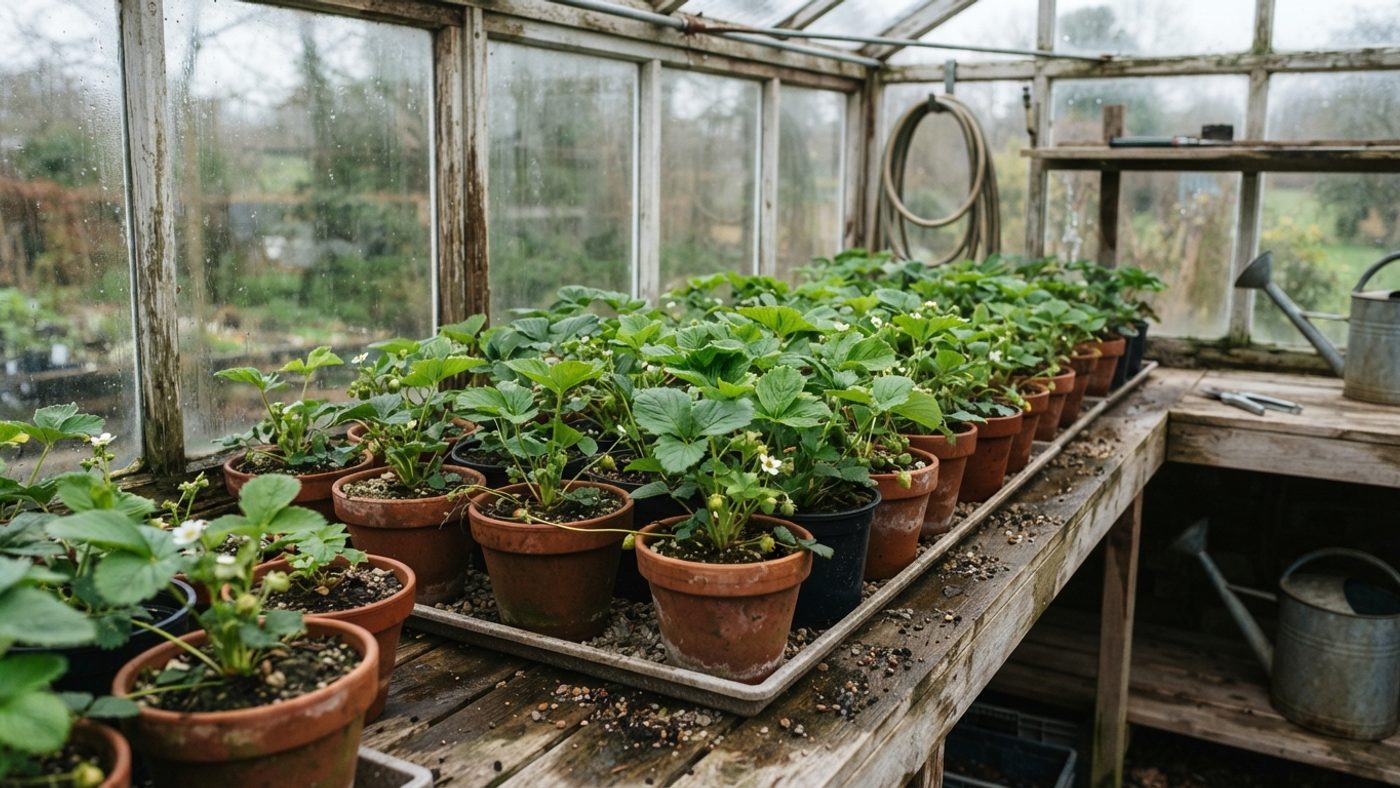
Bringing plants under cover
From around mid-February, move potted strawberries into an unheated greenhouse, conservatory or cold frame. Two or three plants in a hanging basket or large pot of multipurpose compost is the scale Gardeners' World suggests for a greenhouse or conservatory. Feed fortnightly with a general-purpose liquid feed once growth is underway, switching to a high-potassium feed once the first flower buds form; a plant flowering later because Scotland's weaker February light has slowed it down should simply have that switch delayed to match, rather than forced onto the same calendar date every year. Keep the plants well lit, ventilated and watered so they don't grow leggyDescribes a plant that's grown tall, thin and sparse rather than bushy, usually from too little light or not being pinched out. Full definition →, and cut off any runnersLong, trailing stems a plant sends out that root where they touch soil, producing a genetically identical new plant for free. Full definition → that appear, since they divert energy away from the developing crop. Scotland's shorter February daylight hours mean a spot with the most natural light going is worth prioritising over one that's merely warm, a plant kept too dim will grow soft and pale rather than fruit well, whatever the temperature. An unheated cover is still a real risk in a hard late-winter frost: keep horticultural fleeceA lightweight, breathable fabric laid or draped over plants to trap a little warmth and keep off frost, wind and some flying pests. Full definition → to hand for cold snaps as well as for the hot spells it's more often used for, since flowers and young fruit are easily lost to a sudden frost that an unheated greenhouse or cold frame won't fully exclude.
How much earlier, by method
| Method | Earliness gained | Effort |
|---|---|---|
| ClocheA small, portable clear cover placed over an individual plant or short row to trap warmth and keep off wind, rain and pests. Full definition → over an outdoor row | At least 1 week | Low |
| Cold frame | Several weeks | Low–medium |
| Unheated greenhouse or conservatory | Around 6 weeks | Medium |
Scotland's own last-frost dates run later than southern England's, so an outdoor strawberry season here typically starts later to begin with, and six weeks under cover buys a genuinely early crop rather than just nudging an already-early one forward. Whichever cover is used, insect pollination is reduced under cover, so flowers benefit from being hand-pollinated with a soft brush, or the covers opened up on mild days to let pollinators in.
Varieties
'Cambridge Favourite', 'Honeoye', 'Rosie', 'Royal Sovereign' and 'Tamella' all suit this kind of early forcing, with no single one standing out as the better choice for Scottish light or cold, so treat the list as a starting point rather than a ranked recommendation.
Common questions
Can I force chicory without a proper forcing pot?
Yes — an upturned bucket, large pot with the drainage holes covered, or a wrapping of black polythene all work, as long as light is completely excluded from the potted roots.
How is forcing seakale different from forcing chicory?
Both rely on the same principle, total darkness applied to a dormant root or crown, but chicory has a well-documented indoor lift-and-pot method, while seakale’s published technique stops at covering an established crown where it grows. An indoor version is plausible by the same logic, but it isn’t a separately tested method with its own published timings.
Do I need a heated greenhouse to force early strawberries?
No — an unheated greenhouse, conservatory or cold frame all work, and even a simple cloche over outdoor rows brings the harvest forward by at least a week.
Why do my forced strawberry flowers fail to set fruit?
Covered strawberries are cut off from most pollinating insects, so flowers often need hand-pollinating with a soft brush, or the cover needs opening on warm days to let insects in.
Does chicory taste bitter?
Yes, noticeably so eaten raw, a bitter-sweet flavour closer to a sharp salad leaf than lettuce. Roasting or grilling mellows it considerably.
Does Scotland’s colder climate change the forcing timings for chicory or seakale?
Not the method itself, but an unheated Scottish shed running cooler for longer in winter should simply slow the forcing process down rather than prevent it, allow more time than the general guidance quotes rather than assuming a fault.
Sources
8 sources, recorded with what each was used for
- RHS: How to grow chicory: Growing on the roots, lifting, potting and forcing chicory in darkness, harvest timing and chicon flavour
- RHS: How to grow strawberries: Moving potted strawberries under cover in February after an outdoor/cold-frame winter, and general forcing method
- RHS: Cloches — how to use them: Earliness gained from a cloche versus a cold frame or unheated greenhouse
- RHS: Crambe maritima (sea kale) plant details: The H7 hardiness rating for sea kale
- Gardeners' World: How to Force Chicory: The whole-crown potting variant of chicory forcing
- Gardeners' World: How to Grow Sea Kale: The in-situ pot-over-the-crown forcing method and its first-year/consecutive-year rules
- Gardeners' World: Get an Early Crop of Strawberries: Container size and feeding for potted strawberries brought under cover
- Garden Organic: How to grow chicory: A simpler, corroborating version of the lift-and-pot forcing method