
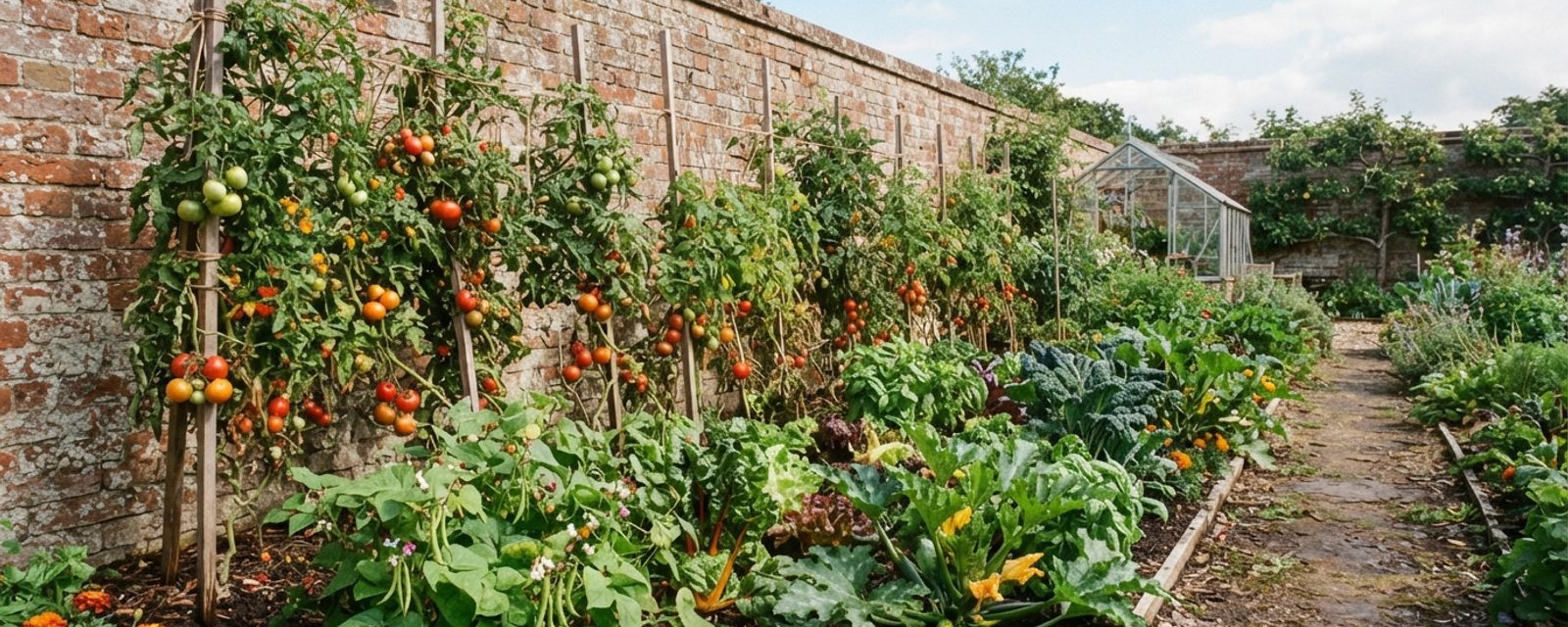
Every garden gets less direct sun in winter than an eyeball glance in July would have you believe. At 56°N, the latitude band that Edinburgh sits on, the sun claws its way to only 11° above the horizon at the winter solstice, compared with 58° at midsummer, a swing of roughly 47 degrees in how high it climbs across the sky. That difference isn't a matter of Scottish weather or cloud cover; it's fixed solar geometry, and it's the reason a spot that looks flooded with light in June can sit in near-permanent shadow from November to February. A home garden, unlike an allotment's assigned rectangular plot, usually offers several different micro-sites to choose from, a sunny corner by a wall, a shadier strip under next door's roofline, a bed hemmed in by a mature tree, and working out which of those sites suits which crops starts with understanding why the sun's path over your own garden changes so much between the seasons.
What aspect actually means for your garden
"Aspect" just describes which compass direction a bed or border faces, and it's the single biggest factor in how much light and warmth it gets through the day.
South-facing ground gets the most light and warmth of any aspect, and that effect is amplified next to a wall: masonry absorbs heat through the day and releases it slowly overnight, which helps fruit ripen and reduces the risk of frost damage to nearby plants. North-facing ground gets the least light of the four main aspects, but that comes with a trade-off worth knowing about, RHS's microclimateThe local growing conditions in one specific spot that differ, sometimes substantially, from the wider area's average climate. Full definition → guidance describes it as giving "a more equable climate without extremes," since it doesn't swing between the fierce midday heat and the sharp overnight cooling that a south-facing spot can. That trade-off is worth weighing against the shallow winter sun angle above, since a spot that's merely gloomy through the summer can lose almost all its usable direct light once the winter sun drops that low.
East and west-facing aspects sit in between, but they're not interchangeable. East-facing ground catches the morning sun, west-facing catches the afternoon sun, and south and west aspects tend to run warmer and sunnier overall, while east and north tend to be colder and shadier. A west-facing bed catching the warmer part of the afternoon can behave quite differently from an east-facing bed of the same size catching cooler morning light, even though both get a similar number of sun hours on paper.
It's also worth trusting a camera over your own eyes here. The human eye compensates for low light automatically, so a spot can look brighter than it actually is; a phone photo taken at the same time of day gives a more honest read of how much light is really reaching the ground.
Tracking the sun's path through the seasons
That 47-degree swing between an 11° winter sun and a 58° summer sun has a direct, physical consequence: the lower the sun sits, the longer and further-reaching the shadows it casts. A wall, hedge, or fence that barely shades the bed in front of it at midsummer can throw a shadow several times its own height across the garden in December and January, simply because the sun is coming in at such a shallow angle.
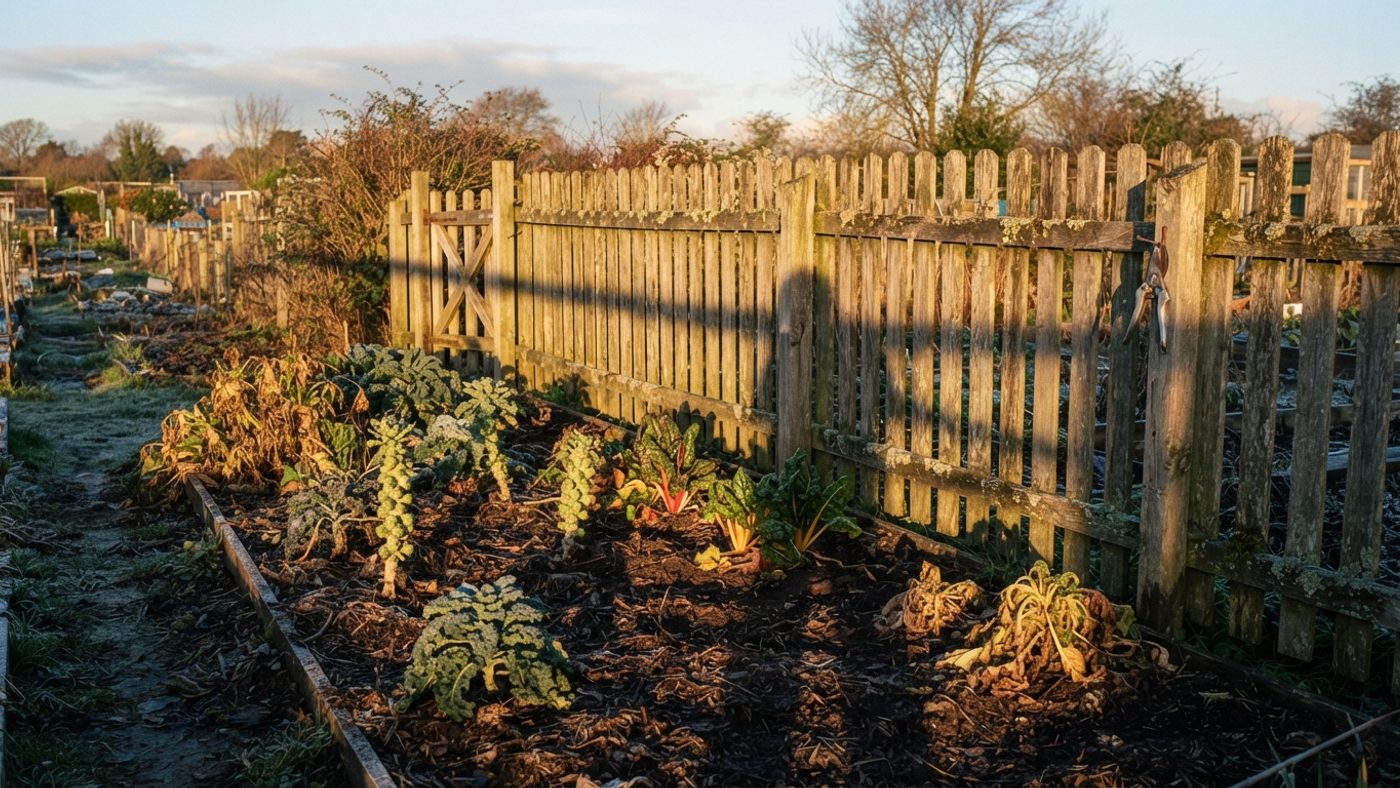
Those figures are for Edinburgh's latitude specifically. Scotland stretches well north of Edinburgh, roughly to Shetland's latitude at the far end, and the winter sun sits lower still the further north a garden is, a Highland or Shetland garden's winter shadows will stretch further again than the Edinburgh figures above, for the same reason the sun angle keeps dropping as you head further north.
It's worth watching your plot properly before committing beds to a particular use: note where the sun falls in the morning, afternoon, and evening, and keep watching across a full year rather than judging from one season. A deciduous tree that looks like it barely shades a bed in April can cast heavy shade once it's in full leaf by July, and the same spot can be flooded with winter light once the leaves drop, a tree's own leaf cycle changes how much shade it casts on top of the sun's changing path, neither one alone tells you what a bed's light will look like across the whole year.
Sun height and shadow direction are a different question from day length, how many hours of daylight you actually get, rather than how high the sun climbs while it's up. That's covered in the guide to day length and photoperiod and in growing under the simmer dim, both worth a read if boltingA plant switching early into flowering and seed production, usually triggered by stress, after which leaves, roots or bulbs turn bitter or unusable. Full page → and long summer evenings are what you're after.
For a practical read on shade itself, RHS's shade-gardening guidance gives a useful scale to measure your own garden against:
| Shade category | Direct sun at midsummer | What it looks like |
|---|---|---|
| Full sun | 6+ hours | Open ground, nothing blocking the sky through the day |
| Partial/semi-shade | 3–6 hours | Some direct sun, some shade through the day |
| Light shade | Open sky, but screened from direct sun | e.g. a nearby wall or fence blocking the sun's low path without covering the sky itself |
| Dappled shade | Varies through the day | Diffused light filtering through an open tree canopy |
| Moderate shade | 2–3 hours | Direct sun only briefly, most of the day in shadow |
| Deep/heavy shade | Under 2 hours | Typical under dense tree cover or hard against a building; "very few plants will thrive" here |
A bed's real light level doesn't just depend on aspect and obstructions, a shadier bed generally stays colder and wetter too, and cold, wet ground tends to warm up more slowly in spring than the sun-hours figure alone would suggest, worth factoring in alongside light when judging a marginal spot.
If a bed's aspect leaves it stuck with only a few hours of direct sun, that isn't necessarily the end of the story. A clocheA small, portable clear cover placed over an individual plant or short row to trap warmth and keep off wind, rain and pests. Full definition →, cold frame, or fleeceA lightweight, breathable fabric laid or draped over plants to trap a little warmth and keep off frost, wind and some flying pests. Full definition → won't add light, but it will trap what warmth a shadier spot does get, which matters more in a Scottish spring and autumn than the raw sun-hours figure alone suggests. A pale-painted or light-coloured fence or wall behind a bed will also reflect some usable light back onto it, a small but real gain on an otherwise marginal aspect. And where a bed's own ground conditions, not just its light, are working against it, a raised bed or large container lets you swap in better soil and drainage on a poor site without waiting for the aspect itself to change, useful on a small garden where there's no second spot to move to.
Working around what's already in your garden
An allotment plot is usually an open rectangle with few permanent obstructions beyond what you put there yourself. A home garden rarely is, it comes with a house, fences, hedges, and often trees already in place, and part of siting a veg bed is working out what those existing features are doing to the light.
Walls and fences cast the most predictable shade, since their height and position are fixed, but they also affect water: a wall casts a rain shadow reaching roughly a metre out from its base, so beds sited close in may need more watering attention than the rest of the garden even where light isn't the limiting factor. The same wind-shelter principles covered in the allotment layout planning guide apply here too, for beds tucked against a boundary.
Mature trees are more variable, and RHS's vegetable-positioning guidance is direct about the risk: it warns against siting a veg plot near large trees or hedges, since they compete with vegetables for water and nutrients as well as casting shade, a double cost that a simple light reading won't capture. Tree canopy also changes how rain reaches the ground beneath it: canopy intercepts rainfall and increases evaporation, so only heavy rain actually gets through to the soil below. Where you do have to work close to a mature tree, the lighter south-west side of a tree is the better bet, since rain is driven under the canopy there more often than on the drier, more heavily shaded north-east side. That guidance is written for ornamental planting, but the same light-and-moisture pattern under a canopy applies to a vegetable bed sited there.
A neighbour's house or a two-storey extension next door blocks and casts shadow exactly as a wall or hedge does, just taller and closer to the boundary than most garden features. The same seasonal swing in sun angle applies: a garden that gets full sun past a neighbour's roofline in summer, when the sun climbs high enough to clear it, can lose that light for months in winter once the sun no longer gets high enough to clear the same roofline at all.
Aspect and obstructions aren't the only siting factors worth checking before fixing a bed's position, even if they're the ones this piece focuses on. Any low-lying corner or hollow in the garden can collect cold air on a still night regardless of how sunny it is by day, making it a poor spot for frost-tender crops even with a good aspect. Height above sea level matters too: a garden higher up a hillside runs cooler and starts its growing season later than a similar aspect lower down. And if you're siting a greenhouse or polytunnel rather than an open bed, the same aspect and obstruction checks above apply to it directly, a structure covering a shady spot doesn't fix the shade, it just adds shelter on top of whatever light was already reaching that ground.
A shadier, damper bed near a wall or mature tree is also generally a bed more hospitable to slugs, which favour damp, sheltered conditions over open, dry ground, worth planning for alongside the light itself, since many of the crops that tolerate lower light, leafy salads and brassicaThe cabbage family: cabbage, kale, broccoli, cauliflower, Brussels sprouts, kohlrabi, swede, turnip and more, sharing the same pests, diseases and rotation rules. Full definition → seedlings especially, are also common slug targets.
Walled gardens as a special case
A walled garden is the most distinctive home-garden site type, and it doesn't map onto anything an allotment offers. The enclosing walls behave exactly as any south-facing wall does, absorbing heat through the day and releasing it overnight, promoting fruit ripening and cutting frost risk, but on all sides at once, an advantage that counts for more in a Scottish garden's shorter, cooler growing season than it would somewhere with heat and light to spare already. The trade-off is the same rain-shadow effect described above, just repeated on every wall: beds close to any of the four walls may need more watering than an equivalent open bed, and the aspect of each individual wall still matters, a bed against the garden's south-facing wall is a genuinely different microclimate from a bed against its north-facing wall, even though both sit inside the same enclosed space.
Matching crops to what each aspect can support
With a bed's real light level worked out, it's a question of matching crops to what that spot can actually support.
| Aspect / shade level | Example crops | Notes |
|---|---|---|
| Full sun (south or west-facing, 6+ hours) | Tomatoes, courgettes, aubergines | RHS calls for a 'warm, sunny, sheltered location' for tomatoes/courgettes and the 'hottest, sunniest position' for aubergines, which only 'fruit outdoors in very mild locations or in long, hot summers' |
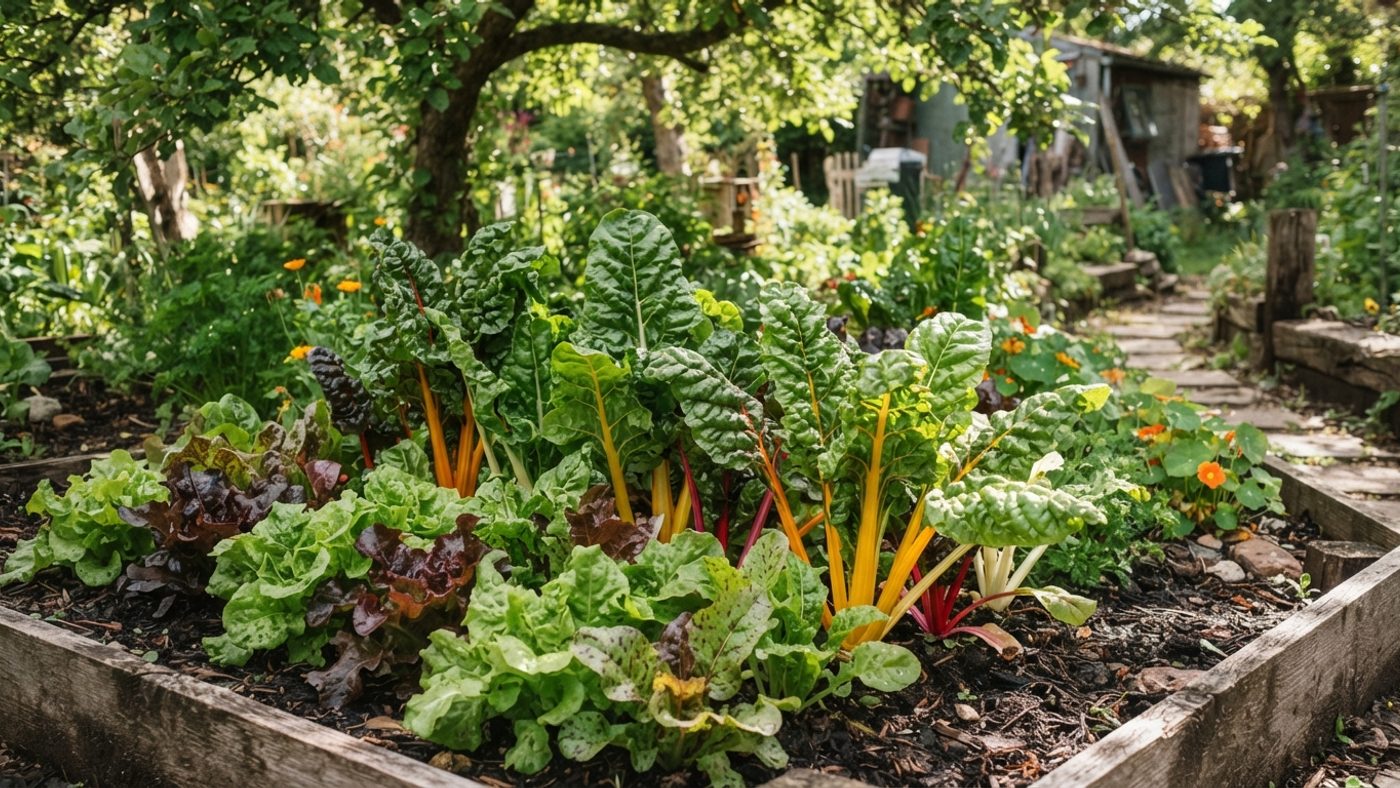
| Shady spot | Endive, lettuce, radicchio, peas, spinach | RHS names these specifically as crops you "can still grow" in shade; other, fruiting crops especially, "will grow, but probably not to their full potential" |
| Shade, cooler-loving | Spinach 'Giant Winter', coriander | 'Giant Winter' spinach benefits from some shade, delaying flowering; coriander is 'shy of harsh sunshine' and avoids premature bolting in shade |
| At least 4 hours sun | Beetroot, kale, chives, mint, parsley | Garden Organic: "few vegetables will grow well with less than 4 hours sun" — a bar harder to clear in Scotland through the darker months |
| Shade, fruit | Raspberries, blackcurrants, gooseberries, rhubarb | Described by Garden Organic as "plants of the woodland edge," naturally more shade-tolerant than most fruiting vegetables |
Once you know which of those bands your own bed falls into, the Garden Conditions Plant Matcher tool can take it from there: filter the site's full crop list by sun exposure alongside frost protection, space, difficulty, and season, and get a proper shortlist for that exact spot rather than working from the handful of examples above.
One practical layout tip applies regardless of aspect: orient rows of tall crops east-west so they don't shade the lower-growing crops behind them, while low-growing crop rows can run north-south without much penalty since they cast very little shade, a sun-shading concern between your own crops, distinct from the wind-shelter orientation covered in the allotment layout planning guide. Starting seedlings in modulesA tray divided into small individual cells, each sown with its own seed or seedling, so each plant grows undisturbed roots until it's ready to plant out. Full definition → before planting out is also worth doing in shadier beds, giving plants a head start before they have to compete for limited light.
None of the above is a fixed rulebook, ground truth from your own garden across a full season beats any general guidance, including this one.
Common questions
Can I grow vegetables in a north-facing garden?
Yes, but with real limits. A north-facing aspect gets the least light of the four main orientations, though RHS’s microclimate guidance points out it also gives "a more equable climate without extremes", no harsh midday heat, no sharp overnight temperature swings. Shade-tolerant crops such as beetroot, kale, chard, and spinach can do reasonably well there, but full-sun fruiting crops like tomatoes and aubergines are a poor match, the sun’s shallow winter angle in Scotland leaves it with barely any usable light for several months, on top of already getting the least light of any aspect year-round.
How do I check my garden’s aspect?
Aspect is simply the compass direction a bed or wall faces, check it with a compass or a phone’s compass app pointed away from the bed toward open sky. But aspect alone doesn’t tell you everything: watch where the sun falls through the morning, afternoon, and evening, across a full year, since deciduous trees, low winter sun angles, and other seasonal changes can shift the picture considerably from what the compass reading alone suggests.
Does a walled garden really grow tomatoes and other tender crops better?
Yes, genuinely, not just folklore. If you have a choice of walls to plant against, the south-facing one earns the tomatoes and the more tender crops; the trade-off is that the same warmth also dries that bed out faster, so it’s worth checking soil moisture there more often than you would elsewhere in the same garden, not just watching for frost.
My garden has a mature tree, where’s the least-bad spot to grow vegetables near it?
Honestly, consider whether a veg bed belongs near the tree at all before picking a side of it, competition for water and nutrients doesn’t go away just because you’ve chosen the better-lit side. If moving isn’t an option, the south-west side at least gets more rain and light than the north-east side, and shade-tolerant crops in a raised bed with its own fresh soil will cope better there than anything planted straight into ground riddled with tree roots.
I don’t know if my garden counts as "full sun" or "partial shade", how do I find out for certain?
Photograph the bed at the same time of day across a few months, and count how many hours it gets direct sun at midsummer specifically, since that’s the benchmark the shade categories in this guide are built on. Once you’ve got a genuine figure, rather than an impression, the Garden Conditions Plant Matcher tool will take that input directly and filter the site’s full crop list against it alongside frost protection, space, difficulty, and season.
Sources
10 sources, recorded with what each was used for
- RHS: Understanding Microclimates in Your Garden: South/north aspect basics, wall heat storage and rain-shadow distance, tree canopy rain interception
- RHS: Get to know your garden: East/west aspect meaning, seasonal observation advice, deciduous tree shade-pattern change
- RHS: Shade Gardening Tips and Plant Ideas: Graded shade taxonomy (full sun, partial, light, dappled, moderate, deep/heavy shade)
- University of Strathclyde ESRU: Sun Charts: 58°/11° solar altitude figures at 56°N (summer/winter solstice)
- RHS: Getting started with vegetables — positioning vegetables: General sunny-position guidance, shady-spot crop list, warning against siting near large trees/hedges
- RHS: The best crops to grow in shade: Spinach 'Giant Winter', coriander
- Garden Organic: Growing vegetables in shade FAQ: 4-hour-sun threshold and named shade-tolerant crop list, row orientation tip
- RHS: Getting started with vegetables — tomatoes: "Warm, sunny, sheltered location"
- RHS: Getting started with vegetables — aubergines: "Hottest, sunniest position" and outdoor marginality
- RHS: Plants for under trees: South-west vs north-east planting-success principle near tree canopy