
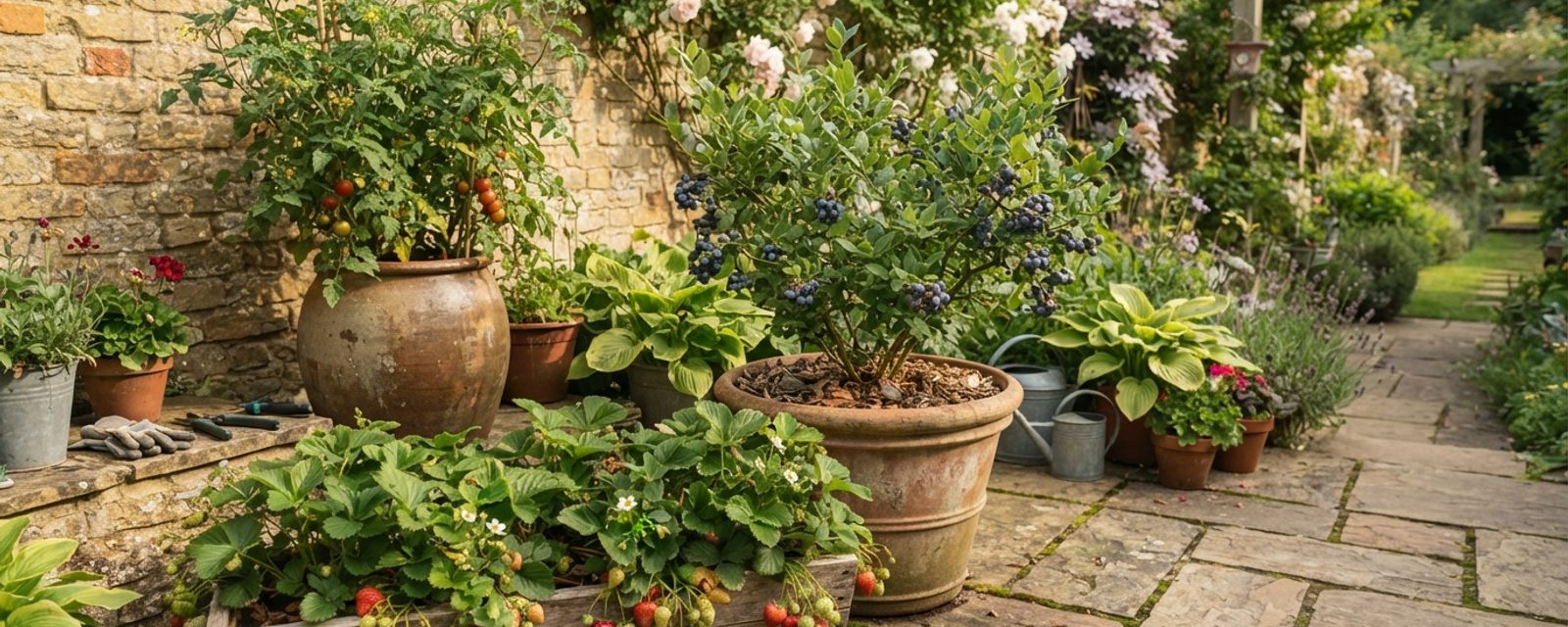
You've got a patio, a balcony, or a paved yard with no bed to speak of, maybe a few slabs, a wall, and whatever pots you're willing to lug about. No open ground means no digging in green manureA fast-growing crop sown specifically to be dug back into the soil, adding organic matter and, with legumes, fixing nitrogen. Full definition →, no rotating cropsMoving each crop family to different ground each year, on a multi-year cycle, so pests and diseases that build up in soil don't get a repeat host. Full definition → through a border, no committing to anything that needs three years to establish. What you've actually got is portability: things you can move into shelter, turn to catch the sun, or shift indoors when the forecast turns nasty. Most food crops will survive in a pot for a season at least, so that's not really the question. What matters more is which ones actually reward being grown that way, rather than merely tolerating it.
That's a narrower list than it looks. Some crops need a container regardless of climate, because your soil, or lack of it, will never give them what they want. Others need one specifically because a Scottish patio is a different microclimateThe local growing conditions in one specific spot that differ, sometimes substantially, from the wider area's average climate. Full definition → from a Scottish allotment: a wall to lean on for reflected warmth and wind shelter that an open bed doesn't get. And some crops simply don't ask for a support structure or a big root run, which makes a shallow, moveable pot the natural home rather than a compromise.
The five picks
Strawberries
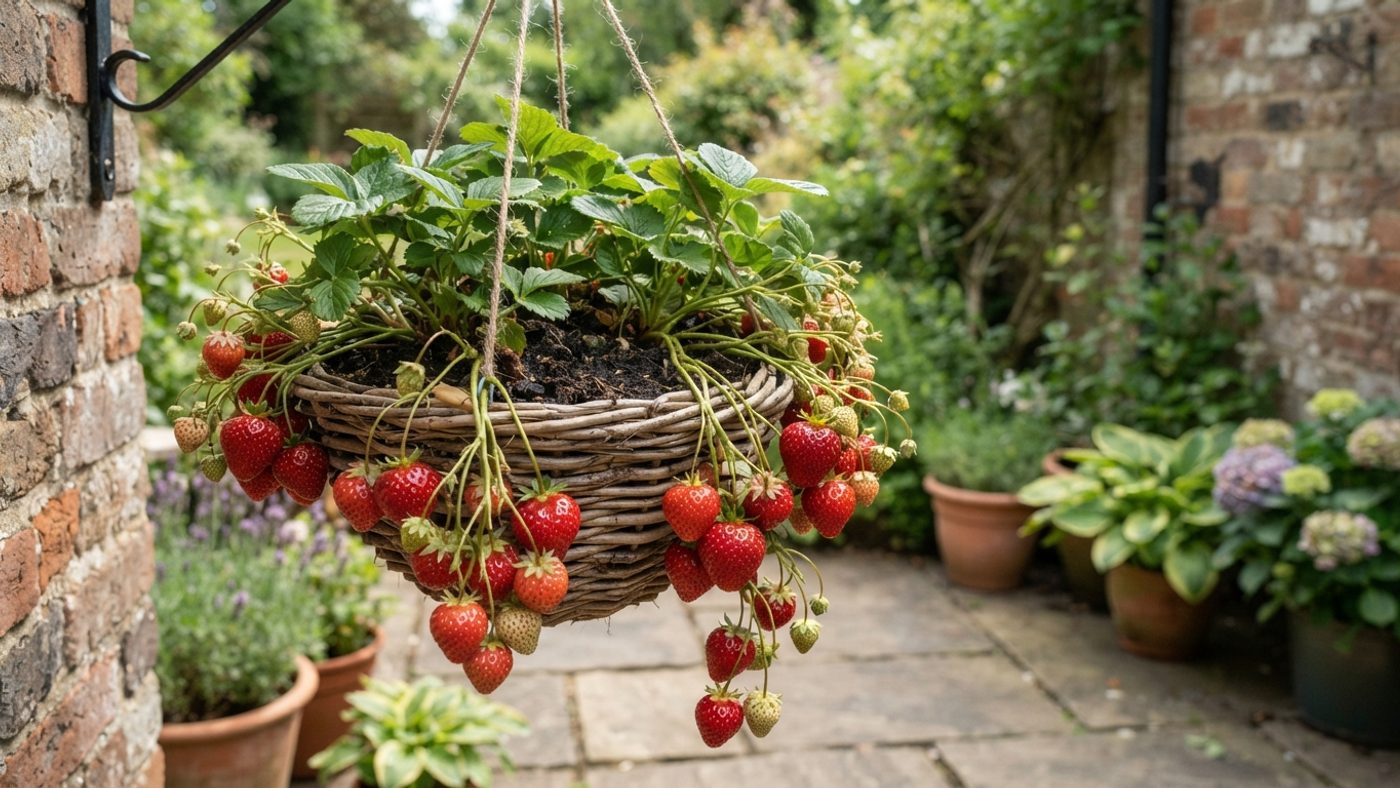
Strawberries are about as close to a made-for-containers crop as fruit gets. They're shallow-rooted, they don't mind a restricted root run the way a tree or climbing crop would, and a pot lifts ripening fruit clear of slugs and soil splash, something a plant in the ground never quite manages. In the ground, plants space 35-40cm apart in rows 75cm apart; in a container that tightens to about 20cm apart, which is what makes a decent crop from a single trough or a few hanging baskets realistic on a patio with no bed at all.
Container plants dry out and use up nutrients faster than plants in open soil, so feed fortnightly through the growing season: a general-purpose liquid feed at first, switching to a high-potassium feed once flower buds appear. 'Finesse' is a perpetual (everbearingA strawberry type that produces smaller flushes of fruit continuously through the season, rather than one large crop over a few weeks. Full definition →) type giving several harvests from early summer into early autumn, a genuine advantage against a short Scottish season, since it spreads a container's yield across months rather than betting everything on a single glut.
The one risk containers raise rather than lower is vine weevil, the grubs eat the roots from inside the compost, and a plant that's wilting for no visible reason is often already lost by the time you notice. A biological nematode drench watered into the compost in August or early September, while still warm enough for the nematodes to work but before the grubs have grown large, keeps it in check. Frost is the other container-specific risk: pot roots freeze harder and faster than roots insulated by open ground, so over winter, group pots together against a sheltered wall or wrap them in hessian during a hard freeze. See the strawberries growing guide for full planting detail.
Blueberries
Blueberries are the pick where a container solves a problem climate has nothing to do with: they need genuinely acid soil, ideally pH 4.5-5.5, and ordinary garden soil, even where it leans acidic, is rarely reliably that acidic without deliberate amendment. A large container filled with ericaceous compost sidesteps the problem outright.
Watering matters here in a way it doesn't for most other crops on this list: use rainwater from a butt rather than tap water where you can, since tap water is usually alkaline, especially in hard-water areas, and will gradually push the compost's pH away from where blueberries need it. Feed every two to three weeks from April to August with a liquid ericaceous fertiliser. Most blueberries are partially self-fertileA plant that can set fruit using its own pollen, without needing a second, different variety nearby to cross-pollinate it. Full definition →, so a single plant will crop, but planting two or three different varieties together gives a noticeably larger harvest. 'Bluetta' and 'Sunshine Blue' are both compact varieties well suited to pots, in a large container at least 45-50cm wide, since blueberries stay in the same pot for years. As with strawberries, vine weevil grubs are a particular risk in containers.
Winter is the other thing to plan for: heavy, prolonged rain can waterlog a container's compost, so move a pot somewhere more sheltered if a wet spell sets in, and during a hard freeze, group pots together or wrap them to protect the roots. See the blueberries growing guide for planting depth and pruning detail.
Dwarf French beans
Dwarf (bush) French beans suit a container for a reason that has nothing to do with size: unlike a climbing or runner bean, they need no cane, wigwam, or trellis at all, which matters when you've got a patio and nowhere to sink a support into open ground. Sow seed 5cm deep and 15cm apart, but wait until after the last frost, typically late May to early June in most of Scotland, before sowing or planting out. Once the first flowers appear, feed every two weeks with a high-potassium liquid fertiliser.
They're fast: dwarf beans start cropping in just eight to ten weeks, comfortably fitting inside even a short growing season with room to spare. A single dwarf plant only crops hard for a few weeks before tailing off, so the way to keep a steady supply is succession sowing, a short row or a fresh pot every three weeks from late spring into midsummer. Harvest pods at 15-20cm, while they still snap cleanly. 'Boston' is a reliable dwarf variety, reaching about 45cm with long, tender pods. See the French beans growing guide for wider spacing and pest notes.
Tomatoes (bush variety)
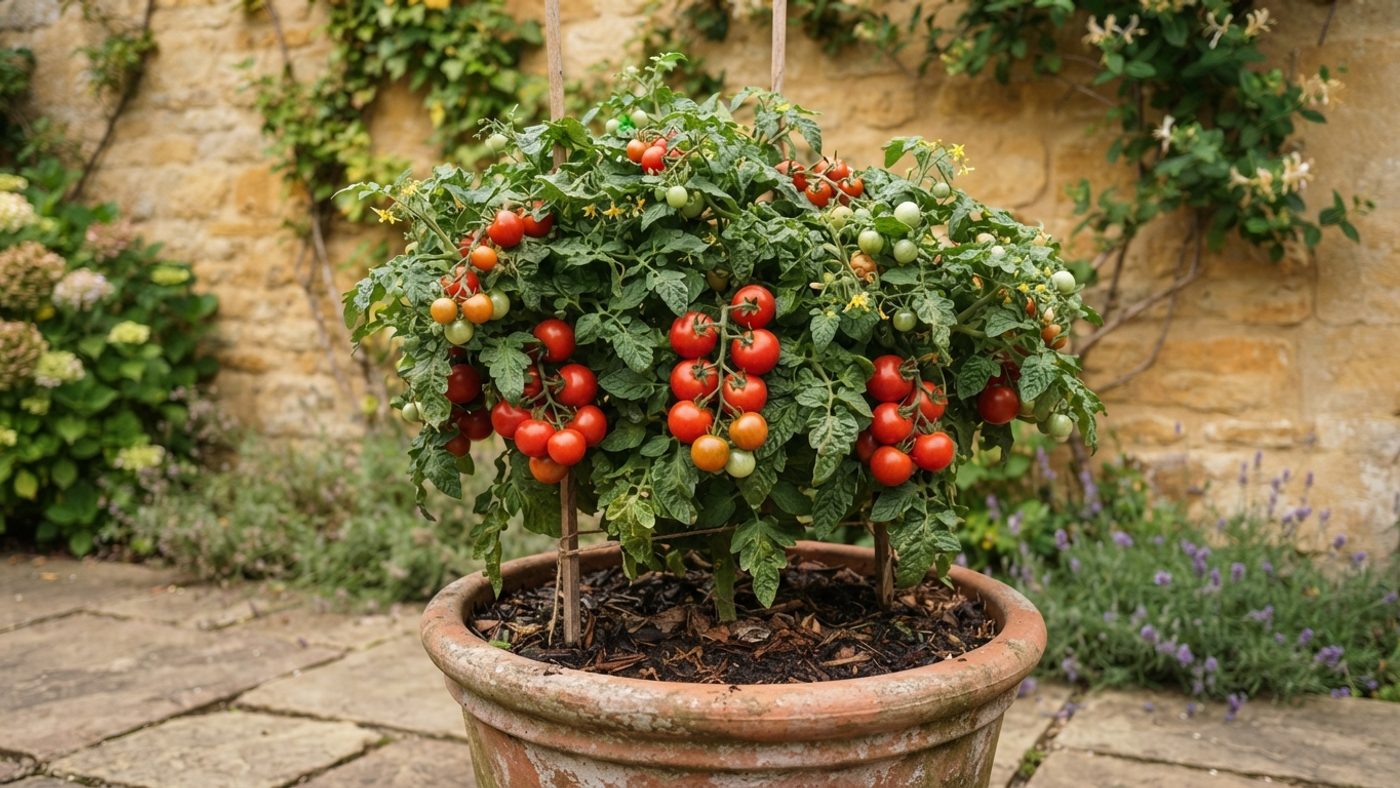
Tomatoes are the pick to be most realistic about. In the open ground, without shelter, ripening a crop outdoors is a marginal bet most years across much of Scotland. A patio isn't open ground though: a container against a warm, sunny, wind-protected wall gets reflected heat and shelter that an exposed bed doesn't offer, and that difference is enough to matter for a bush variety in particular.
Bush tomatoes are naturally compact and don't need their side-shoots removed at all, you just leave them alone. That's different from a cordonA fruit tree or bush trained as a single main stem with short fruiting side-spurs, usually grown at an angle against a wall, fence or wire. Full definition → type, which is trained as a single tall stem up a cane with its side-shoots pinched outRemoving the soft growing tip of a stem to stop upward growth and make the plant branch out sideways instead. Full definition → all summer. Trailing bush types cascade over the sides of a windowbox or hanging basket rather than needing a cane. Plant one to a 30-45cm pot, or two to a standard growing bag. In milder, sheltered parts of the country such as the Central Belt or south-west coast, a warm, wind-protected spot and a bush variety will generally ripen fruit outdoors in a decent summer; in more exposed, northern or upland gardens, treat it as a gamble rather than a plan. Containers dry out fast in a warm spot and may need watering daily in hot weather; curling leaves are an early sign of thirst, not disease. 'Gold Nugget', a compact yellow cherry bush with thin skin, suits a large patio container well. See the tomatoes growing guide for feeding and ripening tips.
Compact courgette
A standard courgette plant sprawls, it's not a natural container crop. A compact bush variety stays put in a pot at least 45cm wide, and a growing bag can support one or two of them, which is what makes courgette workable on a patio at all.
Courgettes want a warm, sunny, sheltered spot, and a container gives you the option to move a plant closer to a wall or under cover if a cold snap threatens. That's genuinely useful here, since cool weather at flowering time is a specific, common failure mode: cold conditions can lead to poor pollination, which can mean no fruit at all, though this usually corrects itself once the weather warms. If the earliest female flowers are failing to set, hand pollination fixes it directly: take a male flower, the one without a swelling at its base, and brush it against the centre of a female flower to transfer the pollen yourself. Once fruits start to swell, feed every 10-14 days with a high-potash liquid fertiliser. Because containers dry out fast, sinking a smaller pot into the compost next to the plant and watering into that sends moisture straight to the roots. 'Astia' is a compact bush variety bred specifically for large containers. See the courgettes growing guide for pollination and harvesting detail.
Comparing the five
| Crop | Min. container size | Sun/aspect | Timeline | Feed once cropping |
|---|---|---|---|---|
| Strawberries | Large trough or basket, 20cm plant spacing | Full sun | Plant Aug-Sept for fruit the following year | Fortnightly, general then high-potassium |
| Blueberries | At least 45-50cm wide, ericaceous compost | Full sun to light shade | Perennial; increasing yield as the plant matures | Every 2-3 weeks, April-Aug, liquid ericaceous feed |
| Dwarf French beans | 30-45cm wide | Full sun, sheltered | 8-10 weeks from sowing | Fortnightly, high-potassium, once flowering |
| Bush tomatoes | 30-45cm pot (1 plant) or growing bag (2) | Full sun, warm sheltered wall | Ripens through summer once warm enough | Weekly-fortnightly, high-potassium tomato feed |
| Compact courgette | At least 45cm wide | Full sun, warm sheltered spot | 8-10 weeks from sowing to first fruit | Every 10-14 days, high-potash, once fruits swell |
What else to consider
A few things apply across all five rather than to any one crop. Wind matters more than most advice accounts for: a patio pot has no neighbouring plants or hedge to break the wind the way an open bed often does, and wind dries compost out fast and can knock over top-heavy plants like tomatoes in fruit, group pots together or use a wall as a windbreak. Every container needs drainage, raise pots on feet or bricks so they're not sitting in a puddle after Scottish rain. OverwinteringKeeping a plant alive and intact through the cold months, whether left outdoors, moved under cover, or stored dormant. Full definition → a pot is riskier than overwintering a border, roots in a container have far less insulation, so a hard freeze bites harder and faster.
Slugs and snails go for container seedlings too, young dwarf bean and courgette plants are as vulnerable in a pot as in a bed. Copper tape around the pot rim and picking slugs off by torchlight are simple, no-chemical protections. Start each annual crop in fresh compost, tip out and bin the old compost at the end of the season rather than reusing it, which cuts down on vine weevil grubs and disease carrying over. Terracotta looks the part but can crack in a hard freeze if damp when the frost hits, a frost-proof glazed or plastic pot is the safer choice for anything staying outdoors all winter. Perennials need refreshing, not just feeding, strawberries and blueberries stay in the same pot for years, so top-dressAdding fresh compost, feed or grit to the soil surface around an established plant, rather than digging it in. Full definition → with fresh compost each spring and repot into a larger container every two to three years.
Common questions
Do I need special "patio" varieties, or will normal seed packets work?
Ordinary varieties will grow in containers, but a compact or dwarf variety (bush tomato, bush courgette, dwarf French bean) will do noticeably better than a full-size or climbing type, which will struggle or need support you can’t easily provide on paving.
What should I do if my tomatoes still aren’t ripening by late summer?
Pick them and finish them off indoors rather than waiting. RHS’s advice is to put unripe tomatoes somewhere warm and dark, or in a drawer with a banana, both speed up ripening once fruit is off the vine.
Is peat-freeCompost made without peat, which is harvested from a slow-forming, carbon-storing wetland habitat that peat extraction damages. Full definition → compost fine for all of these?
Yes for strawberries, dwarf beans, tomatoes and courgettes, soil-based or peat-free multipurpose compost suits them. Blueberries are the exception: they need ericaceous (acid) compost specifically, not standard multipurpose.
What container size does each of these five actually need?
Strawberries and dwarf beans are the most forgiving, a trough or a 30-45cm pot suits either. Tomatoes and courgettes want at least 30-45cm and 45cm respectively. Blueberries need the most room of the five: at least 45-50cm wide, since the plant stays in the same pot for years rather than being replaced annually.
Can I overwinter any of these in containers rather than starting fresh each year?
Strawberries and blueberries are perennial and can be kept in their containers over winter, though both benefit from extra protection: group pots against a sheltered wall or wrap them during hard frosts. Dwarf beans, tomatoes and courgettes are annuals grown fresh from seed each year.
Sources
7 sources, recorded with what each was used for
- RHS: Strawberries — grow your own: Container spacing, feeding schedule, ‘Finesse’ variety, vine weevil risk in containers
- RHS: Blueberries — grow your own: Soil pH requirement, ericaceous container growing, rainwater vs tap water reasoning, feeding and mulchingA layer of material spread over the soil around plants to suppress weeds, retain moisture, and improve soil structure as it breaks down. Full definition → schedule, self-fertility and cross-pollinationPollen moving from one plant to a different, compatible variety, needed for fruit to set on any variety that isn't self-fertile. Full definition →, ‘Bluetta’ and ‘Sunshine Blue’ compact varieties
- RHS: French beans — grow your own: Container size, sowing depth and spacing, frost timing, feeding schedule, cropping time, ‘Boston’ variety, slug risk to seedlings
- RHS: Tomatoes — grow your own: Bush vs cordon habit, side-shooting, container sizing, watering needs, trailing types for baskets, ‘Gold Nugget’ as a named container-suited bush variety
- RHS: Courgettes — grow your own: ‘Astia’ variety, container size, feeding schedule, root-watering technique, cool-weather pollination failure, slug and snail risk
- RHS: Courgette, marrow and squash problems: Hand-pollination method to fix poor fruit set in cool weather
- RHS: Vine weevil: Biological nematode control timing and soil-temperature requirement