
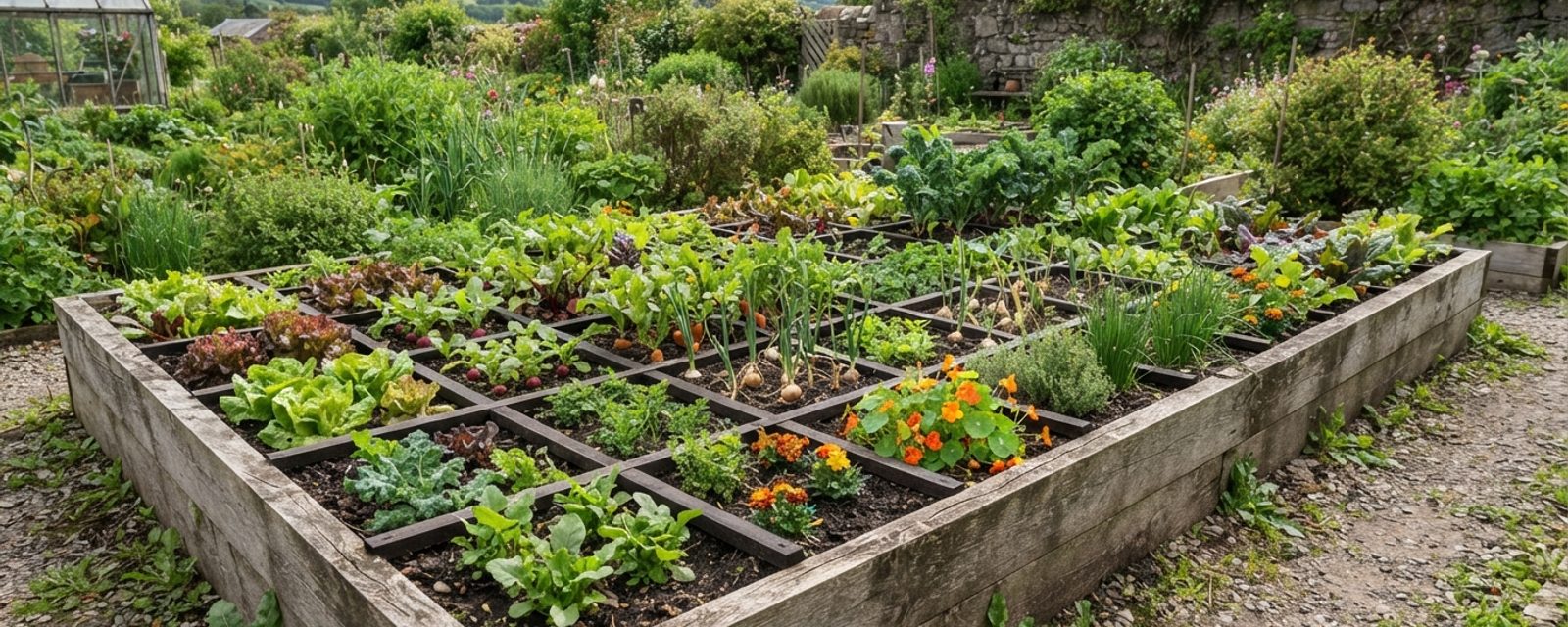
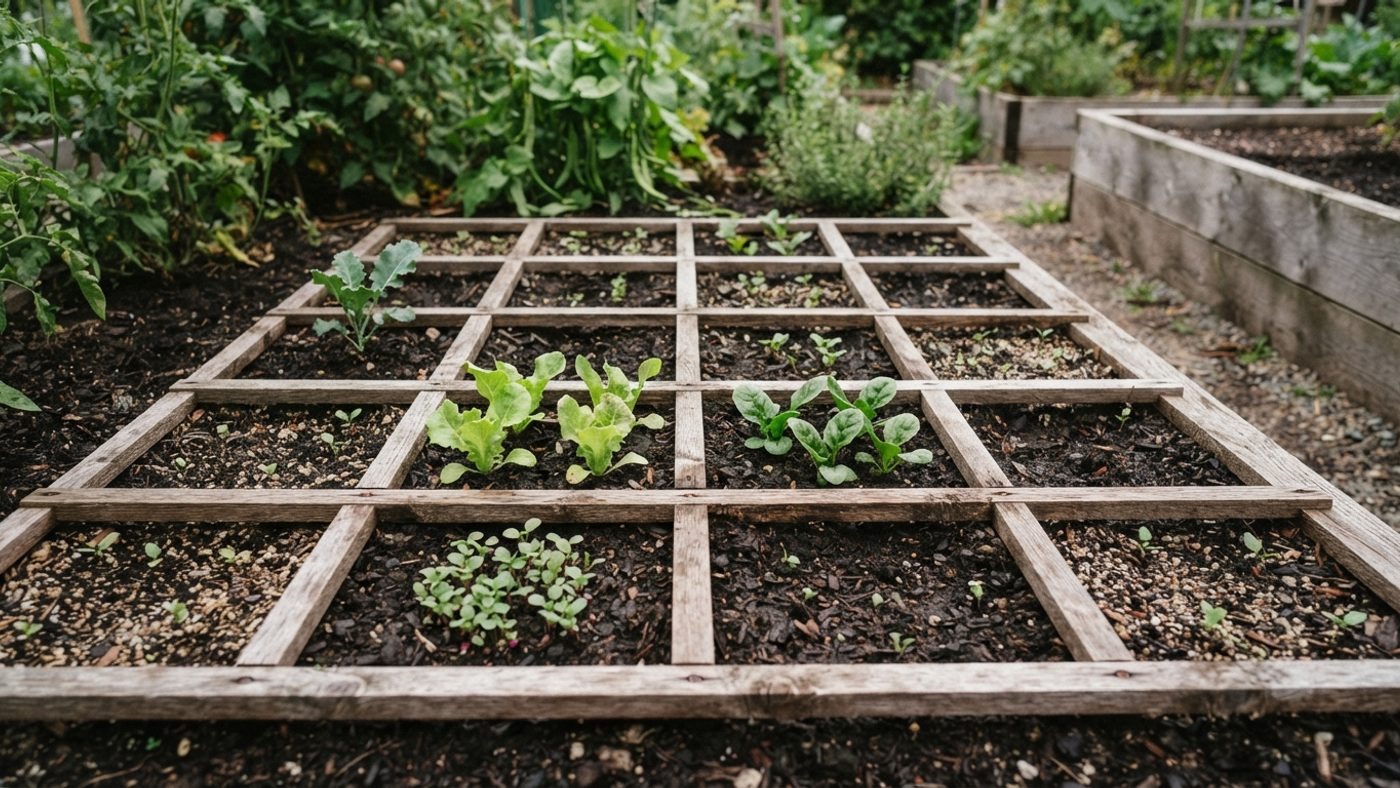
A square foot gardening bed is built around a plan you draw before you plant anything. Take a 4ft by 4ft raised bed, the standard unit in Mel Bartholomew's original method, and lay a physical grid over it: strips of wood, twine or cane pinned at 1ft intervals, so the bed is dividedPropagating a clump-forming perennial by digging it up and splitting it into several smaller pieces, each with roots and shoots attached. Full definition → into sixteen individual one-foot squares. Each square is then treated as its own tiny plot. You don't sow a "row" of carrots or a "block" of lettuce; you decide, square by square, exactly how many plants of exactly which crop go into that one square foot, based on how big that crop gets at maturity.
A large plant like a cabbage or a courgette gets an entire square to itself: one plant, one square. A medium plant like a leaf lettuce or a chard gets four to a square, planted roughly in a 2x2 pattern. A smaller crop like a bush bean or spinach goes in nine per square, in a 3x3 grid. Small, thin crops like carrots, radishes or onions go in sixteen per square, spaced in a tight 4x4 pattern. That 1-4-9-16 progression is the whole planning logic of the method: instead of consulting a seed packet's row-spacing figure and leaving gaps for paths between rows, you fill every square to the density that specific crop can actually support, and you never walk on the growing area at all, everything is reached from the edges of the bed.
The other defining feature is what goes in the bed rather than how it's arranged. Bartholomew specified a particular growing medium, referred to as "Mel's Mix": equal thirds by volume of compost (ideally from several different sources, for a broad nutrient base), coarse vermiculite, and peat moss or coir. No garden soil at all, the bed is filled entirely with this blended medium, on the reasoning that a soil-free mix avoids compaction, drains well, and needs no digging or rotationMoving each crop family to different ground each year, on a multi-year cycle, so pests and diseases that build up in soil don't get a repeat host. Full definition → in the way in-ground soil does.
The claimed benefits
The pitch for square foot gardening rests on a few linked ideas, and some hold up better than others.
Higher yield per square foot than conventional row planting. This is the method's headline claim and the reason for its name: by removing the paths a row garden needs and planting to each crop's actual mature footprint instead, you're told you can grow the same amount of food, or more, in a fraction of the space.
Less wasted space, easier weed control. With every square filled to capacity and reached only from the bed's edge, there's no compacted path soil and, once plants fill out, not much open ground for weed seeds to establish in. Weeding what does come up is also more contained, since you're never disturbing rows that stretch the length of a plot.
Well suited to small spaces and raised beds specifically. The whole system assumes a raised bed as the base unit, and that pairing genuinely fits gardens with limited space, poor native soil, or accessibility needs, a defined, edge-accessible bed is easier to plan, protect and reach than an open plot.
Continuous use of the same ground. Because the unit of planning is a single square rather than a whole bed or row, one square can be cleared and refilled with something new the moment its crop is harvested, without disturbing anything else growing nearby, a smaller, more frequent version of succession planting than a conventional row bed usually allows.
What does the evidence actually say?
The mechanistic case for square foot gardening, that removing paths and tailoring spacing to mature plant size increases usable growing area, is straightforwardly true as geometry. What's harder to verify independently is the specific magnitude of yield increase that gets attached to the method in its own marketing. No institutional source publishes a comparative yield figure for square foot gardening against conventional spacing, a genuine gap, not a minor one, and it means a specific "X times more yield" figure of the kind attached to the method elsewhere is promotional rather than independently confirmed.
A much more modest and general version of the same principle does check out: because raised beds are harvested from the edges rather than walked on, and because they typically have a greater depth of cultivated soil, plants can be spaced closer than the distances given on seed packets, a rough rule of thumb of around a 20 per cent reduction in spacing compared with open-ground planting. That's real, sourced guidance for tighter-than-standard spacing in a raised bed, but it's a fifth tighter, not the far more aggressive densities that square foot gardening's 1-4-9-16 grid produces for many crops. The honest read is that square foot gardening's core insight (paths waste space, raised beds allow closer spacing) is sound and backed in that general form, while the specific extra yield claimed for the full square foot system itself is largely anecdotal, resting on individual growers' reported results rather than on comparative trial data.
The growing medium: expensive to fill, and a real peat question
Mel's Mix asks for a raised bed filled entirely with a bought or blended medium rather than garden soil, in equal thirds compost, vermiculite, and peat moss or coir. For a single 4ft x 4ft x 12in bed, that's roughly 0.44 cubic metres of growing medium, made up of even parts of three different bought materials.
| Approach | What fills the bed | Bought inputs |
|---|---|---|
| Mel's Mix (SFG) | Equal thirds compost, vermiculite, peat moss or coir — no soil | All three components typically bought in, for every bed |
| RHS raised bed mix | 3 parts organic matter, 2 parts sharp sand, 7 parts topsoil | Topsoil forms the bulk; organic matter and sand top it up |
Vermiculite is the ingredient that changes the sum. Bagged topsoil and bagged multipurpose compost cost roughly similar amounts per litre at a Scottish garden centre; horticultural vermiculite typically costs several times more per litre than either, because it's a processed mineral product rather than a bulk soil or compost. Prices vary by retailer, but the pattern holds generally: filling several beds to Mel's Mix's equal-thirds recipe, the method's usual recommendation for a productive plot, means buying that pricier vermiculite fresh for every bed, on top of the compost and peat moss or coir, a genuinely more expensive route into a productive bed than the RHS mix, where cheaper topsoil (or garden soil already on site) makes up the bulk of the volume and only the organic matter and sand need buying in.
There's also a sustainability question specific to Scotland in the traditional recipe's third ingredient. Peat moss is one of the three specified components of Mel's Mix, and peat's environmental cost is not a minor aside: peatlands store more carbon than all the world's forests combined, it takes around a century to form just 10cm of new peat, and a "no new peat" position now applies across major UK gardens, shows and retail from 2025-26, with peat-based compost sales already stopped since 2019 in several cases. Over 95 per cent of UK lowland bogs have been damaged or destroyed by peat extraction, degraded peat releases carbon rather than storing it, and peat regenerates at only around a millimetre a year. "Reduced peat" labelling on bagged compost can still mean up to 80 per cent peat by volume, so buying a bag without checking for an explicit "peat-freeCompost made without peat, which is harvested from a slow-forming, carbon-storing wetland habitat that peat extraction damages. Full definition →" label doesn't reliably solve the problem.
That UK-wide picture lands harder in Scotland specifically, because Scotland holds the great majority of it: more than 20 per cent of the country is covered by peat, it's Scotland's largest terrestrial carbon store, and 80 per cent of that peatland is already damaged. NatureScot runs Peatland ACTION, the Scottish Government programme working to reverse that, since it began in late 2012, it had put over 51,000 hectares of previously damaged peatland into restoration by March 2024, backed by a 2020 government commitment of £250 million to restore 250,000 hectares by 2030. That's a large-scale, government-backed effort to rebuild peat bogs specifically for their carbon-storage value, a genuinely awkward backdrop for filling a home raised bed with fresh peat moss, even in small quantities.
The practical fix is straightforward and doesn't require abandoning the method: swap the peat-moss third of Mel's Mix for coir (coconut coir, which is already Bartholomew's own listed alternative), or use a labelled peat-free multipurpose or soil-improver product.
Melcourt's Sylvagrow, Dalefoot's Lakeland Gold, and Fertile Fibre are producers making exclusively peat-free ranges, worth looking for by name, and home compost recipes (equal parts garden soil, leafmould and sieved garden compost for potting; garden soil, home compost and sharp sand for herbs) show that a peat-free, home-made substitute for a bought three-part mix is entirely workable, if more effort to assemble than opening three bags.
The Scottish climate question: does tight spacing suit a wet, low-light garden?
Square foot gardening was devised in the American Midwest, a climate with hotter, drier summers and considerably more sun than most of Scotland gets. Packing plants to the tightest density their mature size allows is a reasonable trade in that kind of climate: strong sun and dry air evaporate moisture off leaves quickly, so a closed canopy doesn't stay wet for long.
Regional climate runs the other way for most of Scotland: in general, places in the east and south of the UK tend to be drier, warmer, sunnier and less windy than those further west and north, which puts most of Scotland on the cooler, cloudier, wetter side of that line, though the same gradient runs within Scotland too: the Lothians and Fife sit drier and sunnier than the west Highlands and Argyll, so how much this matters for a given garden depends on where in Scotland it is. Ample spacing between plants genuinely reduces disease spread, since good air circulation lets leaf surfaces dry out faster after rain, and many fungal diseases thrive in and spread through wet conditions. The same logic applies to greenhouse ventilation and spacing, precisely because a dense, humid, poorly ventilated growing environment is fungal disease's preferred setting, whether that density comes from a badly ventilated greenhouse or a tightly packed square foot of vegetables.
Nobody has run a trial comparing square foot beds against conventionally spaced beds for disease incidence in Scotland specifically. But the mechanism described applies directly to what the 1-4-9-16 grid does: it deliberately minimises the airflow between neighbouring plants, on the assumption that the growing environment will dry that canopy out quickly enough anyway. In a Scottish summer, with more cloud, more rainfall and less consistent drying wind than the method's country of origin, that assumption is weaker, and the closest-spaced squares, the sixteen-per-square carrots and onions, the nine-per-square beans, are the ones most likely to sit under crowded, slow-drying foliage after rain. Crops prone to fungal problems in the first place, such as courgettes and other cucurbits susceptible to powdery mildew, are the ones where following the method's densest recommended spacing to the letter is hardest to justify here.
Slugs and snails are the other side of the same damp-climate coin, and arguably the more immediate risk for a Scottish square foot bed: they're well suited to a damp, mild climate generally, and Scotland's wetter, cloudier conditions suit them better than the UK average, on the same gradient already at work in the disease risk above. A low, dense, crowded square-foot canopy gives them exactly the cool, sheltered, moisture-retaining cover they favour, right at ground level where seedlings are most vulnerable. General slug advice applies just as well inside a tightly packed square: transplant sturdy pot-grown plantlets rather than young seedlings directly into the grid, water in the morning rather than the evening since evening watering gives slugs and snails ideal conditions to move around at night, and check the densest squares by torchlight on mild, damp evenings.
It isn't all one-directional, though. The same raised-bed structure that makes tight spacing riskier in a wet climate also gives Scotland's shorter, cooler growing season a genuine boost: a raised bed increases soil temperature in spring, helping crops get off to an earlier start, and filling it with a free-drainingSoil that lets water pass through quickly rather than pooling, so roots aren't sitting in wet ground after rain. Full definition → mix improves growing conditions compared with heavy or waterlogged native soil. Both of those cut in the method's favour here, it's specifically the tightest end of the spacing grid, not the raised bed itself, that sits uneasily with Scotland's climate.
The verdict
Square foot gardening's mechanism is sound; its branding oversells it. Where it actually falls down for a Scottish garden is the growing medium, more expensive, more effort-intensive, and, through its peat-moss component, harder to square with Scotland's own peatland restoration effort than the country's gardening authorities would recommend.
For a Scottish garden, the raised bed itself is worth keeping without reservation, the earlier spring warm-up and free drainage a raised bed provides are a genuine advantage in a short, cool, wet growing season. Mel's Mix, followed to the letter with peat moss, is not, coir or a labelled peat-free product does the same job without the sustainability cost. And the tightest end of the spacing chart, the sixteen-per-square crops, and anything prone to mildew, rot or slug damage, is worth loosening a little from the book's recommendation, closer to the RHS's own 20 per cent guidance than to the method's maximum density, simply because a cooler, wetter, lower-light climate gives a crowded canopy far less chance to dry out between one rain shower and the next.
Common questions
Do I need a 4ft x 4ft bed to do square foot gardening?
No, that’s the size in Bartholomew’s original book, but the grid principle scales to any raised bed size; you’re simply marking it out in 1ft squares and applying the same per-square planting counts.
Can I use garden soil instead of Mel’s Mix?
Yes, and it’s the cheaper route. A standard raised bed recipe of three parts organic matter, two parts sharp sand, seven parts topsoil uses garden soil as the bulk ingredient rather than replacing it entirely, and is a reasonable substitute for a soil-free bought mix.
Is peat moss essential to the method?
No. Bartholomew’s own instructions already list coconut coir as an alternative to peat moss in the mix, and peat-free products are recommended generally, Melcourt’s Sylvagrow, Dalefoot’s Lakeland Gold and Fertile Fibre being three exclusively peat-free ranges worth looking for by name.
Will tight square foot spacing actually cause disease problems in Scotland?
No study specifically tests square foot gardening against Scottish weather. What can be said with confidence is that dense planting and poor air circulation are a known combination for fungal disease risk in wet conditions, and Scotland’s climate provides those wet conditions more often than the method’s original American setting, so it’s a real risk to watch for, particularly with the densest-packed, mildew-prone crops, rather than a confirmed outcome.
Does square foot gardening really produce more food per square foot than a conventional plot?
The logic, no wasted path space, spacing tailored to mature plant size, is genuine. The specific yield-multiplier figures attached to the method’s marketing aren’t independently confirmed by RHS or Garden Organic guidance, so they should be treated as promotional rather than verified.
Weighing up other alternative growing systems for a Scottish garden? See hugelkultur: where it actually works and fails, hydroponics for beginners, hotbed gardening: free winter heat from manure, and chaos gardening: what it does to yield.
Sources
10 sources, recorded with what each was used for
- Royal Horticultural Society: How to Make a Raised Bed: The RHS raised-bed filling recipe (organic matter/sand/topsoil), bed dimension guidance, and raised beds increasing soil temperature in spring and improving drainage with a free-draining fill
- Royal Horticultural Society: Vegetable crop planner: The RHS's 20 per cent raised-bed spacing-reduction rule of thumb and its rationale
- Royal Horticultural Society: Growing veg in raised beds: Establishing that RHS raised bed guidance does not cover square foot gardening or a comparable yield-density figure
- Royal Horticultural Society: Preventing pest and disease problems: Guidance on plant spacing, air circulation, and fungal disease risk in wet conditions
- Royal Horticultural Society: Peat-free information for gardeners: RHS's peat carbon-storage figures, formation-rate figures, and its no-new-peat policy and timeline
- Garden Organic: Peat-free growing: Recommended peat-free brands, the "reduced peat" labelling caveat, and UK peat-damage/regeneration figures
- Garden Organic: Garden compost or potting compost?: Garden Organic's own peat-free compost recipes
- NatureScot: Restoring Scotland's Peatlands: The proportion of Scotland covered by peat, the proportion already damaged, and the scale of the Peatland ACTION restoration programme
- Met Office: UK regional climates: The general comparative climate statement that places further west and north in the UK tend to be wetter, cloudier and less sunny than the east and south
- Royal Horticultural Society: Slugs and snails: Slugs and snails being well suited to the UK's damp, mild climate